An appeals court has upheld the 10-year maximum prison sentence of #ShahdokhtKhanjani under Article 134 of the Islamic Penal Code. The sentence was originally issued on 8 February 2024.
Ms. Khanjani was convicted of “forming a group to disrupt national security” and “propaganda against the regime”. In addition, she faces a two-year ban on social, political, and online activities.
#ShahdokhtKhanjani #Bahai #Iran #HumanRights #CourtAppearances
On 20 February 2025, #NazilaKhanipour and her son, #VesalHeravi, two Bahá’ís from #Rasht, were summoned to #Lakan Prison to begin their prison sentences—two years for Khanipour and over four years for Heravi. Their convictions, upheld without a hearing by the #Gilan Province Court of Appeal, were based on allegations of educational and promotional activities contrary to Islamic law.
The court cited Khanipour’s Instagram posts of #Bahai temples and an old book she wrote on Bahá’í history, while Heravi’s possession of Bahá’í books and his work selling toys were used to justify claims of potential future proselytization.
Learn more about Nazila Khanipour here: https://t.co/7QikDrvHfL
Learn more about Vesal Heravi here:
https://t.co/WxFGCkPU9W
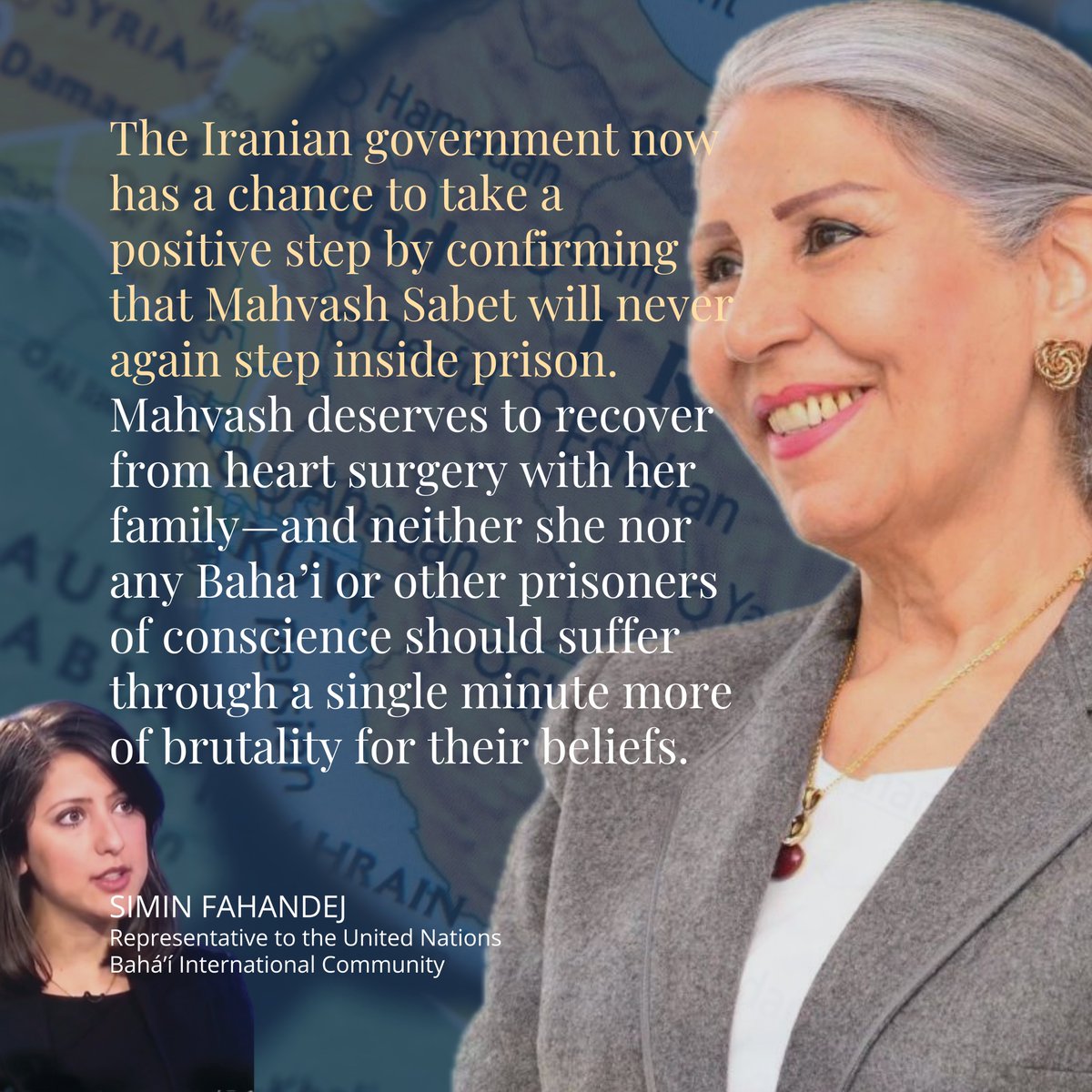
Mahvash Sabet has been unjustly imprisoned for 13 years. My dear friend @SabetNegar speaks to the dire health conditions of her dear mother and calls for her immediate and unconditional release. #FreeMahvash
Supporting this urgent call to help #FreeMahvash across multiple languages. Beloved Mahvash is a cherished friend and renown poet whose health is in a critical condition. She must not return to prison.
The Baha’i International Community (BIC) is appalled at the baseless and unjust imprisonment of senior Baha'i dignitary Remy Rowhani at Hamad International Airport in Doha, Qatar on 23 December.
Remy Rowhani is a highly respected Qatari citizen who has served his country with distinction for decades—most recently as Director of the International Chamber of Commerce’s Middle East and North Africa regional office.
This action marks an arbitrary escalation after decades of discrimination against the Baha’is in Qatar merely on account of their religion.
Read our full story: https://t.co/EAIf40XKhm
Mahvash Sabet, a 71-year-old Iranian Baha’i imprisoned by the Islamic Republic for over 13 years for her beliefs—who has previously been denied proper medical care in prison, despite severe and worsening health issues—has undergone open-heart surgery. Once her recovery period is over, however, Ms. Sabet will be recalled to prison to serve the rest of her second 10-year jail term. The Baha’i International Community calls for her immediate and unconditional release and assurances from Iranian authorities that she will never be returned to jail.
Read our full story: https://t.co/YMNvILwHg9
Just imagine: you accompany your mother to court, summoned solely because of her religion—and then you’re sentenced to prison as well! This is Faraz Razavian's reality: For #Bahai in #Iran, such persecution is not imaginary but a daily reality. #HumanRights#FoRB#OurStoryIsOne
In IR Iran, the Baha’i community has witnessed a concerning rise in attacks against women. It is reported that Baha’i women currently comprise 2/3 of all
Baha’i prisoners in Iran, with a significant number being held without due process, their whereabouts unknown. These women are being separated from their families, some with young children.
In the broader context of the targeting of women in Iran, including the recent draconian 'hijab and chastity' bill, this dramatic rise in the persecution of Baha’i women is an alarming escalation. Baha'i women face intersectional persecution: as women and
as members of a religious minority.
Groups such as Human Rights Watch have called the persecution of the Baha'i a crime against humanity.
More international attention and condemnation must be brought to bear on IR Iran for the crimes it is committing against some of its most vulnerable citizens.
Behrad Azargan, Baha’i Artist, Sentenced to 7 Years in Prison on Appeal
Behrad Azargan, a Baha’i musician residing in Tehran, has had his prison sentence reduced to seven years by Branch 36 of the Court of Appeals in Tehran Province. He had previously been sentenced at the primary trial to 11 years in prison, confiscation of seized belongings, a two-year ban on online activities, and a travel ban.
Under the ruling delivered by Branch 36 and conveyed to Mr. Azargan, he was sentenced to five years in prison for “engaging in educational or promotional activities deemed deviant to Islamic Sharia under the guise of sects, groups, or similar entities” and two years for “spreading falsehoods.”
Previously, Branch 15 of the Revolutionary Court in Tehran, presided over by Judge Salavati, had sentenced him to five years for the above-mentioned charge, four years for “membership in anti-regime groups,” and two years for “spreading falsehoods.” The court also ordered that items seized during the raid on his home be confiscated for the state. Furthermore, Azargan was banned for two years from online activities and from leaving the country.
On July 2, 2024, Azargan’s home in Tehran was searched by security agents, who confiscated personal belongings, including his phone and laptop.
On August 3, he was arrested after appearing before the Third Branch of the Prosecutor’s Office for Security for questioning regarding charges of “propaganda against the regime.” He was later released from Evin Prison on bail.
Baha’is are subjected to violations of their religious rights, comprising 82% of reports on infringements against religious minorities, according to HRA’s 2023 annual report.
#Bahai #Tehran
https://t.co/WoiJMA4Rua
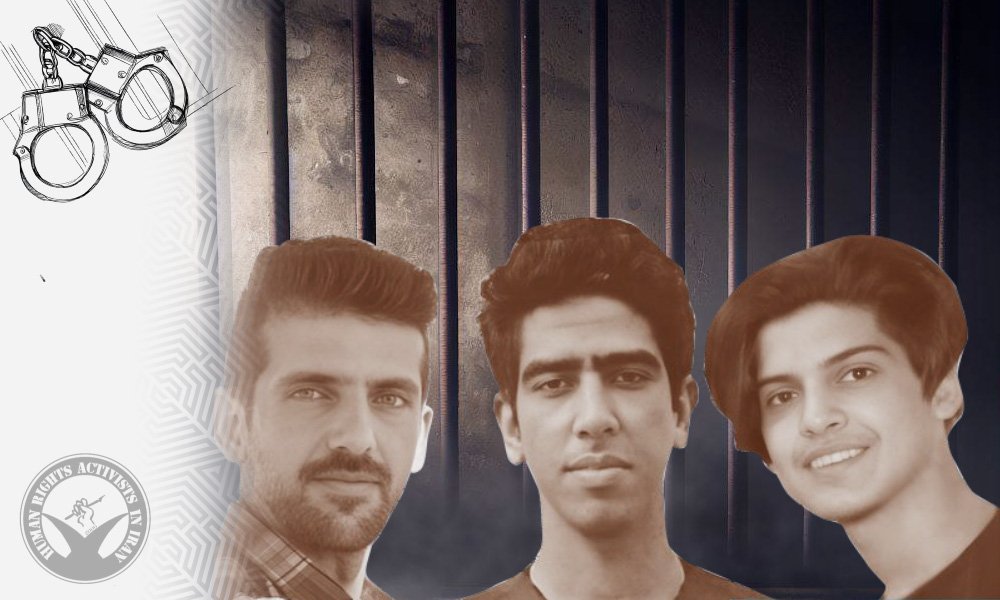
Three Baha’i Citizens Arrested in Isfahan
On Saturday, November 2, security forces arrested three Baha’i citizens—Rashid Dehghani, Pedram Dehghani, and Parsa Dehghani—in the city of Tiran, Isfahan, and transferred them to an undisclosed location, according to Radio Farda. Rashid and Pedram are residents of Tehran, while Parsa resides in Karaj.
The three had traveled to Tiran in Isfahan to attend a Baha’i religious celebration, during which security forces detained them along with eight other Baha’i attendees. While the eight others have since been released, there is still no information on the whereabouts or condition of Rashid, Pedram, and Parsa Dehghani.
Baha’is are subjected to violations of their religious rights, comprising 82% of reports on infringements against religious minorities, according to HRA’s 2023 annual report.
The Baha’i faith is not recognized as a legitimate religion by Iranian authorities, leading to systematic and longstanding violations of the rights of Baha’is in the country. This includes the denial of their fundamental right to practice their religion, which constitutes a clear breach of both Article 18 of the Universal Declaration of Human Rights and Article 18 of the International Covenant on Civil and Political Rights. The United Nations covenant holds that every person has the right to freedom of religion, freedom of converting religion, as well as freedom of expression, individually or collectively; openly or secretly.
#Bahai #Isfahan
https://t.co/2KlILPmXe7
Over Four Decades of Deprivation of Iranian Bahá’ís from Higher Education
The right to access education is one of the fundamental principles in achieving social justice and individual and collective progress. However, this basic right has been seriously violated for Bahá’ís—the largest religious non-Muslim group in Iran—since the Islamic Revolution. With the start of the “Cultural Revolution” in the spring of 1980, widespread changes in the country’s education system began, leading to the closure of universities and significant changes in student admission policies. Among these changes, Bahá’ís were the group of citizens who, due to their beliefs, were deprived of the right to attend universities—a deprivation that has lasted for over four decades and continues to this day.
The following text examines how this deprivation of education for Iranian Bahá’ís began and persisted. It also looks at the history of the Cultural Revolution, its effects on the educational system, and the government’s treatment of Bahá’ís regarding education. Additionally, it addresses the government’s deceptive methods in creating obstacles for Bahá’í citizens entering universities, how these methods limited their educational and social opportunities, and the efforts of Bahá’ís to access education amid widespread repression.
Prelude to the Cultural Revolution
Only a week after the revolution’s victory, on February 19, 1979, the “Kayhan” newspaper published a report titled “Fundamental Changes in Universities,” announcing that the management of universities had been taken over by special “committees.” According to the report, “Muslim students” at Iran’s National University demanded a list of “undesirable elements” to be “cleansed.” These students also requested the formation of an assembly of “qualified” students, professors, and staff to take over the university’s management.[1]
On August 21, 1979, the Ministry of Culture requested the Attorney General to confiscate 41 newspapers and magazines.[2] During this time, public libraries were cleansed, research and investigation were halted, and severe censorship was imposed on the printing, publishing, and translation of books.[3]
In the spring of 1980, Ruhollah Khomeini dedicated part of his New Year’s message to the universities, emphasizing the need to “create an Islamic revolution in universities across the country” and to “purify professors connected to the East and the West.” These events paved the way for the start of one of the most influential events of the post-revolutionary period—the “Cultural Revolution” in June 1980. To manage the revolution, Khomeini ordered the formation of the “Cultural Revolution Headquarters,” and universities across the country were shut down for over two and a half years to reform the education system according to “revolutionary ideals.”
Khomeini’s Policy of Suppressing Bahá’ís
After the Cultural Revolution, Bahá’ís were among the groups labeled as “deviant sects,” and they were placed on a list of individuals who had to be expelled from universities. As a result, thousands of Bahá’í professors and students were banned from attending universities due to their belief in the Bahá’í faith. This event was not surprising to those familiar with Khomeini’s writings and speeches, which clearly expressed his hostility toward Bahá’ís and their principles. In May 1963, Khomeini warned the government against employing Bahá’ís in “sensitive positions” in the military, cultural affairs, and other ministries, and he called on clerics to oppose gender equality, a fundamental Bahá’í principle, and to prevent women from participating in social activities.[4]
Additionally, in a speech on Ashura, delivered on June 3, 1963, at the Feyziyeh School in Qom, Khomeini warned Mohammad Reza Pahlavi, who was seeking to introduce cultural reforms in the country, that ideas such as gender equality and universal and compulsory education were “the views of Abdul-Bahá”—the eldest son of Bahá’u’lláh, the founder of the Bahá’í faith—being instilled in him.[5]
The Cultural Revolution and the Exclusion of Bahá’ís from Higher Education
After 30 months of the Cultural Revolution and the closure of universities, higher education institutions reopened on December 18, 1982, and the first national entrance exam was held. At that time, belief in Islam or one of the officially recognized religions in the Islamic Republic’s constitution was required to register for the exam. The religion section on the registration form offered only four options: Islam, Christianity, Judaism, and Zoroastrianism. Bahá’í applicants, being outside of these religions, either added a fifth option for Bahá’í with a pen or left the section blank. This questioning of religious beliefs violated Article 23 of the Islamic Republic’s constitution, which states that “investigating individuals’ beliefs is forbidden.” This illegal practice continued in the same manner for another two decades, and the refusal of Bahá’ís to conceal their beliefs led to their not being issued exam admission cards, resulting in their exclusion from higher education.
Bahá’í University: Education Under Repression
After Bahá’ís were barred from attending official universities, the Bahá’í Institute for Higher Education (BIHE) was established in May 1987, thanks to the generous efforts of Bahá’ís to meet the educational needs of Bahá’í youth. Classes were held in the homes of Bahá’í students and professors—many of whom had been dismissed from their jobs after the revolution due to their faith. These selfless efforts, highlighting the Bahá’í emphasis on the importance of education, were based on the belief that education is not only essential for individual growth but also for training people who can contribute to building a just and progressive society. However, these efforts were repeatedly targeted by the government. In September 1998, organized raids on the homes of Bahá’í professors and students in Tehran and other cities resulted in the arrest of 36 faculty members and the confiscation of educational equipment, including books and computers, from over 500 homes.[6] Over time, due to security concerns, much of the educational content began to be delivered online. In May 2011, more coordinated raids occurred in the homes of Bahá’í faculty, staff, and students, leading to the arrest of 14 individuals involved with the institute[7] and their sentencing to two to five years in prison.
Education as a Right of Empowerment
Access to education is not only considered a basic human right but also a tool for understanding and achieving other rights. The “United Nations Committee on Economic, Social and Cultural Rights” refers to education as a “right of empowerment,” a right that fosters individual and social growth. While the Islamic Republic systematically deprives Bahá’ís of access to universities and education through various means, it is a signatory to the “Universal Declaration of Human Rights.” According to Article 2 of the declaration, all human beings are entitled to the rights and freedoms set forth in the declaration without any distinction, and Article 26 speaks of the right of everyone to access higher education.
Additionally, Iran signed the “International Covenant on Economic, Social and Cultural Rights” on April 4, 1968, accepted it without any reservations on June 24, 1975, had it approved by the Parliament and the Senate, and finally committed itself to adhere to it on January 3, 1976. Although the signing and ratification of this covenant occurred before the 1979 Revolution, adherence to it is binding for successive governments.[8] According to Article 13, Paragraph 2 of the Covenant on Economic, Social, and Cultural Rights, educational institutions and programs must be accessible to everyone, and this accessibility includes three key characteristics: physical, economic, and non-discriminatory access.
“Incomplete Documents”: A Strategy for Systematic Exclusion
The government’s policy of depriving Iranian Bahá’ís of education took a different form from 2004 to 2020. During Mohammad Khatami’s presidency, in an effort to ease international pressure regarding the violation of Bahá’í rights, the National Organization of Educational Testing announced that the religion question on the exam registration form was meant for selecting the religious studies exam for candidates. With this explanation, Bahá’í applicants who selected “Islam” on the registration form were able to receive entrance cards for the national university entrance exam. However, receiving the exam admission card did not lead to their admission to universities. Bahá’ís who achieved the required ranking for university admission would ultimately be met with the term “incomplete documents” on the National Organization of Educational Testing’s website, resulting in their exclusion from higher education.
It seems that the government, in order to avoid accusations of systematically violating Bahá’ís’ educational rights in international forums, allowed a few Bahá’í students to enter universities in rare cases. However, in most cases, these students were expelled from university at different points before completing their studies. “Archives of Bahá’í Persecutions in Iran,” a website managed by the Bahá’í community, contains numerous documents showing Bahá’í students’ efforts to seek justice. Many letters were written in the hope of achieving fairness, addressed to the head of the National Organization of Educational Testing, the Supreme Council of the Cultural Revolution, the Article 90 Commission, the Administrative Justice Court, and other relevant authorities. In most cases, the responses were indifference, insults, or threats of arrest. In some cases, students were told that “Bahá’ís have no right to education.” This statement is based on the Supreme Council of the Cultural Revolution’s resolution of February 25, 1991, which states that Bahá’í citizens must be expelled from universities “either at the time of admission or during their studies, should it be discovered that they are Bahá’ís.” Additionally, under the section titled “General Position of Bahá’ís in the National System,” Clause 3 states: “The government’s approach towards them must be such that their path to progress and development is blocked.” [9]
Moreover, in 2006, the Bahá’í International Community obtained a confidential letter from the Ministry of Science, Research, and Technology, which instructed Iranian universities to expel any student identified as Bahá’í. The revelation of this letter, marked “confidential” and sent to 81 universities in Iran, occurred despite previous public claims by government representatives that there was no discrimination in Iran’s educational system and that Bahá’ís were free to study. For example, in late 2005, around the time reports of Bahá’í students being expelled from Iranian universities surfaced, a Reuters report quoted the spokesperson of Iran’s United Nations delegation, who confidently stated that “no one in Iran is denied education because of their religion.”[10]
“Rejection of General Qualifications”: The Continued Policy of Oppression
Starting in October 2021, “rejection of general qualifications” replaced the previous “incomplete documents” excuse. Bahá’í applicants once again found themselves barred from universities. This tactic underscored the truth that simply being a Bahá’í was enough to render someone unqualified to enter a university. For over four decades, the government has used various methods to deny Bahá’í youth access to education, but its ruthless policy remains the same: to block the progress and development of the Bahá’í community, which constitutes Iran’s largest religious minority.
Since October 2021, the label “rejected for general qualifications” replaced the previous “incomplete documents” tactic, and Bahá’ís, who had been barred from education for decades, once again found themselves shut out of universities. The rejection of Bahá’í applicants due to a lack of “general qualifications” was another confirmation of the fact that simply being a Bahá’í rendered individuals ineligible for university admission. In this way, thousands of young Bahá’ís were deprived of the opportunity to pursue their passions and develop their talents, as well as the chance to contribute to the building of their beloved homeland, Iran. Over the past four decades, the government’s strategies to deny Bahá’í youth access to education have evolved, but the ruthless policy remains unchanged: “blocking the path to progress and development for a benevolent, patriotic community, which constitutes the largest religious minority in Iran.”
By @Zhinoosforootan
https://t.co/krtjyomBMQ
#EducationIsNotACrime #Bahai #Education



![iranpresswatch's tweet photo. Over Four Decades of Deprivation of Iranian Bahá’ís from Higher Education
The right to access education is one of the fundamental principles in achieving social justice and individual and collective progress. However, this basic right has been seriously violated for Bahá’ís—the largest religious non-Muslim group in Iran—since the Islamic Revolution. With the start of the “Cultural Revolution” in the spring of 1980, widespread changes in the country’s education system began, leading to the closure of universities and significant changes in student admission policies. Among these changes, Bahá’ís were the group of citizens who, due to their beliefs, were deprived of the right to attend universities—a deprivation that has lasted for over four decades and continues to this day.
The following text examines how this deprivation of education for Iranian Bahá’ís began and persisted. It also looks at the history of the Cultural Revolution, its effects on the educational system, and the government’s treatment of Bahá’ís regarding education. Additionally, it addresses the government’s deceptive methods in creating obstacles for Bahá’í citizens entering universities, how these methods limited their educational and social opportunities, and the efforts of Bahá’ís to access education amid widespread repression.
Prelude to the Cultural Revolution
Only a week after the revolution’s victory, on February 19, 1979, the “Kayhan” newspaper published a report titled “Fundamental Changes in Universities,” announcing that the management of universities had been taken over by special “committees.” According to the report, “Muslim students” at Iran’s National University demanded a list of “undesirable elements” to be “cleansed.” These students also requested the formation of an assembly of “qualified” students, professors, and staff to take over the university’s management.[1]
On August 21, 1979, the Ministry of Culture requested the Attorney General to confiscate 41 newspapers and magazines.[2] During this time, public libraries were cleansed, research and investigation were halted, and severe censorship was imposed on the printing, publishing, and translation of books.[3]
In the spring of 1980, Ruhollah Khomeini dedicated part of his New Year’s message to the universities, emphasizing the need to “create an Islamic revolution in universities across the country” and to “purify professors connected to the East and the West.” These events paved the way for the start of one of the most influential events of the post-revolutionary period—the “Cultural Revolution” in June 1980. To manage the revolution, Khomeini ordered the formation of the “Cultural Revolution Headquarters,” and universities across the country were shut down for over two and a half years to reform the education system according to “revolutionary ideals.”
Khomeini’s Policy of Suppressing Bahá’ís
After the Cultural Revolution, Bahá’ís were among the groups labeled as “deviant sects,” and they were placed on a list of individuals who had to be expelled from universities. As a result, thousands of Bahá’í professors and students were banned from attending universities due to their belief in the Bahá’í faith. This event was not surprising to those familiar with Khomeini’s writings and speeches, which clearly expressed his hostility toward Bahá’ís and their principles. In May 1963, Khomeini warned the government against employing Bahá’ís in “sensitive positions” in the military, cultural affairs, and other ministries, and he called on clerics to oppose gender equality, a fundamental Bahá’í principle, and to prevent women from participating in social activities.[4]
Additionally, in a speech on Ashura, delivered on June 3, 1963, at the Feyziyeh School in Qom, Khomeini warned Mohammad Reza Pahlavi, who was seeking to introduce cultural reforms in the country, that ideas such as gender equality and universal and compulsory education were “the views of Abdul-Bahá”—the eldest son of Bahá’u’lláh, the founder of the Bahá’í faith—being instilled in him.[5]
The Cultural Revolution and the Exclusion of Bahá’ís from Higher Education
After 30 months of the Cultural Revolution and the closure of universities, higher education institutions reopened on December 18, 1982, and the first national entrance exam was held. At that time, belief in Islam or one of the officially recognized religions in the Islamic Republic’s constitution was required to register for the exam. The religion section on the registration form offered only four options: Islam, Christianity, Judaism, and Zoroastrianism. Bahá’í applicants, being outside of these religions, either added a fifth option for Bahá’í with a pen or left the section blank. This questioning of religious beliefs violated Article 23 of the Islamic Republic’s constitution, which states that “investigating individuals’ beliefs is forbidden.” This illegal practice continued in the same manner for another two decades, and the refusal of Bahá’ís to conceal their beliefs led to their not being issued exam admission cards, resulting in their exclusion from higher education.
Bahá’í University: Education Under Repression
After Bahá’ís were barred from attending official universities, the Bahá’í Institute for Higher Education (BIHE) was established in May 1987, thanks to the generous efforts of Bahá’ís to meet the educational needs of Bahá’í youth. Classes were held in the homes of Bahá’í students and professors—many of whom had been dismissed from their jobs after the revolution due to their faith. These selfless efforts, highlighting the Bahá’í emphasis on the importance of education, were based on the belief that education is not only essential for individual growth but also for training people who can contribute to building a just and progressive society. However, these efforts were repeatedly targeted by the government. In September 1998, organized raids on the homes of Bahá’í professors and students in Tehran and other cities resulted in the arrest of 36 faculty members and the confiscation of educational equipment, including books and computers, from over 500 homes.[6] Over time, due to security concerns, much of the educational content began to be delivered online. In May 2011, more coordinated raids occurred in the homes of Bahá’í faculty, staff, and students, leading to the arrest of 14 individuals involved with the institute[7] and their sentencing to two to five years in prison.
Education as a Right of Empowerment
Access to education is not only considered a basic human right but also a tool for understanding and achieving other rights. The “United Nations Committee on Economic, Social and Cultural Rights” refers to education as a “right of empowerment,” a right that fosters individual and social growth. While the Islamic Republic systematically deprives Bahá’ís of access to universities and education through various means, it is a signatory to the “Universal Declaration of Human Rights.” According to Article 2 of the declaration, all human beings are entitled to the rights and freedoms set forth in the declaration without any distinction, and Article 26 speaks of the right of everyone to access higher education.
Additionally, Iran signed the “International Covenant on Economic, Social and Cultural Rights” on April 4, 1968, accepted it without any reservations on June 24, 1975, had it approved by the Parliament and the Senate, and finally committed itself to adhere to it on January 3, 1976. Although the signing and ratification of this covenant occurred before the 1979 Revolution, adherence to it is binding for successive governments.[8] According to Article 13, Paragraph 2 of the Covenant on Economic, Social, and Cultural Rights, educational institutions and programs must be accessible to everyone, and this accessibility includes three key characteristics: physical, economic, and non-discriminatory access.
“Incomplete Documents”: A Strategy for Systematic Exclusion
The government’s policy of depriving Iranian Bahá’ís of education took a different form from 2004 to 2020. During Mohammad Khatami’s presidency, in an effort to ease international pressure regarding the violation of Bahá’í rights, the National Organization of Educational Testing announced that the religion question on the exam registration form was meant for selecting the religious studies exam for candidates. With this explanation, Bahá’í applicants who selected “Islam” on the registration form were able to receive entrance cards for the national university entrance exam. However, receiving the exam admission card did not lead to their admission to universities. Bahá’ís who achieved the required ranking for university admission would ultimately be met with the term “incomplete documents” on the National Organization of Educational Testing’s website, resulting in their exclusion from higher education.
It seems that the government, in order to avoid accusations of systematically violating Bahá’ís’ educational rights in international forums, allowed a few Bahá’í students to enter universities in rare cases. However, in most cases, these students were expelled from university at different points before completing their studies. “Archives of Bahá’í Persecutions in Iran,” a website managed by the Bahá’í community, contains numerous documents showing Bahá’í students’ efforts to seek justice. Many letters were written in the hope of achieving fairness, addressed to the head of the National Organization of Educational Testing, the Supreme Council of the Cultural Revolution, the Article 90 Commission, the Administrative Justice Court, and other relevant authorities. In most cases, the responses were indifference, insults, or threats of arrest. In some cases, students were told that “Bahá’ís have no right to education.” This statement is based on the Supreme Council of the Cultural Revolution’s resolution of February 25, 1991, which states that Bahá’í citizens must be expelled from universities “either at the time of admission or during their studies, should it be discovered that they are Bahá’ís.” Additionally, under the section titled “General Position of Bahá’ís in the National System,” Clause 3 states: “The government’s approach towards them must be such that their path to progress and development is blocked.” [9]
Moreover, in 2006, the Bahá’í International Community obtained a confidential letter from the Ministry of Science, Research, and Technology, which instructed Iranian universities to expel any student identified as Bahá’í. The revelation of this letter, marked “confidential” and sent to 81 universities in Iran, occurred despite previous public claims by government representatives that there was no discrimination in Iran’s educational system and that Bahá’ís were free to study. For example, in late 2005, around the time reports of Bahá’í students being expelled from Iranian universities surfaced, a Reuters report quoted the spokesperson of Iran’s United Nations delegation, who confidently stated that “no one in Iran is denied education because of their religion.”[10]
“Rejection of General Qualifications”: The Continued Policy of Oppression
Starting in October 2021, “rejection of general qualifications” replaced the previous “incomplete documents” excuse. Bahá’í applicants once again found themselves barred from universities. This tactic underscored the truth that simply being a Bahá’í was enough to render someone unqualified to enter a university. For over four decades, the government has used various methods to deny Bahá’í youth access to education, but its ruthless policy remains the same: to block the progress and development of the Bahá’í community, which constitutes Iran’s largest religious minority.
Since October 2021, the label “rejected for general qualifications” replaced the previous “incomplete documents” tactic, and Bahá’ís, who had been barred from education for decades, once again found themselves shut out of universities. The rejection of Bahá’í applicants due to a lack of “general qualifications” was another confirmation of the fact that simply being a Bahá’í rendered individuals ineligible for university admission. In this way, thousands of young Bahá’ís were deprived of the opportunity to pursue their passions and develop their talents, as well as the chance to contribute to the building of their beloved homeland, Iran. Over the past four decades, the government’s strategies to deny Bahá’í youth access to education have evolved, but the ruthless policy remains unchanged: “blocking the path to progress and development for a benevolent, patriotic community, which constitutes the largest religious minority in Iran.”
By @Zhinoosforootan
https://t.co/krtjyomBMQ
#EducationIsNotACrime #Bahai #Education](https://pbs.twimg.com/media/GZ33YX8X0AIdJxz.jpg)


