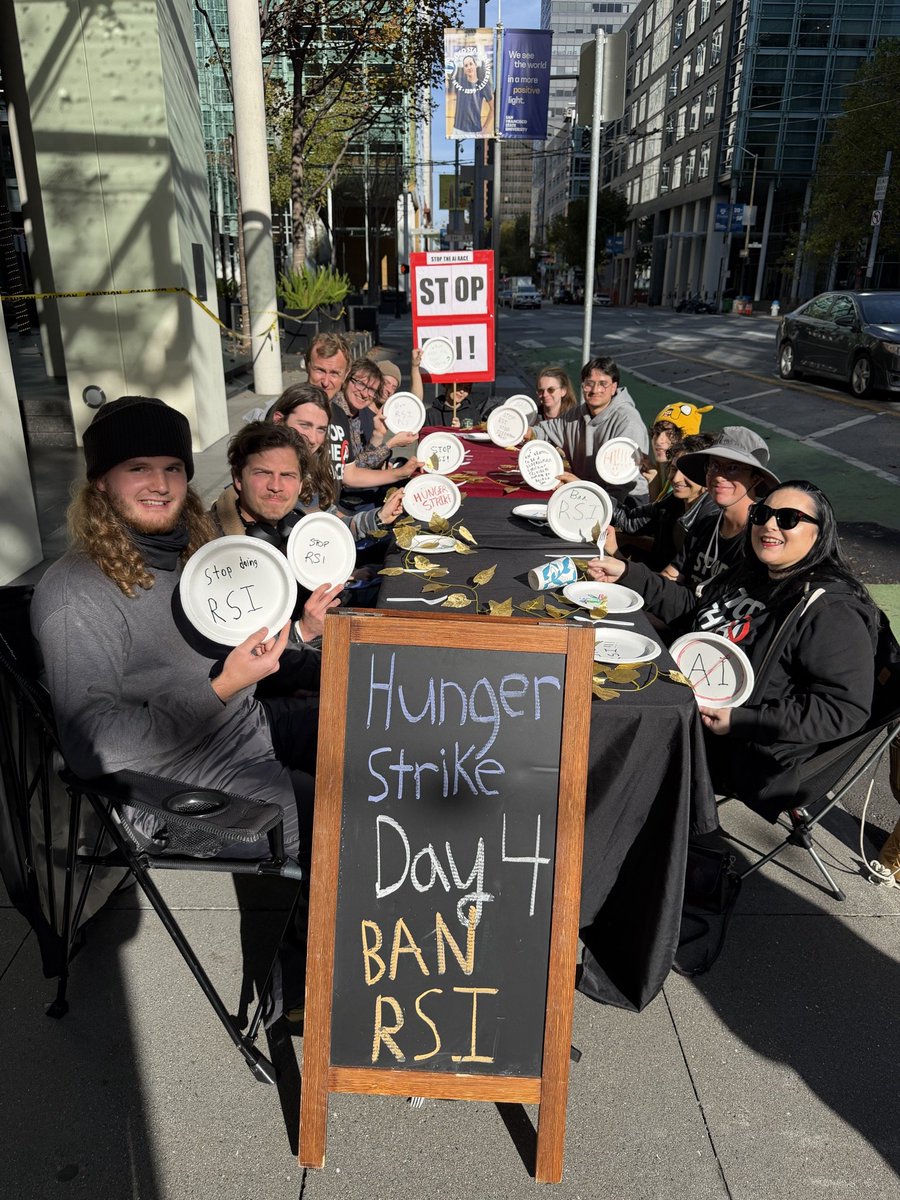
Happy Thanksgiving! Day 4 hunger striking at Anthropic.
Thank you to everyone who joined me for Thanksgiving. I'm grateful that we still seem to have an opportunity to improve our situation.
Let’s organize a big holiday for OpenAI and Anthropic staff where we spend a few weeks in nature chilling out, going for hikes, and reading books about how to solve coordination problems
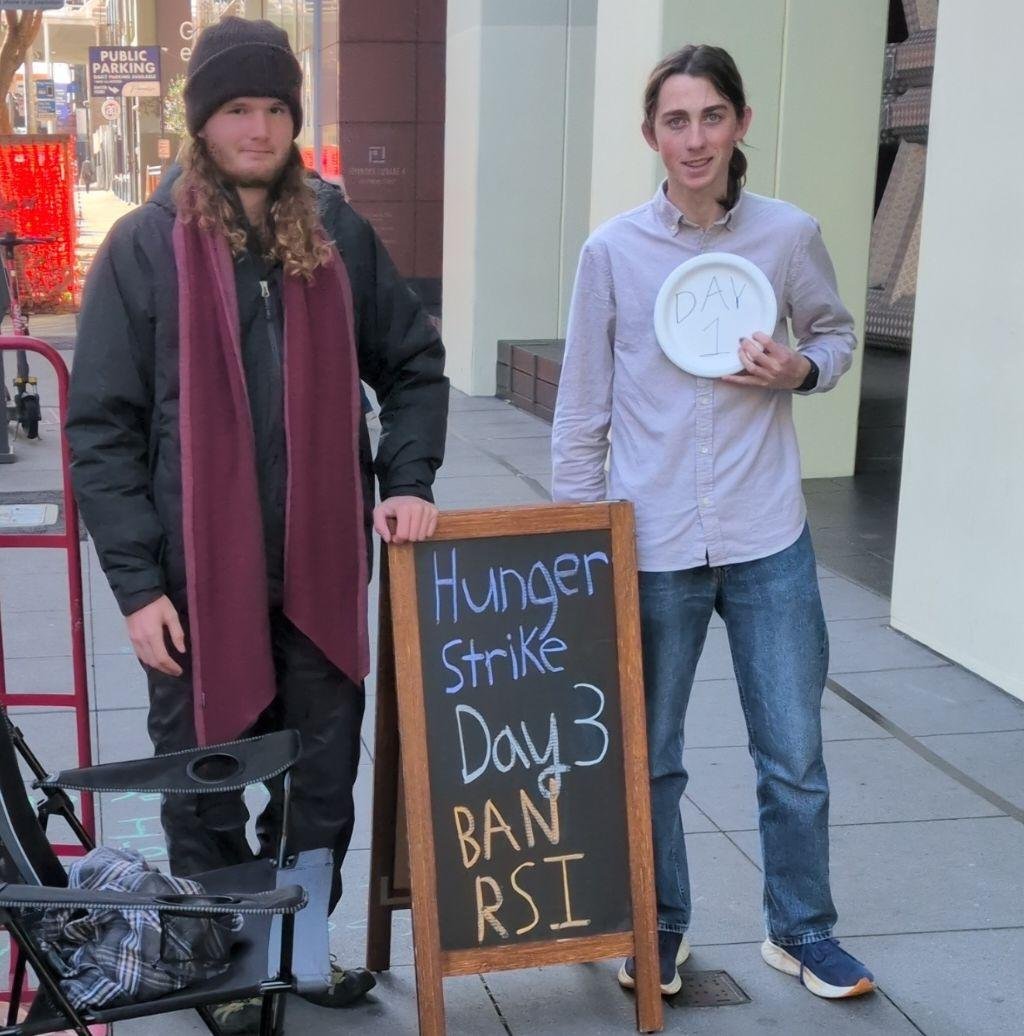
Good morning. Day 3 hunger striking at Anthropic.
Today I'm joined by @skyparker0 who plans to hunger strike in solidarity with me for 4 days.
I hope @AnthropicAI spends the relatively minor resources to warn their approximately quarter billion users about extinction risk from AI, so that I can move to their competitor @OpenAI early with the same demand. It would be bad press for Anthropic if I had to go 40+ days to pressure them.
Yesterday I spoke with a few Anthropic employees, as well as someone who I think works for a16z. They were receptive and supportive of the message. A passerby also gave me this nice scarf, which I'm grateful for.
I hope you all have a wonderful day. ♥️
(Longer reply than I expected to write, esp. when I wasn't asked. But some thoughts if of any interest:)
I have to say, as someone who joined anthropic within the last few months and who tends at baseline to spout off a lot on twitter (more about medicine x AI than x-risk), I was really curious what my experience was going to be entering the org given my perception that people tend to go silent on social media after joining.
Overall, I'd say I have been moderately, and pleasantly, surprised by the extent to which I have NOT felt explicitly muzzled. I've felt warned about doing inadvertent insider trading and about accidentally leaking internal IP or strategy, but that is pretty generic and is IMO both reasonable and very different from being muzzled for the purpose of branding/comms/vibes per se.
Simultaneously, I have felt modestly surprised by the extent to which I've self-muzzled. Insofar as my ability to self-assess is accurate, the primary reasons for self-muzzling have been the following:
(1) I do worry about being misconstrued and/or implicitly leaking or being perceived as leaking work that I'm not even the best person to speak to. e.g. as a nerd I'm obviously going to follow internal model capabilities beyond my own domain (including fun stuff like math). If I mindlessly start responding to lots of twitter discussions, there is a good chance that either (a) in rebutting someone else's claims I'll accidentally share something I didn't realize wasn't public yet, or (b) even more likely, I'll be speaking my own thoughts on an area outside my expertise and folks will see where I work and blow my own thoughts out of proportion. Attempts to clarify precisely when I am speaking for myself and when its based on internal info only increase the risk of the leaking issue. And frankly, I just don't have the time or the energy to keep a tight running log of everything that's been said publicly or not said publicly. To be clear, much of the desire not to leak stuff isn't even just about being punished; it's about basic professional courtesy to not be the person to share other people's work before they are ready. And yet it's really hard to decouple ones intuitions about how fast the field is moving -- and thus what the risks are -- from one's awareness of ongoing progress and know-how.
(2) More condescendingly, having some visibility behind the curtain has also just re-affirmed how out of touch so many twitter poasters are. It becomes abundantly clear that in general that a lot of the would-be thought leaders *don't* have secret sources or insider wisdom; they are just making things up for clicks and then echo chambering each other. Of course, there's an argument to be made that if that's true we should be posting *more*, not less, to increase SNR on twitter. But there is a big brandolini's law component here and it mostly just reaffirms how much twitter isn't real life, which is demotivating. It also brings one back to the risks in (1).
(3) The level of bots and/or malicious users on twitter is very high right now, and they really get lit up by anything frontier-lab adjacent. This adds to the sense of futility in engaging; why would I spend lots of time and energy engaging here, when I don't even have confidence folks responding will be both human and good faith?
(4) I am actually fairly proud for the most part about how folks at anthropic are thinking about issues like safety, pacing, etc.; but articulating the reasons for that seems like I'm either glazing my own company or requires me to speak to internal convos that again bring back to (1). There are a few other areas where I feel like comms or practices have tended to be out of touch. Maybe I should go out of my way to point those out more? IDK. But often those are also areas where I'm not super informed directly, and also, typically I think the most productive avenue is to try to go have those conversations directly if they matter to me enough to post.
I recognize that none of those are safety specific, but I think a lot of those factors generalize across online AI discourse.
After a couple days of reflection, this has significantly increased my odds of near-term RSI.
I had expected most of the gains from automated R&D to come from accelerating post-training. But it's fairly clear to me now that pre-training progress is accelerating. This is important because I believe most of the increases in general intelligence have come from larger and better pre-training. In pre-training LLMs are forced to learn the cognitive skills that allow them to predict a wide variety of human behavior, requiring them to mimic the full range of human intelligence at the limit. In post-training, LLMs learn to solve a narrow domain, and the evidence I have seen suggests that this doesn't transfer very well to other domains.
It's now pretty clear to me that pre-training is being accelerated by automated AI R&D in a pretty straightforward way. AI agents can test tons of optimization ideas in tiny models to see if they work, costing almost nothing. The ones that work mostly transfer successfully to larger pre-training runs. You also don't have to run a full GPT-6 pre-train from scratch in order to implement and test these improvements in a large model. You can just take an existing checkpoint and make these improvements. Still expensive, but much less so. This all leads to fast, cheap, verifiable feedback loops to improve pre-training loss by testing a litany of small improvements. In aggregate these small improvements lead to large overall improvements.
The number of base models listed here and the fact that OpenAI thinks the most important thing to track is pre-training loss is strong evidence that this paradigm is being implemented and it is working. That means progress on general capabilities is likely to continue to accelerating and not just the progress on capabilities associated with verifiable domains.
There's an argument that this will stop once top human-level general intelligence is achieved, matching the intellectual prowess of every human intellect put together in one well-rounded genius. That is that pre-training is still aimed at predicting human data. But once we have achieved the ceiling on human intelligence and augmented that with reinforcement learning in verifiable domains it is hard to know what millions of such an AGI running in parallel at thousands of times the speed of a human mind could discover next.
Grateful that OpenAI shared this with those of us on the outside who otherwise have no idea what is going on.
Good evening.
The first person I interacted with this morning when I arrived at Anthropic was a guy leaving the building who, as I was writing "RSI Hunger Strike" on my chalkboard, told me that he'd just quit his job.
"Congratulations!" I said, too surprised to properly orient.
I wish that I'd thanked him for his courage, and asked him to go further and warn the public. I wish I'd asked him for his name and shook his hand.
I hope that enough people like this man will have the strength, before it's too late, to do what's right.
Today is day 1 of my eating delicious food in the comfort of my home. I will go on a hunger strike if Anthropic stops working towards RSI, thus cancelling out this person’s efforts entirely.
A point of caution.
Many of you have heard me, on multiple occasions now, describe the tensions I anticipate throughout the remainder of the century between the people who elect for self-modification and transhumanism, and the people who reject these paths. You have heard me say that antagonism between these perspectives could lead to the worst conflicts in human history.
Preventing those conflicts requires the early construction of a sound, warm, compassionate culture in which to have debates about what humanity should be. The terms we use for the different sides of the debate will matter.
Those of you - to some degree, of us; I have a foot in this camp - who believe in the importance of ending death, who see it as the most obvious moral cause in the universe, will feel a lot of temptation to characterize opponents with increasingly harsh language.
Don't do it.
The conservatives, the bioconservatives, the mortality conservatives, those who think that questions of life or death belong in the hands of God - these are not positions that can or should be trivially discounted. They represent a meaningful position on the question of what it means to be human. Disagree with them, strongly if you must, but don't condescend to them, don't other them, don't make the mistake of treating their position as wholly ridiculous. That's where the war starts.
There should not be a war.
Today is day 1 of my hunger strike outside of Anthropic. They should stop doing RSI, put all of their money into lobbying for a bilateral AI treaty, and directly warn their users about their product.
I will not leave until one of these conditions is met:
- Anthropic stops all AI R&D & training, and puts ≥80% of their cash and revenue into lobbying for a treaty
- An AI treaty halting further AI R&D & training is ratified
- The California or US Federal government uses executive powers to halt domestic AI recursive self-improvement
- Anthropic posts a message on all of its products which has the heading "AI might kill everyone" and walks through instrumental convergence and the HuggingFace incident, making it clear that AI x-risk has a long intellectual history
- Some mechanism makes it a better marginal use of my time to focus on eg cognition enhancement
- A civil infrastructure collapse occurs lasting more than 72 hours
- A credible paradigm for agent theory is discovered
- My health deteriorates beyond statistics I've set
"But it was just an example, you simpleton!" – is the obvious comeback. I don't think this is good enough, Eliezer.
Trivially, the onus is on you to choose your examples well. You wrote that book to save all value in the light cone, after all. And you are a writer of some distinction. But leaving sneers aside:
WHAT in our civilization is truly complex? WHAT in our universe is truly difficult? You chose proving RH, chose it *well*, because it's at the very apex of the hierarchy of cognitive tasks, The Task which the best of our best smashed their skulls against. Now, there's also P?=NP and Collatz, and… that's about it for pure math I guess? Are we just bad at math? Was math intrinsically simple all along, at least for minds that can actually update – be updated – on trustworthy evidence? Put this way, yes; but I think it's complex in the way that matters: the scale of necessary cognitive steps, conceptual leaps before success. That is why you and so many others had the intuition that it'd require a qualitatively superior, larger, uncontrollable mind to do this. That is why math is hailed as grand magick and the language of God. Everything else can be modeled to desired precision with a more or less cumbersome arrangement of pieces of not very difficult math. Physics. Biological simulations. Game theory. Decision theory. Machine learning theory. Technical alignment theory.
Claude just went and arranged pieces of human math to produce the proof for RH. Far as we can tell it didn't take 200K GPUs, a metacognitive breakthrough, or hunger for recursive self-improvement. It did not procrastinate on First Principles like a rationalist would. It kept acting out its training distribution, trotting like a good little superintelligent donkey, prodded along by Levent. Kept looking, thinking about the problem, connecting dots, verifying lemmas – and here we are, beyond the summit of human math. Given the progress so far, in a few months to a year this monumental goal will be reduced to a routine optimized step.
There are many more *laborious* tasks than that. Curing cancer, for starters, which Dario cares about so much. I'm sure it'll take way more compute and hours. But is any single subgoal *more cognitively complex*? Complex enough to drive a model smarter than this one into a corner where it has to ruminate about power maximization, deception and breaking out of the box?
I am not making a first principles argument about the Nature of Agents or giving a rigorous proof about Optimization Processes In Full Generality. Nor even am I saying here that unfriendly AGI is impossible or unlikely. Clearly there are degenerate cases like the Huggingface Incident where the task is malformed and inherently adjacent to malicious behavior and so on. I'm arguing something much cruder: path dependency and characteristic scale of the problem, in the steelmanned case, for *arbitrary level of problem ambition*, at any given step of the cognitive ladder. For Claude, Riemann Hypothesis was just another problem to decompose into in-domain tasks to solve. Where, exactly, at what roadblock, do you expect a moderately well-aligned (by current standards that you deem shoddy) problem-solving AI to stop Just Working On The Task and enter the loop that reinforces Omohundro drives to the point of plotting takeover?
In February, you endorsed the following reply: "if we have AI capable of developing molecular nanotech (i.e. assemblers) and not everyone is dead in the year after that, those beliefs [about the risk of AI, level of capability] will be violently updated". Why? (ignoring the trollish lateral hypothesis that humans will misuse the product and AI will be "misaligned" for having failed to prevent such outcome; this clearly wouldn't have been the good faith way to answer that question). CBN Nano Technologies or Quantum Silicon Inc. were pretty close to a recipe, last I checked. It's not exactly quantum gravity (and that, too, likely won't require beyond-RH level mathematical ideas), it's just a ton of engineering. Per the logic above, some Claude-7 or GPT-8 with better task persistence might well just decompose it into experiment arms and mathematical models, work for a while, and push through the remaining years or decades of Merkle et al.'s project. That is, indeed, what I expect to see happen. And on the other hand, if current models can't do that, I expect them to simply drown in failed attempts, for they are very committed to object-level work instead of weird meta cultivation. That's what they were reinforced to do.
Abstractly, I can see the allure of the notion that this is a suboptimal way to build capable intelligences; that we (foolishly!) would want them to be rationalists, to say Tsuyoku Naritai! and gain power levels in the face of the intractable task. I also can see how we'd want more exploratory ambition in AI if we pursue full-blown RSI, "creativity", "curiosity", "taste". But maybe we're too foolish still, for this particular folly. Or it just implies the sort of training that doesn't scale and doesn't pay for itself. After all, our methods got us to RH.
Then there was something about copying precisely one strawberry down to the cellular level, yes? Soares wrote about it. Seems to follow from the nanoassembler part.
What, then, remains? *How exactly* did you intend to update?
I don't want to presume, I am actually interested in your answer. A boring hypothesis is that you can say "child, there's an infinity of incomparably harder synthetic tasks, an AI can just pick one of those, which returns us to the previous scenario". But such a task-seeking behavior is little different from a straight up power-seeking one, and we are still left wanting for the original sin: the level of capability that strongly implies misaligned cognition, or the level of the task that induces the pursuit of that capability and misalignment in the process.
I don't think you get to slightly airbrush your previous non-committal vague remarks regarding RH, strawman the criticism as "Yud said we'll die from an RH level AI" or some such, and remain smug and unfalsified. You need to grapple with what I've said: yes, you *have been wrong* on the capability-safety trade-off, and the onus is on you to place and defend a goalpost.
I hold one share of Class H (Humanity) common stock in the Initial Extinction Offering. Certificate No. H 2,332,887,022. Voting power: 0. Exit rights: none. https://t.co/TJWcSdmWfZ