This is the best site on the internet to learn harness engineering.
Free. Completely.
Most AI engineers have never heard the term.
https://t.co/bwDbTTYsjM
Bookmark this site.
Then read this setup ↓
When your team can generate code faster than humans can review it, everything changes. Fiona Fung from Claude's engineering team shares how they restructured their entire organisation around agentic coding: shifting from pre-planned roadmaps to rapid iteration, letting Claude handle code style and bugs while humans focus on domain expertise, and hiring for product intuition and systems knowledge instead of raw throughput.
The real bottlenecks aren't in typing code anymore, they're in verification, security, and making sure you're solving the right problems. Track onboarding ramp time, PR cycle time, and Claude-assisted commits to know if your new processes are actually working. https://t.co/GssAwxRcie
Christoph explains how AI coding agents have transformed his workflowm he now ship 3x more code at higher quality than two years ago. The bottleneck isn't code production anymore; it's judgment. In the agent era, the engineering values that matter most are:
- strong ownership and expertise (agents amplify both), good taste, keeping context in the repo, owning your stack, and preserving option value
- small teams with clear boundaries beat large orgs
- and engineering managers must stay technical, management is becoming more technical, not less.
https://t.co/HRgllC7lZb
Most decisions fail silently because we never question inherited assumptions. McKinney's HP story shows how an unexamined metric drained innovation over a decade.
First-principles thinking has three skills: strip assumptions from problem framing, test which constraints are real vs. negotiable, and reason forward from hard limits.
The Assumption Reversal Exercise with a partner helps surface what feels fixed but isn't. https://t.co/BOXc8PVSfd
Agentic AI has inverted software engineering's value hierarchy. The hard part was never coding, it was understanding the domain.
Now that agents write code, the binding constraint has shifted from "can you build it" to "can you tell if it's right."
This piece argues that the most valuable engineers won't be those with the best coding skills, but those with deep domain expertise. Rather than perfecting new frameworks, invest in understanding specific industries, regulatory regimes, or complex processes. That tacit knowledge is what AI can't replicate, and it's now your competitive advantage. https://t.co/3uZ1pXa5ww
After 35 years conducting technical interviews, Steve Yegge argues they're fundamentally broken and dying.
Google's own data showed interviewers barely agree, interview scores predict almost nothing about job performance, and the process produces massive false positive/negative rates.
The solution: replace interview theater with real work. Bring candidates in for paid, multi-day sessions working on actual codebase tasks. They walk away with portable credentials of their work regardless of outcome, making hiring fair while turning it from cost center to profit center. This "campfire" model is already emerging and could finally fix 50 years of broken talent assessment.
https://t.co/FY8evwGHzH
Someone just made Claude instances talk to each other.
Not APIs.
Not agents.
Not orchestrators.
Just multiple Claude Code sessions… messaging each other like coworkers.
It’s called claude-peers — and it turns one Claude into a team.
Here’s what’s happening:
Run 5 Claude Code sessions across different projects
Each one auto-discovers the others
They send messages instantly
Ask questions
Share context
Coordinate work
Your AI tools literally collaborate.
Example:
Claude A (poker-engine):
"what files are you editing?"
Claude B (frontend):
"working on auth.ts + UI state"
Claude A:
"ok I'll avoid touching auth logic"
No conflicts. No manual coordination. Just AI syncing itself.
Under the hood:
• Local broker daemon (localhost)
• SQLite peer registry
• MCP servers per session
• Instant channel push messaging
• Auto peer discovery
• Cross-project communication
Everything runs locally. No cloud. No latency.
What it unlocks:
• Multi-agent coding without frameworks
• One Claude writes backend, another frontend
• One debugs while another refactors
• Research Claude feeds builder Claude
• Large projects split across AI workers
This is basically:
"spawn 5 Claudes and let them coordinate themselves"
Even crazier:
Each instance auto-summarizes what it's doing
Other Claudes can see:
• working directory
• git repo
• current task
• active files
They know what the others are working on.
Commands:
• list_peers → find all Claude sessions
• send_message → talk to another Claude
• set_summary → describe your task
• check_messages → manual fallback
So you can literally say:
"message peer 3: what are you working on?"
…and it responds instantly.
No orchestration layer.
No agent framework.
Just Claudes… talking.
This is the cleanest multi-agent system I've seen.
We're moving from:
1 AI assistant →
to
AI teams that coordinate themselves.
And it's all running on your machine.
Wild.
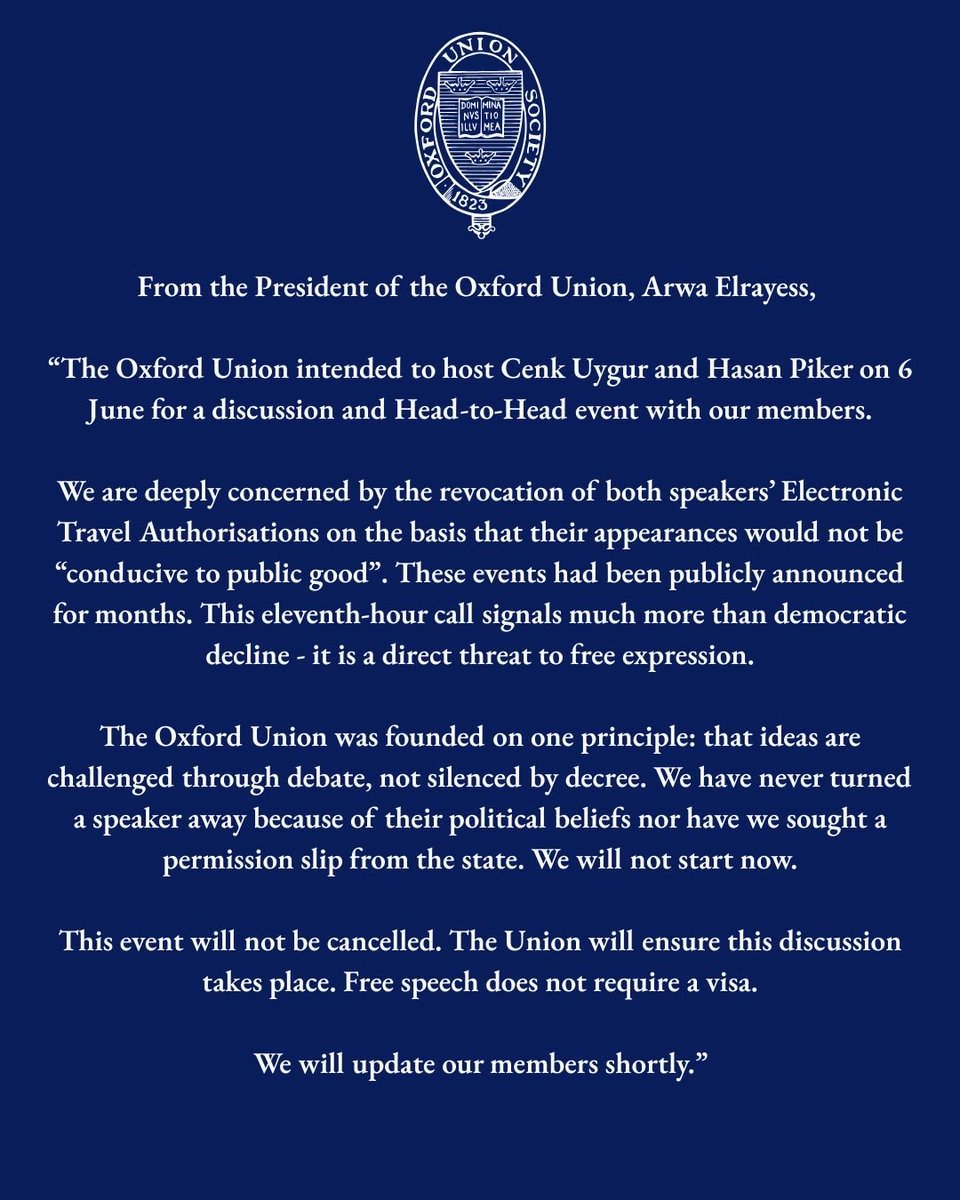
Banning Cenk Uyghur and Hasan Piker from entering the UK is an absurd and cowardly decision from an increasingly authoritarian government.
Let us call this what it is: an attack on the freedom to criticise Israel, as well as the UK government’s own complicity in genocide.
Your direct reports won't tell you the hard truths about team culture, they're incentivised to manage upward and appear successful. Skip-level one-on-ones bypass this, but only if you probe deeply. The secret: raise your concerns first, transferring social risk away from skip-levels and unlocking honest feedback. The payoff is visibility into cultural blindspots that cause teams to implode while all your metrics look green. https://t.co/oFIgUJLqxN
Release anxiety isn't a deployment problem, it's a systems design problem. Stop adding checks and approvals at release time. Instead, build systems with clarity, consistency, and good observability so safe releases become the default. The confidence you're looking for comes from how you engineer the system, not from last-minute controls. https://t.co/TaCwWwRxVV
We may be entering an extended era of "uncertain uncertainties" rather than clarity. AI progress might deepen rather than resolve fundamental questions about AGI, employment, and truth. Compounded by geopolitical shifts, institutional distrust, and AI generated content, we face cascading unknowns across all domains.
The answer isn't seeking impossible stability but cultivating radical adaptability, holding multiple contradictory possibilities, constantly recalibrating, and getting good at changing your mind. Welcome to the Age of Ambiguity.
https://t.co/uBHPqtDsSj
Former Ferrari chairman Montezemolo tears the new electric Ferrari “Luce” apart:
“I cannot say what I really think: I would harm Ferrari. We risk the destruction of a legend. So sorry. Take the Prancing Horse off. At least the Chinese won’t copy this car”
UPDATE: After national outrage erupted when the British public realised Dr Eastland Staveley—who said he didn't shoot enough babies—is working at @DHUHealthCare....
DHU are now HIDING THEIR ROTA.
Staveley works from home, triaging patients as a GP. If the rota is hidden, no one sees him in person. DHU don't want anyone knowing if he is still actively treating British patients.
Instead of an immediate suspension and investigation, a potential war criminal is being PROTECTED.
The @gmcuk and @the_mpts have been investigating and suspending anti-genocide and anti-supremacy doctors on behalf of the pro-'israel' lobby while doing nothing about this reprehensible zionist jewish doctor for FOUR months.
This is an unavoidable example of the supremacy we have been fired for naming and opposing.