New Article: "Anchored inflation expectations and the slope of the Phillips curve" European Economic Review vol 178, September 2025, 105073
https://t.co/FuBOCw39IZ
Is demand or supply more important for inflation? A new Economic Letter finds that supply forces drove low inflation after the Great Recession, while demand drove high inflation during the pandemic era. https://t.co/a0ucwjYIye
New article: A simple measure of anchoring for short-run expected inflation in FIRE models
Peter Lihn Jørgensen, Kevin J. Lansing
Economics Letters 246 (2025) 112050
Free download until January 14, 2025
https://t.co/XUWT5Q4vZH
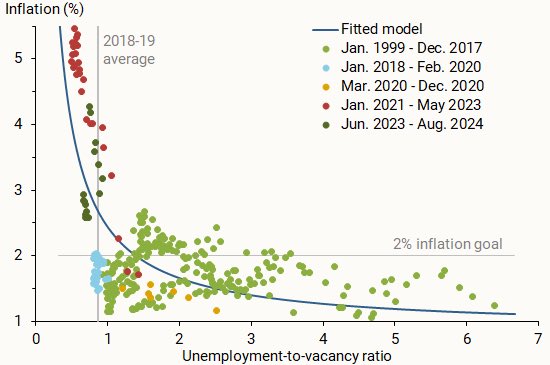
At the same time, the steep part of the Philips curve implies that a relatively small increase in the unemployment-to-vacancy ratio, achieved mainly by a reduction in the vacancy rate, can bring about a substantial decline in inflation.
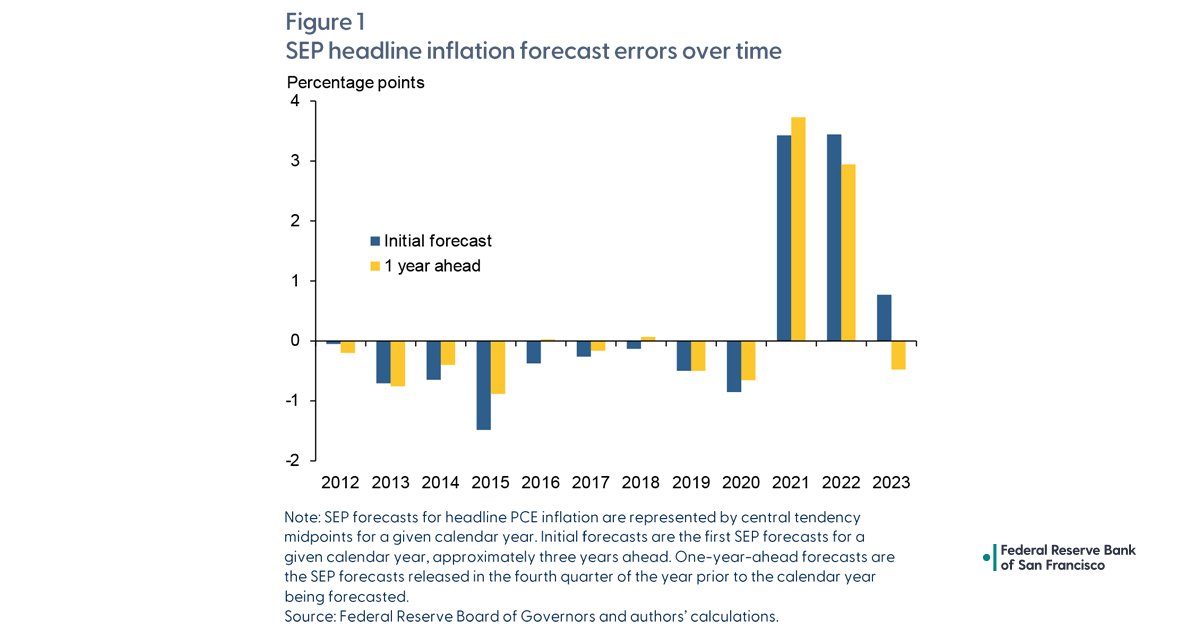
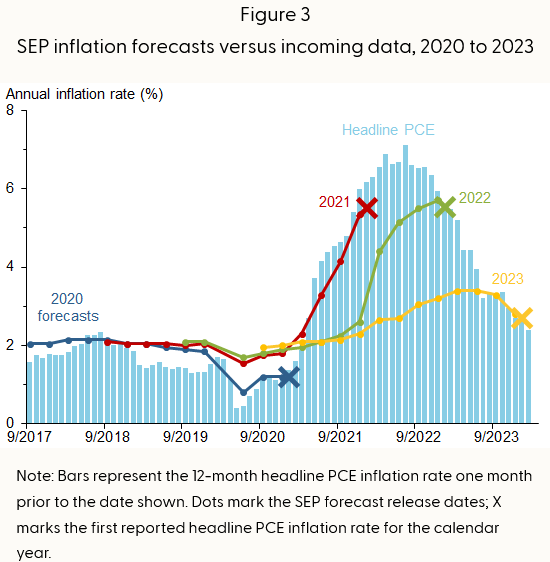
FOMC participants' inflation forecasts were consistently lowered before the pandemic, when inflation was mostly below 2%. Forecasts rose from 2021 onward, when inflation surged. Our Letter looks at the performance of these forecasts over time. https://t.co/FEl9Mw7X6q
Cumulative SEP inflation forecast revisions help predict the size of subsequent forecast errors. This result implies that the typical inflation forecast was slow to adjust to new information that could have improved forecast accuracy.
https://t.co/m8fwb00Q0s
We’ve updated our prior research on inflation and labor market slack. New data reaffirm that a relatively modest increase in the amount of labor market slack can coincide with a sizable decline in inflation, supporting the potential for a soft landing. https://t.co/pTRRD8R5x1
"Replicating business cycles and asset returns with sentiment and low risk aversion," Journal of Economic Dynamics and Control, Volume 167, October 2024, 104921
https://t.co/AuBQUoUCc0
Unlike the 1970s and early 1980s, more recent #inflation tends to coincide with stronger economic activity and higher #stock prices. Our latest Letter traces this pattern to improved anchoring of inflation expectations: https://t.co/LL7X3o7lMf | #SFFedResearch#EconTwitter