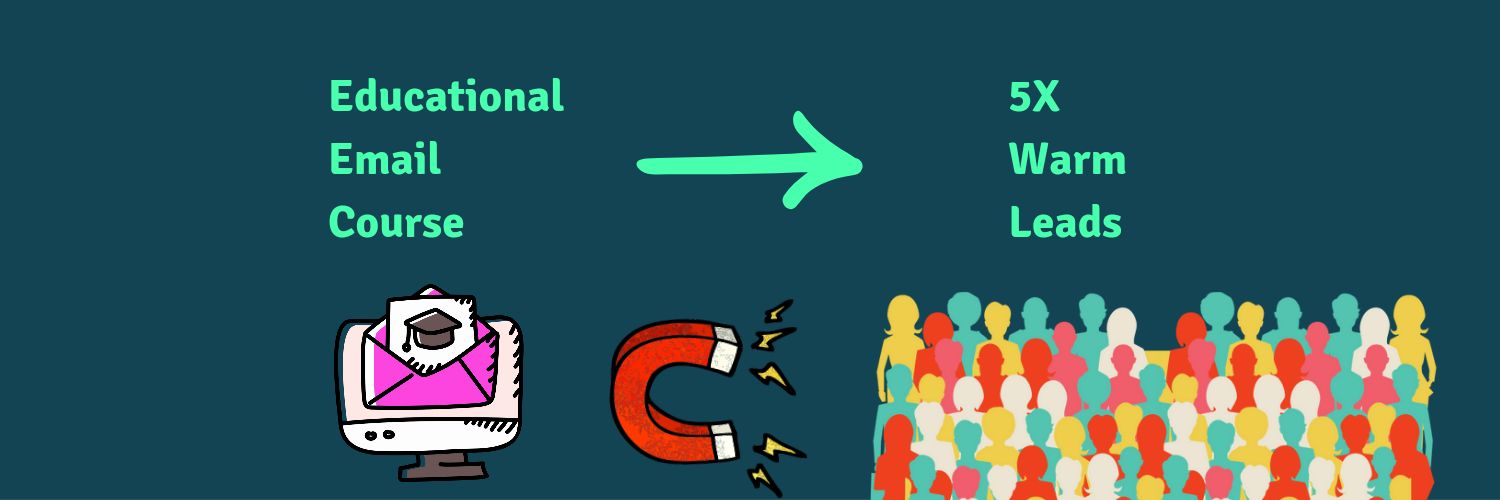
23 Reasons Why Your Business Needs an Educational Email Course Today!
1. Connects with Your Audience: It's like having a direct chat with your audience right in their inbox.
2. Builds Trust: Sharing knowledge builds trust faster than a fancy logo.
3. Shows Expertise: Prove you're the go-to expert in your field.
4. Leads to Sales: Educated leads are more likely to become paying customers.
5. Nurtures Leads: Keep your leads warm and engaged.
6. Automated Marketing: Set it up once and let it work for you 24/7.
7. Cost-Effective: It's way cheaper than traditional marketing.
8. Personalization: Tailor content to individual needs.
9. Brand Awareness: Your brand stays in their minds.
10. Boosts Website Traffic: Drive traffic to your site with each email.
11. Higher Open Rates: People love valuable content.
12. Segmentation: Easily target specific customer groups.
13. Data Collection: Learn more about your audience.
14. Easy to Share: Subscribers can forward emails to friends.
15. Customer Loyalty: Keep them coming back for more.
16. Easy to Scale: Grow your course as your business does.
17. Better Feedback: Get insights directly from your audience.
18. Demonstrates Value: Show customers what you can do for them.
19. Competitive Edge: Not everyone's doing it (yet).
20. Customer Retention: Keep existing customers engaged.
21. Improves Sales Funnels: Guides prospects toward a purchase.
22. Content Repurposing: Turn course content into other assets.
23. It Works: Countless businesses have seen success with email courses; it's time to join the club!
Ai is actually so cool.
But people are busy selling “How to AI” guides created using AI.
Is anyone actually using AI to create something other than how to guides?
Nobody reads your newsletter.
They scan it.
And if the first line doesn’t hook them in 2 seconds, they’re gone.
Here’s what I learned after writing 3000+ emails:
Your subject line sells the open.
Your first line sells the read.
Your last line sells the click.
Most people nail the subject line and forget everything else.
Don’t be most people.
Nobody teaches you THIS in school, and it's costing you every single day 🐺
Let me tell you something that hit me like a truck when I first read it.
Every time you open your mouth to convince someone of something, a job interview, a first date, asking for a raise, you have exactly 4 seconds.
Not 4 minutes.
Not 4 hours.
4 seconds.
That's how long it takes for a human brain to decide if you're worth listening to.
Jordan Belfort calls this the "Straight Line"... the shortest path between "hello stranger" to "yes, I'm in".
Here's the wild part 👇
Every human decision ever made boils down to 3 things:
1. Do I trust you?
2. Do I trust your product/idea?
3. Do I trust the company/situation behind you?
So next time someone says no to you... it's not about your words. It's about which of those 3 they don't believe yet.
You're not losing arguments. You're losing trust.
Now here's how you FIX it 🔧
👉 Fix trust in YOU: Speak with certainty. Slow down. Stop over-explaining. Confident people don't ramble, they declare.
👉 Fix trust in your IDEA: Use a real story. Not stats. Not logic. A story of someone who did it and won. The brain remembers stories, not bullet points.
👉 Fix trust in the SITUATION: Remove the risk for them. "Try it, and if it doesn't work, walk away." People say yes when they feel safe, not when they feel pressured.
The moment all 3 click? That's when people stop saying "let me think about it" and start saying "where do I sign?"
You're not bad at persuasion. You were just never taught the right system. 🐺🔥
The biggest lie in online business:
“Build your email list first, monetize later”
Wrong.
Build your OFFER first.
Then build a list of people who want to buy it.
List size without revenue = expensive hobby.
Hot take!
Most “email marketing experts” are just newsletter writers.
Writing newsletters ≠ building conversion funnels.
One builds an audience. The other builds revenue.
Know the difference.
Your email subject line has ONE job:
Get them to open the email.
Not to be clever.
Not to show off your personality.
Just. Get. Them. Open.
Save the personality for inside the email.
Been ghostwriting for others while my own account was a ghost town.
The irony isn’t lost on me.
Time to practice what I preach.
Building in public starts now.
I created my LinkedIn 43 weeks ago.
Since then I’ve added $80,000 to my agency pipeline, driven 5 figures this month for SEO Stuff, built 7,600+ connections and logged 1,849,116 impressions.
Here’s my full system. Steal it before they close the loopholes.
And if you want an even more in-depth cheat sheet with engagement group templates, carousel strategy, and DM workflows:
Follow me
Repost this
Comment “X LinkedIn growth guide”
You must do all 3 to get the DM.
Alright, let's start at the top.
Here's what is working best as of right now:
Proof + POV posts are killing it right now.
Basically numbers plus your perspective.
Screenshots, dashboards, Stripe, LemonSqueezy, or client receipts paired with your analysis outperform every other format.
Story-driven authority stuff is also doing great.
Think personal lessons and client stories (even small ones).
Real voice and context stand out in an AI-saturated feed.
Also comment-first growth is super effective right now.
Thoughtful comments are the fastest visibility engine.
15–20 high-value comments daily can rival posting.
The best comments add examples or mini-frameworks, not just agreement.
Conversation depth is also key at the moment.
LinkedIn is prioritizing posts where comments turn into discussions.
Ask real questions, reply with substance, and encourage commenters to engage with each other.
Audience overlap matters a lot too.
Consistent visibility across 2–3 adjacent niches multiplies reach.
Build circles of overlap instead of posting scattershot.
My posting routine:
I post 3 times per day, 7 days per week.
Pausing even 36–48 hours cuts impressions in half.
This happened to me two weeks ago when I was traveling. Pretty frustrating.
Morning: Text post with POV, story, or observation
Afternoon: Carousel, proof post, or annotated screenshot
Evening: Mini-thread, framework, or quick win
Formats performing now:
Carousels
Slide 1 = bold headline tied to a pain point or result
Middle = 3–5 slides of steps, bullets, or annotated visuals
Final = CTA (“Drop guide below if you want the SOP”)
Carousels mixing text + visuals outperform plain-text slides by 30–40%.
Short videos
Under 60 seconds, hook in the first 3 seconds
Subtitles matter (auto-preview drives clicks)
Quick demos and walkthroughs beat polished storytelling
Text posts
Hook = question, claim, or contrarian take
1–2 lines per paragraph for scannability
3–5 bullet takeaways > text walls
End with a question that triggers replies
Proof breakdowns
Share a metric or win
Break it down in 3–4 bullets
Turns results into mini case studies
Conversation-driven posts
Open loops, thought experiments, or contrarian POVs designed to spark multi-layer discussions
What’s flopping right now:
AI filler with no voice
Metrics with no explanation
Walls of text with no whitespace
External links in the body (especially without changing the preview image)
Timing sweet spots:
7–8 AM for text-heavy or thought leadership posts
1–3 PM for maximum impressions
Sunday evening for outsized visibility with less competition
Tuesday and Thursday for CTAs or lead-gen
Engagement strategy:
Comment on 20+ posts daily with depth and context
Like 50+ posts/day, focusing on active commenters in your vertical
Reply to every comment within the first hour to trigger velocity
Repost your best performers every 5–7 days with a new hook
DM 5–10 people daily with personalized value tied to their posts
Right now LinkedIn is boosting repeat engagement and threaded comments.
If the same people return to comment again or if your post sparks layered replies, reach extends 2–3x longer.
Hooks converting at the moment:
“I started this account 43 weeks ago. Here’s the exact revenue it has generated.”
“$10K this month from LinkedIn posts. Here’s the breakdown.”
“This 7-slide carousel booked 3 calls in 24 hours. Slide 1 below.”
“If I had to restart on LinkedIn in 2025, here’s the playbook I’d use.”
“The 3-post-per-day system I use to consistently generate inbound leads.”
Always back hooks with proof.
Screenshots, receipts, or client wins outperform text-only claims every time.
30-day LinkedIn growth checklist:
Post 3x/day
Comment on 20+ posts/day with substance
Like 50+ posts/day
Reply to every comment in the first hour
Repost top performers weekly
DM 5–10 people/day with context-first value
Track impressions, replies, leads, and comment depth weekly
LinkedIn is still the most underpriced attention engine in 2025.
Run this playbook for 30 days.
Screenshot your Day 31 results. Tag me when the inbound starts.
And if you want my cheat sheet with engagement group templates, carousel strategy, and DM workflows:
Follow me
Repost this
Comment “X LinkedIn growth guide”
You must do all 3 for the DM.
If patience walks with action, it will build you.
If patience gets stuck with thoughts, it will break you.
Action means progress.
Overthinking means paralysis.
Reading is the most underrated self-care out there. 🙌✨
Why?
Because it’s the only time your mind gets to breathe.
✅ A good book can heal what you didn’t know was broken.
✅ When the world gets noisy, a book whispers just to you.
✅ Reading isn’t an escape; it’s a return to yourself.
Give yourself permission to rest your mind in the pages of a book more often.📚