And now... the rest of the story.
Every year, families across America gather around the television.
They watch a bald kid try to kick a football. A beagle dance on a dog house. Charlie Brown get a rock instead of candy.
They laugh.
They don't know they're watching a man's autobiography.
When Charles Schulz was a boy, the other children called him Sparky. The name of a horse in a comic strip. A joke horse.
He failed every single subject in eighth grade.
Not one or two.
Every. Single. Subject.
But the grades weren't the worst part.
Paul Harvey told this story, and his voice cracked on this line:
"Sparky wasn't actually disliked by the other youngsters. No one cared enough about him to dislike him."
He wasn't hated. He was nothing.
The one thing he had was his drawings. He submitted cartoons to the school yearbook.
Rejected.
He wrote to Walt Disney. Poured everything into the drawings.
The reply was a form letter. Disney only hired the very finest artists. Sparky was not among the very finest.
Harvey paused there. Then: "I think deep down, Sparky expected to be rejected."
This is where the motivational speakers lie to you.
The rest of the story isn't about winning.
Sparky didn't try to prove them wrong. He wrote his autobiography in cartoons.
He drew himself. The loser. The kid who failed everything.
He named him after himself.
Charlie Brown.
You know what Charlie Brown never does?
Win.
His kite crashes. Lucy pulls the football. The Little Red-Haired Girl doesn't notice him.
And sixty years later, we still watch.
Not because Charlie Brown succeeds.
Because Charlie Brown keeps showing up.
Here's the part even Paul Harvey didn't tell.
Schulz taught Sunday school. He read the Bible so constantly his strips are filled with scripture.
When network executives tried to cut Linus reciting Luke 2 from the Christmas special, Schulz refused.
Either the Gospel stays, or there's no special.
It stayed.
A boy called a horse.
A student who failed everything.
An artist Disney rejected.
Planted the Gospel of Luke in front of sixty million homes.
The loser became the messenger.
God has a history of using the rejected ones.
Moses had a stutter. David was the forgotten son. Peter denied Him three times.
The kite never flew.
But the Gospel did.
Still falling?
Good company, brother.
Get up.
He's not done with you yet.
Charles Goodnight bought a steer out of a bunch of five thousand because the animal already knew something the men did not.
This was 1878, or thereabouts. Goodnight had noticed a small thing on the trail that nobody else had bothered to notice: cattle bed down at night and get up the next morning into exactly the same position in the herd they held the day before. They arrange themselves. Once he understood that, he understood that the herd already had a shape, and the job was to find the animal at the front of it.
The one he found was a tall longhorn with horns that spread wide and a coat the cowboys called mulberry. Old Blue. Goodnight put a bell round his neck and let three thousand animals learn to follow the sound.
What Blue had was not speed. It was steadiness. Longhorns on the trail are a stampede looking for an excuse: a snapped twig, a coyote, a sneeze, and four hundred tons of beef is gone over the horizon taking a cowboy or two with it. Blue declined to participate. He stood there while the herd emptied itself into the dark, and when they had run themselves into exhaustion he walked back to the point and took the panting survivors north again.
He found the water. He found the grass. He found the river crossings that could be forded without drowning anything, on a route the men themselves were still learning.
He did the Palo Duro to Dodge City run eight times. More than ten thousand cattle followed him up that trail, and for every single one of them it was a one-way journey. Blue always came back.
At night he would not bed down with the herd he had spent the day leading. He came in and stood by the campfire with the men, where they fed him cornbread, biscuits and dried apples, because by then the crew had worked out what they were dealing with.
There is one other job on his record. When Goodnight started his buffalo herd, he sent Blue out with the men to collect wild bison calves. They roped the calves, necked them tight to the steer, and turned him loose. Blue was furious about it, dragged the first one halfway across the Panhandle, then got over it and walked the animal home. They used a cow as recovery equipment for wild bison, and it worked.
After the eighth drive Goodnight retired him to a grass pasture on the JA and let him get old. He made it to twenty. When he died they cut off his horns and mounted them in the ranch office, in the good spot on the wall, and they are in a museum in Canyon, Texas to this day.
The whole American cattle trail, the thing every Western ever made is about, ran on a piece of technology nobody has ever put in the film. Not the rifle, not the horse, not the chuckwagon Goodnight also invented.
A steer with a bell on, who knew the way.
The men in the hats were following him.
1979: fasting glucose over 140 makes you diabetic.
1997: lowered to 126.
Millions of new diabetics. Same blood.
1997: prediabetes starts at 110.
2003: lowered to 100.
A third of American adults, created by a footnote.
1984: high blood pressure is 160/95.
2017: lowered to 130/80.
American hypertension goes from 32 per cent of adults to 46. Thirty-one million new patients in a morning.
2001: the cholesterol target is 130.
2004: lowered to 100, and to 70 for the high risk.
Statin eligibility expands by millions.
Eight of the nine men who wrote that 2004 update were on the payroll of companies selling statins. They disclosed it only when forced.
1994: a WHO panel invents osteopenia. Bone that is not thin enough to break, given a name and a prescription. Half of older women qualify.
Nobody got sicker on any of those dates. A committee sat down and a number moved.
The threshold drops, the market widens, and the drug is already licensed and sitting in the warehouse.
Your grandfather was healthy at 145/92. You are ill at 132/81.
Nothing about the body has changed. Only the paperwork, and who profits from it.
While most sane people rightfully rip Fauci…lost amongst the typical American political battle…the fact the Chinese and WHO are at fault for all of this. They lied. Then in the case of the Chinese they also foment online hate with their bots and warehouses full of people being paid to stir up political problems in the US.
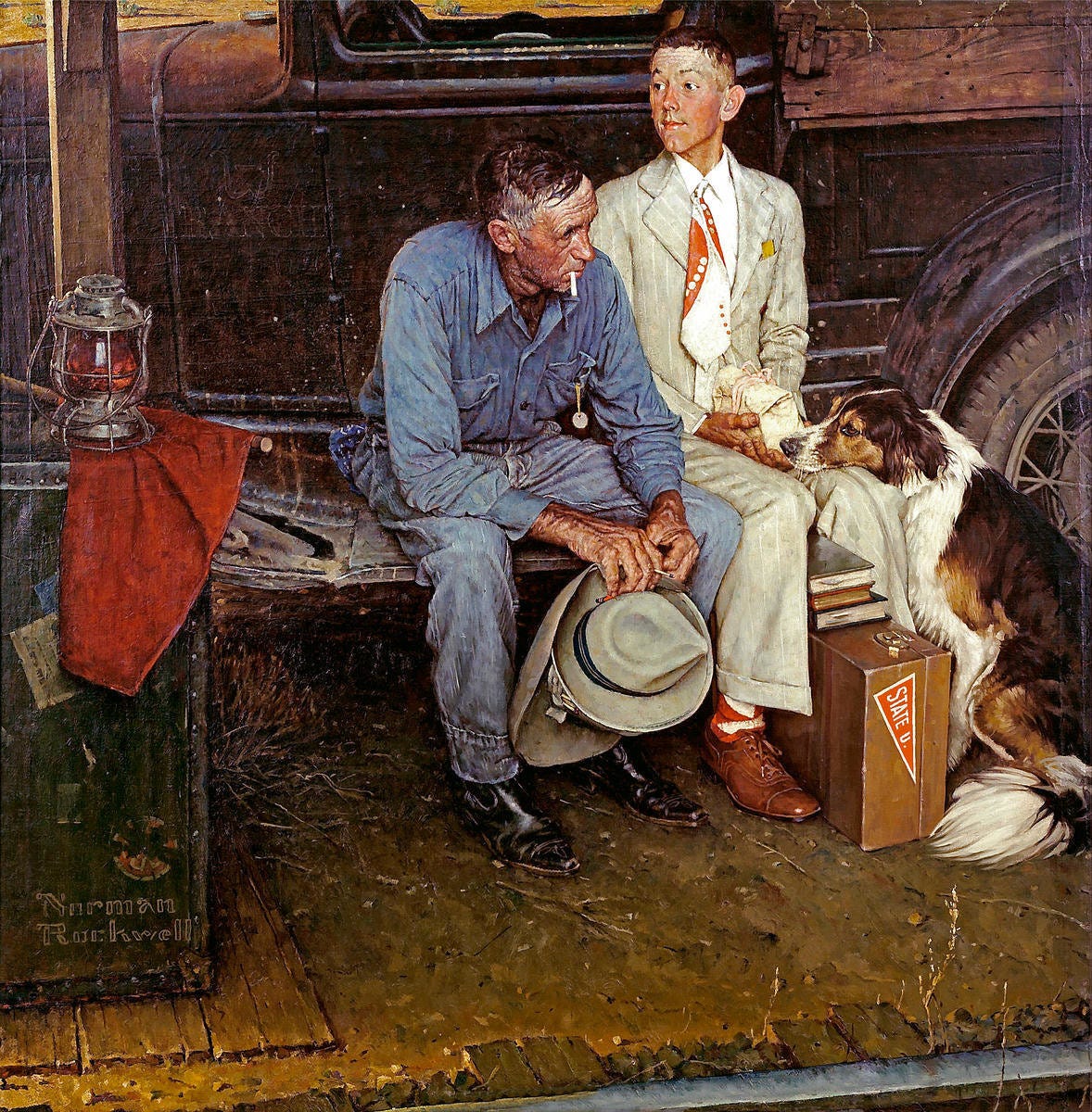
This is one of the most beloved paintings in America, and it puts its finger on something we all pass through, first as the child, and one day as the parent left behind...
The painting is Breaking Home Ties, by Norman Rockwell, on the cover of the Saturday Evening Post in 1954. A father and his teenage son sit side by side on the running board of a battered farm truck, waiting at a railway stop. A single track runs along the bottom of the picture. A ticket pokes from the boy's pocket. His suitcase is stacked with schoolbooks and wears a "State U" pennant. The train is coming to carry him off to college, away from home, for the first time in his life.
Everything is in the way they sit.
The son sits upright, scrubbed and dressed in his best, eyes fixed on the horizon, on the track, on the future rushing toward him. He is already half gone. For him that train is the beginning of everything.
His father sits beside him in worn work clothes and scuffed boots, looking the other way, down the line, as if he cannot bear to watch it arrive. The same train means the opposite thing to him. For the son it is the start of a life. For the father it is the day the house grows quieter, the chair at the table sits empty, and the person he built his world around walks out into a life that no longer has him at its centre.
Look at his hands. He is holding two hats. His own battered one, and resting on top of it, his son's crisp new one, held carefully together, because it is the last small thing he can still do for the boy...
And then the dog, its head laid in the son's lap, gazing up, refusing to look away. Rockwell knew exactly what that was for: "The father couldn't show how he felt about the boy's leaving," he said. "The dog did."
It has moved people for 70 years because every leaving is a beginning for one person and an ending for another. The child steps out into the world, as they should. And someone stays behind, watching them go, and loving them enough to let them go anyway...
What wild 24 hours. Here are 3⃣ misconceptions/misinformation I'm seeing regarding the Brendan Sorsby case:
1. He bet on games he played in.
He did NOT bet on any games he suited up for.
While not great he bet on games while redshirting, he never bet on a game he suit up in.
2. The Judge in this case is from Lubbock.
Ken Curry is a retired Tarrant County (Fort Worth) judge that graduated from Houston and UT-Arlington. He is currently eligible to practice law and his practice is listed in Colleyville, TX (over 300 miles from Lubbock).
3. Texas Tech did something wrong.
He made all of his bets before taking a snap at Texas Tech. Cincinnati was alerted to his potential gambling activity (per ESPN).
Texas Tech declared him ineligible and will now follow the temporary injunction (like the rest of the NCAA).
Golden moment: yesterday my grandson graduated. We went to the “meet up spot” with my daughter & her ex-husband was there. It was an ugly divorce. She turned to him, stuck out her hand to him & said “Congratulations, you did a good job.” 1/2
“I feel like sometimes I’m not confident in myself but he’s always confidence in me so that makes me want to fight for him.”
NiJaree Canady on Gerry Glasco