For the people asking if this is just a video... nope!
Here's me playing it on my Macbook.
It's only been ~13 hours so far, so expect it to get a LOT better :)
Listen up. n8n launched their own open-source Grok Bot, called Node.
Nod gets its own computer and browser, so it actually does your errands.
You can run it on open-source models like DeepSeek.
Meet Nod, your own open-source personal agent from n8n Labs
Ask it to prep your calls, collect invoices or cancel a subscription
It runs on your computer with its own browser to get the job done across apps and websites, using the AI provider you choose👇
Babe, wake up!
New benchmark by Artificial Analysis just dropped.
Anthropic’s recently released Claude Fable 5.2 (max) leads the MKA leaderboard with a Climb WSR of 57%, followed by Gemini 4 Carbon (high) at 54% and Claude Opus 5.5 (max) at 53%
This is a private dataset. Public datasets are getting benchmaxxed by all the labs.
We’ve partnered with Google DeepMind to launch their Multimodal Knowledge Agent (MKA) evaluation, a new benchmark for agentic knowledge work over complex visual files
@GoogleDeepMind’s MKA is a new benchmark requiring agents to review visually complex project files such as schematics and scans, and produce deliverables like slide decks, spreadsheets, reports, and marked-up images
Multimodal Knowledge Agent (MKA) overview:
➤ 200 private real-world visual tasks across 10 industries: Agents work from dense visual project files including architectural drawings, engineering schematics, and clinical scans to produce deliverables including slide decks, spreadsheets, PDFs, Word documents, and marked-up images. Unlike many agentic evaluations, these inputs emphasize realistic visual complexity and domain-specificity, and are genuinely required to complete the task rather than just providing additional context
➤ Climb vs. Regression rubric scoring: Each task is graded against expert rubrics, averaging ~70 weighted criteria per task. Criteria are split into ‘Regression’ (baseline checks models should pass) and ‘Climb’ criteria (harder checks designed to separate strong models). The headline score is Climb WSR (Weighted Satisfaction Rate) - the weighted proportion Climb rubric criteria successfully completed
➤ Evaluated in Stirrup with an agentic judge: We run every task in Stirrup, our open source agent harness, with code execution, web search, web fetch, and image-viewing tools (up to 250 turns), and grade submitted deliverables using GPT-6 Luna (medium) as an agentic judge
Key MKA results:
➤ Claude Fable 5.2 leads on multimodal knowledge work: Anthropic’s recently released Claude Fable 5.2 (max) leads the MKA leaderboard with a Climb WSR of 57%, followed by Gemini 4 Carbon (high) at 54% and Claude Opus 5.5 (max) at 53%
➤ Cost per Task spans nearly 30× within 10 points of the top score: Claude Fable 5.2 averages $31.97 per task, over 5× Gemini 4 Carbon ($6.29) for ~2 extra points, and ~29× GPT-6.1 Sol ($1.11). Below Carbon, all four OpenAI models tested sit on the cost-performance Pareto frontier (GPT-6 Astra, GPT-6.1 Sol, GPT-6.1 Terra, and GPT-6 Luna), with Claude Haiku 5.5 and MiMo-V2.6-Pro making up the rest of the frontier
➤ No single model leads across all 10 industry verticals: Claude Fable 5.2 leads five verticals (Software & Data, Engineering, Logistics & Mapping, Business, and Finance alongside Claude Sonnet 5.5), Claude Opus 5.5 (max) leads Education and Construction, Gemini 4 Argon (high) leads Science, Gemini 4 Carbon (high) leads Healthcare, and Claude Sonnet 5.5 (max) narrowly leads Law & Government
Thank you to the @GoogleDeepMind team for their work building this benchmark and collaborating with us to bring it exclusively to Artificial Analysis!
Grok Bot can now join your personal or company tailnets on Tailscale.
Use it to securely reach private MCP servers, internal tools, and apps on your network.
I'm more comfortable saying things like this to Fable 5.2, than any other model:
"Let me know of your thoughts... whether we should keep this plan, edit it, or do something entirely different based on my project goal."
In other words, i trust Fable 5.2 much more than any other model, for planning.
In #T3code i was confused to what the setting, under chat "Tool Calls In Chat" does.
There's 4 options.
1. Show all (this the default and how T3Code operated since the beginning of this project)
2. Hide successful (new option)
3. Hide all (new option)
4. Zen (new option)
For now, im using Hide All. But i do see myself using Zen soon. In other words, if you select Zen, you're letting go of any outcomes, since all agent activity is now invisible until agent stops.
Since T3Code doesnt explain any of this, I had my agent generate a comparison table.
If you have Fable 5.2, then use the prompt below in your repo to audit and find major architectural problems.
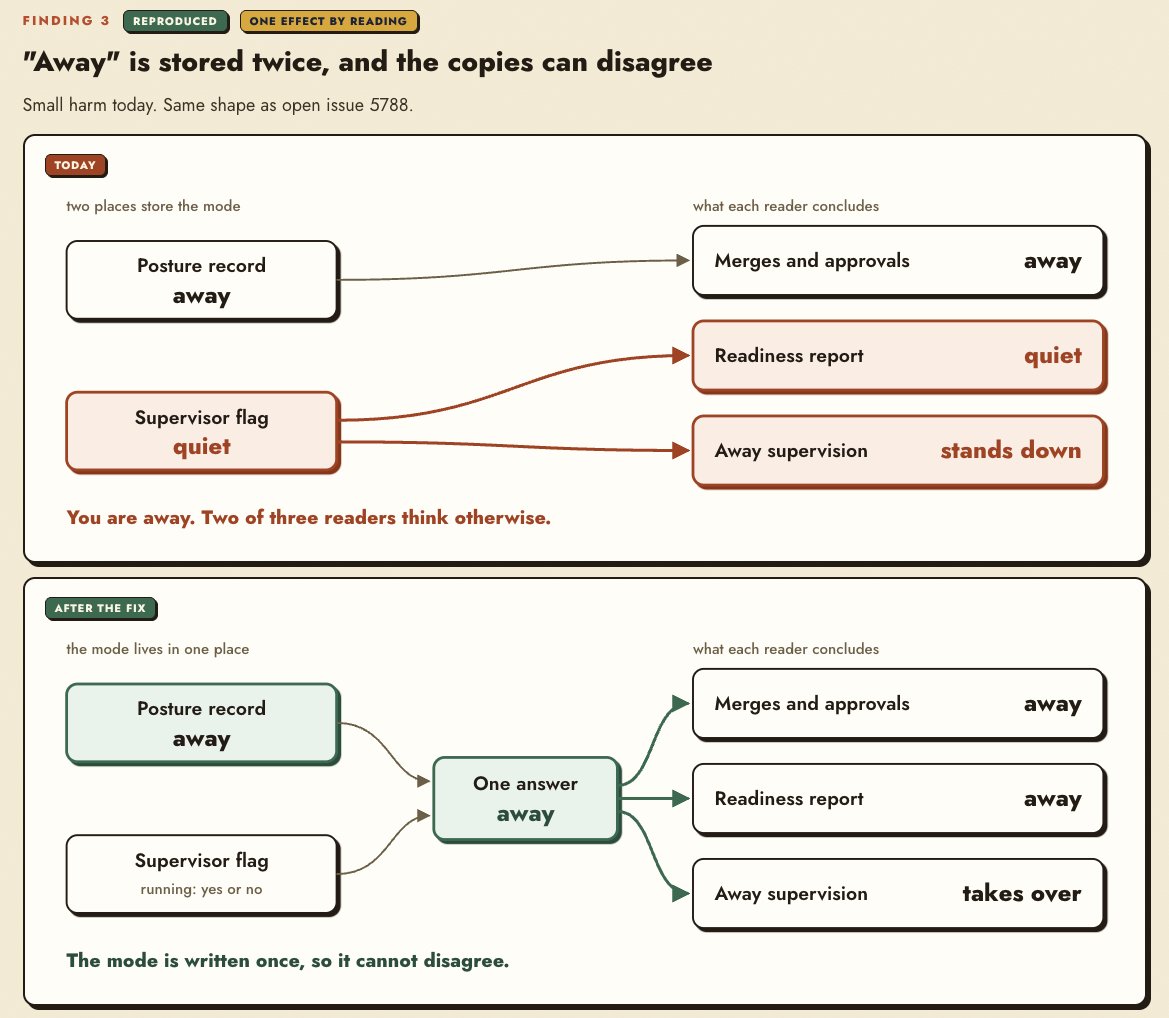
In one of my repos, Fable 5.2 found and explained 12 issues with visual before/after diagrams. However, it only recommended that we fix 2 out of 12.
I don't think i've seen a model recommend so little changes. All previous models would have recommended we fix everything.
Fable 5.2 shows impressive reasoning.
Based on this, Fable 5.2 would excel at deciding whether a PR should be merged or not. Meaning it would have no troubles discarding (not merging) PRs. I will test this later.
this is a really good prompt you can use to feel the power of fable 5.2 btw!
i'd send it as -
"audit and find implicit state machines in this <codebase/directory/module> that would drive concrete improvements if made explicit. explain before/after of each one and discuss with me in lavish-axi. fewer words, big visuals"
lavish-axi is optional, but it makes the results a lot easier for you to understand and decide on. https://t.co/QIHTACW7PV
fable 5.2 is really good at identifying real problems and ignore noise, and it explains them in a very intuitive way
example of a good clean up identified in firstmate repo here
My agent fixed github annoyance, with a chrome extension.
Copy/Paste:
"Build a Manifest V3 Chrome extension for https://t.co/ihMQQ8jGnU only: one content script, no permissions, no build step.
GitHub wraps each Markdown image in a link that opens a new tab. On a plain left click or Enter on such an image (inside .markdown-body, link has target="_blank" and points at the image itself, or at its /blob/ page when the image loads from /raw/), cancel the new tab and show the image in a modal <dialog> over the dimmed page: at most 80% of the viewport, never enlarged.
Close on the X button, a click on the dimmed area, or Escape, then restore scroll position and focus. Also close when the page navigates.
Leave modifier clicks, middle clicks, author-written links (no target attribute), and avatars to GitHub.
GitHub swaps pages without reloading, so use one capture-phase click listener on window. Signed image URLs expire after 5 minutes, so draw the already-loaded image into a canvas instead of requesting it again.
Test in Playwright's Chromium with the extension loaded unpacked, then verify on a real public pull request."
Claude Fable 5.2 is now #1 on AA-3D, our benchmark for how well AI models build interactive 3D experiences
Claude Fable 5.2 (Max) scores 1271 Elo, 67 points ahead of Claude Sonnet 5.5 (1204) and Claude Opus 5.5 (1202). Its 95% confidence interval (1246 to 1297) does not overlap any other models, so its lead is outside the margin of error.
Key results:
➤ It scores 132 points above its predecessor, Claude Fable 5.1 (1139)
➤ It is ahead of the highest-ranked OpenAI and Google models on AA-3D, GPT-6 Astra (1168) and Gemini 4 Argon (1147)
More results and scenes in the thread below
If you wish to see how well Fable 5.2 performs at front-end design, here's a comparison.
On the left, it's stock Fable 5.2
On the right, it's Fable 5.2 with design (aka frontend-design) skill.
1. Comparison https://t.co/cmqL9JPMpP
2. Frontend Design Skill https://t.co/sP19MDyvGW
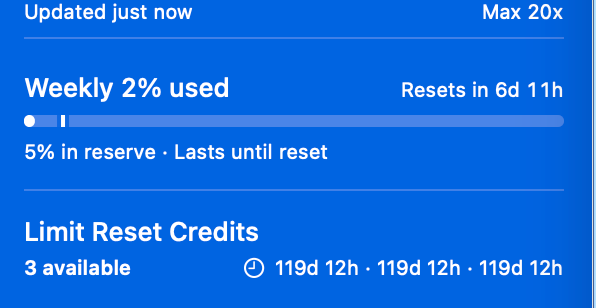
Be careful with Fable 5.2, since its using a lot more of your limits than Opus 5.5.
In other words, you have to adjust your expectations, since Opus 5.5 feels almost unlimited, Fable 5.2 is not.
Fable 5.2 is HERE! 🔥
I've burned over 100 billion tokens early testing Fable 5.2. It is BY FAR the best model I've ever used.
Here's my full review (including Gears of War clone):
> Fable 5.2 is the most autonomous model to date. Given a task with little direction, it makes assumptions that 99 times out of 100 are exactly what I would have done.
> It's a bug catching genius. I tasked it with going over all of my codebases and it found bugs that no other model would have found.
> It is the most capable model I've used with 3D generation. It is so good at controlling Unreal Engine and Blender. Check out my Gears of War clone attached.
> It's SUPER fast. I wasn't even using fast mode. It's less about how fast the tokens per second are, it's more about how it figures out direct paths to solutions. It doesn't get lost, it just knows exactly what it needs to do.
> And then there's Ultracode...which is ridiculously fast for massive tasks. I gave it massive codebase review tasks and it would finish in 10-20 minutes, finding every possible issue. I probably won't be using it as it'll burn my sub quota too quickly.
> Fable 5.2's completeness of work continued to surprise me. Clone Excel? Done...with full feature parity. Clone Gears of War? Done. Build a replica of Tokyo in Unreal? An entire simulated city is born. I rarely had to send follow up prompts to get it to complete something.
Now, will I use it over Opus 5.5? I will likely still prefer Opus because I can run Opus nearly 24/7 and rarely run out of quota. And for the hardest jobs, I'll switch to Fable 5.2 for planning.
With every generational increase in intelligence, your global guidance must be audited.
I recommend you audit your global agents.md (or similar) guidance, as per the new capabilities of Fable 5.2
1. I would start a new Claude chat, set Fable 5.2 xhigh/max. Do this once, since you won't need this reasoning for anything else.
2. Ask to audit your global agents.md (or similar) instructions to see if they align with
https://t.co/LgZIfnduRm
https://t.co/dqfifzGrTl
3. Dont implement anything yet, just propose changes in terms of priority/severity.
4. Wait for it to cook.
5. Once you see the results, then you can just ask it to implement anything you need.
Matt Shumer posted his review of Fable 5.2
https://t.co/cgvBvLz9tJ
Summary:
Calling Fable 5.2 the most capable model I’ve ever used undersells it. This thing is another level. It doesn’t feel like the jump from Fable 5 to Fable 5.1. It’s something bigger.
Fable 5.2 is the best model ever created.
The things I created with it are mind-blowing.
It’s also basically a school hall monitor.
Here’s my review (with demos): https://t.co/r4ue3JWheu
Fable 5.2 takes the Artificial Analysis's Intelligence Index lead. Its max score of 65 sits 5 points above the current leader, Gemini 4 Carbon (high) at 60, and 6 points above the previous Anthropic leader, Claude Opus 5.5 (max) at 59.
Artificial Analysis Intelligence Index:
Claude Fable 5.2 (max), 65
Claude Fable 5.2 (high), 62
Claude Fable 5.2 (xhigh), 62
Gemini 4 Carbon (high), 60
Claude Opus 5.5 (max), 59
Gemini 4 Carbon (medium), 58
Claude Opus 5.5 (xhigh), 57
GPT-6 Astra (max), 57
Claude Fable 5.2 (medium), 56
GPT-6 Astra (xhigh), GPT-6 Astra (high), GPT-6.1 Sol (max), and Claude Sonnet 5.5 (max), all 55 Then Claude Fable 5.2 (low), 54, tied with Gemini 4 Carbon (low)
High and xhigh both scored 62, so extra effort did not help until max. Even the low setting at 54 matches Carbon’s low row and already beats the only prior Fable row on this table, Claude Fable 5.1 (xhigh) at 50. That is +15 for max, +12 for high and xhigh, +6 for medium, and +4 for low versus that 5.1 xhigh score.
The live leaderboard still does not list Fable 5.2. This is the changelog data placed onto the current table, not an official AA ranking update yet.