It has been suggested that there could be an association between age-related hearing loss and an increased risk for Alzheimer’s disease. By initially focusing on healthy individuals, our study aims to enhance our understanding of the hippocampus's role in auditory processing.
I'm happy to share that I have received an R21 grant from the NIDCD to investigate connectivity between hippocampus and auditory cortex in noisy speech processing. We will utilize 7T fMRI to examine layer-specific cortical activity, aiming to uncover FF/FB mechanisms involved.
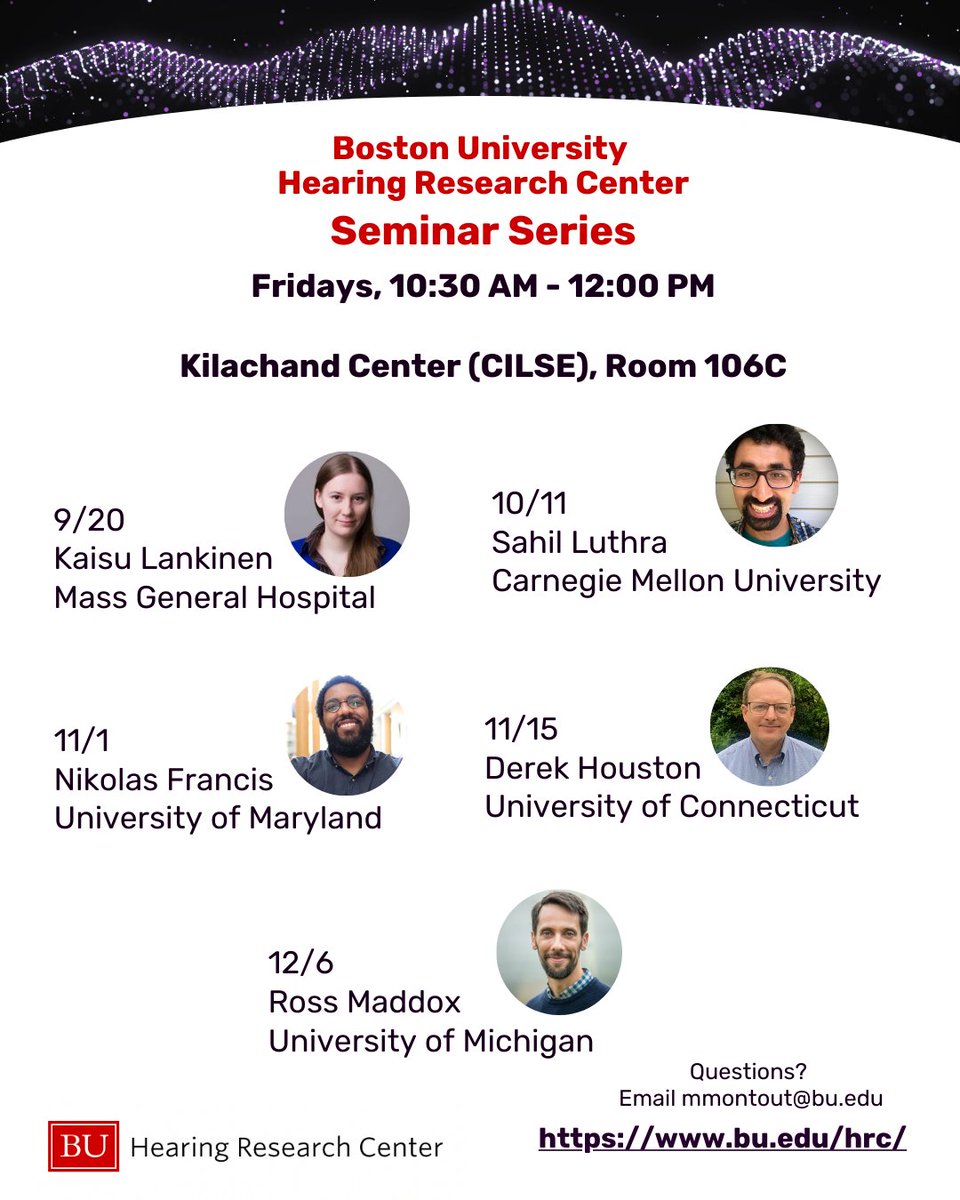
Announcing our Fall Seminar Series! Join us Fridays to learn about these researchers new work in hearing and neuroscience.
Beginning tomorrow with Kaisu Lankinen @klankine from MGH Martinos: "Using 7T fMRI and MEG to examine functional properties of the human auditory pathways."
The responses elicited by auditory and visual stimuli were consistent with feedforward and feedback type of input patterns observed in animal models. The results extend our knowledge of neural underpinnings of cross-sensory processing
Human brain sensory areas, which process external and internal sensory information, are influenced by inputs from other regions. By combining MEG and computational modeling, we characterized the inputs arriving to auditory cortex when auditory or visual stimuli were presented
What happens in the brain (#MEG) during paradoxical thinking about others? and how it may impact our emotions towards others.
Thanks to @klugenschmuck Niko Somila & @klankine
https://t.co/bJ8EZdpHOE
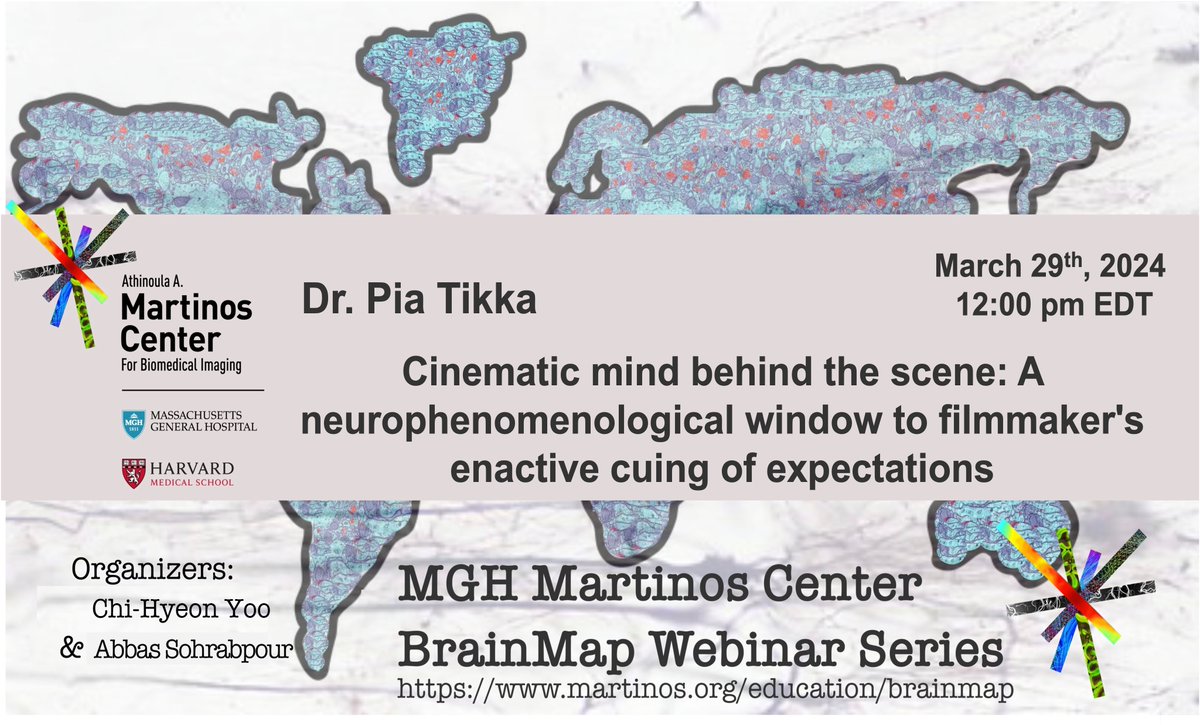
Join us Friday March 29th, 2024 at 12 pm EDT
for an exciting BrainMap Webinar 🧠📽️🧠🎞️
by Dr. Pia Tikka, PhD - Tallinn University (@PiaTikka )
Webinar link: https://t.co/sYR7FhScjz
Contact organizers for info:
@abbas_neuro@klankine@cx290_martinos
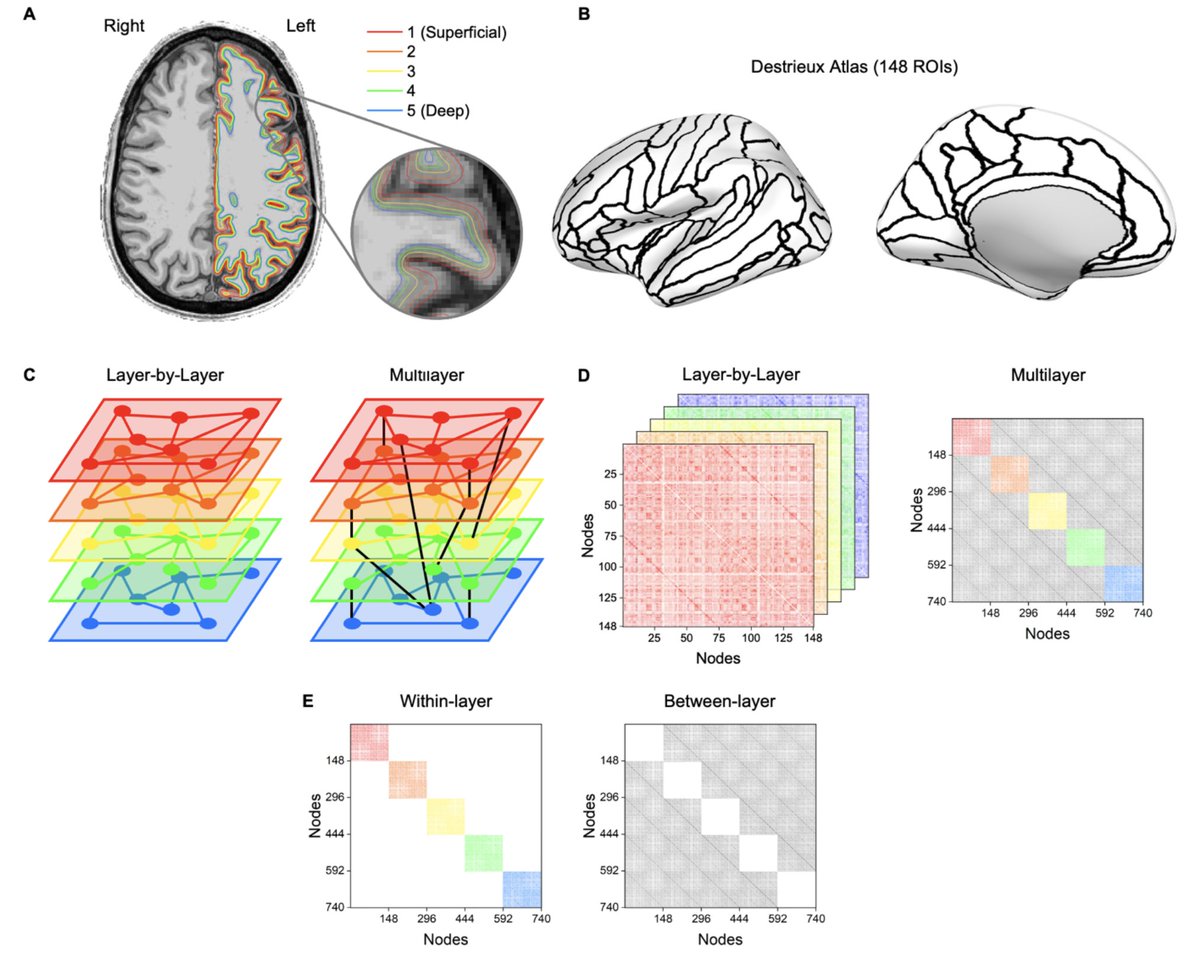
New layer-fMRI preprint that applies graph-theory analyses on resting-state layer-fMRI data.
Kotlarz et al. conclude that superficial layers have more influence on information transfer.
https://t.co/FlKiwIRHLD
We are excited to share our latest paper published in JOSS! HNN-core: A Python software for cellular and circuit-level interpretation of human MEG/EEG. https://t.co/2ShlsxB19J
I will present our work on characterization of feedforward and feedback influences in auditory cortex using layer-specific 7T fMRI, MEG and computational modeling at SfN tomorrow Nov 14 at 1 pm EST in WCC room 152B
I am happy to share our newest publication that provides insight into the role of articulatory motor networks in speech perception
https://t.co/4u7lidktCA
We recorded BOLD signals from speech production and perception tasks using 7T fMRI. The similar brain regions in the left precentral, premotor and inferior frontal cortex were activated during speech production and perception
Our results support the hypothesis that the articulatory-motor networks in the left hemisphere that activate during speech production also play a role in the perceptual categorization of acoustic signals.
We used Fast Multipole Method to individually estimate the distribution of TMS-induced E-field on articulatory motor area defined using 7T fMRI. We found that the performance of the subjects in a behavioral task was affected right after the continuous theta-burst stimulation.
Congratulations to the Center's Jyrki Ahveninen, PhD, on receiving the 2023 Jim Thrall, MD Mentoring Award - Research Faculty! We checked in with Jyrki to learn about his experiences with mentoring: https://t.co/blrbdkUQjH @MGHImaging @MGH_RI
We found that the shapes of the depth profiles in response to auditory and visual stimuli were different. This could reflect sensory-specific feedforward vs. cross-sensory feedback influences in the auditory cortex