@elliotpsych@AAJDeVille1@JonathanShedler Thread 2/2. The first issue is DBT, although not a PDT, shares certain sensibilities, more so that CBT. Second, DBT is for BPD and CBT proper is not a good treatment for BPD (sans SFT). So if you are tx BPD, your more likely to use DBT than CBT proper. IMHO.
@elliotpsych@AAJDeVille1@JonathanShedler In my experience, many psychodynamic therapists (PDTs) practice DBT and quite well. It helps to have a theory of motivation. And, I do believe that they are more likely to practice DBT than CBT. There are several reasons but most is probably an artifact of two issues Thread 1/2
@elliotpsych@proud_penelope@AAJDeVille1@JonathanShedler Thread 2/2 whereas mindfulness can refer to a stand alone treatment or be a component of a tx like DBT. It is typically considered a CBT technique, although many dynamic people use and practice it because it is more broadly part of meditation.
@elliotpsych@proud_penelope@AAJDeVille1@JonathanShedler Mentalization Based Therapy is a psychodynamic treatment approached based on psychoanalytic or psychodynamic theories and techniques, including attachment theory. It was developed by psychoanalysts (Fonagy & Bateman) and based on theory by Fonagy, Target, and others. Thread 1/2
@jack_murbach@DrEricKuelker@JonathanShedler RCTs are very useful for testing mechanisms of action in therapy, which has the potential to lead the kind of data you both are seeking. "What treatment, by whom, is most effective for this individual with that specific problem, and under which set of circumstances?"(Paul, 1967)
@jack_murbach@DrEricKuelker@JonathanShedler Dr. Kuelker, I agree that therapist effects research is of the utmost importance, as is 'patient-therapist fit' (as Dr. Murbach notes), BUT RCTs are important too. There is so much more we need to know from them. We just need the funding to use better designs.
@DeltaXR9 @JonathanShedler That database could be search for terms like BPD, DBT, and by investigators like Linehan, etc. That is how I determined the funding disparity. A disparity that is not justified by the ES from meta-analyses or differences in studies that directly compare DBT to legitimate Tx.
@DeltaXR9 @JonathanShedler There is, or at least was, a definitive publicly available data base that one could search to explore what has been funded. That information is (or was) publicly available & in fact, through FOI request one could acquire the actual grant application.
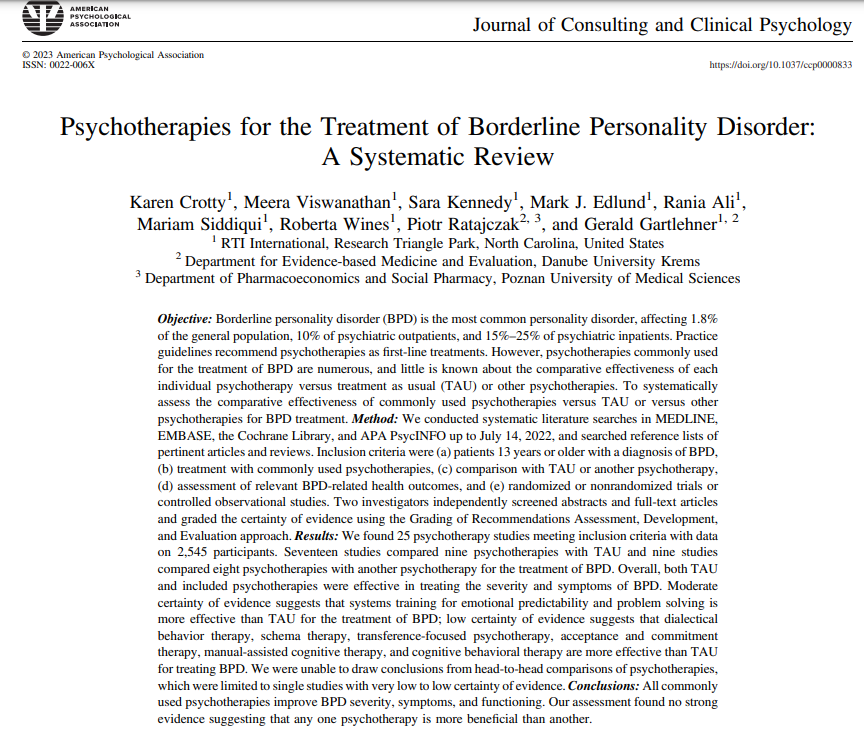
@DrJenIzaakson@JonathanShedler DBT's "success rate," as shown in several meta-analyses in terms of effect sizes, is no different than several other treatments, including psychodynamic ones like Transference-Focused Psychotherapy (TFP), MBT, & DDP. It's a good tx, but there is no reason to privilege it.
DSM Disorders Disappear in Statistical Clustering of Psychiatric Symptoms
Comments on a fabulous study by @MiriForbes et al on reconstructing psychopathology
https://t.co/cGYuqsXd0I
I am extremely thrilled to announce that I will be heading to @FloridaState this Fall to pursue my PhD in Clinical Psychology. I cannot wait to begin working with @DrPamKeel and the Keel Lab!
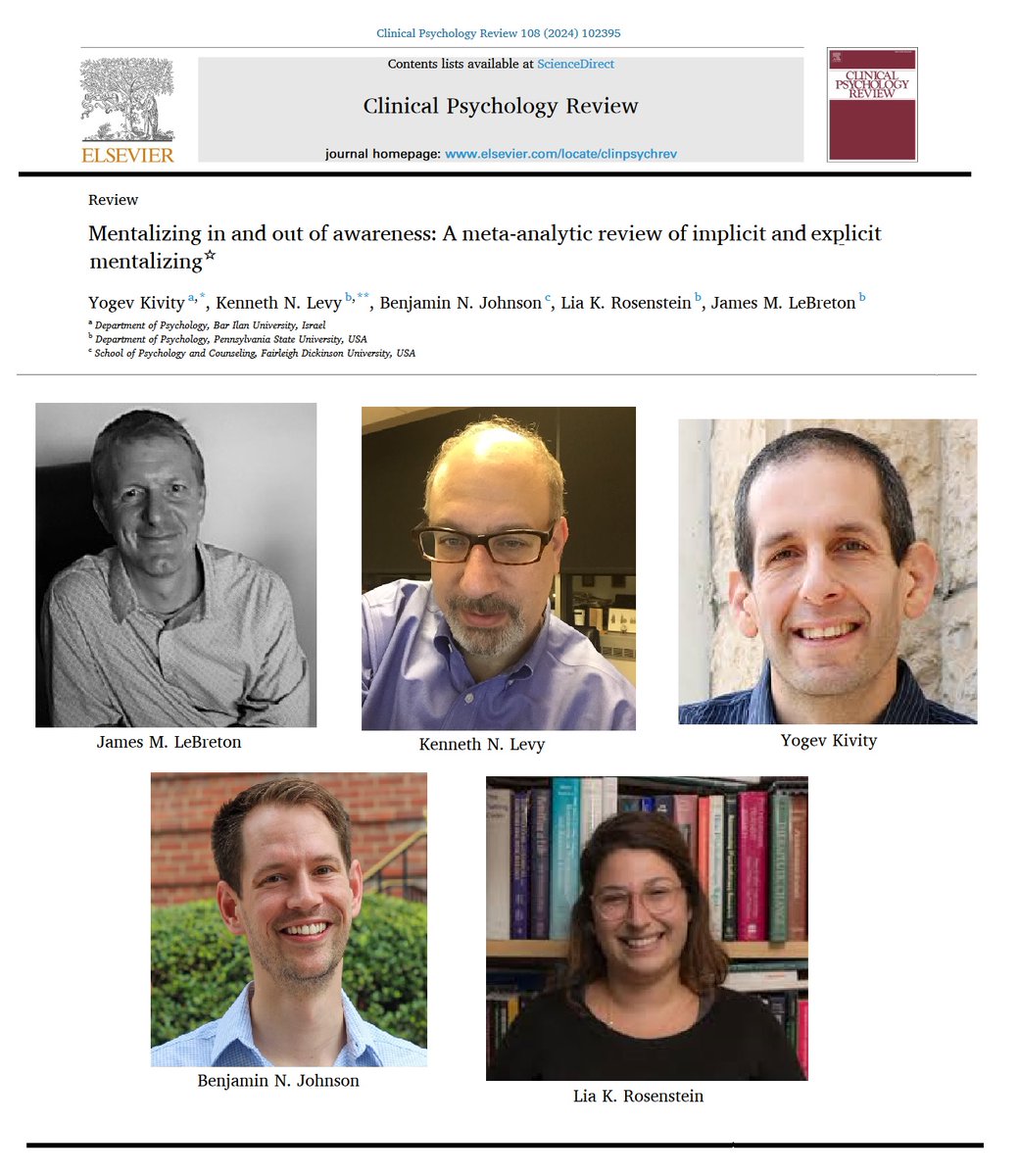
Penn State faculty, Drs. LeBreton and Levy, along with former postdoc Dr. Kivity, and past grad students, Dr. Johnson and Dr. Rosenstein, recently published a meta-analytic study available free for a limited time (through March 26) at: https://t.co/pZPgWLsILn
'Graduate students need more quantitative methods support', a Comment by Andrea L. Howard (@DrAndreaHoward)
Web: https://t.co/GviK7HnTQ1
PDF: https://t.co/Bbbx9WhuUD