While this headline point by @JarrettRenshaw is technically correct, I think it does not hit the nail on the head. The issue is not with biofuel plants but with obligated parties (refiners) under the RFS. The RVOs can be met if obligated parties bid up the price of D4 RINs to a sufficiently high level to incentivize production at the required levels. It really is just a question of price. And this may be the real rub. It appears that obligated parties are balking at doing their job under the RFS, which, of course, is an old story. Again, the issue is not plant capacity but the incentives to make sure all of it is used and then attracting biofuel imports needed to fill in any gaps. I'm not buying any argument that it cannot be done. It may not be easy and right now it appears that record D4 RIN prices are not high enough. But it can be done. The market will work.
The Supreme Court, in a 7-2 opinion (https://t.co/MNHchguEMl), has concluded that federal pesticide law expressly preempts the state law failure to warn claims commonly raised by plaintiffs who claim that exposure to the herbicide Roundup caused them to develop cancer. The decision settles a question of law that has been at the forefront of pesticide liability litigation for the past decade. To learn more about the arguments raised in this landmark case, click here for analysis from NALC Staff Attorney, Brigit Rollins: https://t.co/9fuBWt2qZk
So much noise on the #glyphosate decision. Let's nail down what we know.
It has been evaluated by dozens of regulatory agenices for 50 years with no indication of cancer at dietary or occupational levels.
Researchers continue to test, still no hard evidence of "causing cancer."
Lots of talk about glyphosate, so I want to add some context to the noise.
Glyphosate is a molecule.
It has been studied for 50 years.
Hundreds of regulatory reviews.
Tens of thousands of pages of data.
Toxicology, residue studies, epidemiology, environmental fate.
You don’t have to “trust Monsanto.”
You can read assessments from:
🇺🇸 EPA
🇪🇺 EFSA
🇯🇵 PMDA
🇨🇦 Health Canada
Here’s what gets lost in the shouting:
Hazard ≠ Risk.
Risk = Hazard × Exposure.
Real‑world dietary exposure?
Measured in micrograms.
Hundreds of times below conservative safety limits.
That’s risk assessment.
And no- IARC saying “probably carcinogenic” does not mean “causes cancer at real‑world exposure.”
It means same category as:
– Red meat
– Night shift work
– Very hot beverages
Context matters.
If you think farmers spray poison because they enjoy it, you’ve never met a farmer.
They use tools.
Tools are evaluated.
If they don’t work, they’re dropped.
If they aren’t safe under regulation, they’re not approved.
The claim that we are all being secretly poisoned? That collapses under dose‑response curves and biomonitoring data.
Emotion spreads faster than toxicology. But toxicology still wins.
If you care about food, health, and the environment, learn the difference between hazard and risk.
It will change how you see almost every chemical debate online.
And yesterday, SCOTUS (7–2) made something else clear:
You don’t get to turn fear into a label.
If regulators didn’t require a warning,
you don’t get to invent one through litigation.
FIFRA (US Law) says the EPA has total authority to write labels for products in the US
Biased state courts said Roundup needs a cancer warning label. The EPA has found it doesn't cause cancer, hence it doesn't need that label.
EPA authority > state courts making up labels
Okay, so after making some calls, this seems like the Bloomberg article is making a mountain out of a molehill here. But here is what we know. ASA has not taken a public position on the amendment and is not actively opposing the House vote. ASA says any reporting claiming it has formally opposed the legislation is inaccurate.
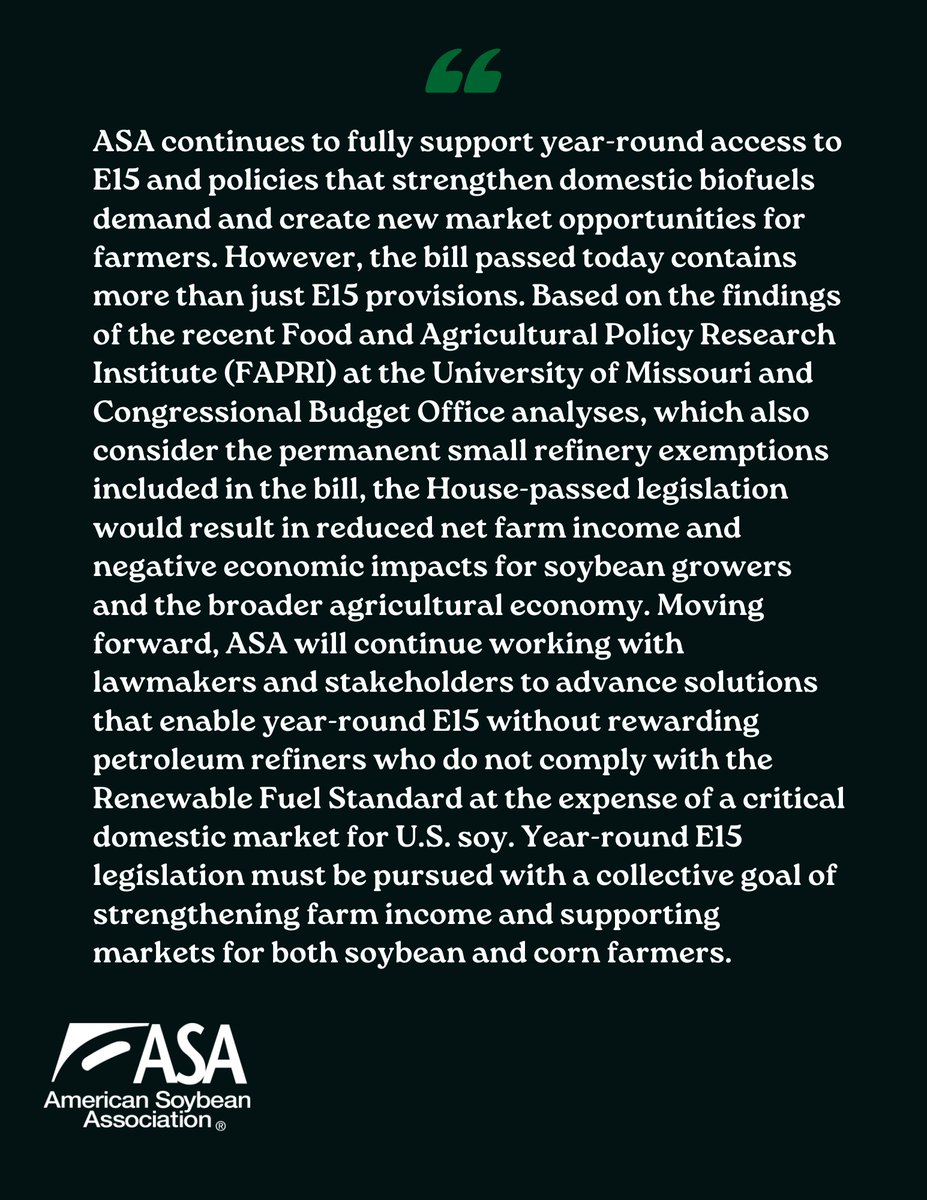
@TheeGrainLady The story is missing the “because of Small Refinery Exemptions trade off.” No one in soy is opposed to standalone E15 legislation but this bill undercuts the RFS.
@E_Energy_Adams@deucefarms@ckleene@ASA_Soybeans Fair. I guess “the amendment in its current form” is that. Hard to tell if it was the full statement provided to the reporter or they just took what they wanted from what ASA said.
@E_Energy_Adams@deucefarms@ckleene@ASA_Soybeans The story is missing the “because of Small Refinery Exemptions trade off.” No one in soy is opposed to standalone E15 legislation but this bill undercuts the RFS.
🇺🇸The U.S. EPA has finalized 2026 and 2027 biofuel blending volumes (see table below).
EPA's report also states: "To provide continued certainty for American corn growers & ethanol producers, EPA will maintain the 15 billion conventional biofuel level for 2026 & 2027."
🚨The Trump Administration never wants to see another farmer or trucker experience the costly pain and aggravation that comes with a faulty DEF system, which is why President Trump just announced that the EPA is ENDING the requirement for DEF sensors on diesel vehicles and equipment. https://t.co/ZVO6k6q8Cz