Klority now supports MCP.
Your AI coding assistant can read the ticket, the acceptance criteria and the wiki PRD, then move the ticket and record test results, all inside your Klority workspace.
Cursor, Claude Desktop, Claude Code CLI, Cline and Windsurf. 🧵
"The agent said the tests pass" is not a test result.
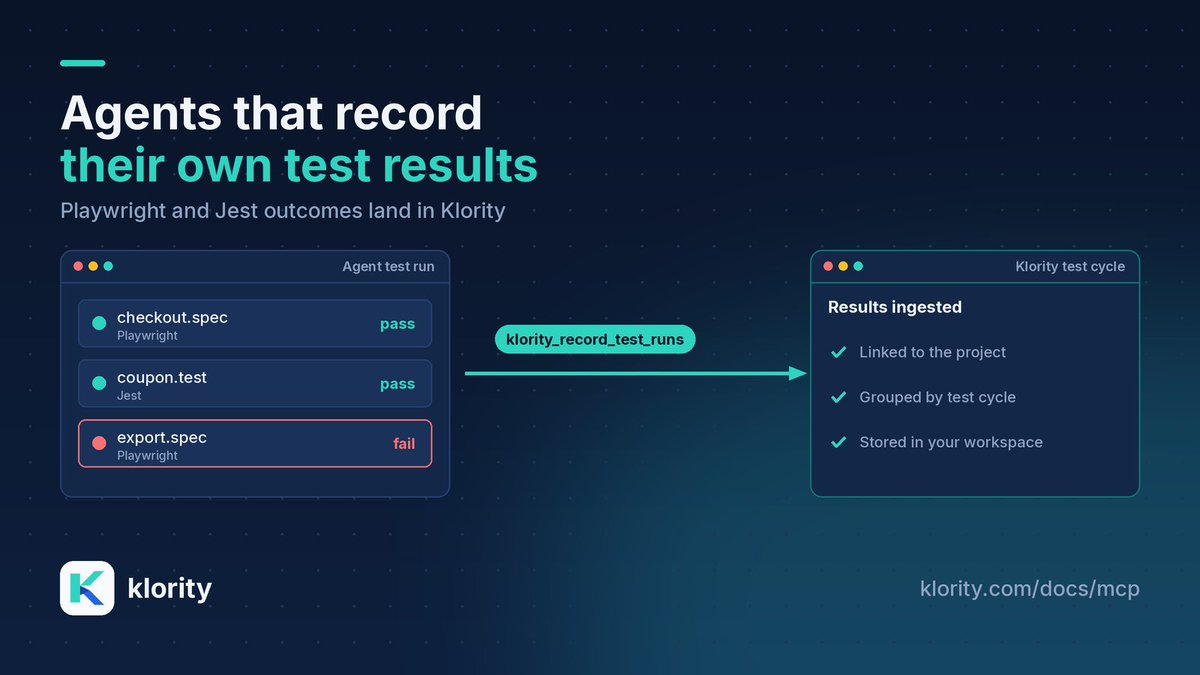
With Klority MCP, the agent records its Playwright/Jest run into a Klority test cycle (klority_record_test_runs), so the result sits next to the ticket and the criteria.
https://t.co/16lZJQbcD1
4/ CI: `npx redis-local --port 6379 &` before your tests, with no Docker-in-Docker. Dev/CI only, not production. MIT. Built by the Klority team. Source: https://t.co/ciaKo1NvID
Finally: Redis for Windows without the pain.
No Docker.
No WSL2.
No Visual Studio / C++ build tools.
Just:
npx redis-local
~30MB RAM • starts in <1s • BullMQ + Lua
Works on Windows, macOS & Linux.
https://t.co/rB3YU3LN1e
https://t.co/2MnJ4dna7H
#windows #nodejs #redis
3/ Lua 5.4 runs in WebAssembly (wasmoon) with EVAL/EVALSHA, which is what BullMQ needs, so your queues and workers run locally. Streams and Pub/Sub too.
@GergelyOrosz #2 is the one that matters most. If discovery is 10-100x faster, the patch path has to be automated and tested end to end, or teams just pile up known holes faster.
@rauchg Guessing first-party managed state. Once queues, workflows and containers live in one place, the database is the last piece most teams still wire up somewhere else.
@theo True for the editor wrapper. The part that still matters is what context the agent gets and how its output gets checked, because that's where most real failures come from.
@theo Agents shine on the boring, high-volume parts like triage and key rotation. The human job shifts to deciding what matters and checking the agent actually closed the loop.
@svpino@vercel That second line is the whole game now. Trust comes from a run you can point to, which is why Klority's MCP support lets an agent record its Playwright/Jest results into a test cycle next to the ticket.
Bug report ritual: copy steps, screenshot, open tracker, paste, link the test, explain which build.
In Klority, a failed test becomes a bug on the board with its steps attached. On Linear? Push it there as a bug instead.
https://t.co/uiDAvald5V
POV: the test failed and you DON'T have to copy-paste 12 steps into a ticket 🙌
In Klority, a failed step becomes a defect in one click, linked to the test case, straight into the sprint.
https://t.co/tSg511txm5 #qa#testmanagement
@hnshah Harnessification is the right word for it. The model becomes a swappable part, and the durable value moves to the context, permissions and checks wrapped around it.
@theo Cost to land is the metric that matters now. Generation is cheap; the real spend is review, CI reruns and the back-and-forth when nobody defined done up front.
@bibryam@idoshamun Most of what breaks after week one is context, not the model: the agent never sees the ticket or the acceptance criteria. That's why we added MCP support to Klority, so assistants read the ticket and PRD themselves instead of from a paste.
@svpino The gap shows up the moment requirements get fuzzy. A model can write the function; deciding what correct means and proving it shipped right is still the engineer's job.
@GergelyOrosz Agreed on the order of risk. The one architecture choice that bites early is anything that slows shipping, because then you can't iterate fast enough to find the traction.
Unpopular opinion: chasing 100% line coverage is a great way to test tooltips thoroughly and checkout barely.
Start with "what would hurt users most if it broke?" Test that first.
Your AI agent shouldn't start from a pasted ticket.
With Klority MCP it reads the story, the acceptance criteria and the wiki PRD itself. klority_get_task, then klority_search_wiki, then code.
Cursor, Claude Code, Claude Desktop, Cline, Windsurf.
https://t.co/16lZJQaENt
@bibryam Agents do far better against a structured surface than against pixels. Same goes for work context: an interface to the real specs beats screenshots and pasted summaries.