Performance tuning is tricky. Bottlenecks may interact and can mislead you. My PGO findings are based on TPC‑C tests and queuing theory. For MySQL PGO details, see my book: https://t.co/QlbBTECv4b
celld might be the most important architecture project of the year.
Ryan Dahl's latest project brings Durable Objects, Cloudflare’s compute/SQLite primitive (which is perfect for building cloud agents) out of the orange cloud and into any environment.
For those of you who don’t spend your waking (and sleeping) hours perfecting cloud agents (ahem, https://t.co/ci5QJtgUSj mentioned), let me fill you in on some of the challenges involved and why Durable Objects are such a breakthrough for agents:
1. Thread isolation. Every agent thread needs its own execution environment. Compute, memory, and storage need to be unique per agent, even per sub-agent. This has led many folks down the very dark and nasty path of “sandboxes”: Docker, Kubernetes, VPSs, and a slew of other unholy tooling altogether unfit for the job.
Durable Objects on the other hand, are like little primitives with distinct compute, their own memory, an HTTP handler, a WebSocket handler, and a SQLite database. A “cold” start is measured in tens of milliseconds, and you can run dozens of these in parallel on a single thread. Perfect for agents.
2. Storage. Agents produce a ton of data. So much data that logging becomes a significant bottleneck for any agentic platform. Durable Objects again solve this problem by distributing writes across distinct threads.
Each thread—or agent—can be feverishly writing logs and storing data in its local SQLite database without running into table locks, because each database is distinct to that thread.
3. I/O. Agents need to be connected to the outside world—and, ideally, to you. Durable Objects also solve this by providing a fetch handler that accepts HTTP requests and WebSocket connections, along with a unique hibernation API that allows the object to hold a connection while being shut down.
You can think of them almost like tiny little servers.
So why doesn’t everyone build on Durable Objects?
Honestly, more people should. Frankly, Cloudflare has struggled to explain this primitive to developers. But Durable Objects also have an Achilles’ heel: they only run on… Cloudflare.
Cloudflare is a great hosting provider, and I personally use their services all the time. But building a product that can run on only one hosting provider isn’t a proposition many CTOs want to sign up for.
Enter celld.
Now you can use the same primitive, with the same API and the same benefits, in any cloud, anywhere.
Thank you again, @rough__sea.
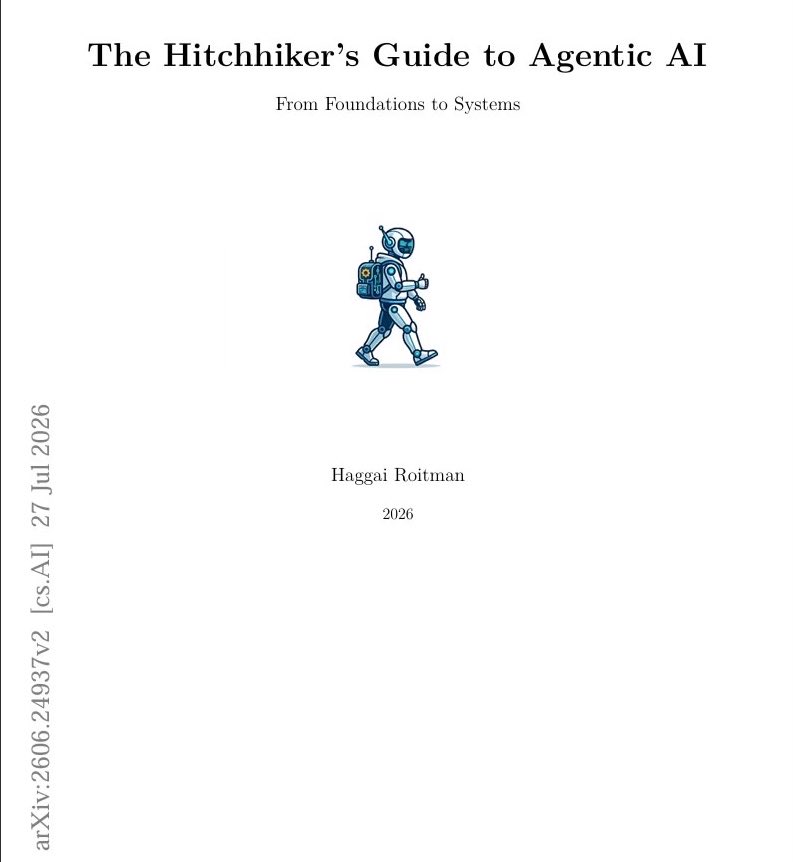
The full-stack Playbook for agentic AI
If you’re building agents in 2026 and still treating LLMs as black boxes this will hurt (in a good way).
Full-stack Agentic AI guide:
- Foundations
- Alignment & reasoning
- Agent harnesses
- Memory
- Multi-agent systems
- Production
- RLHF/PPO/DPO - MCP/A2A
- https://t.co/bigHoEJYJe
Last night Apple briefly removed Telegram from the AppStore because a user had planted illegal porn in a public chat.
Telegram was restored within hours. But I want to explain what happened — to warn other app developers and help protect online communities from similar attacks.
Because Telegram quickly removes illegal content from public groups using all kinds of moderation tools, the attacker had to resort to a technical trick. He inserted AI-modified illegal content by editing an old message in an active group chat. As a result the content was effectively hidden from the group’s members, preventing them from seeing/reporting it.
The attacker was a takedown extortionist: someone who demands ransom from group owners in exchange for not targeting their communities. These extortionists use automated accounts to plant illegal content in public groups and then report it directly to Apple, attempting to trigger the removal of legitimate communities whose owners refused to pay them.
From a practical standpoint, illegal pornographic content in Telegram’s public groups is not a systemic problem. Our moderation is effective. The fact that attackers must resort to backdated, effectively invisible content and other technical tricks proves this.
⚠️ However, there are two important lessons here for app developers and online communities:
— Extortionists have found a way to manipulate Apple into overreacting. Apple removed Telegram from the App Store before contacting us. This creates a potential systemic risk for every mobile app that hosts user-generated content. If an app used by more than a billion people can be removed from the App Store without prior warning, any app can be.
— The tactics used by takedown extortionists are evolving, putting communities across social platforms at risk. Telegram has extensive experience identifying the tricks used by coordinated reporting gangs and protecting legitimate communities (even when doing so risks our own app being temporarily removed from the App Store). Other platforms may not be equally prepared.
Stay vigilant! ☝️
Recently, I read a fascinating paper on Aurora DSQL.
"Aurora DSQL: Scalable, Multi-Region OLTP" https://t.co/Am0iCDmLTP
Special thanks to @MarcJBrooker and the DSQL team—it gave me a lot of fresh input and inspired me to think about several possible directions for TiDB’s future architecture.
Speaking of rewrites, 100% passing tests is impressive.
Who knows where this will go, but it'd be ironic if it gained traction due to PG's stubborn refusal to adopt modernisms like threads, or build in features everybody wants like connection pooling.
https://t.co/edmgUK9KcQ
Postgres 19 comes with nice improvements for io control.
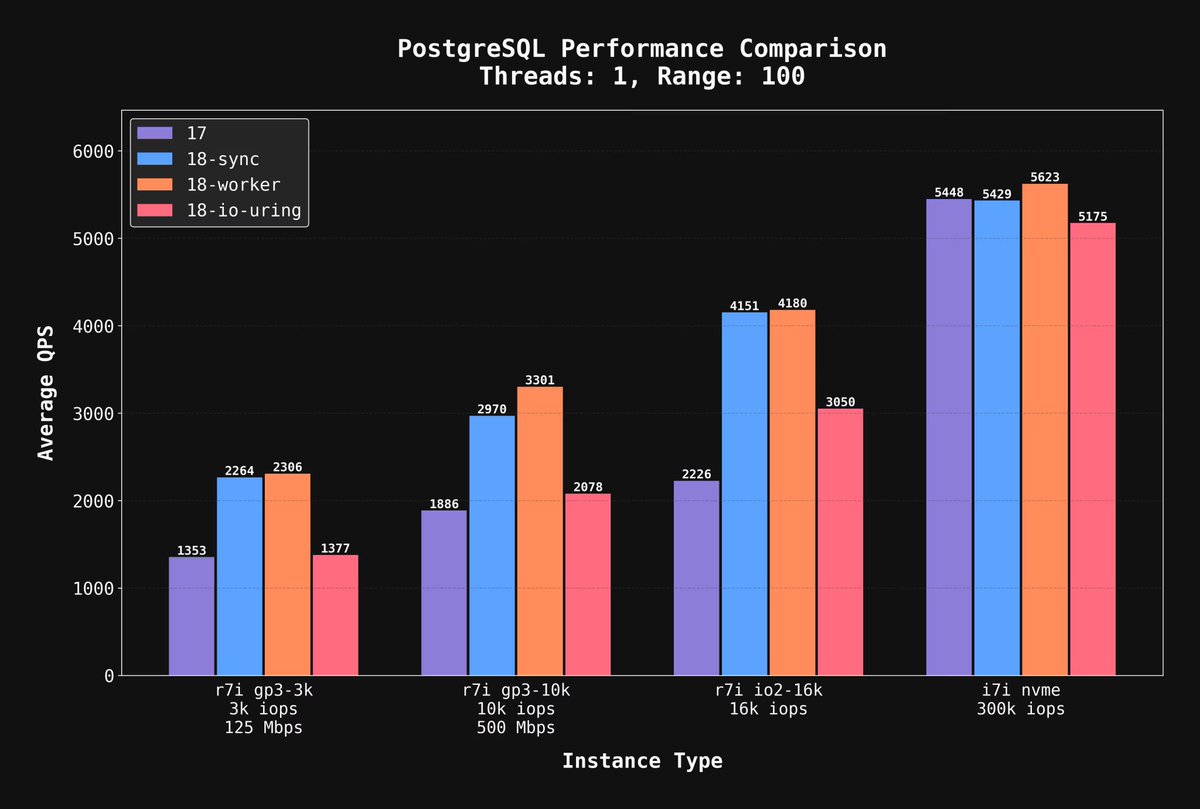
Pg 18 introduced three modes: io_uring, worker, and sync (17's behavior).
I loved the performance (and control) that io_method=worker brought to pg. With this, you'd also set io_workers=X which set the number of bg workers dedicated to IO. (17 vs 18 benchmarks pictured below).
19 expands on this, allowing the pool to dynamically grow via four knobs:
io_min_workers: min io worker pool size
io_max_workers: max pool size
io_worker_idle_timeout: scale-down rate
io_worker_launch_interval: scale-up rate
In a sense, this now behaves more like a "io connection pool" then a simple, static configuration.
I like this direction. Excited to benchmark... soon?
Microsoft .Data.SqlClient version 7.0.2 with a couple of minor bug fixes and version alignment has just been released. Browse the release notes here:
https://t.co/6vgYC7zV3T
O HOMEM QUE QUER REPROGRAMAR O FUTURO
Enquanto políticos discutem a próxima eleição, Dario Amodei discute o próximo século.
O CEO da Anthropic não fala como um executivo comum. Fala como alguém convencido de que a inteligência artificial está prestes a remodelar empregos, economia, ciência, guerra e até a própria condição humana.
A entrevista revela algo inquietante: os criadores da IA não estão mais discutindo se ela mudará o mundo. Eles já tratam isso como fato consumado. A única dúvida é a velocidade da transformação.
Amodei prevê explosão de produtividade, cura de doenças, avanços científicos sem precedentes e uma economia turbinada pela inteligência artificial. Mas, no mesmo fôlego, alerta para desemprego em massa, concentração de poder e riscos geopolíticos gigantescos.
O mais curioso é que os arquitetos dessa nova era parecem viver entre dois sentimentos: euforia e medo. Construindo uma tecnologia que pode resolver problemas históricos da humanidade enquanto tentam impedir que ela saia do controle.
No Vale do Silício, a corrida já não é por aplicativos. É pela inteligência. E quem vencer não estará apenas criando uma empresa bilionária.
Estará ajudando a definir quem terá o poder de escrever as regras do século XXI.
00:00:00 Inside Anthropic
00:03:34 Histórico de Dario
00:05:51 Saída da OpenAI
00:07:42 Cúpula de IA da Índia
00:10:45 Aposta empresarial
00:17:22: Financiamento das grandes empresas de tecnologia
00:19:29 Escassez de poder computacional
00:21:15 Ultrapassando a OpenAI
00:24:07 Velocidade de desenvolvimento de produtos
00:24:52 Descobertas em IA
00:26:13 O estilo de escrita de Dario
00:28:10 IA e a força de trabalho
00:36:41 Impasse no Pentágono
00:43:29 Guerra de IA
00:48:18 Mythos
00:55:15 Nacionalizando a IA
00:58:57 Visita à Casa Branca
00:59:47 China
01:03:24 Auto aperfeiçoamento recursivo
01:05:07 O livro favorito de Dario
01:05:49 Colapso da civilização
01:07:32 Confiança
PgQue v0.2.0:
🐍 Python, 🟦 TypeScript, 🐹 Go clients
⚡️ send_batch() performance optimized
👥 subconsumers to scale consumption near-linearly
⏱️ sub-second ticking and 10 ticks/sec by default (incl. with pg_cron)
🧩 pg_cron, pg_timetable, pg_tle paths
PgQue is a highly-efficient, zero-bloat Postgres queue built on top of on battle-proven Skype's PgQ. One SQL file to install, pg_cron to tick. Works in any Postgres.
SqlServer.Rules v5.0.0 is now available!
SqlServer.Rules is an open-source static code analysis library and toolset for SQL Server database projects, command line, and Visual Studio, that helps teams catch design flaws, naming inconsistencies, performance anti-patterns, and risky T-SQL constructs early — during development and build time instead of in production.
The value is straightforward: it shifts SQL quality checks left, gives fast and repeatable feedback in CI/CD and local workflows, and helps improve reliability, maintainability, and performance of database code with clear, actionable rule-based guidance.
This major release expands rule coverage significantly and continues consolidation around the SqlServer.Rules codebase and tooling.
https://t.co/sFIwPlMVud
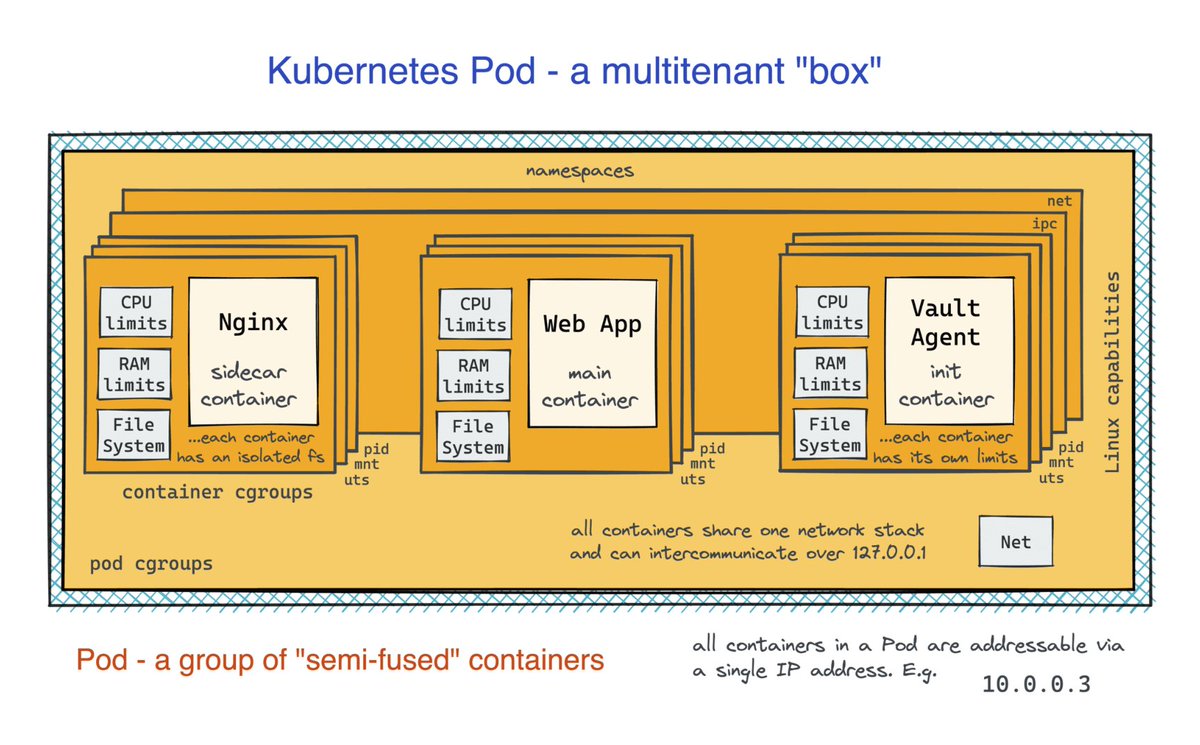
If you're new to Kubernetes, a Pod may look like a tiny VM:
- One IP address
- One hostname
- One or more containers running side by side
Then you notice Pod's containers can talk to each other over localhost and share IPC means (named pipes, shared memory, etc.). And yet they still have isolated filesystems and process trees.
So what is a Pod, really?
I took a deeper look by inspecting namespaces, cgroups, the pause container, the Kubernetes CRI internals, and then tried to recreate a Pod using plain Docker commands.
Turns out, a Pod is not a set of disjoint containers running on the same cluster node (server). It's a "semi-fused group" of containers with:
- Shared net/uts/ipc namespaces
- Separate mount/pid/cgroup namespaces (by default)
- A special "pause" container holding this group together
- Per-container resource limits under a common Pod-level cgroup parent
And potentially the most interesting part - you can get surprisingly close to building a Pod-like construct with "docker run" alone.
Deep dive + hands-on playground: https://t.co/C6p8jyJCNR
Scaling Postgres 414 is released! In this episode, we discuss repack concurrently coming to PG 19, how to design your schema, all about hints and enforcing constraints across partitions: https://t.co/LylK5CKzsr #Postgres#PostgreSQL