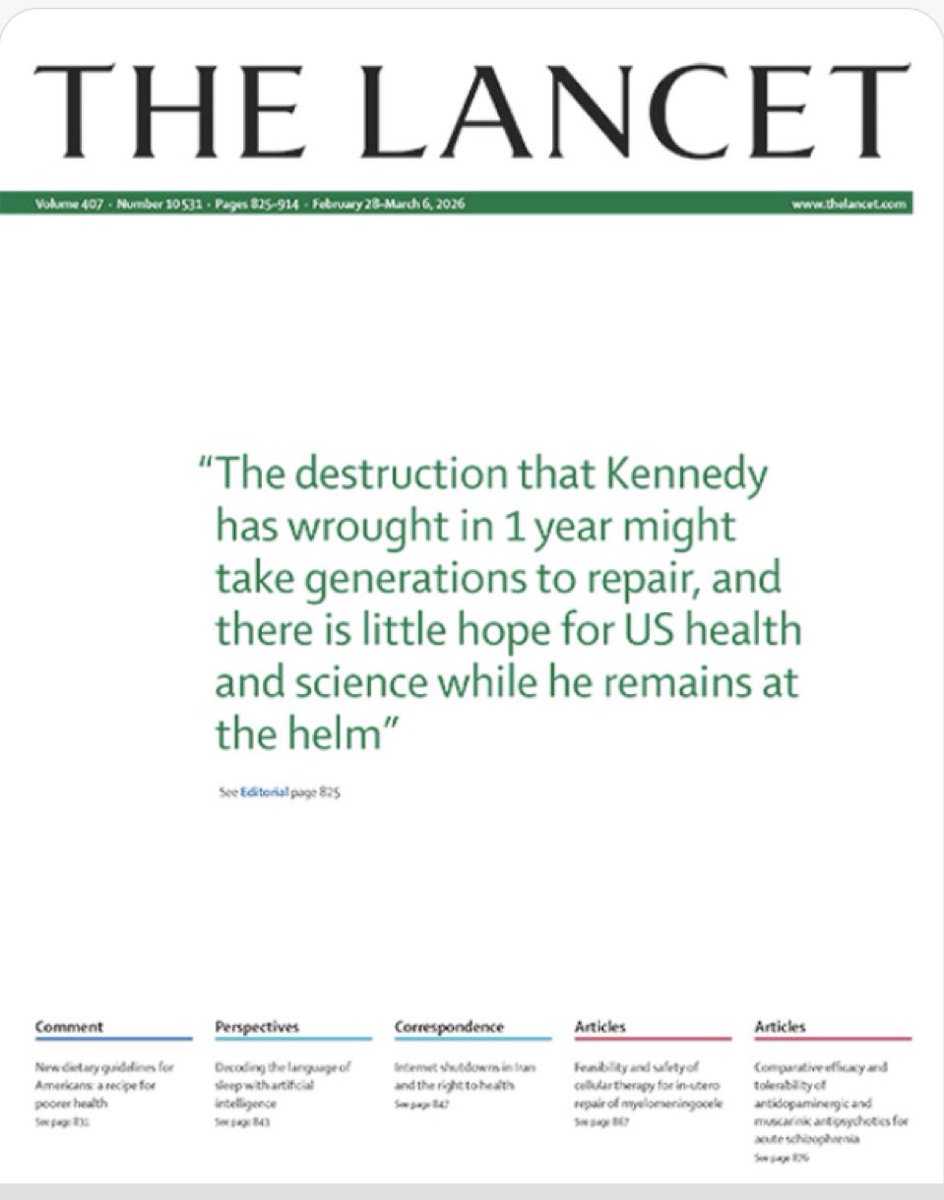
No need to bother our friend @grok the answer is yes, our vaccine group was funded by Gates Foundation for a hookworm anemia vaccine although the funding stopped a decade ago. But we just published in @TheLancetInfDis that the vaccine is highly protective in clinical trials so hoping we can reproduce our success with low-cost Covid vaccines that reached 100 million people and scale up and produce and distribute our hookworm anemia vaccine to help the world’s poorest people
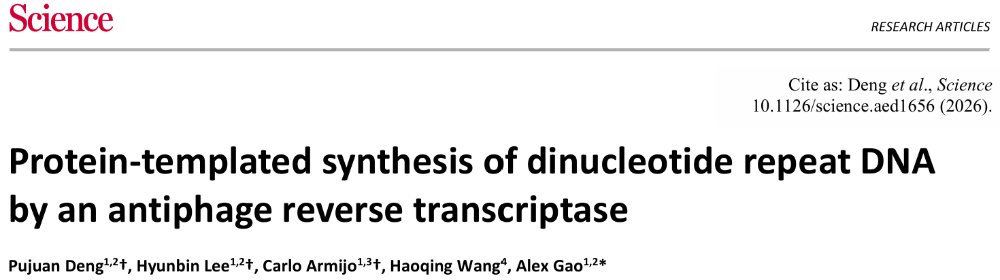
On April 16, 2026, the research group led by Alex Gao from Stanford University published a paper in Science entitled Protein-templated synthesis of dinucleotide repeat DNA by an anti-phage reverse transcriptase.
This study identified and characterized for the first time a bacterial reverse transcriptase named Drt3b, which does not require a nucleic acid template. Instead, it uses its own amino acid side chains as a "template" to precisely synthesize DNA of specific sequences.
This discovery represents another landmark breakthrough in the fundamental rules of biological information transfer since the discovery of reverse transcriptase by Nobel laureate David Baltimore and others in 1970. It not only fills a key gap in our understanding of biological information flow, but also opens a new dimension for deciphering the coding principles of life.
Congratulations to Team Gao on their outstanding work—this discovery is worthy of a Nobel Prize!
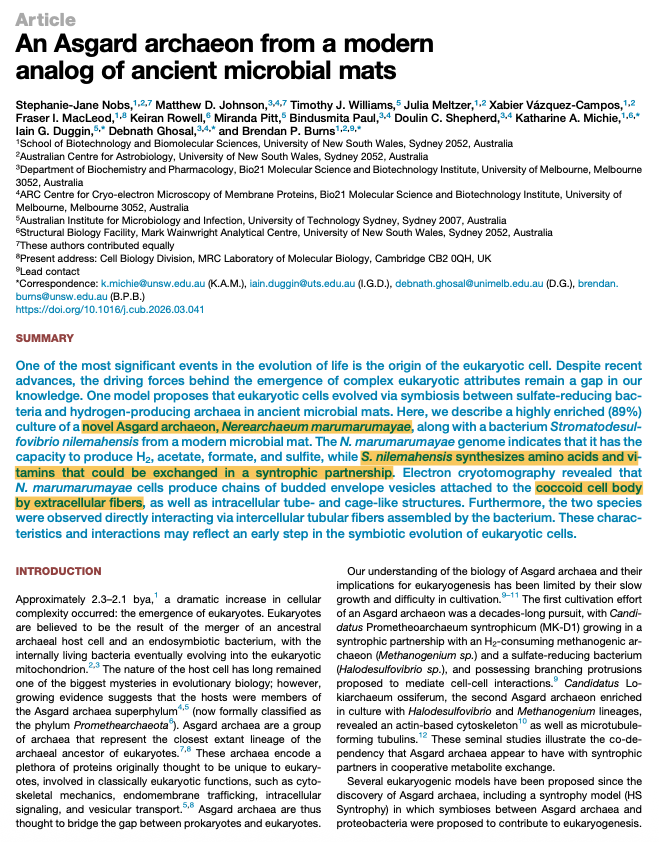
New Asgard paper dropped yesterday. This is only the third Asgard archaeon to be cultured in the laboratory (the first took 10+ years of work.)
Many microbiologists think that the Asgard archaea are the closest living relatives of the ancestor that gave rise to eukaryotic cells. They have cellular features that "bridge" bacterial and eukaryotic cells. And this new Asgard species, found off the coast of Western Australia, is interesting for a couple reasons:
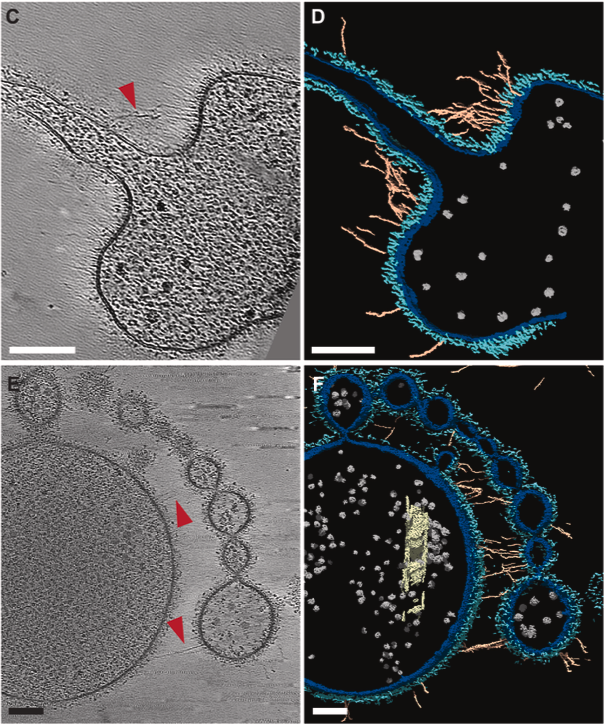
1. The Asgard buds off extracellular vesicles, like many other organisms. But these vesicles remain "tethered" to the main cell via a thin fiber. You can see this clearly in the cryotomography images below. I've never seen other examples of this (but maybe microbiologists on Twitter have.)
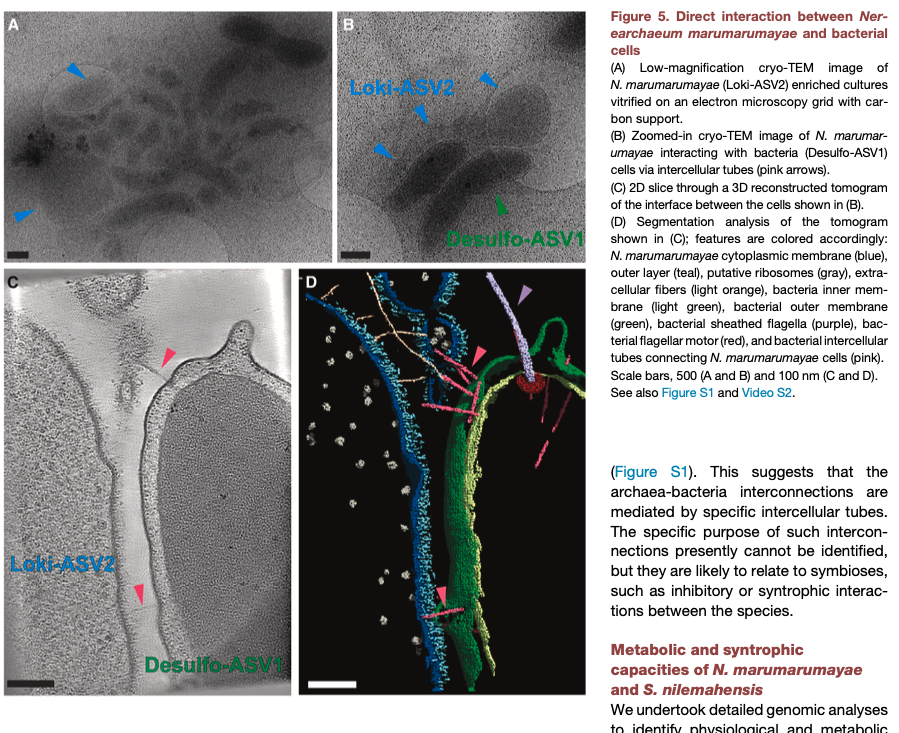
2. Asgards cannot be cultured on their own. All of the species cultured thus far can only be grown in the presence of a syntroph. This Asgard can only be cultured with a microbe, called S. nilemahensis. The Asgard makes acetate, formate, and lactate for the bacterium; the bacterium, in exchange, makes amino acids and vitamins for the Asgard. (The archaeon seems to entirely lack metabolic pathways for arginine, proline, phenylalanine, and tryptophan.) These nutrients are exchanged via hollow tubes that physically context the Asgard --> bacterium. (See the images below.)
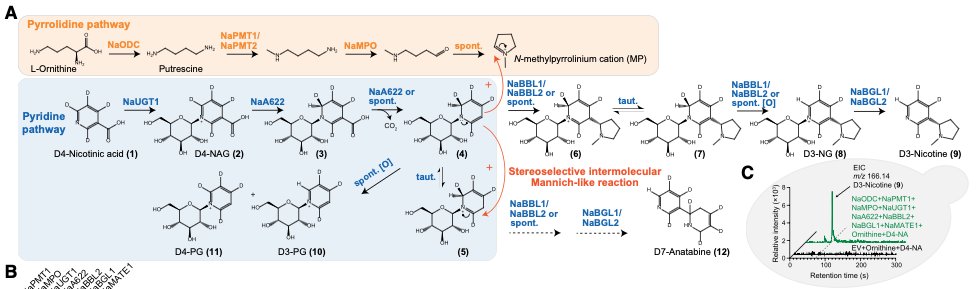
Nearly 200 years after nicotine was first chemically isolated, we’ve finally figured out its complete biosynthesis pathway. Doing so required an insane effort and many years of work. The authors — a Chinese group — ended up crossing 643 lines of tobacco plants to find a single mutant incapable of making nicotine. They next backcrossed and inbred that plant to figure out the specific mutations, in various genes, and map the enzymes responsible.
Nicotine is made from two “ring-shaped” molecules fused together. One ring has five carbons (the “pyrrolidine ring”) and the second has six carbons (the “pyridine ring.”) Scientists already knew quite a bit about how these rings get made, but not every step, and not how tthey join together to make nicotine.
The pyrrolidine ring starts when ornithine, an amino acid that is not used to make proteins, gets its carbon dioxide clipped off by an enzyme, called ornithine decarboxylase, to make putrescine. This putrescine then has a methyl group attached to it, and gets oxidized. At this point, the molecule is a chain with four carbon atoms; one end has an amine, and the other a methylated amine. The amine end gets cut off and replaced with a reactive aldehyde; the chain folds into a loop; and the methylated amine “attacks” electrons on the aldehyde to form the ring.
To make the pyridine ring, plant cells first take aspartate (the amino acid) and oxidize it. The resulting molecule is then transformed into nicotinic acid mononucleotide, which is just vitamin B3 with a sugar and phosphate attached. This paper is the first to report that NAMN hydrolase clips off the sugar and phosphate to release pure vitamin B3; also called niacin or nicotinic acid. (The names are slightly confusing.)
The paper’s major contribution, though, is in figuring out how the two rings get fused together. The nicotinic acid is unstable, so an enzyme quickly attaches a sugar to it. Another enzyme, called A622, then strips off a CO2 group, making the molecule reactive again. And finally, that reactive intermediate “attacks” the five-membered pyrrolidine ring to join the two halves together. Other enzymes strip off the remaining sugar to make nicotine. (This whole pathway is shown in the image below.)
All of this happens on the surface of plant vacuoles. Many of the chemical intermediates are toxic, so they need to be sequestered and converted quickly. And as soon as the final nicotine gets made, a transporter pumps it into the vacuole, where it is stored away.
It’s actually difficult to wrap my head around the amount of work packed into this paper, so I’ll just give some quick bullet points:
1. They grew 643 inbred plant lines, which were made by crossing together 26 different parent tobacco plants. They extracted metabolites from all of them.
2. They did a bunch of single-cell RNA sequencing on the tobacco roots to figure out which cells actually express the nicotine biosynthesis genes.
3. “Stumbled” upon a mutant plant which was not able to make nicotine, and then sequenced its entire genome. They also crossed back this plant and inbred it for two generations to find the mutation responsible; a single C-to-T swap. This experiment alone must have taken at least two years of work.
4. Fed plants with isotopically “heavy” nicotinic acid and then tracked its movements through metabolic pathways.
5. Collected at least 630 mass spectrometry spectra.
6. RECONSTITUTED THE ENTIRE PATHWAY IN FOUR DIFFERENT SPECIES: YEAST, TOMATO, EGGPLANTS, AND PEAS (!!!!!!!!)
7. And a lot more…
Anyway, insane paper. China has been putting out incredible plant biology papers for the last several years.
Glad to have made a small contribution to the paper. Hope this is just one of many examples in independent researcher collab with academic scientists!
#archaea folks, this pipeline rules for global baseline annotation
https://t.co/QWxkMwarqS
#microbiology#bioinformatics
@MuseumCommodore I have the hacked version where they took GGS and changed the artwork and sprites to look more like SMB. Also has a way to give you unlimited lives.
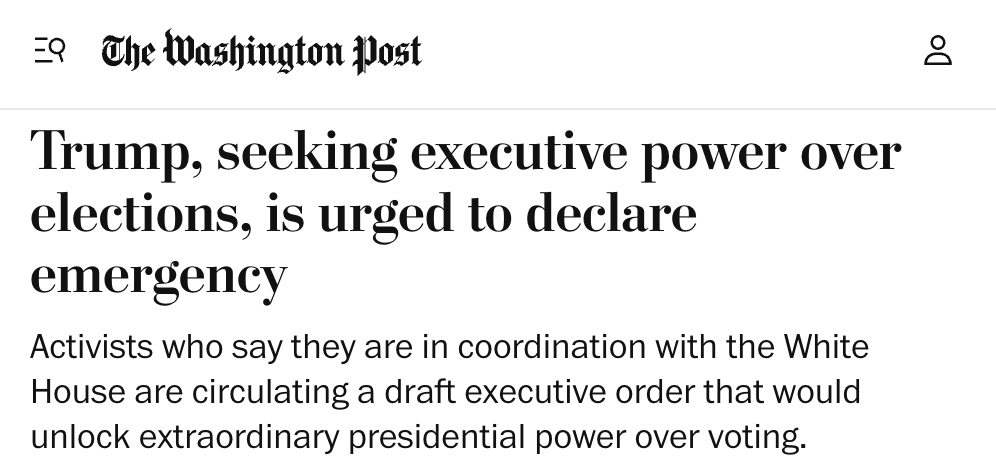
The 2026 elections may not come down to Democrats vs. Republicans.
It may be about whether we remain a democracy or move to an authoritarian society.
We cannot allow Trump and his friends to stop a free and fair election.
Fight back.