@plevy MIT TechnologyReview says:
"...the need to make AI faster and more energy efficient is putting so-called small language models in the spotlight." #IEML :-)
Today we unveiled our latest quantum chip, Willow. But how does quantum computing work? What even is a qubit? Our @GoogleQuantumAI team is here to teach you the basics — and give you a tour of their lab ↓ https://t.co/8ROLn9E2DK
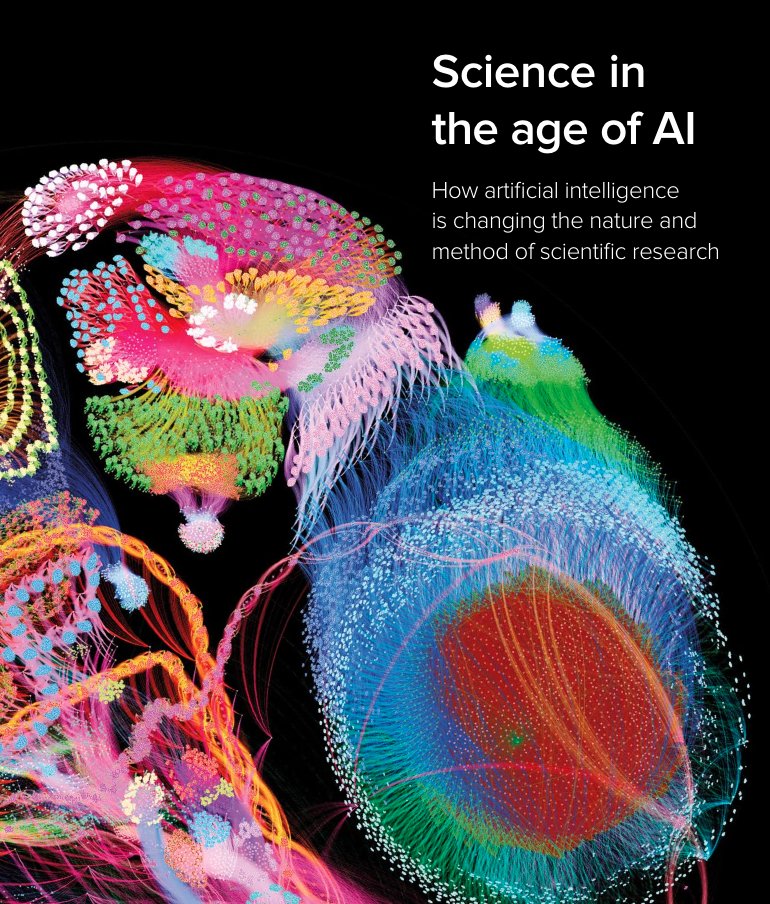
🚨BREAKING: the @royalsociety publishes "Science in the Age of AI - How AI is changing the nature and method of scientific research," and it's a must-read for everyone interested in AI & science. Important information:
➡️According to the official release, the report addresses the following questions:
➵ How are AI-driven technologies transforming the methods and nature of scientific research?
➵ What are the opportunities, limitations, and risks of these technologies for scientific research?
➵ How can relevant stakeholders (governments, universities, industry, research funders, etc) best support the development, adoption, and uses of AI-driven technologies in scientific research?
➡️Some of the key findings are:
"Beyond landmark cases like AlphaFold, AI applications can be found across all STEM fields, with a concentration in fields such as medicine, materials science, robotics, agriculture, genetics, and computer science. The most prominent AI techniques across STEM fields include artificial neural networks, deep learning, natural language processing and image recognition"
-
"China contributes approximately 62% of the patent landscape. Within Europe, the UK has the second largest share of AI patents related to life sciences after Germany, with academic institutions such as the University of Oxford, Imperial College, and Cambridge University featuring prominently among the top patent filers in the UK. Companies such as Alphabet, Siemens, IBM, and Samsung appear to exhibit considerable influence across scientific and engineering fields."
-
"Interdisciplinary collaboration is essential to bridge skill gaps and optimise the benefits of AI in scientific research. By sharing knowledge and skills from each other’s fields, collaboration between AI and domain subject experts (including researchers from the arts, humanities, and social sciences) can help produce more effective and accurate AI models. This is being prevented, however, by siloed research environments and an incentive structure that does not reward interdisciplinary collaboration in terms of contribution towards career progression."
➡️Link to the full report below.
➡️To stay up to date with the latest developments in AI policy & regulation, subscribe to my weekly newsletter (link below).
Today, the whole world is rushing toward Generative AI. But we know that we still need Knowledge Graphs!
Read about my ideas: https://t.co/cID9eUWm70
Join us at the Knowledge Graph Conference 🤗
The aim of this article is to elucidate the anthropological conditions for computing. How symbolic manipulation is constitutive of hominization? I'll also comment the main features of contemporary digital civilization...
https://t.co/iI5N4MgaVs
It is only rarely that, after reading a research paper, I feel like giving the authors a standing ovation. But I felt that way after finishing Direct Preference Optimization (DPO) by @rm_rafailov@archit_sharma97@ericmitchellai@StefanoErmon@chrmanning and @chelseabfinn. This beautiful paper proposes a much simpler alternative to RLHF (reinforcement learning from human feedback) for aligning language models to human preferences.
RLHF has been a key technique for training LLMs. In brief, RLHF (i) Gets humans to specify their preferences by ranking LLM outputs, (ii) Trains a reward model (used to score LLM outputs) -- typically represented using a transformer network -- to be consistent with the human rankings, (iii) Uses reinforcement learning to tune an LLM, also represented as a transformer, to maximize rewards. This requires two transformer networks, and RLHF is also finicky to the choice of hyperparameters.
DPO simplifies the whole thing. Via clever mathematical insight, the authors show that given an LLM, there is a specific reward function for which that LLM is optimal. DPO then trains the LLM directly to make the reward function (that’s now implicitly defined by the LLM) consistent with the human rankings. So you no longer need to deal with a separately represented reward function, and you can train the LLM directly to optimize the same objective as RLHF.
Although it’s still too early to be sure, I am cautiously optimistic that DPO will have a huge impact on LLMs and beyond in the next few years.
You can read the paper here: https://t.co/m14qRYszVa I also write more about this in The Batch (linked to below).
https://t.co/8h2ag2plIa
We're rolling out new features and improvements that developers have been asking for:
1. Our new model GPT-4 Turbo supports 128K context and has fresher knowledge than GPT-4. Its input and output tokens are respectively 3× and 2× less expensive than GPT-4. It’s available now to all developers in preview.
2. Assistants API and new tools (Retrieval, Code Interpreter) will help developers build world-class AI assistants within their own apps.
3. The platform is becoming multimodal. GPT-4 Turbo with Vision, DALL·E 3, and text-to-speech are all now available to developers.
Oh… and we’re doubling GPT-4 rate limits. https://t.co/BMnsBAHorI
My next research move is to teach ChatGPT (or any convenient open source LLM) to read and write in #IEML from natural languages prompts. Currently working on some experience design. Any ideas?