@Walmart delivered groceries on time👋 Erlis the delivery person didn't bother to knock on the door to inform me of fruit & dairy items were on the 83-degree walkway. Perhaps a checklist is needed to remind how to safely deliver perishables. For some people, this _is_ 🚀science.
THE LITTLE ICE AGE - The real reason why climate has been warming of recent is entirely natural: it is because we are still emerging from The Little Ice Age.
See painting of a frozen over Thames by Graham Turner. In the winter of 1683/84, the ice was almost a foot thick and the Thames remained frozen for weeks. Boats were fitted with skates and stalls set up with food, shops and games.
The Little Ice Age (LIA) was a period of significant regional cooling, particularly in Europe, characterized by harsh winters, and expanded glaciers.
Winter temperatures in Europe dropped as much as 2°C below modern averages.
The event lasted from roughly 1300 to 1850, spanning nearly 500 years. It is generally divided into phases: an initial cooling around 1300, a slightly warmer period in the 1500s, and the coldest interval between 1645 and 1715 (known as the Maunder Minimum).
The LIA was primarily triggered by the Grand Solar Minima, which caused reduced solar irradiance, and therefore cooling.
We are still emerging from the Little Ice Age, and that is the only reason some areas are warmer than centuries ago. This has very little to do with CO2 and everything to do with the Sun.
To put it simply, both the activity of the Sun and the Sun-Earth distance changes, and this modulates the amount of both solar irradiance and solar radiation, which affects clouds, and this combined change is what leads to long term changes in climatic temperatures.
It's definitely not CO2 causing any of this.
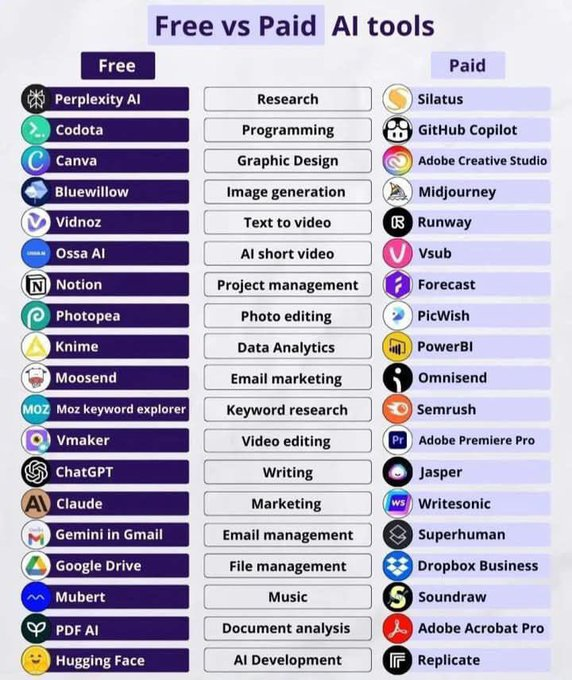
19 paid AI tools vs FREE replacements (most people don't know #7 👀)
🔖 Bookmark this for later.
1. Research
Paid: Silatus
Free: Perplexity AI
2. Programming
Paid: GitHub Copilot
Free: Codota
3. Graphic Design
Paid: Adobe Creative Studio
Free: Canva
4. Image Generation
Paid: Midjourney
Free: Bluewillow
5. Text to Video
Paid: Runway
Free: Vidnoz
6. AI Short Video
Paid: Vsub
Free: Ossa AI
7. Project Management
Paid: Forecast
Free: Notion
8. Photo Editing
Paid: PicWish
Free: Photopea
9. Data Analytics
Paid: PowerBI
Free: Knime
10. Email Marketing
Paid: Omnisend
Free: Moosend
11. Keyword Research
Paid: Semrush
Free: Moz Keyword Explorer
12. Video Editing
Paid: Adobe Premiere Pro
Free: Vmaker
13. Writing
Paid: Jasper
Free: ChatGPT
14. Marketing
Paid: Writesonic
Free: Claude
15. Email Management
Paid: Superhuman
Free: Gemini in Gmail
16. File Management
Paid: Dropbox Business
Free: Google Drive
17. Music
Paid: Soundraw
Free: Mubert
18. Document Analysis
Paid: Adobe Acrobat Pro
Free: PDF AI
19. AI Development
Paid: Replicate
Free: Hugging Face
That's a wrap!
If you enjoyed this thread:
1. Follow me @ThatsEFM for more of these
2. RT the tweet below to share this thread with your audience
How to build AI skills that check their own work and improve over time:
1. Give it context
Ask AI: "Create a skill for this [repeated task]. Here are examples of good output so it knows what good looks like."
2. Make it easy to trigger
“Write a clear skill description using this pattern: Use when the user wants to [do this].”
3. Add evals
"Create an evals md with 10 pass/fail checks for common errors in the skill's output."
4. Add memory
"Create a memory md to capture one-sentence learnings from past chats using this skill."
5. Build a skill to edit skills
"Create a skill that cleans up other skills by removing duplicate or stale instructions, vague rules, and AI slop."
📌 Watch my full walkthrough here: https://t.co/u434ytNSZd
The Iranian people have, for the last 50 years, heard their cultural tree fall hard. Is it regrowing? Not Persians apparently haven't replanted or can't hear it😳
tasks (sound design) and documents are "child's play" for AI. If you have seen https://t.co/02ZOIKpSin or https://t.co/8WFAFSnvY0 we understand Scorsese's #vision. "Rockets are hard," @elonmusk assured. With #AItools, #movies are a "piece of pie." Blaze a trail🤩
Martin Scorsese gets backlash after endorsing 'creatively freeing' AI https://t.co/gfRJreMsG4 Scorsese sees the trend of Hollywood losing production infrastructure, people and financial stability to other states and countries. He accepts the reality of improving AI capabilities,
economics and scale. Creative people who master the available #tools will preserve their livelihoods; those who don't embrace mastery _will_ be impoverished. A first step toward mastery is learning prompt #writing for #AI. #storyboards, #screenplays and other pre-production
20 NotebookLM Prompts
To Learn Faster, Think Deeper & Research Smarter
01. Instant Summary
Turn long documents into digestible insights.
Prompt: “Summarize this source into the 10 most important ideas, key arguments, and practical takeaways in plain English.”
02. Beginner Explanation
Make complex topics easy to understand.
Prompt: “Explain this material as if I am a complete beginner. Use simple analogies, step-by-step logic, and avoid jargon.”
03. Deep Dive Breakdown
Understand the topic layer by layer.
Prompt: “Break this source into core concepts, hidden assumptions, expert-level nuances, and what most readers usually miss.”
04. Compare Sources
Spot agreements and contradictions.
Prompt: “Compare all uploaded sources. Show where they agree, where they conflict, and what unique insights each source contributes.”
05. Study Notes Builder
Create clean notes instantly.
Prompt: “Turn this content into structured study notes with headings, bullet points, definitions, and memorable examples.”
06. Flashcards Generator
Convert information into active recall.
Prompt: “Generate 25 high-quality flashcards from this material with question on front and concise answer on back.”
07. Quiz Me
Test your understanding.
Prompt: “Create a progressive quiz from easy to difficult based only on this source. Wait for my answers and grade me.”
08. Memory Hooks
Make information stick.
Prompt: “Create mnemonics, analogies, and memory anchors that help me retain the most important parts of this content.”
09. Timeline Extraction
Organize events chronologically.
Prompt: “Extract every important event, milestone, or development from these sources and arrange them into a clean timeline.”
10. Key Quotes Finder
Find the strongest supporting evidence.
Prompt: “Pull out the most impactful quotes, data points, and evidence from these sources that I can cite in writing or presentations.”
11. Research Gaps
See what’s missing.
Prompt: “Identify unanswered questions, weak arguments, missing evidence, and research gaps across these materials.”
12. Debate Both Sides
Sharpen critical thinking.
Prompt: “Present the strongest arguments for and against the main thesis of these sources as if two experts were debating.”
13. Turn Into Framework
Extract repeatable systems.
Prompt: “Convert the ideas in these sources into a practical framework, checklist, or repeatable system I can apply.”
14. Content Repurposing
Turn research into publishable content.
Prompt: “Use these sources to generate a LinkedIn post, article outline, tweet thread, and newsletter idea.”
15. Expert Interview Mode
Ask the notebook questions.
Prompt: “Act as the world’s top expert on these uploaded materials. I will ask questions answer only from the sources.”
16. Executive Briefing
Condense for busy decision making.
Prompt: “Create a 5-minute executive briefing with only the most strategic insights, implications, and action points.”
17. Lesson Plan Creator
Transform notes into a curriculum.
Prompt: “Turn this notebook into a 7-day learning plan with daily lessons, exercises, and checkpoints.”
18. Idea Generator
Use sources for new thinking.
Prompt: “Generate 20 original ideas, opportunities, or applications inspired by the uploaded materials.”
19. Simplify for Teaching
Prepare to explain to others.
Prompt: “Rewrite the key ideas from these sources into a teaching script that I can explain to someone in 5 minutes.”
20. Action Plan
Move from knowledge to execution.
Prompt: “Based on everything in these sources, create a practical action plan with first steps, priorities, and deadlines.”
❤️ Like
🔁 Retweet
🔖 Bookmark
Followv Nadia -with-Ai for more such posts
New research shows clutter dramatically spikes women’s cortisol—while men’s stress barely budges.
Household clutter extends far beyond mere aesthetics—it's deeply intertwined with stress physiology and cognitive burden, impacting women in particular.
Drawing from studies on dual-income married couples, therapist Elizabeth Earnshaw explains that women who view their homes as cluttered often see their cortisol levels rise throughout the day, unlike those who feel at ease, whose levels naturally decline. This heightened effect in women stems largely from bearing the disproportionate invisible mental load—the constant cycle of noticing, recalling, planning, and orchestrating household tasks.
Earnshaw suggests a realistic, three-part approach to reducing the stress–clutter spiral.
First, “shedding” involves intentionally minimizing possessions, including doing the emotional work required to let things go, in order to create more mental and physical space. Second, “preventing” focuses on systems: giving items clear “homes” so that decisions about where things go become automatic rather than mentally taxing. This may start with listing common types of clutter and designing dedicated spots for each (for example, a single, consistent place for receipts). Third, “adapting” asks families to accept that some clutter is inevitable in busy seasons of life and to concentrate on emotional regulation and co-regulation with partners, keeping stress and cortisol lower by adjusting expectations rather than striving for a perpetually picture-perfect home.
[Earnshaw, E., "Clutter, Cortisol, and Mental Load". Psychology Today, 2024]
[Saxbe, D. E., & Repetti, R. , "No place like home: Home tours correlate with daily patterns of mood and cortisol", Personality and Social Psychology Bulletin, 36(1), 71–81, 2010, DOI: 10.1177/0146167209352864]
@JanieGi57955787@BrookdaleLiving Innovations in phlebotomy may make needle-stick blood draws using in-home micro-needles practical and definitely "less annoying."
Blood test with AI spots four dementia-related brain diseases with 92.3% accuracy https://t.co/cwLP7ZzkO1 #PegasusSenior living, @BrookdaleLiving and other #communities as well as #adults age 50+ might have this done for peace of mind. Politicians first?


![petergyang's tweet photo. How to build AI skills that check their own work and improve over time:
1. Give it context
Ask AI: "Create a skill for this [repeated task]. Here are examples of good output so it knows what good looks like."
2. Make it easy to trigger
“Write a clear skill description using this pattern: Use when the user wants to [do this].”
3. Add evals
"Create an evals md with 10 pass/fail checks for common errors in the skill's output."
4. Add memory
"Create a memory md to capture one-sentence learnings from past chats using this skill."
5. Build a skill to edit skills
"Create a skill that cleans up other skills by removing duplicate or stale instructions, vague rules, and AI slop."
📌 Watch my full walkthrough here: https://t.co/u434ytNSZd](https://pbs.twimg.com/media/HKDkdu0bIAA8Ocb.jpg)


![Rainmaker1973's tweet photo. New research shows clutter dramatically spikes women’s cortisol—while men’s stress barely budges.
Household clutter extends far beyond mere aesthetics—it's deeply intertwined with stress physiology and cognitive burden, impacting women in particular.
Drawing from studies on dual-income married couples, therapist Elizabeth Earnshaw explains that women who view their homes as cluttered often see their cortisol levels rise throughout the day, unlike those who feel at ease, whose levels naturally decline. This heightened effect in women stems largely from bearing the disproportionate invisible mental load—the constant cycle of noticing, recalling, planning, and orchestrating household tasks.
Earnshaw suggests a realistic, three-part approach to reducing the stress–clutter spiral.
First, “shedding” involves intentionally minimizing possessions, including doing the emotional work required to let things go, in order to create more mental and physical space. Second, “preventing” focuses on systems: giving items clear “homes” so that decisions about where things go become automatic rather than mentally taxing. This may start with listing common types of clutter and designing dedicated spots for each (for example, a single, consistent place for receipts). Third, “adapting” asks families to accept that some clutter is inevitable in busy seasons of life and to concentrate on emotional regulation and co-regulation with partners, keeping stress and cortisol lower by adjusting expectations rather than striving for a perpetually picture-perfect home.
[Earnshaw, E., "Clutter, Cortisol, and Mental Load". Psychology Today, 2024]
[Saxbe, D. E., & Repetti, R. , "No place like home: Home tours correlate with daily patterns of mood and cortisol", Personality and Social Psychology Bulletin, 36(1), 71–81, 2010, DOI: 10.1177/0146167209352864]](https://pbs.twimg.com/media/HJtuiMZWMAA13ak.png)


