#WATCH | Delhi | Devastated family members of Sarthak Mattoo, who died after being allegedly rammed into by a Thar in the Rajokri area on the morning of 25 June, mourn his loss and demand justice.
Elon Musk on Philanthropy:
“If you care about the reality of goodness rather than simply the perception of it, it’s extremely difficult to give away money well.
I have a large foundation, but I don’t put my name on it. In fact, I’ve said I don’t want my name on anything. The biggest challenge I find with the foundation is trying to give money away in a way that is truly beneficial to people.
It’s very easy to give money away in a way that creates the appearance of goodness. It is very difficult—extremely difficult—to give money away for the reality of goodness.”
These Bar Headed Geese are one of the natures wonder. While migrating during winter from Tibet, Kazakhstan, Mongolia & Russia to India they cross the freezing Himalayas. One of highest flying birds, they have specially adapted to extract oxygen from hypoxic air & generate lift.
They are recorded upto 8000 meters of height. In winter season they are found in many parts of the country in wetlands in huge numbers.
A BJP MLA from Rajasthan was caught in a sting operation demanding a 40% commission to approve a project under the MLA-LAD fund, something long known to happen, but now on video.
Take a simple example: if a road project worth ₹1 crore is approved for a village, ₹40 lakh is effectively pocketed by the MLA/MP even before the work begins. From the remaining ₹60 lakh, further cuts go to PWD officials, district and block officials, middlemen, fixers, audit and clearance facilitators, after which the contractor still takes his profit. What finally reaches actual construction may not exceed ₹10 lakh. That is precisely why such projects barely last a few months.
In China, such a case would trigger a swift inquiry and severe punishment, including death penalty. In India, there isn’t even an FIR yet. Absolutely nothing will happen.
Shocking: A news reporter from Tata Nagar, Jamshedpur (channel unknown), was seen littering in broad daylight. When confronted by an NGO that works tirelessly around the clock to keep the streets clean, he offered these excuses. Can we track him down and make him issue a public apology? I’ve always said civic sense isn’t determined by education. This behavior is utterly shameless.
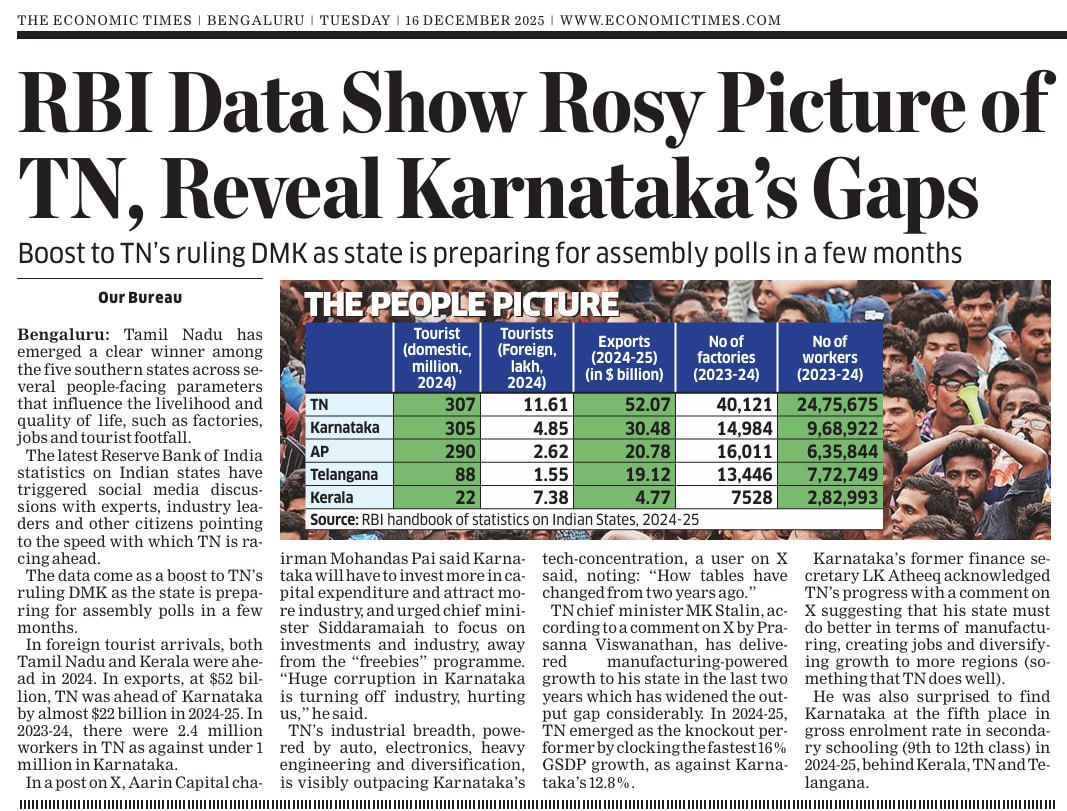
Tamil Nadu’s economic performance in 2024–25 must be read beyond headline figures.
A 16% nominal GSDP growth matters because of how that growth is structured and where it is produced.
Unlike models that concentrate economic momentum in one metropolitan core, Tamil Nadu has expanded its productive geography across districts. Every district functions as economic units in their own right, anchored by SIPCOT and SIDCO estates, MSME clusters, agri-value chains, food processing, fisheries, manufacturing, and emerging IT and services infrastructure.
This breadth is visible in the scale of MSME participation running into thousands of units across districts, the spread of industrial estates beyond Chennai, and the coexistence of export-oriented manufacturing with local enterprise.
Growth here is not narrow specialisation, but industrial depth.
Equally important is the parallel investment in human development that sustains this economy. Across districts, the expansion of government schools and colleges, medical colleges, hospitals, primary health centres, drinking water schemes, housing, hostels, transport infrastructure, and urban health facilities shows that social infrastructure is treated as economic infrastructure.
This is why Tamil Nadu’s Human Development Index remains among the highest in India, comparable to levels seen in several developed regions. Literacy, health outcomes, workforce participation, and rising district-level per capita incomes move together, not sequentially.
The political economy behind this is clear. The Dravidian model does not treat inequality as an acceptable by-product of growth. Participation is the benchmark of success. Farmers, workers, women, artisans, fisherfolk, small entrepreneurs, students, and first-generation learners are integrated into markets through decentralised planning, public investment, and institutional continuity.
When growth is spatially distributed, incomes rise beyond capitals, migration pressures reduce, local markets deepen, and resilience improves.
Tamil Nadu demonstrates that high growth need not come at the cost of inclusion, and development need not be geographically concentrated to be competitive.
This is #RisingTamilNadu for you.
When I regularly shared data and facts about Tamil Nadu, I was mocked by some. I always used to say every single information I provided can be verified in public domain and more than anyone, it is central government ministries and institutions sharing most of the data.
I'm happy Tamil Nadu now leads in India. Unlike models hyped for political purposes, Tamil Nadu has been focusing on both economic development and social welfare for a long time.
As I shared in an article this afternoon, Tamil Nadu has added double the manufacturing GDP of Maharashtra in the recent years.
I was happy to see this article where RBI is acknowledging Tamil Nadu as best and just wanted to share.
I want all states to do well and happy that our state is a genuine role model.
Notice how Japan and Germany are such huge manufacturing powers, with much smaller population than India and with vastly higher labour costs than India or even China. Switzerland and Netherlands also punch way above their weight in global manufacturing.
Their prowess comes from their mastery of capital goods: such as advanced and high precision machinery, advanced materials, sensors, mastery of highly intricate industrial processes (such as making specialty alloys, growing crystals, specialty chemicals), optical/imaging/medical equipment and so on.
All these areas have a very value addition and you can compete even with high wages. That is why high wage nations are such huge manufacturing powers. China has been catching up in these areas and as it does, it is becoming a high wage nation.
To be a truly great manufacturing nation and achieve high income for our people, India needs to master all these areas. We can do it.
Show me one place on earth with 8000+ man-made lakes built in the area of <8000 sqkm. The lake networks in the Pudukkottai, Sivagangai, and Ramanathapuram districts are man-made wonders. It even got mentioned in the Sangam literature of Purananooru. Ancient Tamil knowledge
My 2 cents on Kanpur:
A failed city with zero civic sense plus aloof public representatives.
A city with 3 ls MPs,1 Rs I suppose.
Residents of many MLA's + Mayor. Same encroachment which I used to saw 20 years back. Same way urination places.1/n
@volklub Honda Jazz diesel. 1.9 lac km. No engine issues till now. Have replaced all the suspensions just recently. Clutch plate also replaced.
No other issue. Planning to keep it till 3 lac km.
I want to add that Singapore, one of the most advanced economies in the world and one of the most livable cities, relies extensively on public transport. Singapore also limits the number of private cars through the mechanism of open market trading of Certificate of Entitlement (COE) needed to own a car and the certificate costs more than Singapore $100K (and the car price is on top of that).
Indian cities are far more dense than Singapore. We have to build extensive public transport to make our cities livable. It can be done.
Great to see voices like Sri @svembu’s amplifying the cause of better public transport in Indian cities.
India simply can’t go the US model of each man owning a car. We are too densely populated for it.
World over, city after city, it has been shown that public transport is the only solution for congestion.
Bengaluru definitely needs to limit the number of cars on the streets while rapidly increasing reliable, comfortable, efficient and affordable public transport.
Meet Pune journo Sneha Barve, founder editor of Samarth Bharat.
The Lady of spine & courage.
On 4 July, she was brutally beaten while ground reporting an illegal construction. Blacked out & Hospitalised wid serious injuries. Main accused not yet arrested.
But wait. 🧵1/5
This is has happened in Indore, the city which consistently wins the Swachh Bharat award every year. Street Dogs are a national health & safety crisis, unfortunately there is no holistic effort by any executive authority to deal with it scientifically & humanely.
Politics often goes bizzare. Few TN political parties are up in arms against Parandur airport, saying, "it will remove the few lakes(combined storage of <0.05 TMC) & exaggerate flooding". But all are silent on Cooum river, the heart of Chennai flood drainage getting blocked 1/2
Person A drives responsibly, follows guidelines, gets regular servicing and maintenance.
Person B drives recklessly, ignores maintenance, and the car ends up in terrible shape.
Yet, in the Republic of India, both are treated the same. Once a car hits 10 or 15 years, it’s deemed unfit, regardless of how well it's maintained or how clean it runs. So where’s the incentive for being a model citizen?
If age alone decides a car's fate, why bother with PUC? No car ever fails it anyway, even those belching black smoke somehow pass. At the very least, stop this PUC farce if cars are to be scrapped based purely on age, regardless of their emission status. This is nothing but institutionalized extortion, a system that punishes the responsible.
Because the govt failed to weed out polluting vehicles through robust PUC enforcement, it’s now hiding that failure behind a blanket age-based ban. It’s NCR today, the whole country tomorrow.
Everyone who loves:
• Traditional Indian homes
• Courtyard houses
• Old-style architecture
• Calm and earthy interiors
• Village-style living
• Simple, self-sufficient life
• Nature-inspired design
I hope you find my account!