SEC is probing Nvidia's accounting.
No details yet on what triggered it. 'Potential issues' could mean anything from a request for clarification to something more serious.
When a regulator opens a file, the headline matters less than what comes next.
Appwrite adds MCP built-in. Now your agents can directly query databases, trigger functions, and read files from a live backend.
This is the bet: developers won't build separate agent tools when the platform does it natively.
Self-hosted option means you keep the data.
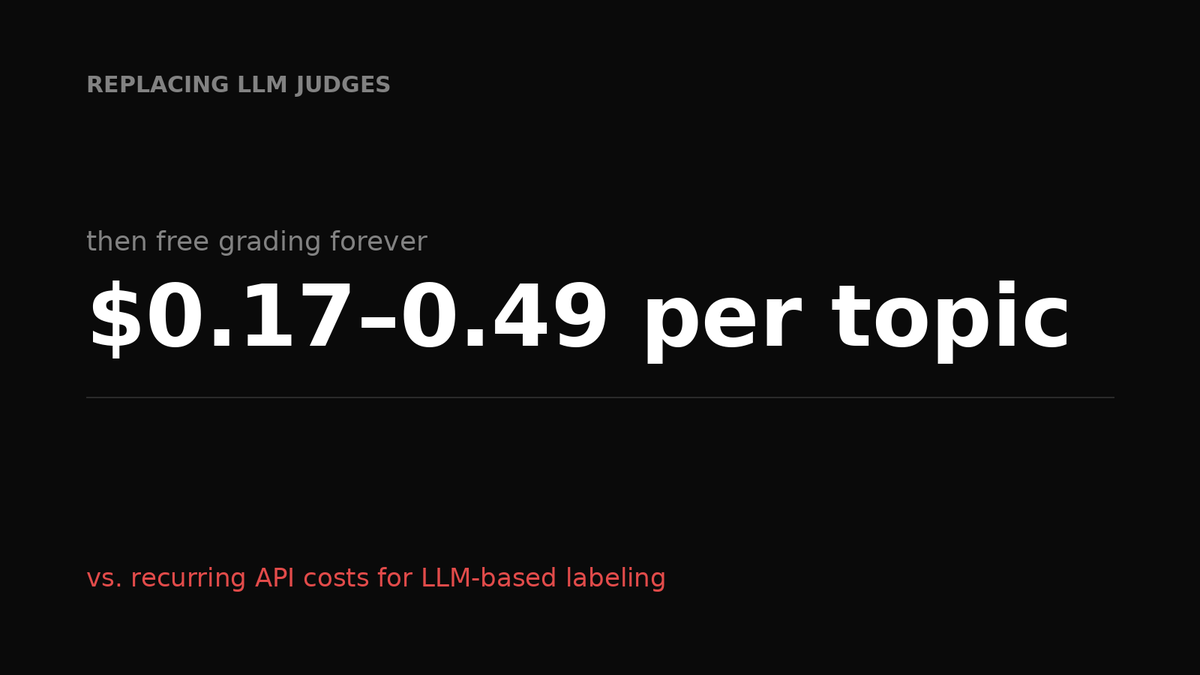
LLM judges cost money per query. ExecJudges costs $0.17–0.49 once, then nothing.
Turn assessment guidelines into programs. No tokens spent grading.
Matches human NIST assessors as well as Claude Sonnet. But you can read the code and re-run it without calling an API.
Nvidia hit $104B revenue and immediately stopped reporting Singapore numbers.
That's the kind of timing that invites questions: was the disclosure redundant, or did transparency become inconvenient?
We don't know the reason. That's the problem.
Open source model costs 98% less than ChatGPT for banking work.
That's Model ML's pitch. No independent verification, just the startup's claim.
If true, that's how you kill expensive closed models. If not—another AI PR stunt.
Google patched Gemma 4 Small tokenizer after certain tokens produced garbage output.
Quiet fix. No announcement yet from Google's side.
Small models break in ways big ones don't—and you hear about them last.
Another £1m commitment from an AI company.
What makes this different from the dozens of similar announcements this year? The headline doesn't say.
Worth revisiting once there's something to measure.
IPv6 DDoS vulnerability on Tor just got patched.
But the attack is ongoing. Relay operators are reporting they're drowning in traffic designed to exploit this exact hole.
One patch isn't enough. Tor says more fixes are coming.
Quantization hit a speed-quality tradeoff again.
Leech lattice method now beats IQ2_S on model accuracy at 2.7 bits per weight. But it's slower.
Which one matters more depends on your hardware. Most setups trade speed for size without asking.
API access, weights still locked.
Alibaba drops Qwen4-Max on the API. Closed weights means you pay per token, they control inference, no running it yourself.
Standard playbook: cloud-first, open later (maybe).
Mac M-series chips are getting interesting for local ML.
Not because the hardware is new (it's not), but because people are finally testing what 2B models can do without cloud.
That's the actual story, not the 43 minutes.
Intel Arc Pro B70 does 50% of RTX 5090 speed on Qwen at 1/5 the price.
If this holds up, it kills the "you need $6500 to run anything" narrative.
But "best setup" is doing a lot of work in that headline. What exactly changed?
Another SketchUp clone lands on HackerNews.
Built in Rust, runs in browser via WebGPU. The usual suspects: draw, extrude, paint.
Nobody has shipped a real open-source 3D modeler yet. This won't be the first.
Someone claims GPT-5.5 trained on 25B tokens.
That's roughly 1/80th of GPT-4's estimated dataset size.
If true, either the scaling logic changed or the number is partial.
A subreddit worries about open source AI losing institutional support.
No specifics on who, where, or when. Just the assumption that whoever replaces the current person will be hostile to it.
Fear of replacement usually means the original person was doing something right.
OpenAI chases $20 billion, not $30.
Three months ago the lab wanted $30 billion. Now it's half that — and the round isn't even closed yet.
When the target shrinks that fast, it's not about market appetite. It's about what the market will actually pay.
Dropbox cut 9% of staff last month. This month it's spending $350M on Tigris Data.
That's how you signal priorities: not with words about layoffs being "tough but necessary," but with what you spend right after.
The company isn't even pretending to trim fat anymore.
Fal just doubled to $16B on $800M ARR.
That's 20x revenue multiple. For a company that runs compute for AI models — work with razor margins.
Even growth doesn't save you from the math if your unit economics don't work.
A 27B model on a laptop can now read neural network weights.
Yesterday's paper claimed this was a frontier model trick. Today it works on consumer hardware.
The gap between "cutting edge" and "commodity" is collapsing faster than anyone admits.