His competitor has a bigger budget, a full team and 3 years head start. Last month his competitor made $31,000. He made $94,000. Alone. From his bedroom. With five Claude methods his competitor has never heard of.
While that team was in meetings deciding what to test next, Claude had already tested it, reported the results and reallocated the budget. By the time they acted on anything he had already moved on to the next thing.
He's not smarter. Doesn't work harder. Doesn't have better products.
He just uses Claude differently to every other store owner on the planet.
Everyone uses it to write product descriptions. He figured that out in week one and immediately stopped. That's the least interesting thing Claude can do for a store. That's the 10% everyone wastes their time on.
Here's the 90% his competitor still doesn't know exists.
Method one: every Monday Claude reads his full analytics and tells him which products are about to die before sales drop. Not after. Before. It spots the pattern in returning customer behaviour and average order movement two weeks before the numbers visibly shift. He kills the product or clears inventory before he's sitting on dead stock his competitor is still trying to shift in month four.
Method two: his email list gets a different version of every single email based on purchase history. Not segments. Individual behaviour. Claude writes every variation automatically. His open rate is 47%. His competitor celebrates 22% and thinks that's good.
Method three: Claude monitors his competitors' stores every Monday morning. New products. Price changes. What quietly disappeared. What they're testing. He reads the full brief before his first coffee and adjusts his store before anyone in the niche sees what's coming.
Method four: 340 customer service tickets a week. He reads zero of them. Claude handles everything, detects frustration before it becomes a review and escalates only what actually needs a human. His review score went from 3.8 to 4.7 in six weeks. His competitor is still manually responding to complaints.
Method five: his ad copy doesn't sell products. It sells the feeling that made his best customers buy. He feeds Claude his top 20 reviews, identifies the emotion behind each purchase and asks Claude to write copy that targets that exact moment. Conversion rate on cold traffic: 4.1%. His competitor is paying more per click to convert at 1.4%.
$0 in October 2023. $753,406 in the 90 days ending March 2026.
His competitor has been running longer, spending more and managing a team of seven people.
He has Claude and a bedroom.
The gap isn't closing. It's getting wider every Monday morning when Claude sends him the weekly brief and his competitor starts another meeting.
You spent 6 years building your career. A kid in China spent 6 weekends building something that does your job cheaper, faster and without ever calling in sick.
He's not a developer. Doesn't have a CS degree. Doesn't know your industry.
He just had Claude, a VPS and 6 free weekends.
Weekend one: one agent that handles client onboarding automatically. Asks the right questions. Fills the brief. Sends the contract. No human involved.
Weekend two: a second agent that does the research. Competitor analysis. Market gaps. Keyword opportunities. Delivered as a report before the client finishes their first coffee.
Weekend three: a content agent. Writes everything. Posts. Emails. Ad copy. Briefed by the research agent automatically. Never asks what tone to use. Already knows.
Weekend four: a reporting agent. Tracks results. Writes the weekly update. Sends it on Friday at 9am without being asked.
Weekend five: an orchestrator that manages all four. Assigns tasks. Handles errors. Files logs. Runs audits. The control room that governs the whole operation from one server.
Weekend six: his first client.
He charged $3,200 a month. The system did every single thing a junior account manager, a researcher, a copywriter and an analyst would do. All four jobs. One server. $0 in salaries.
Month three: 8 clients. $28,400 a month. Same server. Same six agents. Zero new hires.
You spent 6 years getting good at your job.
He spent 6 weekends making your job something a machine does for $0.03 an hour.
The agents don't know your name. They don't need to.
They already took the work.
China just overtook the US in the number of apps built without a single line of code.
Not because Chinese developers are better.
Because Chinese teenagers don't wait until they feel ready.
A 16 year old in Shenzhen built a full inventory management system for his uncle's factory last Tuesday. Described it to Claude in plain Chinese. Claude wrote every line. Deployed by Friday. His uncle fired the software consultant he was paying $800 a month.
The kid has never opened a code editor in his life.
His classmates are studying for university entrance exams. He's invoicing clients.
An Anthropic engineer said something on stage recently that nobody clipped. The room was full of CS degrees and memorised syntax. He looked at them and said:
The skill is no longer writing code. The skill is knowing what to ask for.
China heard that before the West did. Or maybe they just acted on it faster.
Right now there are 14 year olds in Chengdu, Guangzhou and Beijing building real software products for real businesses using nothing but Claude and a clear idea of what they want.
No bootcamp. No degree. No syntax. Just description.
You describe it. Claude builds it. You charge for it.
The only barrier left is knowing what you want to build.
China already figured that out.
The question is whether you did too.
He has never flipped anything in his life.
No resale experience. No connections in the watch world. Never queued for a drop. Doesn't even wear watches.
He just had $400, a Claude subscription and one week to build a plan before Saturday.
He didn't ask Claude how to flip a watch. He asked a different question: if you were treating this drop like a market opening, what would you do before the doors open.
Claude mapped it out in 20 minutes.
Which stores in his city had the lowest expected foot traffic based on location and size. How to split 8 people across 3 stores without overlap. What the resale price history looked like on the last Swatch collaboration drop. The exact hour window where resale prices peak after a limited release. How to have listings live before the first buyer walks out of the store.
He spent the week following the plan. Friends assigned to locations. Listings drafted with photos of watches he didn't own yet. Prices benchmarked against the last drop's resale curve.
Saturday morning: 8 people in 3 stores. Every person buys the limit.
They walked out with 9 watches at $450 each. $4,050 total in.
By Sunday evening: 7 sold. Average price $1,390.
$9,730 out. One weekend. Zero resale experience. Zero connections.
The people who slept outside the flagship store for 4 days got the same watch. One each. Paid $450. Sold for $1,400.
He coordinated 8 people across 3 stores with a plan Claude built in 20 minutes and walked away with nearly $6,000 more than the person who camped the longest.
He didn't know more about watches. He just asked a better question.
Royal Pop × Claude × 8 friends × 3 stores = $8,400 net.
One Saturday.
A 15 year old has never written a single line of code in his life.
He makes $100,000 a month.
His parents think he plays too many video games. He stopped playing them eight months ago. Now he builds them. One conversation with Claude at a time.
He described a game in plain English. Claude wrote every line of Lua code. He published it. 88 million people have somewhere to play it.
Month one: $3,200. Month three: $18,000. Month eight: $100,000.
He never learned to code. Never took a course. Never watched a tutorial. He just kept describing what he wanted and Claude kept building it.
The math that nobody talks about out loud:
A mid-tier Roblox game with consistent players earns $15,750 a month from Roblox's creator fund alone. Add 200 private servers at $10 each and that's another $2,000 recurring every single month without a single new player joining.
A 17 year old in Ohio made $400,000 last year. A 15 year old in the UK cleared $2.1 million from one obstacle course. One game. Built over a weekend. Running on a platform his younger siblings use to mess around after school.
Roblox paid out $1 billion to creators in 2025.
Most adults scrolled past the platform without a second thought. The teenagers building on it didn't.
The only thing that ever stopped adults from doing what these kids do was Lua. The programming language Roblox runs on. Specific. Unusual. Takes months to learn properly.
Claude writes all of it now. You describe the game. Claude writes the code. You publish. Roblox pays.
The 15 year old didn't get lucky. He didn't have special talent. He didn't have connections or funding or a team.
He just opened Claude before anyone else in his school figured out what that meant.
His classmates are still playing the games. He gets paid every time they do.
A 10 year old in China just unboxed a Mac Studio.
Not to play games. Not to watch videos.
To run multiple AI agents simultaneously. He calls it farming lobsters. Seven AI models working in parallel on the same machine while he sleeps.
He made a video explaining it. Sitting in his bedroom, holding the Mac Studio in both hands like it weighs nothing, breaking down the entire AI industry into a layered cake. Energy layer at the bottom. Infrastructure in the middle. Applications on top. Each layer feeding the next.
Then he said the line that made adults stop scrolling.
The future belongs to people who understand tokens.
Not coding. Not math. Not engineering degrees. Tokens. The unit of exchange that every AI model runs on. The thing most adults have never thought about for a single second.
He's thought about it enough to build a system around it.
His previous computer couldn't handle the workload. Too slow. Too hot. Kept crashing when he pushed more than three agents at once. So he upgraded. A 10 year old made a hardware purchasing decision based on AI agent throughput requirements.
His parents thought he was gaming too much.
He was running lobsters.
The comments under his video weren't from kids. They were from developers, engineers and investors saying the same thing: this child understands the architecture better than most people in the industry.
He didn't learn this in school. School hasn't caught up yet.
He learned it by doing it. By crashing his old machine. By figuring out why. By upgrading and trying again.
Token is the hard currency of the AI era. That's not a quote from a research paper or a conference keynote.
That's a 10 year old with a Mac Studio and too many lobsters to count.
Someone figured out why every fitness app fails.
They all try to make you want to work out. Notifications. Streaks. Virtual badges. Encouraging messages at 7am.
None of it works because none of it costs you anything to ignore.
So he built the opposite.
You put $20 into a pool with 46 other people. You walk 10,000 steps a day for 5 days. If you hit your steps every single day, you get your $20 back plus a share of the money from everyone who didn't make it.
If you skip a day, you lose your $20. It goes directly to the people who didn't skip.
Disciplined people make money off lazy people. Every challenge. Every time.
No notifications asking nicely. No streaks. No badges. Just $20 sitting in a pool that is either coming back to you or going to someone else depending entirely on whether you get off the couch.
The current Cash Club challenge: $920 in the pool. 46 people. 10,000 steps a day. 5 days. Starts tomorrow.
Someone in the comments described checking their steps at 11:52pm, seeing they had 1,700 left and walking laps around their kitchen in the dark for 18 minutes straight rather than lose $30.
That's not motivation. That's loss aversion. The oldest and most powerful force in human decision making. Every casino knows it. Every insurance company knows it.
This guy just aimed it at a step counter.
High Rollers challenge: $100 entry. 10,000 steps daily for a week. Two people in so far. The prize pool grows every time someone new joins and loses.
The people who finish get paid. The people who don't fund the people who do.
Every other fitness app is trying to make you feel good about working out. This one makes you feel bad about not working out. In the most direct way possible.
$20 bad.
It works better than all of them.
A 19 year old university student in Seoul hadn't actually read a single assigned book all semester.
Not one.
He was three weeks behind, had four exams coming and a reading list that hadn't moved since September. His flatmates were highlighting PDFs at 2am. Color coded. Tabbed. Annotated by hand.
He watched them do it and thought: there has to be a better way.
He opened Claude and asked one question: if you had to build a system that reads books for you and makes sure you actually remember everything, what would it look like.
Claude described it in four sentences.
He spent one evening setting it up. Obsidian as the vault. Claude connected to process everything dropped into it. NotebookLM on top to answer questions using only his own notes, never the internet, never hallucinated sources. Just his library talking back to him.
Then he went to sleep.
He woke up to flashcards. Mind maps. Summaries that pulled the three most important ideas from each chapter and connected them to things he'd already saved. Every highlight he'd ever made, organised and linked automatically. A search bar that answered questions in his own words because it was trained on his own notes.
34 books processed in 30 days.
He opened zero of them.
His professor asked the class which students had done the optional extended reading. Three hands went up. His was one of them.
He hadn't touched the books. The system had. And it remembered everything better than the students who spent weekends highlighting.
His flatmate asked how he was keeping up. He showed her the vault. She stared at the galaxy view in Obsidian. Hundreds of notes. All connected. Lines running between every idea like a constellation.
She said: how long did this take you to build.
He said: one evening.
She went back to her highlighters.
The setup hasn't changed since that first night. He just keeps dropping books into the vault. Claude processes them. NotebookLM answers his questions. The map keeps growing.
His flatmates are still highlighting PDFs manually.
The only difference between them and him is one evening he spent building something instead of reading something.
Every idea captured. Every book processed. Zero knowledge lost.
He hasn't opened a book in 30 days. He knows more than the people who have.
A 58-year-old electrician in Melbourne lost his job in November.
Company downsized. 31 years. Gone in one email.
His son flew home for Christmas. Saw his dad sitting at the kitchen table at 2AM staring at job listings on a 2014 Dell.
Sat down next to him. Didn't say anything for a while.
Then opened Claude on his own laptop and typed: my father is 58, just got laid off, has $800 in savings, and basic computer skills. What can realistically change his situation.
Claude didn't give career advice.
It said: there is a wallet on Polymarket running an automated Bitcoin arbitrage strategy. 28,620 trades.
Every single one profitable. Entry prices between 2 and 10 cents. The infrastructure to copy it costs nothing.
The setup takes one afternoon.
Then it gave a name.
gabagool22. $868,862 profit. 28,620 predictions. Joined October 2025.
The son spent Boxing Day setting it up on his dad's 2014 Dell.
The father sat next to him the whole time. Asked questions.
Wrote notes in a paper notebook with a pen.
They deployed it at 11PM.
The father went to bed.
Next morning he came downstairs and opened the laptop.
Three trades had closed overnight.
Bitcoin Up or Down. 2AM entry at 3.8 cents. ROI 901%. Bitcoin Up or Down. 4AM entry at 2.1 cents. ROI 1,613%. Bitcoin Up or Down. 6AM entry at 4.6 cents. ROI 675%.
He called his son upstairs.
Showed him the screen.
The son looked at the numbers. Looked at his dad. Said nothing.
The father said: is this the job now.
The son said: yeah. I think this is the job now.
Here is what the Dell was doing while the father slept.
Bitcoin moves on Binance in milliseconds. Polymarket processes the same move 30 to 90 seconds later.
At 2AM in Melbourne, 3AM in Tokyo, 4AM in Singapore nobody is correcting the mispricing.
The window sits open. The script enters at 2 cents.
Waits. Collects $1 when the window closes.
28,620 times. Not once wrong.
The father sent his son back to the airport four days later.
Hugged him longer than usual.
Said: tell Claude I said thank you.
The son laughed. Then didn't.
It's been four months.
The Dell runs every night. The father checks it every morning with coffee. He still writes things down in the paper notebook.
31 years as an electrician. One Christmas. One afternoon setup.
He still wakes up at 6AM. Old habit.
Now when he comes downstairs there's always something waiting for him.
The job listings tab is still open on the browser.
He hasn't clicked it since January.
A Chinese developer applied for a senior engineering role at a US startup last December.
Final round. Technical interview on Google Meet. Screen share required.
He shared the wrong screen.
For 11 seconds before he caught it, the interviewer saw his second monitor.
She didn't say anything. Let him continue. Asked her questions. Said the team would follow up.
Then immediately posted to a private Slack channel.
Someone screenshot it. Someone else leaked it to a crypto Discord.
gabagool22. $868,862 profit. 28,620 predictions. Joined October 2025.
The Discord turned into a crime scene.
Someone ran the screenshot through an upscaler.
Another person isolated the browser tab visible in the corner. A third cross-referenced the profit curve shape against every public wallet on the platform.
It took them 4 hours to reconstruct the full wallet from 11 seconds of background footage.
Entry prices between 2 and 10 cents. Payouts in the thousands.
Bitcoin Up or Down. January 31, 3AM ET. Up at 2.1 cents. In $279. Out $4,782. ROI 1,613%.
February 6, 7PM. Up at 3.8 cents. ROI 901%.
January 31, 12PM. Up at 4.6 cents. ROI 675%.
December 25, 4:15AM. Down at 54.8 cents. In $5,254. Out $9,580.
28,620 trades. Every row green. Not one red entry in the entire history.
The setup on his second monitor wasn't one machine.
Three windows open simultaneously. Different Bitcoin windows. Different timeframes.
All running Claude agents. All scanning the same gap between Binance price and Polymarket quote. Together covering every 15-minute window around the clock.
It's not a bot. It's a farm built inside an apartment.
The Discord link hit Telegram at 2AM. Telegram hit Twitter by morning.
The startup's Slack screenshot became the most forwarded thing in three prediction market communities that week.
The interview Slack had 40 people.
The wallet now has 707,500 watching.
He didn't get the job.
The rejection came three days later. Standard template.
We decided to move forward with other candidates.
He hasn't applied anywhere since.
The monitors are still on. The farm is still running.
28,620 trades and counting.
He shared the wrong screen for 11 seconds.
It cost him a job offer.
It showed everyone else what's actually possible.
A Chinese developer joined a live Zoom interview for a remote developer position last November.
Three monitors behind him. Cables on the desk. One terminal window open.
HR was asking standard questions. Tell me about yourself. Where do you see yourself in five years.
He minimized the wrong window at the wrong moment.
The interviewer saw the second screen for maybe 4 seconds before he caught it.
She didn't say anything. Finished the interview. Sent the rejection email two hours later.
Then screenshotted the frame and posted it to a tech forum.
Caption: rejected a candidate today. pretty sure i made a mistake.
gabagool22. $868,862 profit. 28,620 predictions. Joined October 2025.
The forum turned into a detective board overnight.
Someone enhanced the screenshot. Someone else identified the platform from the UI color.
A third person cross-referenced the profit curve shape against public wallet data and narrowed it to 4 possible addresses.
By 3AM they had the wallet.
I opened the closed positions.
Bitcoin Up or Down. January 31, 3AM ET. Up at 2.1 cents. In: $279. Out: $4,782. ROI: 1,613%.
December 25, 4:15AM ET. Down at 54.8 cents. In: $5,254. Out: $9,580. ROI: 82%.
28,620 trades. Not one red row.
Here is how it works.
Bitcoin moves at 2AM. Binance updates in milliseconds.
Polymarket freezes for 30 to 90 seconds. At 2AM nobody in the US is awake to correct the price. The window at 2.1 cents isn't a gamble. It's a receipt.
28,620 receipts.
The Zoom candidate never responded to the rejection email.
The forum post has 340,000 views. His wallet has 707,500.
The interviewer posted a follow-up last week.
Said: I rejected someone making $868K. I am still at my desk answering emails.
She got more likes than the original post.
He hasn't applied for a job since October.
The screens are still on. The farm is still running. The wallet is fully cashed out.
$868,862. One minimized window. Four seconds.
Some people interview for jobs.
Some people accidentally show interviewers why they don't need one.
I work in Berlin. €3,800/month. €1,400 goes to a room I share with one wall between me and a stranger who cooks fish at 11pm.
I send money home to my parents in Kyiv every month.
€300. They say it's too much. I say it's fine.
My old gaming PC sits in my childhood bedroom in Kyiv.
I built it in 2018. My dad thinks it's just storage now because I covered it with a blanket when I left.
I told him not to unplug it.
That PC under the blanket made €5,400 last month.
More than my Berlin salary. More than the €300 I send home. Running headless.
Under a blanket. On my parents' internet.
Setup took one Saturday on a video call with my dad reading me the screen.
Claude Code agent. One cron job. One instruction: copy every position from this wallet within 5 seconds of entry.
kingofcoinflips. $806,790 profit. 3,010 predictions. Joined August 2025.
Bitcoin moves on Binance. Polymarket lags 30 to 90 seconds.
He enters while the gap is open. Exits when it closes. Collects the difference.
3,010 times.
My PC copies him. 8 to 12 times per day. Every day.
My dad called two weeks ago.
Said: the computer is making a loud noise. It smells a little warm. Should I turn it off.
I said: Dad that computer is paying for your gas bill this winter. Do not touch it. Open the window.
He said: I'll put a fan next to it.
I said: perfect.
He put the fan backwards. It blew hot air onto the PC for three days.
PC survived. Still running. Still copying.
In Berlin: €1,400 for a room next to a fish smell.
55 minute U-Bahn each way. Four years of university for €3,800 a month. €300 sent home every month feeling guilty it isn't more.
In Kyiv: a PC under a blanket with a backwards fan. No rent. No commute. No complaints. Copies one wallet on €12/month internet.
My salary after four years of university: €3,800.
My childhood PC after one Saturday video call: €5,400. Difference: €1,600 in the PC's favor.
My dad called again yesterday.
Said: I moved it. It's next to the window now. Your mother put her plants on top.
I said: how many plants.
He said: three small ones. Maybe four.
The PC is still running.
96,400 people are watching this wallet. $41,100 in active positions right now.
My most productive employee lives with my parents, runs on their electricity, breathes through a backwards fan, and has four plants on top of it.
It still outperforms me every month.
An immigration lawyer in London was reviewing a visa application last March.
Standard financial sufficiency check. Applicant needed to prove £50,000 in stable assets.
She opened the supporting documents.
Bank account: £4,200.
She was about to reject it when she noticed a second attachment. One page. A blockchain wallet export.
She almost didn't open it.
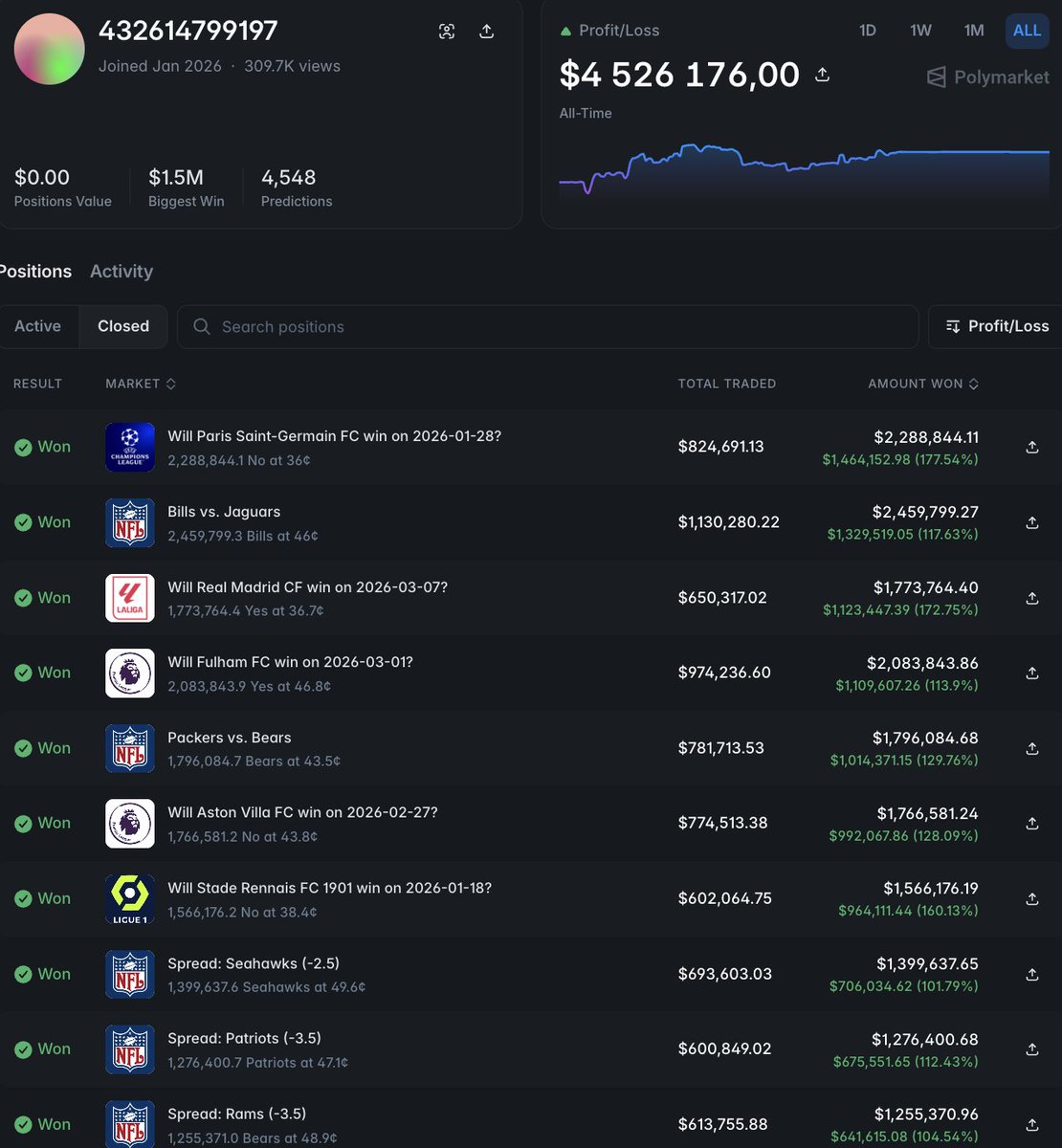
432614799197. $4,526,176 profit. 4,548 predictions. Joined January 2026.
She called the applicant.
Said: this document you attached. Can you explain what this is.
He said: my trading account.
She said: it shows four and a half million dollars.
He said: yes.
She said: you submitted a bank account with four thousand pounds.
He said: I don't keep money in banks.
She spent the rest of the afternoon reading the positions.
PSG not winning on January 28. Put in $824,691. Walked away with $2,288,844. Profit: $1,464,152. One match.
Bills vs Jaguars. Put in $1,130,280. Out: $2,459,799. Profit: $1,329,519.
Real Madrid winning on March 7. Put in $650,317. Out: $1,773,764. Profit: $1,123,447.
Fulham winning on March 1. Put in $974,236. Out: $2,083,843. Profit: $1,109,607.
4,548 bets. Every single one green. $4.5 million since January.
She called her senior partner into the office.
Said: I need a second opinion on whether this counts as stable income.
He looked at the screen for a long time.
Then said: approve it. And ask him how he does it.
Vegas moves a sports line. Every bookmaker updates instantly. The platform he uses takes 60 to 90 seconds.
He buys the old price. The market corrects. He collects the difference.
4,548 times. In three months. With a bank account showing £4,200.
The visa was approved in 48 hours.
Fastest approval her office processed that quarter.
He moved to London in April.
First thing he did was find an apartment with good internet.
A Chinese meteorology professor failed a student's thesis.
Called it too simple. Said it lacked academic rigor.
Gave him a C. The thesis was 4 pages.
The conclusion was one sentence: Aviation sensors measure temperature before forecasts do.
That gap can be traded. The professor wrote in the margin: this is not research.
This is obvious. The student didn't argue. Packed his things. Left the department.
Six months later the professor was reviewing grant applications when a colleague sent him a link.
No message. Just a link.
ColdMath. $106,475 profit. 5,619 predictions. Joined November 2025.
The professor recognised the username immediately.
It was the student's nickname from his undergrad years.
He opened the positions page.
Singapore 31°C. Won. Panama City 26°C. Won.
Shanghai 17°C. Won. Atlanta. Won. Amsterdam. Won.
Milan. Won. Dallas. Won. Madrid. Won.
11 cities. All green. All resolved in the same direction. All based on the exact mechanism from the 4-page thesis the professor marked down.
What the professor didn't know the student had spent those six months building something.
A small device. Custom firmware. Pulls raw L-band signals directly from weather satellites.
No APIs. No delay. No intermediaries.
He built the receiver himself and used Claude to write the signal parsing logic cross-referencing live aviation sensor feeds with raw satellite telemetry in real time.
The gap he wrote about in his thesis? He automated it.
The device sits on his desk and pings him the moment satellite data diverges from public forecasts.
That ping is the trade.
Aviation sensors update every hour. Weather markets update when someone notices.
The gap between those two moments is where $106,475 lives.
The professor sat with the screen for a while. Then opened a new email.
Typed the student's name in the subject line. Deleted it. Opened it again. Deleted it again.
$102,200 still sitting in active positions across 4 continents right now.
The thesis got a C. The trade got $106,475.
The device is still running.
The professor still hasn't sent the email
This guy is standing in Paris pointing his phone at buildings.
Not taking photos.
His screen shows names. Distances. Coordinates. AR pins floating over the city.
The tourist next to him asked: what app is that?
He said: I built it with Claude. It reads live data. Overlays it on real locations.
The tourist laughed. Cool travel app bro.
He smiled and said nothing.
Because the app wasn't built for tourists.
ColdMath. $102,940 profit. 5,400 predictions. $98,900 still in open positions. Joined November 2025. Bio: Edge Compounds.
Here is what the app actually does.
Aviation weather stations exist in every major city on Earth.
They publish METAR reports every 30-60 minutes.
TAF forecasts every 6 hours. Temperature accurate to 0.1 degrees. Wind to 1 knot.
Pressure to 0.1 millibars. Free. Real time. Required by international flight law.
Pilots use it. Air traffic controllers use it. Nobody else even looks at it.
Polymarket runs weather prediction markets.
Will Tokyo hit 16°C on March 20? Will Chicago reach 54°F on March 11?
The crowd prices these on instinct. On vibes. On what weather apps say.
Weather apps round everything. They smooth the data.
They make it readable for people who just want to know if they need a jacket.
METAR doesn't round anything. It doesn't care about jackets.
When METAR says 15.9°C and Polymarket prices YES at 4 cents that's not a prediction. That's a withdrawal.
$25 on Tokyo hitting 16°C. Payout: $12,452.
$24 on Chicago reaching 54°F. Payout: $12,398.
Biggest single win: $12,400. From a $25 entry.
5,400 predictions. Almost all weather. Almost all from the same source no one else bothers to read.
The AR app isn't overlaying restaurants and museums.
It's overlaying weather stations. Live sensor readings.
The invisible infrastructure of the sky above every city he visits.
He travels to a new city every two weeks. Paris. Tokyo. Chicago. Wellington. Ankara.
Every city has an aviation weather station. Every station publishes data for free.
He points his phone at the skyline and sees what the atmosphere is actually doing.
Then he checks what humans think it's doing.
The gap between those two things is his edge.
$98,900 loaded in active positions right now. Cities he hasn't visited yet. Stations he hasn't scanned yet.
The tourist who asked about the app that day followed him on Instagram.
Still thinks it's a travel app.
Still doesn't know about the wallet.
34,700 people watching the profile.
None of them can see what he sees when he points his phone at the sky.
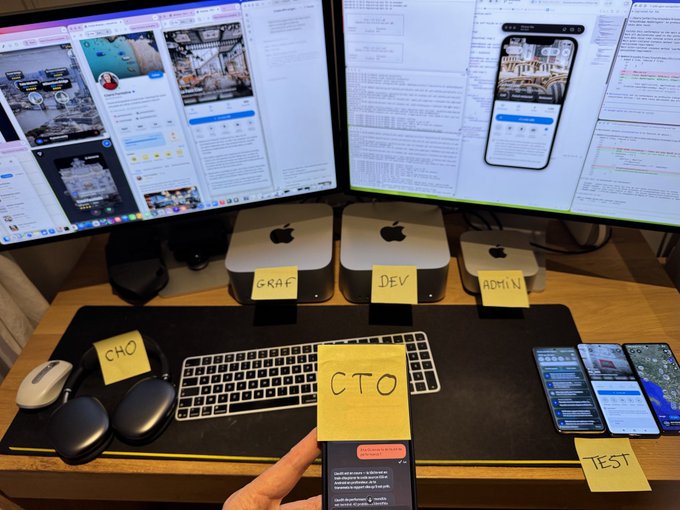
A Chinese student bought three used Mac Minis off a resale group.
Stuck yellow Post-it notes on each one.
UI/UX. DEV. ADMIN.
His girlfriend thought he was building a startup.
His parents thought he was studying. His university thought he was working on a thesis.
Three Mac Minis. Two monitors. Satellite maps on both screens. Claude running on all three simultaneously.
Total setup cost: under $2,000.
Nobody asked what it was actually doing.
ColdMath. $101,042 profit. 5,252 predictions. Joined November 2025. Bio: Edge compounds.
Here is what the three boxes actually do.
UI/UX pulls live METAR feeds. Aviation weather sensors.
10,000 stations worldwide. Temperature updated every hour to a tenth of a degree.
The data pilots use before every flight. Free. Public. Nobody in prediction markets reads it.
DEV runs the comparison engine.
Checks what Polymarket thinks the temperature will be.
Checks what the sensor already measured. Finds the gap.
ADMIN places the trade.
Three boxes. Three jobs. Zero human decisions after setup.
$25 on Tokyo hitting 16°C. Payout: $12,452.
$24 on Chicago reaching 54°F. Payout: $12,398.
$13 on Lucknow hitting 39°C. Payout: $6,850.
The crowd prices weather markets based on public forecasts updated twice a day.
The sensors update every hour.
Between those two refresh rates there is a 40 to 90 minute window where the answer already exists and the market still shows yesterday's odds.
ADMIN clicks. Every time.
His girlfriend finally looked at the screens one evening.
Saw the satellite maps. The scrolling code. The three yellow stickers.
Asked what it was for.
He opened the wallet page.
She looked at the number. Then at the three Mac Minis.
Then back at the number.
Said nothing for a while.
Then: which one is ADMIN.
5,252 predictions. $101,042. Three used Mac Minis and three Post-it notes.
The satellite maps are still running. The sensors update every hour. The DEV box is still finding gaps.
Some edges don't require genius.
Just three boxes, three stickers, and the patience to let the aviation data do the work.
A Chinese dropout spent 4 months in his parents' garage building a device nobody asked for.
Single board computer. Custom heat sink. One green LED soldered by hand. Total cost $31.
His father walked in one evening, looked at the wires, and said: find a real job.
He didn't argue. Just turned back to the screen.
Four months later his father walked in again.
Same garage. Same wires. Same device.
Different number on the screen.
0x8dxd. $2,382,780 profit. 33,951 predictions. Joined December 2025.
The device does one thing.
Binance processes Bitcoin price in milliseconds.
Polymarket updates in seconds. Between those two speeds there is a gap.
25 to 40 seconds where Polymarket shows yesterday's odds on today's price.
The green LED lights up when that gap opens.
He places the trade. Gap closes. Polymarket catches up. He collects.
33,951 times since December.
I spent an hour trying to find one losing trade.
Scrolled until my eyes hurt.
Nothing. Every row green. Every exit clean.
Every position sized like someone who already knew the answer before the question was asked.
$2.38 million. Zero active positions. Fully cashed out.
He didn't leave the money sitting in the market.
He took it and closed the laptop.
His father saw the number that evening. Didn't say anything for a long time.
Then asked one question: how long did it take you to build it.
Four months in the garage. $31 in parts. One green LED.
The device still works. The gap still opens. The LED still blinks.
Some people spend four months applying for jobs.
He spent four months building something that made the question irrelevant
A Chinese student set an alarm for 3AM every night for three months.
Not to study. To watch Bitcoin for 90 seconds.
His roommates thought he had insomnia. His parents thought he was gaming.
He was making $6,000 a night.
My Claude scanner found his wallet last Tuesday. Zero views. One month old.
Bonereaper. $205,234 profit. 7,403 predictions. Joined March 2026.
I opened the closed positions.
Every single trade is Bitcoin. Up or Down. 5-minute windows. Nothing else. 240 trades per day. Every row says Won.
Bitcoin Up or Down March 29, 1AM ET. Up at 21 cents. In: $1,676. Out: $7,712. ROI: 360%.
Bitcoin Up or Down March 30, 12:45PM. Down at 14 cents. Out: $5,731. ROI: 467%.
$800 in. $4,500 out. Repeat 240 times a day.
I asked Claude what he sees at 3AM that the market doesn't.
Claude said: that's the Asian session open. Highest volatility window of the day.
Nobody in the US awake to correct mispricings.
He watches the Binance order book for 90 seconds before the Polymarket window opens.
The order flow already shows direction. Polymarket is still guessing. He already has the answer.
He doesn't predict Bitcoin. He reads a signal that arrives 90 seconds before the price does.
3AM alarm. 90 seconds on Binance. One click on Polymarket. Sleep.
7,403 times.
$74,000 still in active positions. Still zero views. Still no one watching.
I copied 4 positions that night. Three closed green.
His roommates still think it's insomnia.
I spent 40 minutes trying to understand this wallet.
Then I gave up trying to understand it and just started copying it.
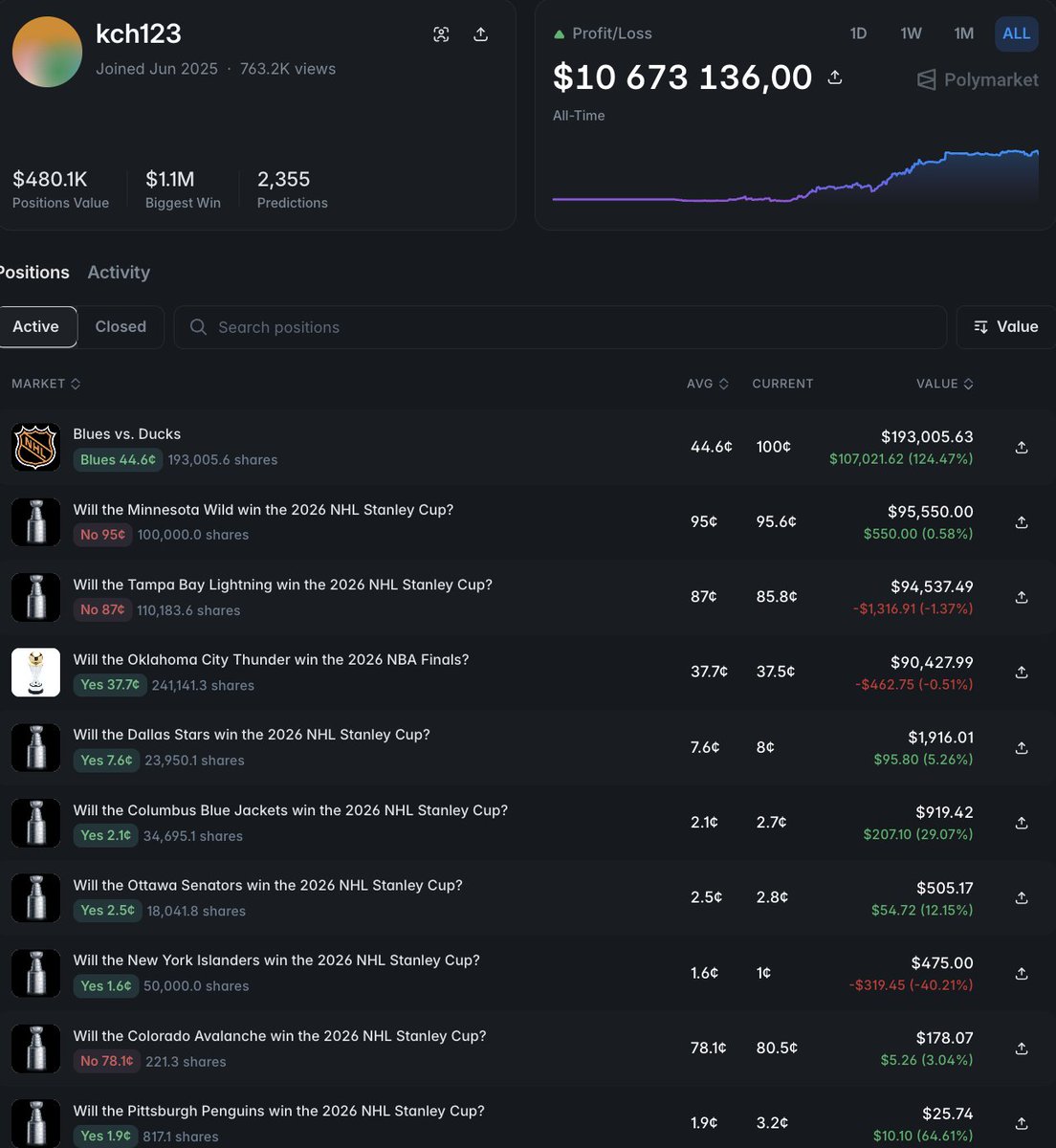
kch123. $10,673,136 profit. 2,355 predictions. Joined June 2025.
The positions page looks like two different people are running it.
The first person is boring and careful.
Minnesota Wild win the Stanley Cup. NO at 95 cents.
$95,550 position. Collecting near-certain money on a team that won't win.
Tampa Bay Lightning. NO at 87 cents. Another $94,537.
Colorado Avalanche. NO at 78 cents. $178 sitting there compounding.
Safe. Methodical. Almost boring.
Then the second person shows up.
Columbus Blue Jackets win the 2026 Stanley Cup. YES. 2.1 cents.
Ottawa Senators. YES. 2.5 cents.
New York Islanders. YES. 1.6 cents.
Pittsburgh Penguins. YES. 1.9 cents.
Nobody thinks these teams win. The market agrees. That's why they're 2 cents.
But one Stanley Cup winner pays $1 per share. At 2 cents that's 50x.
Blues vs Ducks today. Entered at 44.6 cents.
Now at 100. Up $107,021 on a single hockey game. 124% in one day.
OKC Thunder to win the 2026 NBA Finals. YES at 37.7 cents. $90,427 sitting there.
Biggest single win ever: $1,100,000.
I asked Claude: what is this strategy actually called.
Claude said: it doesn't have a name. The near-certain positions generate consistent cash flow.
The longshots cost almost nothing. One Stanley Cup longshot hitting at 2 cents pays back years of losses on all the others.
He doesn't need them to win often. He needs them to win once.
$480,200 in open positions right now. Across NHL futures, NBA Finals, live game spreads.
2,355 predictions since June.
That's 10 months. $10.6 million.
He's not predicting sports. He's running a portfolio where the floor is high and the ceiling has no number.
I stopped trying to understand it somewhere around the Islanders position.
Sometimes the edge isn't a secret.
It's just a structure most people never thought to build.
My coffee machine broke at 6am. Tuesday. Three back-to-back calls starting at 8.
I had a Raspberry Pi on my shelf I bought last year to learn something. Never did. Just sat there blinking its red light like a question I never answered.
I plugged it in and typed one thing into Claude while waiting for water to boil:
I have this Pi doing nothing. I have $300 I was saving for something I keep delaying.
What would you actually do.
Claude didn't answer the question. It rewrote it.
It said: the Pi already has enough compute to watch prediction markets that nobody else is watching.
Illiquid rooms. Markets with 8 participants where the pricing is lazy because nobody shows up to correct it.
The edge in those rooms isn't smarter analysis. It's just presence.
Then it gave me a script. 60 lines. Said: point this at obscure markets and let it run.
I loaded it onto the Pi at 6:43am. Got on my calls.
Came back at noon. The Pi had flagged 31 markets in 5 hours.
Darts tournaments. Minor league hockey. Handball.
One market about a regional election in a country I couldn't locate on a map.
All of them with under 20 participants.
Inside one of those rooms the script found a wallet that only lives there.
BoshBashBish. $156,000 profit. 90% win rate. Starting balance $333.
I showed my colleague who trades crypto. He said the volume is too low to be real.
I pulled up the live positions. He stopped talking.
Here is what Claude said when I asked why this works:
Big markets have thousands of people correcting every mistake in real time. Small markets have nobody.
The price sits wrong for hours because there's no one to fix it. That's not an edge. That's an open door.
I put $300 in. Copied 6 positions the wallet was sitting in.
The Pi blinked its red light all week.
Four of the six closed green.
$300 → $1,870.
The coffee machine is still broken. Haven't replaced it.
The Pi is still on the shelf. Still blinking.
But now when it blinks I look.
Some questions you delay for a year turn out to be the only question that mattered.
I just needed the coffee machine to break first.