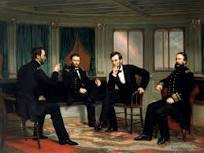
#DuringThisWeek in March, 1865, President Abraham Lincoln met with his three top military officers at City Point, Virginia. They discussed military operations and terms of surrender that should be offered to the rebel armies. Lincoln desired the terms to be lenient.
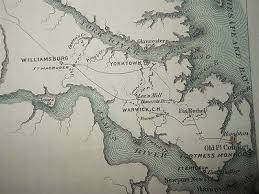
#DuringThisWeek in March, 1862, Confederate Major General John B. Magruder was authorized to extend martial law throughout James City County. This order gave him military jurisdiction over the City of Williamsburg and command of all troops stationed on the Virginia Peninsula.
#DuringThisWeek on March 9, 1862, the USS Monitor and the CSS Virginia (formally the USS Merrimack) were engaged in a 3 hour battle, which ended in a tactical draw. Though the two ships never fought each other again, the age of the iron warship had begun.
#OnThisDay in 1779, the Continental Congress authorized the creation of the U.S. Corps of Engineers. The Corps' mission was to construct fortifications for the national defense. After the war, its mission expanded to include public civil works as the nation expanded westward.
#OnThis day in 1792, John Stuart, 3rd Earl of Bute, former Prime Minister and adviser to King George III, during the Seven Years' War, died at the age of 78. He helped negotiate the Treaty of Paris (1763), which ended the the Seven Years' War with France.
#OnThisDay in 1781, the Battle of Pensacola, Florida, began. After a two month siege, the British garrison surrendered. Two years later, Great Britain was forced to surrender all of its claims along the Gulf of Mexico to Spain because of this defeat, under the Treaty of Paris.
#OnThisDay in 1782, 160 Pennsylvanian militiamen massacred 96 Christian Indians at a Moravian Mission in the Ohio territory. The Gnadenhutten Massacre destroyed the peaceful relationship between the Indians and the Americans that Christian missionaries worked so long to achieve.
#OnThisDay in 1876, Alexander Graham Bell patented the telephone transforming telecommunication forever. The Bell Telephone Company was the first to commercialize Bell's invention, and for the next few decades out preformed the telegraph. In 1911, AT&T became Bell's competitor.
#OnThisDay in 1776, the Sandy Hook lighthouse in New Jersey was dismantled to prevent the British from invading New York. The British reinstalled the light shortly thereafter, and in July, the British army arrived in New York Harbor and occupied Staten Island.
#OnThisDay in 1770, five Americans, including Crispus Attucks, a free black man, were killed by British soldiers in what became known as the Boston Massacre. John Adams defended the 12 British soldiers and officers who fired upon the colonists and the court acquitted all but 2.
#DuringThisWeek in March, 1864, the Kilpatrick-Dahlgren Raid ended in failure. Dahlgren planned to free Union prisoners in Richmond, but was killed before he got to the city. The raid became highly controversial when rebel soldiers found plans to assassinate Davis in his coat.
#OnThisDay in 1776, the Continental Army occupied Dorchester Heights completely encircling the British army in Boston. Though the siege began two days earlier, the capture of these heights strengthened their position and forced the British army to evacuate rather than surrender.
#OnThisDay in 1776, Continental Marines, the predecessors to the US Marine Corps, conducted their first amphibious assault against a British outpost on Nassau, Bahamas. The marines occupied the island for two weeks. The American flag flew over foreign soil for the 1st time.
#OnThisDay in 1776, the siege of Boston began. General George Washington had occupied the heights surrounding the city and ordered a massive bombardment of the British positions. After two weeks of bombardment, the British evacuated the city. It was Washington's first victory!
#OnThisDay in 1781, the Articles of Confederation were ratified establishing the first national government in the United States. The Articles protected the sovereignty of the states by limiting or denying the federal government the power to regulate commerce and raise revenue.
#OnThisDay (Feb. 29), 1760, Reverend Thomas Dawson, rector of Bruton Parish in Williamsburg, Virginia, was permitted to establish a school to educate free and enslaved Negro children; Ann Wager served as the school's instructor for the next 14 years.
#OnThisDay in 1784, John Wesley charted the first Methodist Church in the United States. The Anglican Church of England refused to recognize Wesley and his practices forcing Wesley to establish himself as bishop with the power and authority to ordain ministers.
#OnThisDay in 1776, Patriots under the command of Richard Caswell defeated 1,600 Loyalists at the Battle of Moore's Creek, North Carolina. General Clinton was forced to evacuate the British army at Wilmington thus surrendering the colony over to the Americans.
#OnThisDay in 1813, Robert Livingston, who helped draft the Declaration of Independence, died in Clermont, New York. He assisted in the drafting of New York's constitution in 1777, and he was named Chancellor of New York. He swore in Washington as the first president in 1789.
#DuringThisWeek in February, 1865, Major Julius Hicks, commander of Fort Magruder, requested to destroy all houses within 1 mile of the telegraph lines in his area because Rebel saboteurs and unruly citizens were disrupting Union communications. The order was never carried out.