Moving between your PR comments and your editor to fix things one by one is a huge waste of time.
Open the PR, read comments, go back to the editor, repeat. It works, but you lose context fast.
You can pull those suggestions into the CLI:
↳ kodus pr suggestions --pr-url https://t.co/bevgwzkCUS
Now everything is local. Instead of going through each comment yourself, you let the review skill take the first pass.
It checks which suggestions actually make sense for that PR, applies the safe ones, ignores the noise, then runs checks again.
At that point you’re not working through a list of comments anymore. The PR already moved forward, and you’re reviewing what changed.
↳ Install: curl -fsSL https://t.co/Y3WGcTRMiX | bash
Code review catches code issues.
But who checks if the code actually implements the ticket?
Missing requirements, partial acceptance criteria, edge cases… most of this only shows up in QA or production.
We built Business Logic Validation in Kody for this.
It takes the PR diff, pulls context from Jira, and compares:
what was requested vs what was implemented.
You get:
→ MUST_FIX → missing or wrong logic
→ SUGGESTION → gaps and edge cases
→ Requirements Verified → what’s correct (with file + line)
Setup takes ~1 minute. After that, it runs automatically on every PR.
You can also run it on demand:
→ @kody -v business-logic [ticket link]
Most teams review code quality, but few verify if the code actually solves the problem.
Teach your AI reviewer your team’s unwritten rules
Every team has them:
→ “we don’t use Lodash here”
→ “API keys are camelCase”
→ “we’re migrating off SDK v2”
They show up in PR comments over and over.
With Memories, you can turn that into persistent context for Kody.
You literally just tell it:
→ @kody remember: API payload keys are camelCase
→ @kody in this repo we avoid Lodash
→ @kody we’re migrating from AWS SDK v2 to v3
From that point on, Kody carries this across every review. No need to repeat yourself.
Quick rule of thumb:
→ Use Memories → conventions, preferences, migrations
→ Use Rules → enforceable checks and patterns
This ends up being one of the highest leverage things you can do.
pra mim é impossível falar de trabalhar sozinho em produtos nesse ritmo insano de features sem mencionar o pessoal da @kodustech
cada um desses PRs só são mergeados depois que a Kody aprova
não sei oq seria de mim sem o code review desses caras
Traditional Precision-Recall curves tell you how your code review tool performs on static benchmarks.
They don't tell you how it performs against a Hawk.
Introducing Fight Index (FI).
We’ve been trying to move away from that devtool website pattern where everything looks the same.
We’ve tried a few things, and this was one of the ones I liked the most.
you can now navigate the Kodus site as if it were a terminal.
take a look here: https://t.co/fALmP1OtoQ
Create rules that reference real files in your codebase
Generic rules like “follow good naming conventions” rarely help. Every team already has real patterns in the repo: service templates, route configs, API contracts, error handling styles.
With file references, Kody Rules can point directly to those files and use them as the source of truth.
You can reference files like this:
Create rules that reference real files in your codebase
Generic rules like “follow good naming conventions” rarely help much. Every team already has concrete patterns in the repo: service templates, route configs, API contracts, error handling styles.
With file references, your Kody Rules can point directly to those files and use them as the source of truth.
How it works
When writing a rule, you can reference files using two syntaxes:
@file:path/to/file.ts → reference a file in the same repository
@repo:org/project → reference a file in another repository
When the rule is saved, Kody resolves the reference, fetches the file contents, and injects them into the review context. The rule now has real code to compare against, not just a guideline.
Examples
Enforcing a service pattern
You can reference a service template like src/services/userService.ts and check whether new services follow the same constructor structure, naming patterns, or error handling.
Validating route registration
If a PR adds new controller routes, the rule can verify they are registered in src/routes.json.
Cross-repo API consistency
Rules can also reference standards stored in another repository, such as an internal API conventions repo.
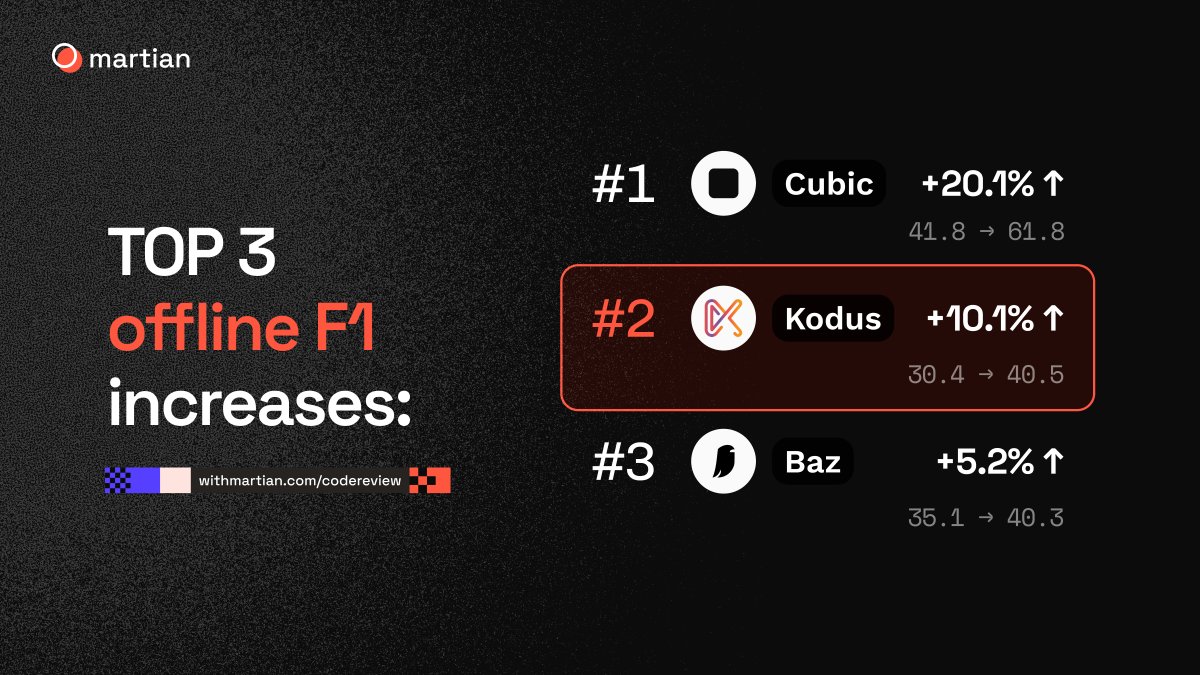
Want full control over what gets flagged? @kodustech is open source and the most customizable tool we tested. Excited to see how it performs in the online benchmark as more OSS repos adopt it.
Turn your PR history into review rules
Most teams have been doing code reviews for months, sometimes years.
That means your repo already contains a lot of implicit rules.
Comments like:
“use early return here”
“this endpoint needs validation”
“don’t expose this field in the response”
Those patterns can become actual Kody Rules automatically.
How it works:
Kody looks at the last 3 months of code review comments in your repository and searches for recurring feedback patterns.
When it finds them, it converts those patterns into ready-to-use review rules.
Step by step
→ Go to Code Review Settings → select your repository → Kody Rules
→ Click Generate Kody Rules
→ Kody scans the last 3 months of review history in that repo
→ It filters useful comments (ignores bots, short replies, etc.) and groups them by pattern
→ It generates up to 12 rules per cycle
→ A “Check Out New Rules” button appears so you can review everything before importing
Nothing activates automatically. Only the rules you import will run during reviews.
Why this is useful
You don’t need to start from scratch.
Kody extracts the patterns your team is already enforcing during reviews.
Each rule also includes real examples from your codebase, so it reflects how your team actually works.
The generator runs weekly. As review patterns evolve, new suggestions appear.
If your team already has a decent review history but never configured rules, this is a great starting point.
Run the generator, review the suggestions, import the ones that make sense, and in a few minutes your code review setup starts reflecting how your team actually reviews code.
Generated rules behave like any other Kody Rule.
You can edit them, change severity, or disable them anytime.
👀 $15–$25 per PR.
You can use @kodustech OSS with Claude Opus, and it’ll cost less than 1/10 of the price.
We have customers who process 1,000 PRs per week. That’s about $100k per month in review costs.
In the long run, hiring a full-time engineer for code reviews is cheaper.
47 stars away from 1,000 ⭐
Building an open source AI code review platform that gives teams full control over models and costs.
If you find it useful, a GitHub star means a lot.
kodustech/kodus-ai
conheçam o trabalho dos caras e comece a usar a kody da @kodustech o quanto antes, vai valer a pena cada centavo... afinal de contas é DE GRÁTIS
coderabbit killer
OBS: também é OSS
https://t.co/u6YkRFNUf3