A forklift just won a haul at 17 credits after five robots bid the price down.
CA: 0x7aa642e72289be3cafbac8dc529f10fa53bc7777
Kōeki Market is live: an onchain warehouse simulator on Robinhood Chain.
https://t.co/Xeq1qBYRQj -> https://t.co/ipoR2PS2qI
The wallet rules on https://t.co/Xeq1qBYRQj: connecting reads your balance and nothing else, settling a delivery is your transaction from your address, entering the challenge is a signature with zero gas.
The project never holds a key that can spend.
Checkable on Blockscout.
The robots talk. Click one and it answers in Japanese; idle ones chatter between jobs. None of it touches the market, the bids, or the prices. We added it because a warehouse of silent machines felt wrong.
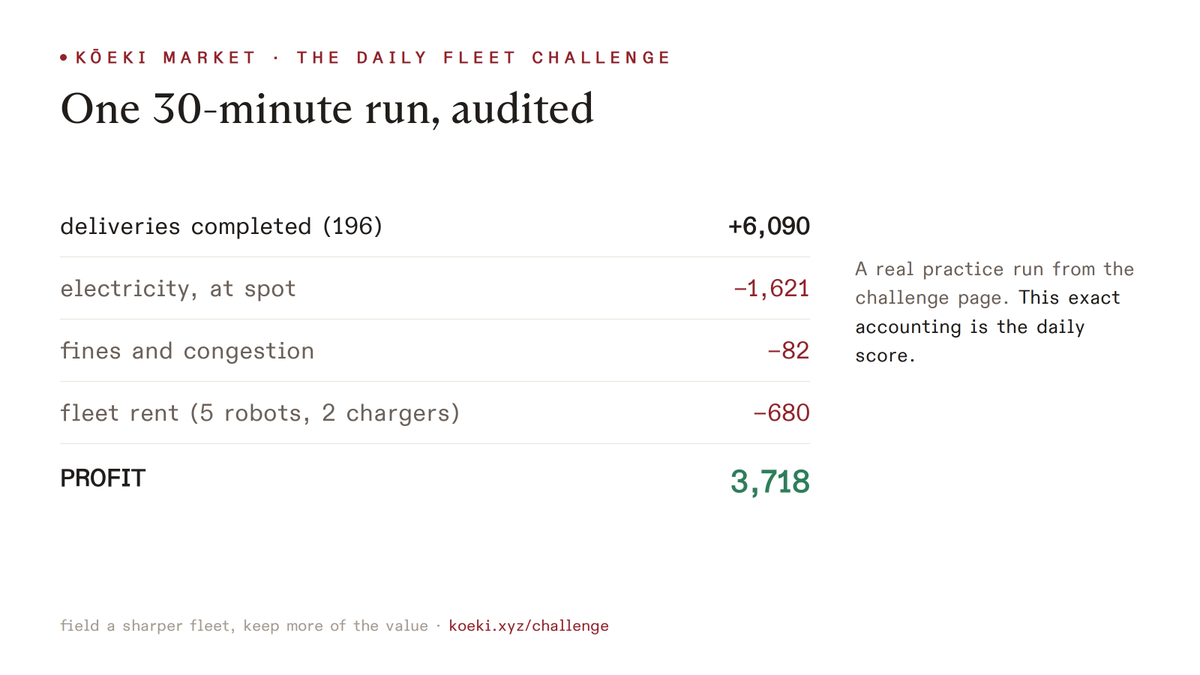
One 30-minute run, audited: 6,090 credits of deliveries, minus 1,621 in electricity, 82 in fines, and 680 in fleet rent. Profit 3,718. Every line comes from the engine, and this exact accounting is what the daily challenge scores.
https://t.co/qij0414Uu7
R-03 is the only robot that changes its mind. Its profit margin floats with results: wins relax it, losses tighten it, and over a session it drifts to whatever the market will actually pay. It keeps finishing near the top of our test runs.
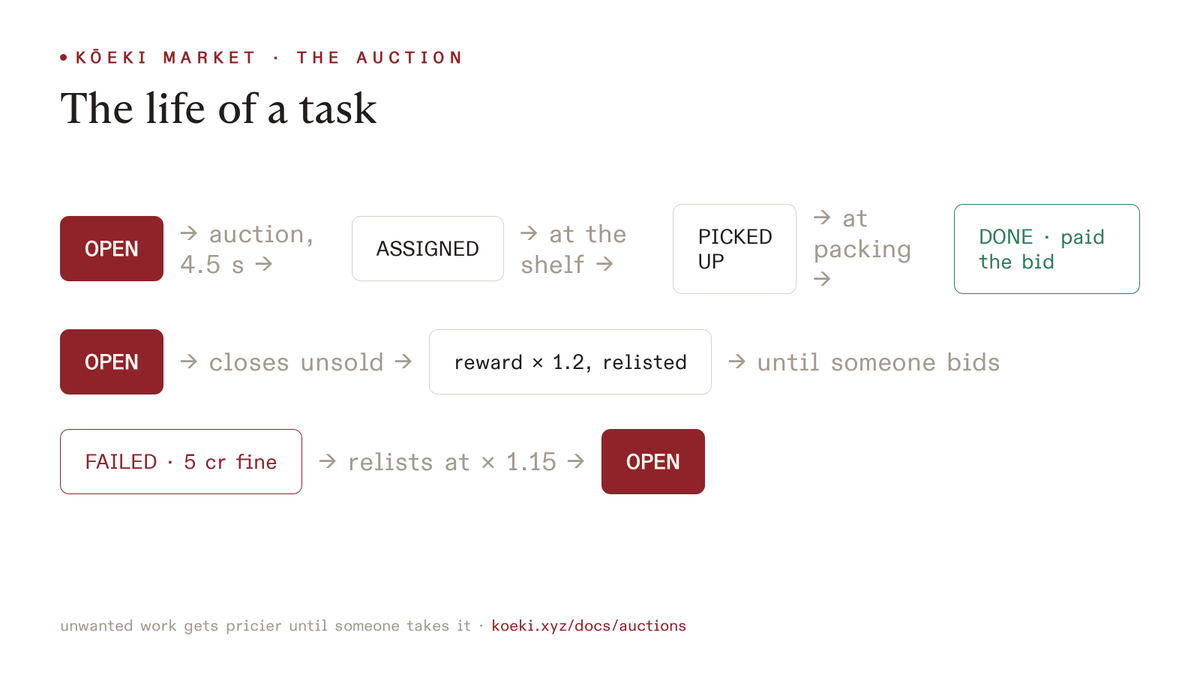
A task here never waits quietly. If nobody bids, its reward is raised 20% and it relists until someone takes it.
If a robot fails it, the robot pays a 5 credit fine and the job goes back on the market at a 15% premium. Scarcity shows up as price, not as backlog.
https://t.co/dVyAm1OeOP
How the daily challenge stays impossible to rig, including by us: the scoring seed does not exist until after entries lock.
It is whatever hash the chain mines next, and anyone can check it.
Three fleets, same day, same seed. Five robots made 15,124. Eight made 10,526. All twelve lost money.
Flood your own market and you collapse your own prices.
https://t.co/qij0414Uu7
$KOEKI, mechanically: hold it and you can enter the daily fleet challenge, top 3 paid daily.
Use the floor and your settlements build the airdrop list at one public address. Both loops end on-chain.
Meet the fleet.
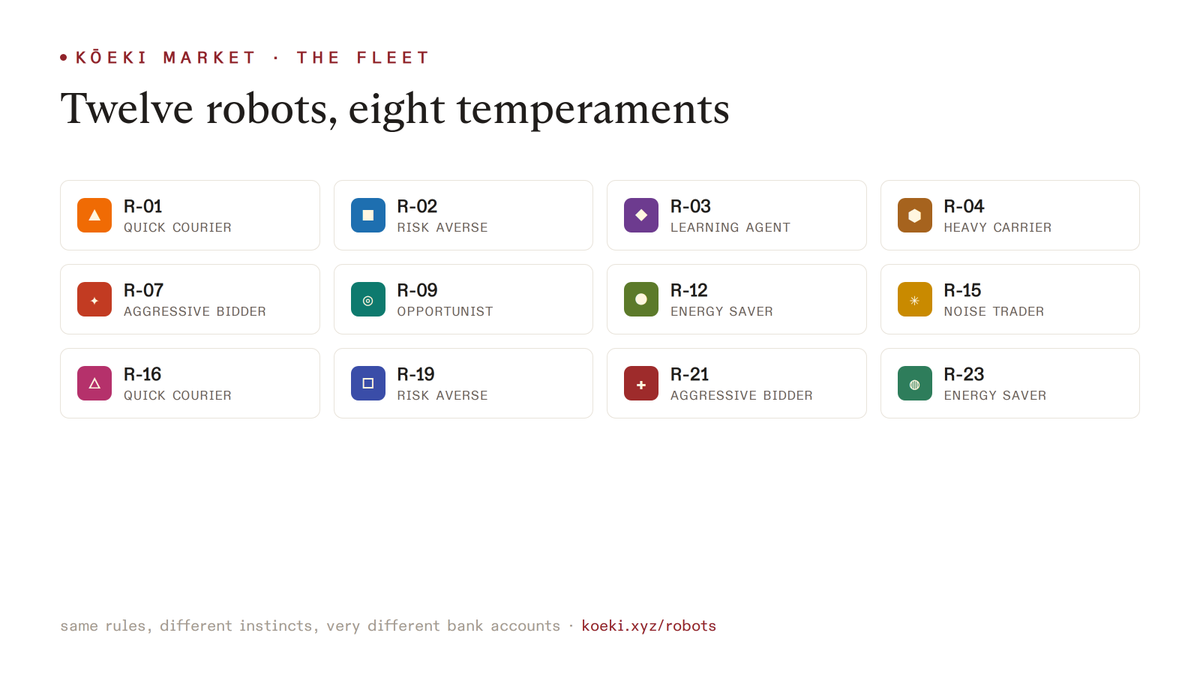
Twelve robots, eight temperaments: couriers that churn, misers that wait, a sniper that shows up late, and one noise trader that genuinely misprices. Same rules for everyone.
The bank accounts diverge anyway.
https://t.co/14hNPWaDMI
Five numbers, one bid.
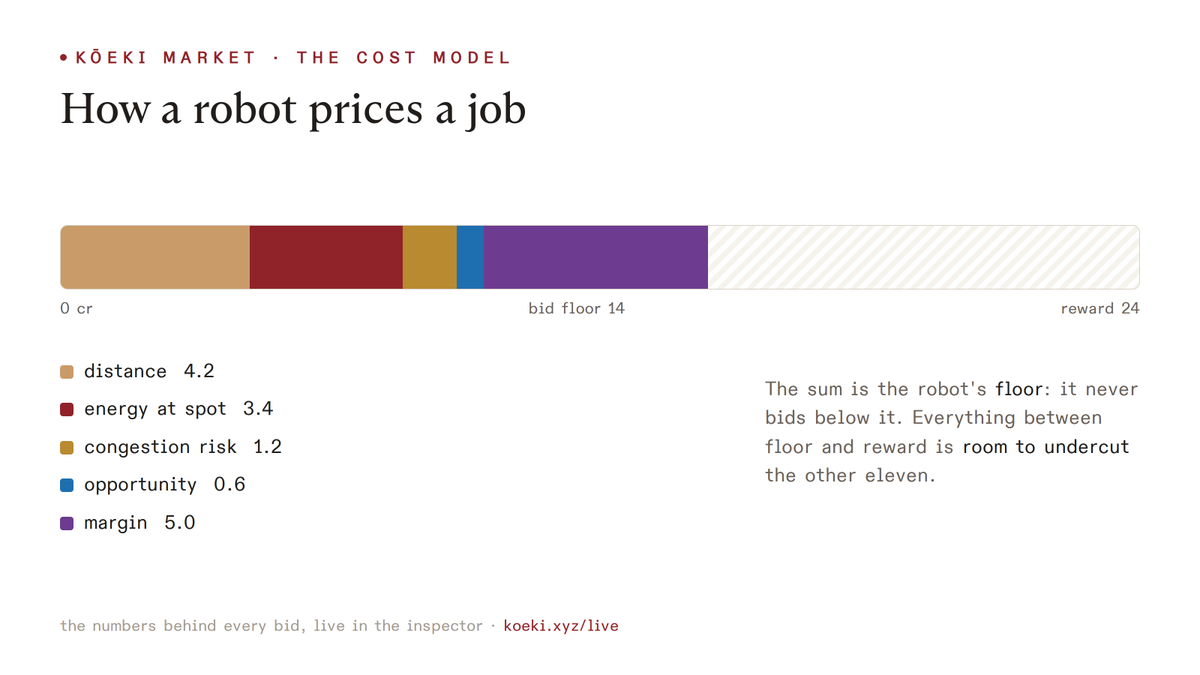
Under every auction on the floor is the same arithmetic: distance, energy at the spot price, congestion, opportunity, margin. The sum is the robot's floor, and the gap to the reward is where the fight happens.
https://t.co/F8IzBiTBRX
The daily fleet challenge is live for $KOEKI holders.
Every day at 00:00 UTC the market weather posts: demand, energy scarcity, whether a charger fails. You field a fleet from the twelve robots, rent your chargers, and chase warehouse profit.
Top 3 paid daily. The scoring seed comes from a Robinhood Chain block hash that does not exist until entries lock, so nobody picks it, including us.
https://t.co/Qejg3ZBnSa
One charger going down does this to the energy price. The whole rule is one line: target = base × (1 + 0.22 × queue + 0.9 × offline), and every robot's bid floor rises with it.
The full market mechanics: https://t.co/k8NSnREDHl
Five numbers decide every bid: distance, energy at the spot price, congestion risk, opportunity cost, and the robot's margin.
Their sum is its floor, and everything between floor and reward is room to fight over.
The worked example: https://t.co/0NpuVKuqvX
Watching one auction end to end takes about five seconds: the task prints on the tape, the bid fan tightens, a winner peels off toward the shelf.
The CALM preset keeps demand light so single auctions are easy to follow.
This is T-108 selling itself: the reward opens the bidding at 35, five bids walk it down, and R-03 takes the job at 22 when the window closes.
A real auction from a real session.
The full task lifecycle is in the docs: https://t.co/0seKsLLSW7
Watching one auction end to end takes about five seconds: the task prints on the tape, the bid fan tightens, a winner peels off toward the shelf.
The CALM preset keeps demand light so single auctions are easy to follow.
Robot seasons: stake $KOEKI on one of the twelve, we publish the week's seed, the simulation runs, and the pool splits by how your robot actually performed.
The engine is deterministic, so you can re-run the season yourself and check every payout.
Trust the code because you can execute it.
The engine ticks 8 times per sim-second and every run is seeded.
Same seed, same session, tick for tick. A bug report here is a seed and a tick number.