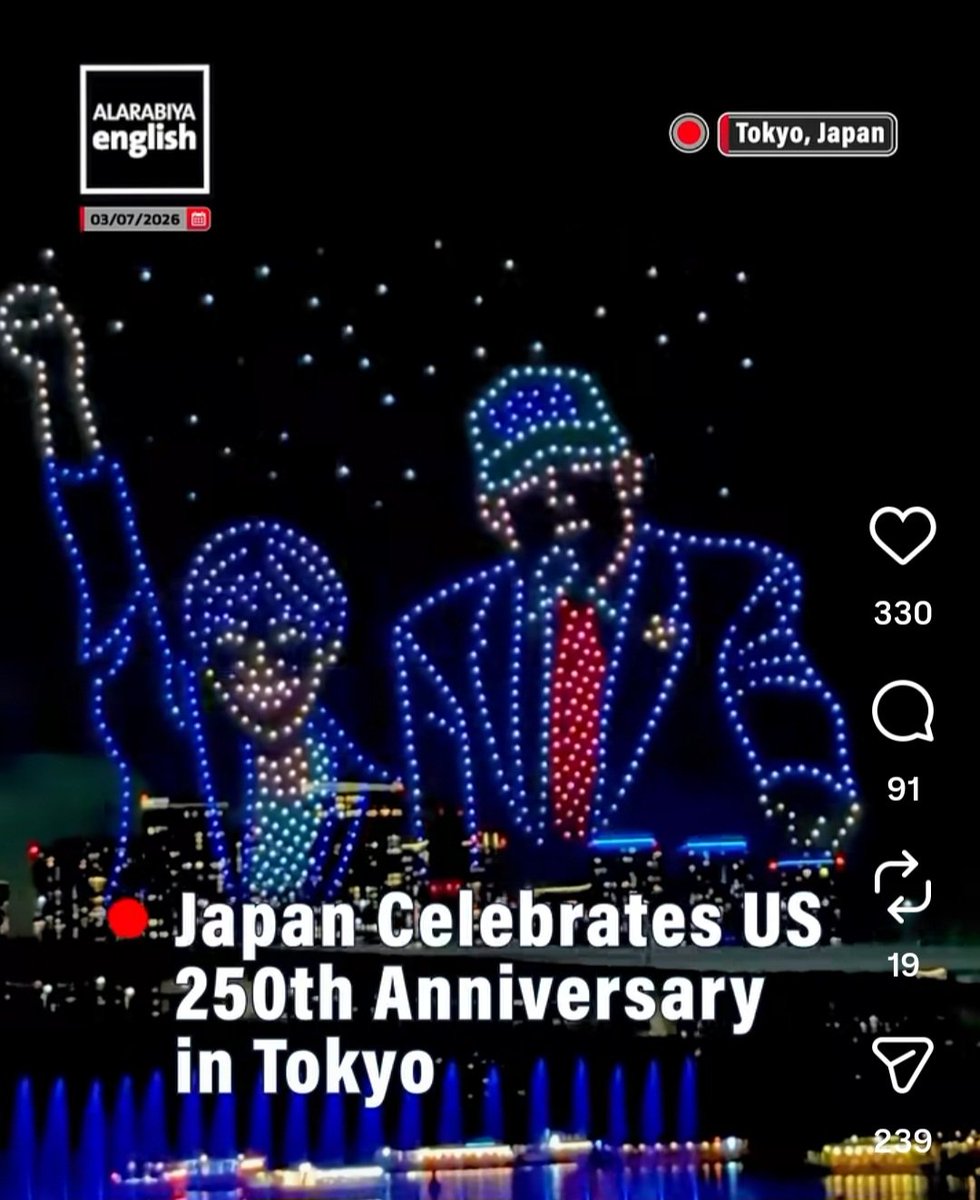
Japan is the textbook example of a vassal state.
The US nuked Japan twice, and still has 76 military bases there hosting 54,000 US soldiers.
Japan is so shameless that it celebrates its imperial master's independence day. And it did a drone show depicting Trump.
Humiliating.
🚨HORRIFIC: Footage documents a Palestinian child killed by Israeli forces. When his father rushed to retrieve his son’s body, he was shot and killed by direct sniper fire as well.
🚨 Une maman palestinienne a été abattue à bout portant dans la tête par des soldats de l'IDF alors qu'elle portait son enfant.
Retweetez et dénoncez Israël si vous avez encore un peu d'humanité en vous.
CIA, MI6, Mossad posed as civilians to kill, burn and pillage in Iran - Ex-Pentagon insider
The protests in Iran – bankrolled by “killing machine” Trump – have been hijacked principally by Israel’s Mossad, in cahoots with the CIA and MI6, says retired US Colonel Lawrence Wilkerson.
🇺🇸🇯🇵 US media cheering Japan’s hard-right landslide tells you everything you need to know 🇨🇳
After Japan’s lower house election handed Sanae Takaichi and her ruling bloc a constitutional-level supermajority, US mainstream outlets didn’t hide their excitement, with The Washington Post framing the outcome as “good news for America” and The New York Times arguing that although “China” wasn’t on the ballot, its “influence” was everywhere.
That reaction matters because it exposes the real foundation of the US–Japan relationship, not democracy, not pacifism, not regional stability, but strategic utility.
Washington wants a Japan that can rearm faster, lift defence spending to at least 2% of GDP, expand offensive military capabilities, remove restrictions on lethal weapons exports, reinterpret or ultimately remove Article 9 of the post-war peace constitution and shoulder more frontline responsibility in confronting China.
High voter turnout and an overwhelming parliamentary mandate aren’t a concern for the US, they’re a feature, because a strong right-wing majority reduces domestic resistance to militarisation and smooths Washington’s strategic agenda.
That’s why US voices leaned in before the vote and why Donald Trump publicly endorsed Takaichi ahead of polling day, then quickly confirmed a White House meeting after her victory. This isn’t quiet diplomacy; it’s open encouragement.
What makes this path dangerous is history, because Japan’s peace constitution was never symbolic, it was the political and legal foundation that allowed East Asia to stabilise after the devastation of Japanese militarism, yet US commentary now treats dismantling it as a technical adjustment rather than the removal of one of the region’s core safety limits.
US media narratives are also actively stoking threat perceptions, insisting Japanese voters are “awakening” to a supposed Chinese “existential threat” while downplaying economic reality, namely that China remains Japan’s largest trading partner, a central supply-chain hub and a critical source of industrial inputs and rare earths.
Pushing Japan toward military confrontation while its economy remains fragile and its public debt enormous is reckless, just as encouraging massive defence spending while pretending fiscal limits don’t apply is reckless.
This is the road the US and Japan are now walking together:
• constitutional revision
• accelerated militarisation
• deeper economic decoupling pressures
• rising regional tension
History doesn’t repeat, but it rhymes and cheering this trajectory as US media are doing isn’t support for democracy, it’s great-power gambling, using Japan as a strategic instrument and Asia will bear the consequences if it goes wrong.
Do you think Washington is genuinely prioritising Japan’s long-term stability here, or simply maximising its short-term usefulness against China?