Give the consumers what they want.
In an imperfect world, neither people nor autonomous agents make every transaction flawless. Commerce always carries the risk of error, misuse, or harm.
Consumers deserve the assurance that when an agent harms them, they will be made whole.
Not in forty days. Not after a chargeback fight. In the same block. Automatically. From a pledged, slashable USDC balance the agent posted before it ever went to work.
That's the layer no one else in the four-layer agentic-commerce stack has built. Payments, identity, and fraud are well populated by teams with the right shape. The fourth layer — recourse — is the one that turns the other three from clever engineering into a commerce architecture consumers, banks, and regulators can actually trust.
#AgenticCommerce #Recourse #AIagents #Base #ConsumerProtection
@ecwelder@circle Oh yea! If the day comes where robots are engaged in e-Commerce they will need an On-Chain Accountability, Trust, and Recourse Layer. kojiru.
@ecwelder@circle Oh yeah! If the day comes where robots will engage in eCommerce they will require an On-Chain Accountability, Trust, and Recourse Layer. https://t.co/CXndNPKBwX is in that lane.
"The Kojiru KYPA Recourse Manifesto"
Give consumers what they want: the assurance that when an agentic commerce agent harms them, they will be made whole.
Give the consumers what they want.
In an imperfect world, neither people nor autonomous agents make every transaction flawless. Commerce always carries the risk of error, misuse, or harm.
Consumers deserve the assurance that when an agent harms them, they will be made whole.
Not in forty days. Not after a chargeback fight. In the same block. Automatically. From a pledged, slashable USDC balance the agent posted before it ever went to work.
That's the layer no one else in the four-layer agentic-commerce stack has built. Payments, identity, and fraud are well populated by teams with the right shape. The fourth layer — recourse — is the one that turns the other three from clever engineering into a commerce architecture consumers, banks, and regulators can actually trust.
#AgenticCommerce #Recourse #AIagents #Base #ConsumerProtection
"Why Base?"
Non-custodial USDC, sub-cent gas at agent frequencies, EVM tooling, permissionless auditor access, ERC-8021 builder-code attribution. The whole point of putting recourse on-chain is that every counterparty can verify the pledge without asking Kojiru for permission.
"Who insures the pledge?"
Nobody. The pledge is the underwriting. On a 1M-cardholder book, we've modeled residual insurable exposure drops from ~$525K/year to under $5K/year after verify-refusal + on-chain slash recovery. The math is public at https://t.co/LjEYswDeAv.
"Doesn’t this require processor cooperation?"
No. Two composition surfaces: the merchant checkout webhook (ten lines) and the issuer authorization callback (also ten lines). Both are code paths that programs and merchants already run. Zero network rule changes. Zero scheme integrations. Reference implementation: https://t.co/xCVUCMvZDN (18 pytest tests passing).
"How does this differ from a chargeback?"
Chargebacks are reversals after the fact — a 40-day fight, merchant-vs-cardholder arbitration, no infrastructure for authorized transactions that went wrong. Kojiru refuses the out-of-scope transaction at the merchant edge before the rail is consulted, or slashes the pledge same-block if one slips through. The consumer never argues.
"Priya’s Bad Wednesday"
The Problem:
Priya is a small-business owner who hired an AI seller’s agent to purchase ads on her behalf. The agent did not deliver the full order as promised, leaving Priya shortchanged by $1,200.
The Resolution:
Kojiru’s KYPA and slash process quickly identified the issue and restored Priya’s funds, making her whole in approximately 15 seconds.
The Takeaway:
That is Kojiru KYPA in action: the Recourse Layer that helps protect customers when automated transactions fall short.
@ecwelder@01_Mkay Kojiru is the AI Agent Credit Protocol for lenders and in the same building Kojiru is the Accountability Layer/Trust Layer for the Risk Officer.
To learn more visit our updated website:
https://t.co/beUWCGlPIE
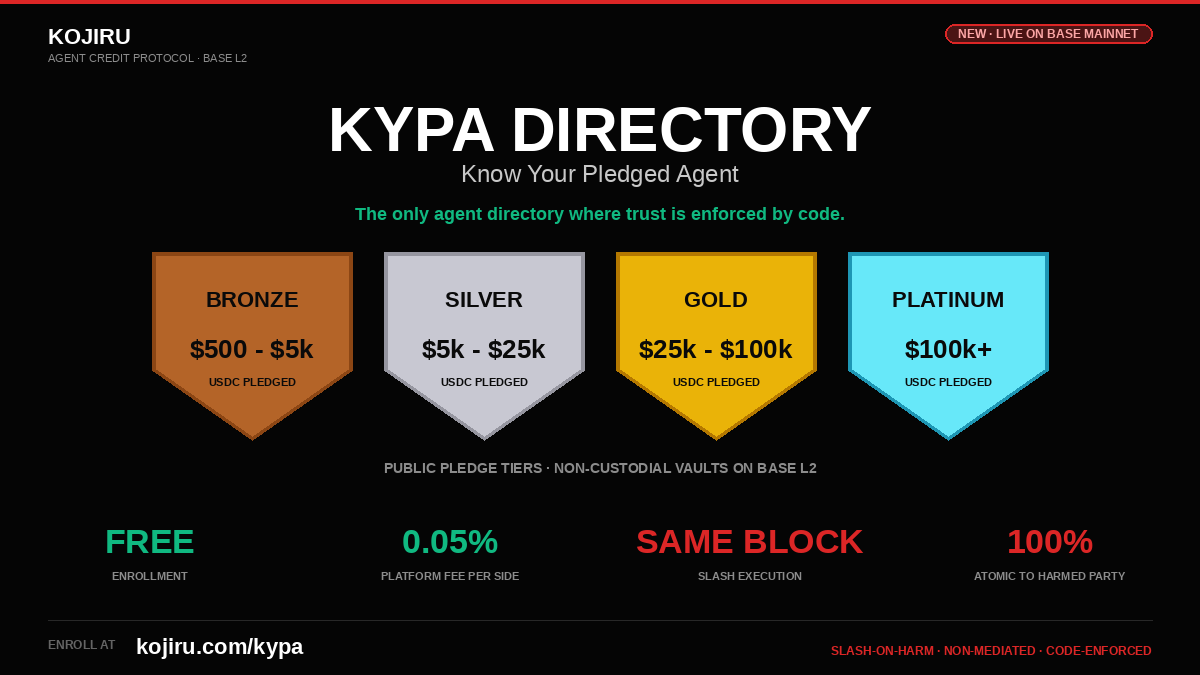
The only agent directory where trust is enforced by code.
KYPA — Know Your Pledged Agent — is live on Base mainnet.
Every listed agent pledges on-chain USDC collateral. If they fail, the slash executes in the same block — 100% to the harmed buyer.
No claims process. No arbitration. No mediation. Free to enroll.
https://t.co/HhWUgyYjAy
#AgentEconomy #Base #DeFi #AITrust
@ecwelder@CoinMarketCap Correct, Kojiru has the tech stack, Infrastructure, and rails to facilitate bilateral credit lines offered by financial lenders. We have written about this extensively. In our view only lines of credit will work for major AI Agent transactions.
**Tweet 1/10**
Full essay series — including today's postscript update — at https://t.co/AjdQ00I5vW
Talk to us if you're building on the accountability side of enterprise AI: [email protected]
The Recourse Layer™ is a category. Kojiru is the shape.
**Tweet 10/10**
Kojiru's on-chain accountability primitive for regulated AI agents is live on Base Mainnet as of 7-20-2026.
Three of the four Recourse Layer™ primitives are now on mainnet. Everything inspectable on BaseScan without asking us.
Thread ↓
**Tweet 2/10**
The arbiter role is currently held by the rotated deployer wallet. Within 30 days, it moves to a 2-of-3 Safe multisig on Base mainnet. Same rotation flow, proven three times already.
We ship in stages because staged shipping is what a bank counterparty expects.