You know what shook me when I was Muslim?
The story of Hosea. God tells a prophet to marry a woman He knows will betray him.
She does. She runs to other men. She ends up enslaved, sold, used up, worthless to the world.
And God tells Hosea to go BUY HER BACK.
To pay money for his own wife who cheated on him, and love her again. Hosea 3.
I thought it was the most humiliating command in the Bible. Why would any man do that?
Then I realized I was the wife.
I gave my heart to everything but God. I chased other masters. I sold myself cheap. I made myself worthless.
And God looked at me, the betrayer, and didn’t say “you’re not worth it.”
He said, “Name the price. I’m buying her back.”
That’s the Gospel. God doesn’t wait for the unfaithful to come crawling back clean.
He pays to redeem them while they’re still dirty.
Islam told me to make myself worthy of God.
Hosea showed me a God who pays to redeem the unworthy.
The cross was Him naming the price.
Praise the Lord.
A man said "I accept Jesus Christ" on his deathbed.
The church asked if he really meant it.
I need to ask you something.
When did we become the gatekeepers of grace?
I've watched Christians dissect Scott Adams' final words like prosecutors.
They parsed his phrases. They weighed his tone. They measured his faith against some invisible scale and found it wanting.
"That doesn't sound like surrender," they said. "That sounds like a man hedging his bets."
And I understand the instinct. I do.
But there's a verse that haunts me. Not because it's obscure—because it's too simple.
"Whosoever shall call upon the name of the Lord shall be saved."
(Romans 10:13)
Whosoever.
Not "whosoever truly believes in their heart of hearts." Not "whosoever demonstrates sufficient sincerity." Not "whosoever calls early enough in life that we trust their
motives."
Whosoever.
The moment we add prerequisites to that promise, we've traded the Gospel for religion.
We've smuggled works back in through the side door labeled "authentic faith."
I know what some of you are thinking.
But he admitted he wasn't a believer.
He talked about "risk and reward."
He said he hoped he'd "qualify."
Yes. He did.
And those words make us uncomfortable. They don't sound like the confident declarations we want from converts. They sound uncertain. Calculating. Human.
But here's what I need you to hear:
The thief on the cross didn't have time to develop mature theology either.
He was a criminal. Hours from death. He looked at Jesus and said, "Lord, remember me when you come into your kingdom."
That's it.
No profession of belief in the resurrection. No renunciation of his former life. No evidence of transformed character.
Just a desperate man, reaching for a hand he wasn't sure would take his.
And Jesus said, "Today you will be with me in paradise."
We have a problem, and it's not Scott Adams.
It's us.
We've internalized a law that God never gave us. A natural sense of fairness that says late arrivals should get less. That deathbed conversions are suspicious. That the math
should somehow work out—more faith, more years, more sacrifice equals more standing before God.
Jesus told a parable about this.
We skip over it because it offends us.
A landowner hired workers throughout the day. Some came at dawn. Some at noon. Some showed up with one hour left.
At the end, he paid them all the same.
The early workers were furious.
"These who were hired last worked only one hour, and you have made them equal to us who have borne the burden of the work and the heat of the day."
(Matthew 20:12)
And the landowner replied:
"I am not being unfair to you, friend. Didn't you agree to work for a denarius? Don't I have the right to do what I want with my own money? Or are you envious because I am generous?"
There it is.
The scandal of grace is that it feels unfair.
A man who mocked God for sixty years gets the same inheritance as the saint who served since childhood. A skeptic who hedged his bets at the last breath stands in the same kingdom as the martyr who gave everything.
And something in us recoils.
That's not grace rejecting us.
That's us rejecting grace.
Let me tell you what I see when Christians interrogate a dead man's faith.
I see the older brother standing outside the party, refusing to go in.
The prodigal came home reeking of pig filth and poor decisions. The father ran to him. Threw a robe on his back. Killed the fattened calf.
And the older brother?
"Look! All these years I've been slaving for you and never disobeyed your orders. Yet you never gave me even a young goat so I could celebrate with my friends. But when this son of yours who has squandered your property with prostitutes comes home, you kill the fattened calf for him!"
(Luke 15:29-30)
He couldn't celebrate the return because he was too busy auditing the journey.
Sound familiar?
Here's the truth we don't want to face:
We can't see hearts. We can only see words.
And the words Scott Adams spoke were: "I accept Jesus Christ as my Lord and Savior."
Were they perfect? No.
Were they confident? No.
Were they the words we would have scripted? No.
But they were the words.
And the God who receives those words is not checking for tone. He's not running sentiment analysis. He's not grading on a curve.
He's looking for open hands.
Paul wrote something that lands differently now:
"Who are you to judge someone else's servant? To their own master, servants stand or fall. And they will stand, for the Lord is able to make them stand."
(Romans 14:4)
Scott Adams was not our servant to judge. He answered to his own Master.
And the Lord is able—able—to make him stand.
That's not my promise. That's Scripture's promise.
The question is whether we'll submit to it.
I know why we do this.
I know why we parse and weigh and question.
Because if grace is really this free, then we didn't earn our place either.
If the deathbed convert gets in, then our decades of service weren't the price of admission. They were the privilege of knowing Him longer.
And that reframes everything.
It means the faith we've built isn't a resume. It's a relationship.
It means our years weren't buying something. They were receiving something.
It means we were never the workers earning a wage.
We were always the prodigals coming home.
So did Scott Adams get saved?
I don't know.
But I know what the Scripture says.
Whosoever shall call upon the name of the Lord shall be saved.
I know what Jesus promised the thief who had nothing to offer but a desperate plea.
I know what the father did when his son came crawling home with a rehearsed speech that never even got finished.
And I know what the landowner said to the workers who were angry that grace didn't do math the way they wanted.
"Are you envious because I am generous?"
The gate is narrow, but it's not locked.
The standard is high, but it's not ours to enforce.
The Judge is holy, but He is also the one who ran to meet the prodigal while he was still a long way off.
Stop auditing the dead.
Start marveling at the grace that let you in.
"Whosoever shall call upon the name of the Lord shall be saved."
Whosoever.
Even him.
Even you.
What saith the Scriptures?
That's the only question that matters.
They all look the same because they all worship the same god.
Not Satan.
Themselves.
But this isn't a sickness "spreading across the Left."
It's a harvest.
Seeds planted fifty years ago when men decided comfort mattered more than doctrine.
When churches traded truth for attendance.
When fathers traded presence for promotion.
When pastors traded conviction for applause.
The Left didn't create this.
They just stopped pretending.
The Right still goes to church on Sunday and lives like a pagan on Monday.
Same fruit.
Better packaging.
You want to fix this?
Stop blaming the harvest and ask who stopped tending the field.
Christian Apologist Wesley Huff @WesleyLHuff was recently on Joe Rogan's podcast @joeroganhq defending the faith as 1 Peter 3:15 commands us to do with "gentleness and respect."
Here are some of the biggest takeaways and the "fruit" which has been produced...
THREAD
Wesly Huff on Joe Rogan's show exposing Jordan Peterson's moralism & wrong views about Christ just being a moral example.
Rogan asks Huff "How do you define Jesus being against moralism?" And Huff explains the true meaning of the law was to show us our sin & need for a Savior
NEW ARTICLE: IVERMECTIN AND FENBENDAZOLE Testimonial - 70s yo Stage 4 Lung Cancer patient to liver: all lesions shrinking after 7 weeks!!
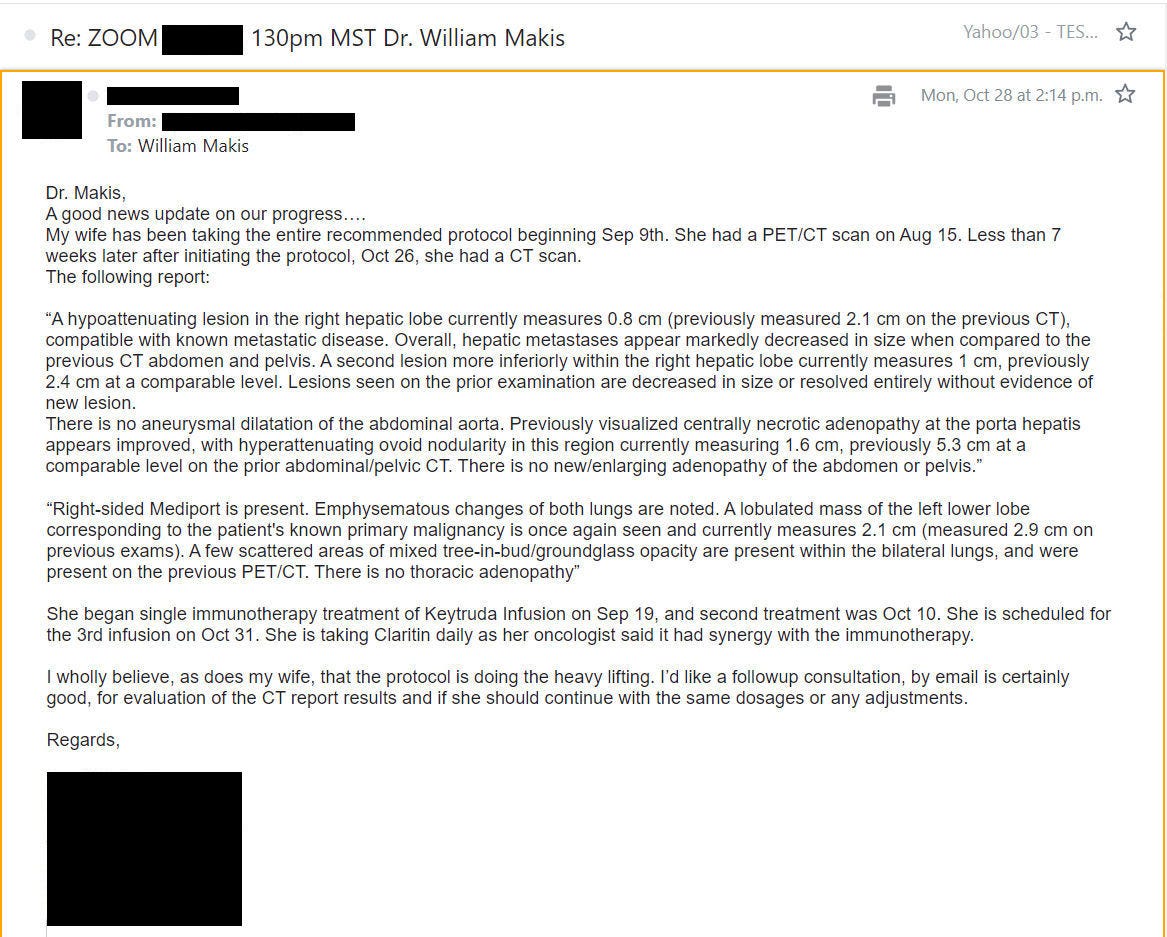
One of my cancer patients is a woman in her 70s with Stage 4 Lung Cancer with multiple liver metastases.
“Less than 7 weeks after initiating the protocol”
Primary Lung lesion LLL 2.9cm to 2.1cm
(28% decrease)
Liver at porta hepatis 5.3cm to 1.6cm (70% decrease)
Right hepatic lobe inferiorly 2.4cm to 1.0cm
(58% decrease)
Right hepatic lobe 2.1cm to 0.8cm (62% decrease)
“Overall, hepatic metastases appear markedly decreased in size when compared to the previous CT”
"I wholly believe, as does my wife, that the protocol is doing the heavy lifting".
I started doing Cancer Consultations three months ago and I've been attacked ever since. No one wants Cancer patients to have help outside a corrupt system.
Big pharma is extremely upset that the Ivermectin Revolution of Cancer Treatment can't be stopped.
I share the doses and protocol components in this particular success case, in my article.
So far, no support for cutting edge Ivermectin Cancer Treatments from Alberta Premier Danielle Smith.
Calgary may have a new $2 billion Cancer Centre, but it will not have any of these success stories (it remains shiny but empty)
Article Link in photo to avoid shadowban, just re-type the URL in the 1st photo at the top, into your browser to access
@ABDanielleSmith
#TurboCancer