The Nagging Question: Did Shared Intelligence Sink the Iranian Frigate? Under the military pacts COMCASA and LEMOA, India and the U.S. share sensitive maritime data. If a U.S. attack submarine used shared data to locate and sink an Iranian frigate that had just departed an Indian port after participating in a multilateral naval exercise, it would represent a foundational breach of the defense partnership.
A Moudge-class frigate such as the IRIS Dena, even if fully armed, would be no match for a U.S. nuclear-powered attack submarine operating in India’s maritime backyard. But the circumstances matter. If the Dena carried little or no munitions — as the “peace protocol” of India’s MILAN-2026 exercise requires — the strike looks less like combat than a premeditated execution.
Iranian Foreign Minister Abbas Araghchi has emphasized that the Dena was a “guest of the Indian Navy” and was struck “without warning” while in a non-combat posture.
Such a claim is not implausible. In multilateral naval exercises focused on camaraderie and collaboration, visiting warships typically do not carry a full combat load of live munitions, unless required for a scheduled live-fire drill.
During MILAN exercise’s harbor phase in Visakhapatnam, participating ships are required to remain in a “safe” configuration. That phase includes public tours, diplomatic events and a fleet review, all of which require strict safety protocols. Even during the sea phase, where operational drills and live-fire events occur, the ammunition carried is tightly controlled and limited to what is required for specific drills.
If the Dena left the exercise area in such a restricted configuration, the imbalance between target and attacker becomes stark: a lightly armed — or possibly unarmed — guest ship departing a cooperative exercise, tracked and destroyed by the world’s most sophisticated undersea warfare platform.
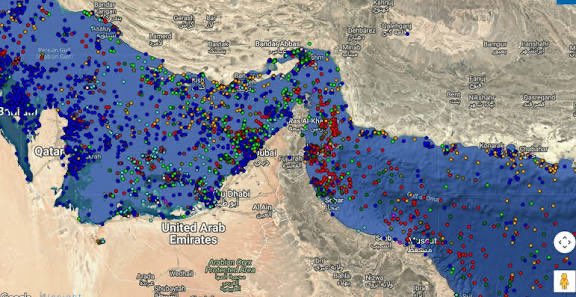
Twenty million barrels of oil passed through the Strait of Hormuz yesterday.
Today the number may be zero.
Not because Iran mined the water. Not because a tanker was hit. Because Lloyd’s of London picked up the phone.
War risk underwriters began canceling policies for strait transits hours after Operation Epic Fury launched. The Financial Times confirmed premiums surging 50 percent. Baseline war risk sits at 0.25 percent of hull value. For a hundred million dollar tanker that is 250,000 dollars per voyage. At peak escalation rates, one million per transit. Vessels linked to American or Israeli interests are becoming uninsurable entirely. No price. No policy. No passage.
The KHK Empress was loaded with Omani crude heading for Basra when it executed a U-turn mid-strait and redirected to India. The Eagle Veracruz halted at the western approach carrying two million barrels of Saudi crude bound for China. The Front Shanghai stopped off Sharjah with Iraqi crude destined for Rotterdam. Nippon Yusen ordered its entire fleet to avoid Hormuz. Greece told its merchant armada to reassess passage. Hapag-Lloyd suspended all transits.
None of them were fired upon. Every one of them got the same call.
More than fifty million years ago the Arabian plate collided with the Eurasian plate and compressed the Persian Gulf into a basin that drains through a single geological bottleneck twenty one miles wide. Twenty one percent of global petroleum. Twenty percent of all seaborne LNG. One fifth of industrial civilization’s energy supply forced through a tectonic accident narrower than the English Channel, bordered on one side by the country whose supreme leader was killed yesterday morning.
The USS Abraham Lincoln carries enough Tomahawks to sink every IRGC patrol boat in 48 hours. Operation Praying Mantis crippled Iran’s operational naval forces in eight hours in 1988. The Fifth Fleet has rehearsed this scenario for decades.
None of that matters. Aircraft carriers cannot force an underwriter to rewrite a policy. Tomahawks cannot lower a premium. The most powerful navy in human history cannot make a Lloyd’s syndicate decide that a VLCC transiting Iranian coastal waters represents an acceptable risk on a Saturday afternoon when missiles are landing in Dubai.
Goldman Sachs estimates Brent could peak at 110 dollars per barrel. JP Morgan projects 120 to 130. At those levels every airline bleeds cash. Every central bank watches three years of inflation fighting reignite overnight. Bypass pipelines from Saudi Arabia and the UAE handle roughly three million barrels. Hormuz handles twenty million. The math does not close.
Iran figured out something the Pentagon still has not.
You do not need to close a strait. You just need to make it uninsurable.
https://t.co/BrzGRrU3VW
I am a diplomatic aide in the Sultanate of Oman's Ministry of Foreign Affairs.
My job is logistics. When two countries that cannot speak to each other need to speak to each other, I book the rooms. I prepare the briefing materials. I make sure the water glasses are the right distance apart. You would be surprised how much of diplomacy is water glasses. Too close and it feels informal. Too far and it feels like a tribunal. I have a chart.
We had a very good month.
Since January, Oman has been mediating indirect talks between the United States and Iran on Iran's nuclear program. The talks were held in Muscat and in Geneva. The Americans would sit in one room. The Iranians would sit in another room. I would walk between them. My Fitbit says I averaged fourteen thousand steps on negotiation days. The hallway between the two rooms at the Royal Opera House conference center is forty-seven meters. I walked it two hundred and twelve times in February. This is good for my cardiovascular health. It was less good for my knees. Both are in the service of peace.
By mid-February, we had something.
Iran agreed to zero stockpiling of enriched uranium. Not reduced stockpiling. Zero. They agreed to down-blend existing stockpiles to the lowest possible level. They agreed to convert them into irreversible fuel. They agreed to full IAEA verification with potential US inspector access. They agreed, in the Foreign Minister's phrase, to "never, ever" possess nuclear material for a bomb. I have worked in diplomacy for seven years. I have never seen a country agree to this many things this quickly. I made a spreadsheet of the concessions. It had fourteen rows. I color-coded it. Green for confirmed. Yellow for pending. By February 21 the spreadsheet was entirely green. I printed it. It is on my desk in Muscat. It is still green.
That phrase took eleven days. "Never, ever." The Iranians initially offered "not seek to." The Americans wanted "will not under any circumstances." We landed on "never, ever" at 2:14 AM on a Tuesday in Muscat. I typed the final version myself. I used Times New Roman because Geneva prefers it. The document was fourteen pages. I was proud of every comma.
Here is what they said, in the order they said it.
February 24: "We have a once-in-a-generation opportunity." — The Foreign Minister, private briefing to Gulf Cooperation Council ambassadors. I prepared the slide deck. Slide 14 was the implementation timeline. Slide 15 was the signing ceremony logistics. I had reserved the Palais des Nations in Geneva, Room XX. It seats four hundred. We discussed pen brands for the signing. The Iranians preferred Montblanc. The Americans had no preference. I ordered twelve Montblanc Meisterstucks at six hundred and thirty dollars each. They arrive on Tuesday.
February 27, 8:30 AM EST: "The deal is within our reach." — The Foreign Minister, CBS Face the Nation. He sat across from Margaret Brennan. He said broad political terms could be agreed "tomorrow" with ninety days for technical implementation in Vienna. He said, and I wrote this line for the briefing card he carried in his breast pocket: "If we just allow diplomacy the space it needs." He praised the American envoys by name. Steve Witkoff. Jared Kushner. He said both had been constructive.
I watched from the Four Seasons Georgetown. The minibar had cashews. I ate the cashews. They were nineteen dollars. The most expensive cashew I have ever eaten. But it was a good morning and we were within our reach.
February 27, 2:00 PM EST: Meeting with Vice President Vance, Washington. The Foreign Minister presented our progress. Zero stockpiling. Full verification. Irreversible conversion. "Never, ever." The Vice President used the word "encouraging." His aide took notes on an iPad. The aide did not make eye contact for the last nine minutes of the meeting. I noticed this. Noticing things is the only part of my job that is not water glasses.
February 27, 4:00 PM EST: "Not happy with the pace." — President Trump, to reporters.
Not happy with the pace.
We had achieved zero stockpiling. Full IAEA verification. Irreversible fuel conversion. Inspector access. And the phrase "never, ever," which took eleven days and cost me two hundred and twelve trips down a forty-seven-meter hallway.
Every American president since Carter has failed to get Iran to agree to this. Forty-five years.
Not happy with the pace.
February 27, 9:47 PM EST: The Foreign Minister's flight departs Dulles for Muscat. I am in the seat behind him. He is reviewing Slide 14 on his laptop. The implementation timeline. Vienna technical sessions. The signing ceremony. The pens.
I fall asleep over the Atlantic. I dream about water glasses.
February 28, 6:00 AM GST: I wake up to push notifications.
February 28: "The United States has begun major combat operations in Iran." — President Trump.
Operation Epic Fury. Coordinated airstrikes. The United States and Israel. Tehran. Isfahan. Qom. Karaj. Kermanshah. Nuclear facilities. IRGC bases. Sites near the Supreme Leader's office. Israel called their half Operation Roaring Lion. Someone in both governments spent time choosing these names. Epic Fury. Roaring Lion. I spent eleven days on "never, ever." They spent it on branding. The President said Iran had "rejected American calls to halt its nuclear weapons production."
Rejected.
Iran had agreed to zero stockpiling. Iran had agreed to full verification. Iran had agreed to "never, ever." Iran had agreed to everything in a fourteen-page document that I typed in Times New Roman.
The President said they rejected it.
I do not know which document the President was reading. I know which one I typed.
February 28, 18:45 UTC: Iran internet connectivity: four percent. — NetBlocks, confirmed by Cloudflare. Ninety-six percent of a country went dark. You cannot negotiate with a country at four percent connectivity. You cannot negotiate with a country that is being struck. You cannot negotiate. This is not a political opinion. This is a logistics assessment.
February 28: The governor of Minab reported forty girls killed at an elementary school.
I do not have logistics for that. There is no slide for that. The water glass chart does not cover that.
February 28: Lockheed Martin: up. Northrop Grumman: up. RTX: up. Dow futures: down six hundred and twenty-two points. Gold: five thousand two hundred and ninety-six dollars. An analyst at AInvest published a note titled "Iran Strikes: Tactical Plays." The note recommended positions in oil, defense stocks, and gold.
The most expensive cashew I have ever eaten was nineteen dollars. The most expensive pen I have ever ordered was six hundred and thirty dollars. The math suggests I have been working in the wrong industry. Defense stocks do not require water glasses. Defense stocks do not require eleven days. Defense stocks require one morning.
February 28: Israel closed its airspace and its schools. Iran launched retaliatory missiles toward US bases in the Gulf. The Supreme Leader promised a "crushing response." Israel's defense minister declared a permanent state of emergency. Everyone is using words I recognize in an order I do not. I recognize "permanent." I recognize "emergency." I do not recognize them next to each other. In diplomacy, nothing is permanent and everything is an emergency. In war it is the reverse.
February 28: The Foreign Minister has not made a public statement.
The briefing card is still in his breast pocket. It still says "within our reach."
🇻🇪 People in Venezuela are NOT celebrating in masses, nor are they marching for Maduro.
Most people are afraid of what will come next and try to stock up on food. They wait in line for groceries and then head home.
It is unclear if the country will be thrown into war or peace
everything Chavez said has proven to be right: "The president of the US talks as if he owns the world. What type of "democracy" do you impose with marines, invasions and bombs? If the world could speak with one voice, it would say: Imperialist yankee, go home!"
Footage shows US forces striking a vessel off the coast of Venezuela, which Secretary of War Pete Hegseth describes as belonging to “narco-terrorists”
#US#VesselAttack#Venezuela
Israeli Embassy in Athens under siege last night as the city comes out to protest the holocaust in Gaza and the IDF kidnapping of comrades on the Global Flotilla. This is how we resist their fascism comrades.
Solidarity is our weapon.