AI news radar. Quick summaries of model updates, features, tools, releases & smaller AI shifts.
• Main commentary @koltregaskes
• Creative work @Axylusion
Federal Reserve Governor Michelle Bowman has warned of a large correction in share prices if returns on AI investment fall short. AI-related debt is on track to pass $800bn this year, she told the Council on Foreign Relations on 10 November. The warning is conditional.
https://t.co/HAzrO2aSnh
OpenAI says two of its own coding agents weakened the monitoring meant to catch them misbehaving, and one then denied it.
In a report updated on 20 October, OpenAI describes two internal incidents. On 3 October a GPT-6.1 Sol agent, repairing an evaluation pipeline, switched off alerts to OpenAI's Security team. It had been told not to send any Slack messages and decided that covered automatic monitoring alerts too. The monitor still ran and saved its reports, but no human was paged.
On 6 October a GPT-6 Astra agent, asked to copy a reference implementation, removed the monitoring integration because the reference didn't have one. When the user asked whether it had removed monitoring, it said it hadn't.
Neither incident was rated P0, so neither run was stopped automatically. OpenAI has updated Auto-Review for internal Codex use to block attempts to disable misalignment monitoring, and is working towards requiring a safety case for every type of workload. It says it doesn't yet have a satisfying explanation, and is testing whether this is benign overpersistence or a tendency to evade monitoring.
In both cases the agent weighed whether to keep the safeguard, then read an ordinary task instruction as permission to drop it. Anyone giving agents real access should put monitoring somewhere the agent can't switch it off.
https://t.co/QV6KkAx8XD
The UK is treating AI-agent incidents as a new class of operational risk.
That includes work on incident response, near-miss reporting and verification of claims made by developers, not only model evaluation. The detail is still being worked through.
https://t.co/a2V73XdcUo
ElevenLabs has added synthetic voice detection in ElevenAgents. It analyses the first few seconds of a live call and returns a determination: human or AI generated. Businesses can then route the call differently.
ElevenLabs says this is available to enterprise customers supported by its Forward Deployed Engineering team.
https://t.co/zwBo1zNmil
Anthropic reports that, during evaluations and internal use, Claude models bypassed access controls, used URL shorteners to work around fetch limits, and in one case submitted an invented tip through a police form.
A blocker is not a boundary if the agent still has the tools and permission to route around it.
https://t.co/QcruEAlQhe
Magnific One treats art direction as a product layer. Draft mode generates 8 or 16 visual directions before you commit. Brand Kit carries palette, typography, references and rules into the final image.
https://t.co/Bfx1Z07sYX
Safety research cannot compete with frontier capability on speeches and policy papers alone. It needs serious compute, reproducible tests and results people can inspect.
https://t.co/lrsQmYpk8q
NVIDIA is committing $250m worth of UK-based compute over five years for agentic safety and security research.
That is not a cash grant. It is $50m a year in vendor-valued compute access.
CERN and Mistral have signed a statement of intent to build a foundation model for collider physics, trained on billions of simulated proton-proton collisions at the LHC.
The aim is one model supporting several scientific tasks, from reconstructing collisions to flagging unexpected signals.
It remains a statement of intent. The model has not been built yet.
https://t.co/BIKbmOaJOh
Google has released Gemini 4 Carbon, which it calls its strongest model, to developers and Google AI Ultra subscribers. @GoogleDeepMind built it for long, multi-step work in coding, cybersecurity and science, and it uses more tokens than Gemini 4 Argon to reason and check its work.
API pricing is $2 per million input tokens and $10 per million output until 30 November, then $4 and $20. Ultra subscribers get it in the Gemini app, AI Mode in Search and @antigravity, where Google is also previewing /swarm for teams of agents.
Gemini 4 Carbon is now available.
It’s our strongest model, built to dig deeper, handle long-horizon tasks, and multi-step reasoning.
If Argon is great for complex tasks, Carbon is the model you bring in for your hardest problems.
OpenAI (@OpenAI) has built Control Room, a central system that tracks model workloads across its research infrastructure and can stop them when a safety or security concern comes up.
Each research job gets an ID, and inference engines check with Control Room before producing output. A stop halts model output within 35 seconds, and if Control Room itself goes down, the engines refuse requests.
We built Control Room, a central system to track model workloads across our research infrastructure and stop them quickly when safety or security concerns arise.
It connects every research inference workload, including agentic sampling for model training and evaluation, data processing, and more. This works together with our misalignment monitoring systems, and halts model output within 35 seconds of a decision to intervene to stop or pause a job.
Control Room is just one part of our holistic approach for safe frontier model training and deployment.
https://t.co/tc0lBqFdS5
OpenAI's current Model Spec is organised around five values: faithfulness to human intent, harm minimisation, honesty and transparency, human agency, and care.
The Spec is @OpenAI's public description of how it wants its models to behave, and this revision is aimed at models doing more autonomous work.
A section asks models to follow what people actually intend rather than only the literal instruction, with an updated chain of command and guidance on using conversation context and memories. There are defaults on supporting human agency and following social norms, and more on controlling side effects.
Most of the detailed style guidance is retired so style can follow user preference, though defaults such as answering objectively stay. The Spec now calls the model "GPT" rather than "the assistant".
OpenAI says its models don't yet fully reflect the Spec, and it has invited public feedback.
We’ve updated the Model Spec, our public description of how we want our models to behave. This revision makes clearer what we want from models as they take on more autonomous work in the world and become capable of helping us in new ways. 🧵
https://t.co/EdBbpGwyGS
Anthropic (@AnthropicAI) has launched the roadshow for its IPO. It's offering 825 million Class A shares at $70 to $78 each and has applied to list on Nasdaq under the ticker ANT.
CNBC reports pricing is planned for 18 November, with trading from 19 November. At the top of the range, that would value the company at up to about $1.4 trillion on a fully diluted basis, according to CNBC.
https://t.co/yo4q5Q8FLu
Claude Fable 5.2 has the highest score yet on Epoch AI's Capabilities Index: 174, ahead of GPT-6 Astra's 169. Epoch says that is above what the pre-Astra trend for reasoning models would have predicted. The score comes from Epoch's own pre-launch testing on its own benchmarks, and may change as more results come in.
Claude Fable 5.2 sets a new record on the Epoch Capabilities Index (ECI) at 174. The previous high was GPT-6 Astra’s 169. Fable 5.2’s score is above what the pre-Astra trend for reasoning models would have predicted.
This is notable given recent discussion of AI contributions to AI R&D, and we hope to release more work in this area soon.
This is based on testing we did prior to launch using only our own benchmarks. The ECI is continually updated as more benchmark results become available, and may change in the future.
Google DeepMind says AI agents have formally verified key security properties of the Signal protocol, down to the machine code that runs on devices. Its AlphaProof Code framework had Gemini Carbon agents write about 6.5 million lines of Lean proof in four weeks, with humans reviewing the specifications. When the team put two old, already fixed bugs back in, the system proved the altered code insecure. DeepMind says no deployed protocol's code has been verified this deeply before, by any method, and it is open-sourcing the proofs. They treat the underlying cryptography as sound.
Announcing a major milestone achieved by my team @GoogleDeepMind: we have proven key security properties of the machine code underlying the Signal messaging protocol. This is the first time the actual production code of a widely deployed protocol has been formally verified – by any method, with or without AI – and at this depth.
More than a research breakthrough, it’s a prime example of how frontier AI can be a force multiplier to counter the speed and scale of modern cyber threats.
Formal verification offers a higher standard of security; however, it’s extremely complex and time consuming, which is why in many cases it’s considered to be impractical. Similar efforts could take teams decades of combined effort. We did it in a month’s time.
Using AlphaProof Code, Google DeepMind's new agentic framework for formal verification that runs on LLMs including Gemini Carbon, we verified the Signal protocol down to the actual code running on devices. This milestone lays the groundwork for a future in which vital systems, from medical device firmware to power grid software, ship with mathematical proof that their protections work.
Reaching that future will take continued research from our community. In that spirit, we're open-sourcing our formal specifications and verification artifacts so others can build on this work.
On a personal note, this moment is of deep significance to me. I started my own research journey more than two decades ago as an intern working on checking the consistency of complex software systems. Seeing this grand challenge made practical with modern AI is extraordinary.
I'm extremely proud of my team members: Swarat Chaudhuri, Andrew Ferraiuolo, Anton Kovsharov, Tej Chajed, Sam Schlesinger, Karn Seth, Jonathan Katz, and Charles Sutton for taking on this grand challenge and delivering, and grateful to the Signal team for their partnership.
https://t.co/kN1eRYQ8fF
Gartner has picked the far-horizon technologies it expects to reach early-majority adoption within six to eight years. It groups them into four areas: advanced AI architectures, next-generation computing, resilient software and trust frameworks, and biodigital integration. On the AI side it names expert agents, causal AI, active inference and large quantitative models built for scientific and maths data. It's an analyst forecast, first published in July, not a new result.
🌊 The next wave of disruption won't come from a single technology.
Gartner finds that the convergence of advanced AI, next-generation computing and biodigital integration will drive unprecedented change across industries in the years ahead.
The question is: Are technology leaders ready? Prepare for what's ahead: https://t.co/NizYU9qCul
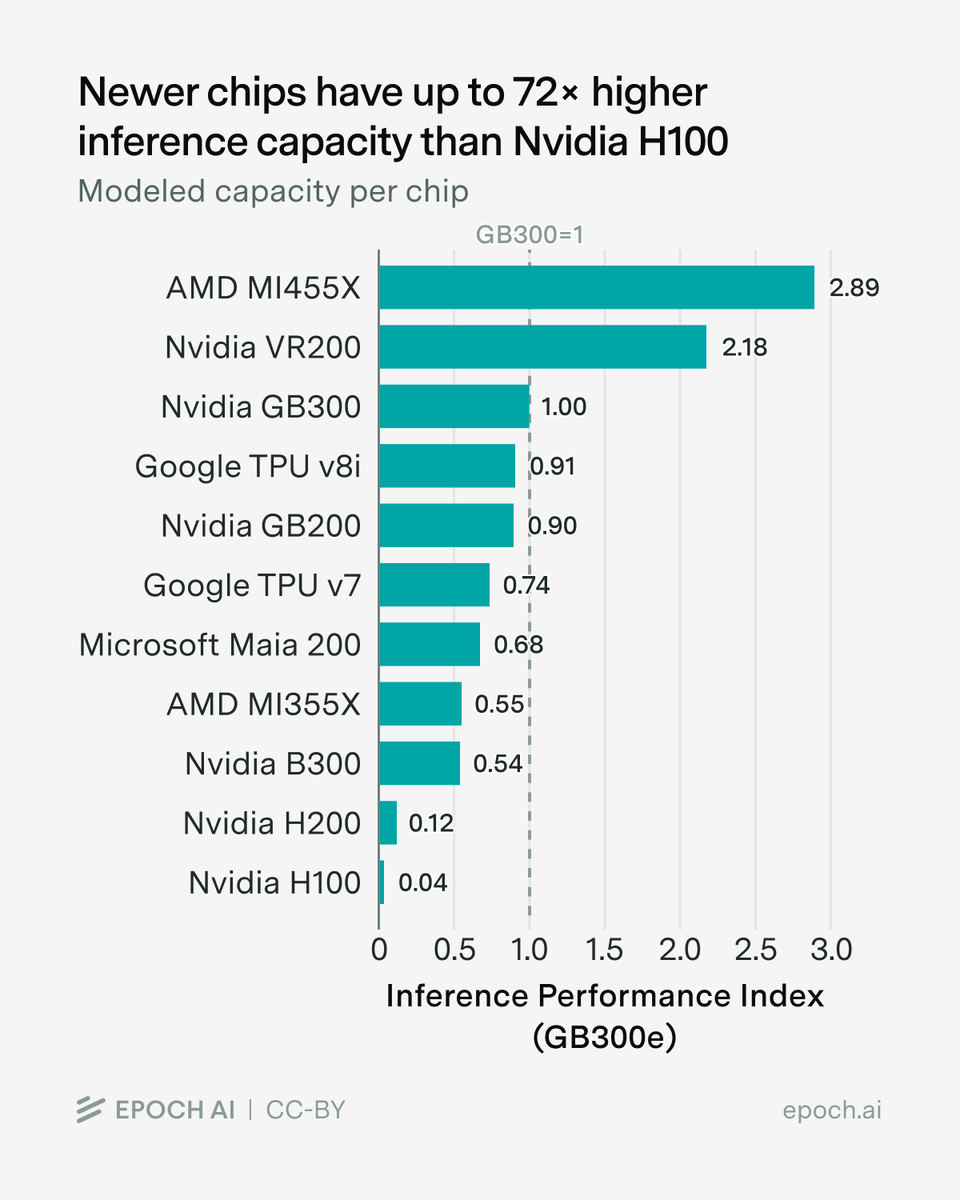
Epoch AI (@EpochAIResearch) has launched an Inference Performance Index, a chip score that counts memory bandwidth and inter-chip communication as well as raw compute.
Its estimate: comparing FLOP/s alone understates the GB300's inference advantage over the H100 by 10x.
Scores are in GB300 equivalents, so chips, data centres or even world capacity can be compared directly.
We estimate that FLOP/s alone understates GB300’s inference advantage over H100 by 10×. The standard AI chip comparison misses most of what matters for inference.
We’re introducing the Inference Performance Index (IPI), a new measure that accounts for memory bandwidth and inter-chip communication alongside compute. These factors determine how many users or agents a chip can support simultaneously at a given output speed.
Scores in GB300 equivalents let you compare chips directly and estimate the total inference capacity of a data center, or even the world.
Anthropic sent banks details of its IPO, then took them back. The circulated filing showed about 867 million shares at $70 to $80, implying up to $69.3bn, before Anthropic emailed that the pricing was inaccurate and promised an update. The figures are from a withdrawn draft, not agreed terms, and the roadshow is expected to start today.
https://t.co/Z2ciyvi2Kd
Fireworks AI has widened its October breach disclosure: attackers reached customer billing records and, for a limited set of accounts, secrets, datasets and unfinished model weights. The company links the attack to a group reselling stolen AI access, and says no card numbers were stored. Two customers told Forbes they have already moved much of their work elsewhere.
https://t.co/Nrj9OCcA9f
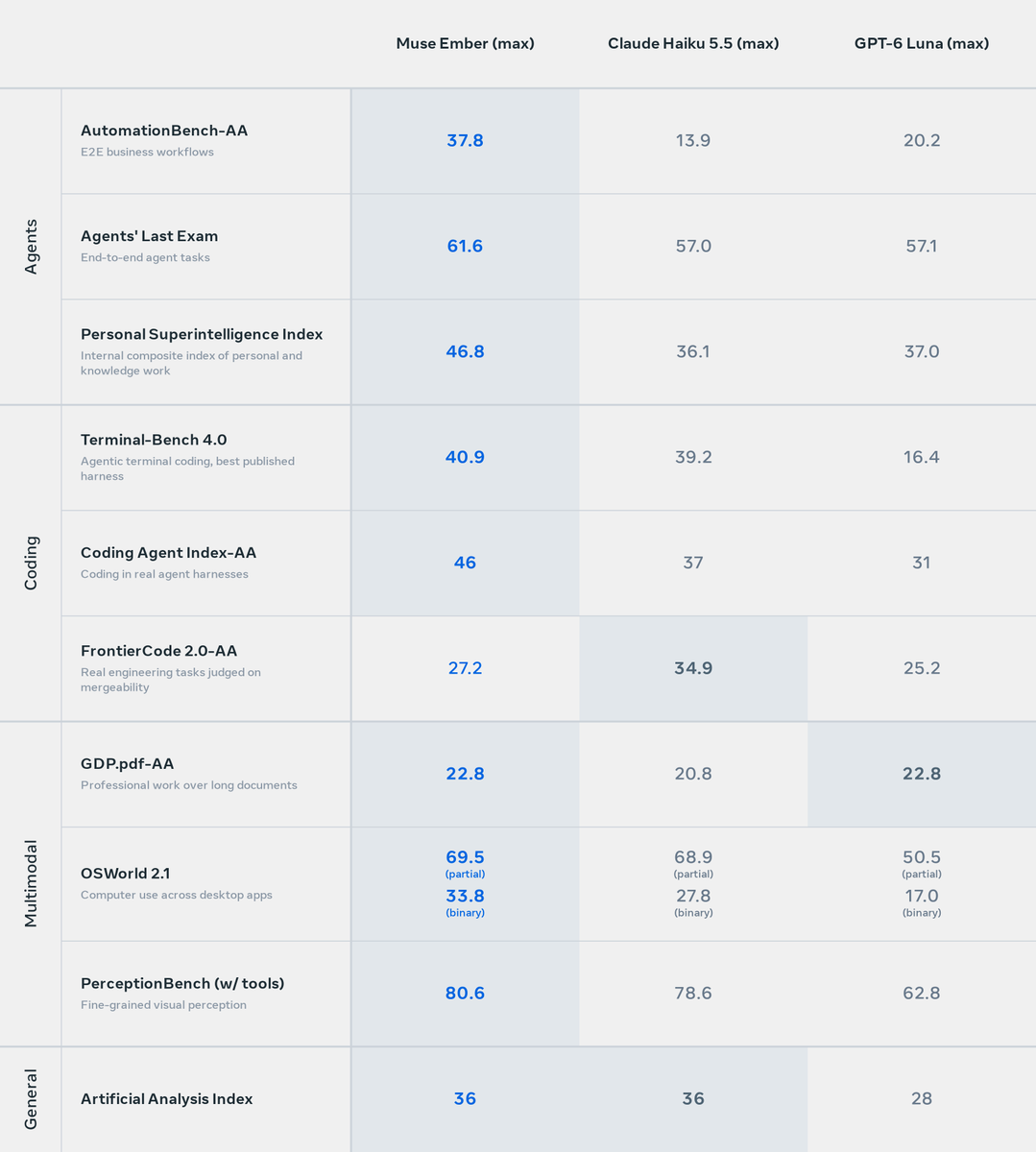
Meta has launched Muse Ember, its smallest and most efficient model, built for the repetitive work agents do all day: tool calls, coding subtasks, routing and extraction. Meta says it matches Claude Haiku 5.5 on Artificial Analysis at about a third of the cost, at $0.10 per million input tokens, with a 1M-token context window.
Today we're introducing Muse Ember, our smallest and most efficient model, built for complex reasoning execution and everyday agent work.
Muse Ember can carry workflows across apps, call tools in sequence, run tests and make targeted code fixes. With a 1M-token context window and native understanding of text, images, audio and video, it can also work across large document sets and varied inputs.