4 themes. 5 layouts. 1 navigation config for the whole portal.
Kong Konnect Dev Portal ships all three today. Every one is opt-in, and switching a theme back is a single setting.
Previews + details: https://t.co/vjFUlrK8ig
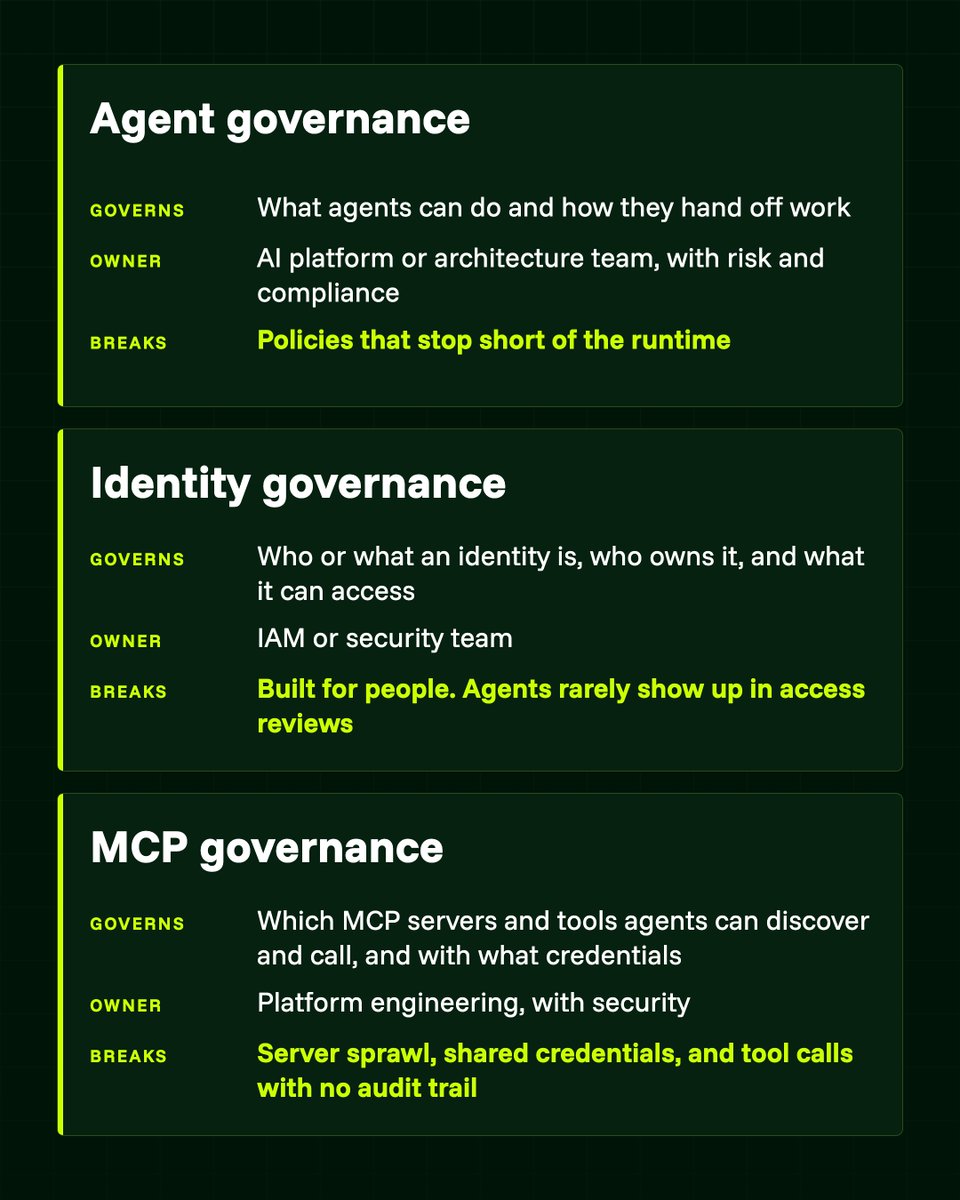
The terms agent, identity, and MCP governance tend to get used interchangeably. They aren't the same thing, and the differences explain why most programs end up with three separate stacks.
Here are those differences. ⬇️
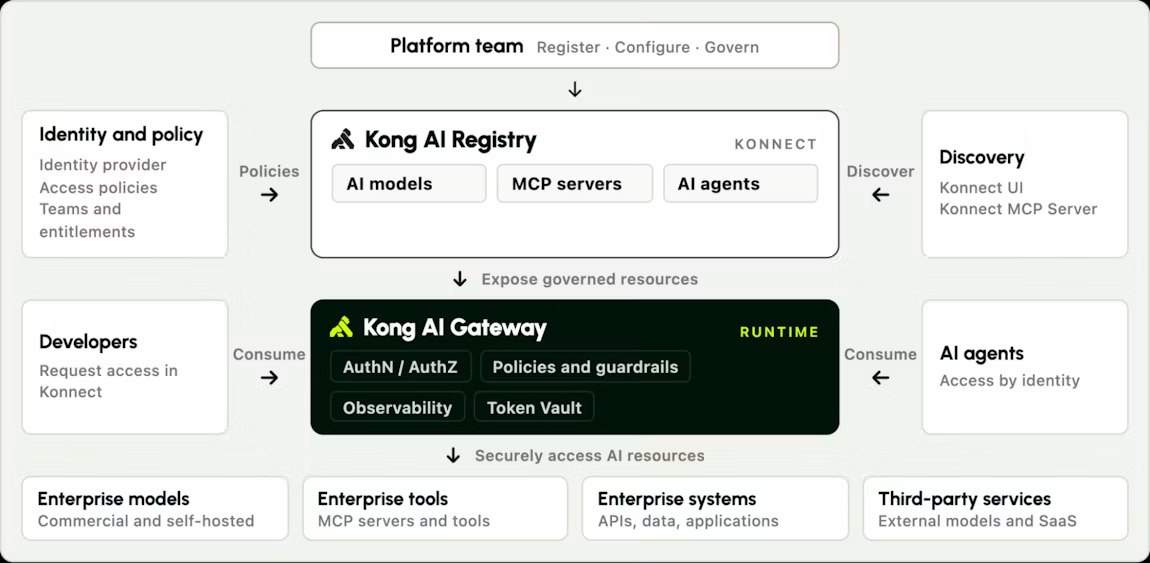
Hard-coded agent connections don’t scale. Every new model, MCP server, or agent means reconfiguring every agent you already have.
Kong AI Registry gives agents one governed catalog to discover from. Register once. Control who sees what.
👉 https://t.co/e6BYzSvdoS
"It's like under 5%." – Kong CEO @sonicaghi on open-weight AI adoption among its largest enterprise customers.
"The long tail will always go for the cheapest intelligence to get stuff done. But in large, large, large enterprise, most of the spend is still on the usual suspect, whether it's Anthropic or OpenAI."
An agent goes sideways at 2 a.m. Revoking its access shouldn’t mean rotating a key that fourteen services share.
Kong Token Vault keeps credentials out of the agent, so revocation is one targeted action.
👉 https://t.co/YD4OeR3DD2
A secrets manager has to trust whoever it hands the secret to.
With agents, that’s the party you trust least.
Kong Token Vault injects per-user OAuth credentials at the gateway, so the agent never holds one. https://t.co/EMNSbflTix
Your agent replays a thinking block after the context changed. The provider returns a 400. Your user returns a very short message. Kong AI Gateway 2.3 now drops the stale block by default on Anthropic, Vertex, Azure Foundry and Bedrock.
A valid login and a valid token can still read other customers’ invoices. Change one number in the request and you’re in.
That’s BOLA, the #1 risk on the OWASP API Security Top 10. Authentication says who you are. Ownership checks say what you can touch.
https://t.co/1N87HK9PtH
AI agents are the newest Kafka clients, and there are a lot of them. Hand-written ACLs won’t scale.
Kong Event Gateway turns onboarding into policy: OAuth, mTLS, field encryption, per-agent data slices. One cluster, many virtual views.
https://t.co/sIa0z88fYX
Your AI bill says “OpenAI: one line item.”
It should say which team, which app, which agent, and which loop ran all weekend. Attribution belongs where every request already passes through: the gateway.
https://t.co/zZjlfPUg0C
Day-0 support for Fable 5.2 on Kong means:
▪︎ Detailed Fable 5.2 pricing updates (across providers) in the Konnect price catalog
▪︎ Fable 5.2 cost tracking and budgets
▪︎ Switching agents over to Fable 5.2 with minimal business disruption
And a lot more...all on day-0.
Learn more about Kong AI Management: https://t.co/yFv5E8iWCc
Self-host an LLM and the endpoint ships with no API keys, no rate limits, no usage reporting. Here’s the fix in six steps: Kong authenticates, llm-d picks the vLLM replica, the response streams back. https://t.co/RZ2ZhXz0A0
Every MCP provider does AuthN/Z differently. Token Vault in Konnect stores users' credentials for GitHub, Slack, Atlassian etc. and releases them only to Kong AI Gateway, which injects them. The agent never holds the credential.
Preserved thinking binds thinking blocks to the conversation prefix that produced them. Replay one after the context changed and you get a 400. Kong AI Gateway 2.3 now enables drop_block by default on Anthropic, Vertex, Azure Foundry and Bedrock.
ACLs decide whether you can ask. They never read the request. Event Gateway 1.3’s Request Rule Validator does: write rules on partition count, replication factor, and naming, then reject violations or log them. https://t.co/HfE2F2L0ru
Kong AI Gateway now runs fully hosted on Dedicated Cloud Gateways in AWS and Azure. Pick the cloud and regions; Kong provisions, scales, and upgrades. Add Managed Cache and token counters and semantic cache vectors live there too. No Redis to run. https://t.co/G8a5Okbe0h
Managed Cache is the data store for your AI policies, including token rate limiting counters and semantic cache vectors. Valkey on AWS, Azure Managed Redis on Azure. Provisioning takes about 20 minutes. Prefer your own Redis? Point your policies at it.