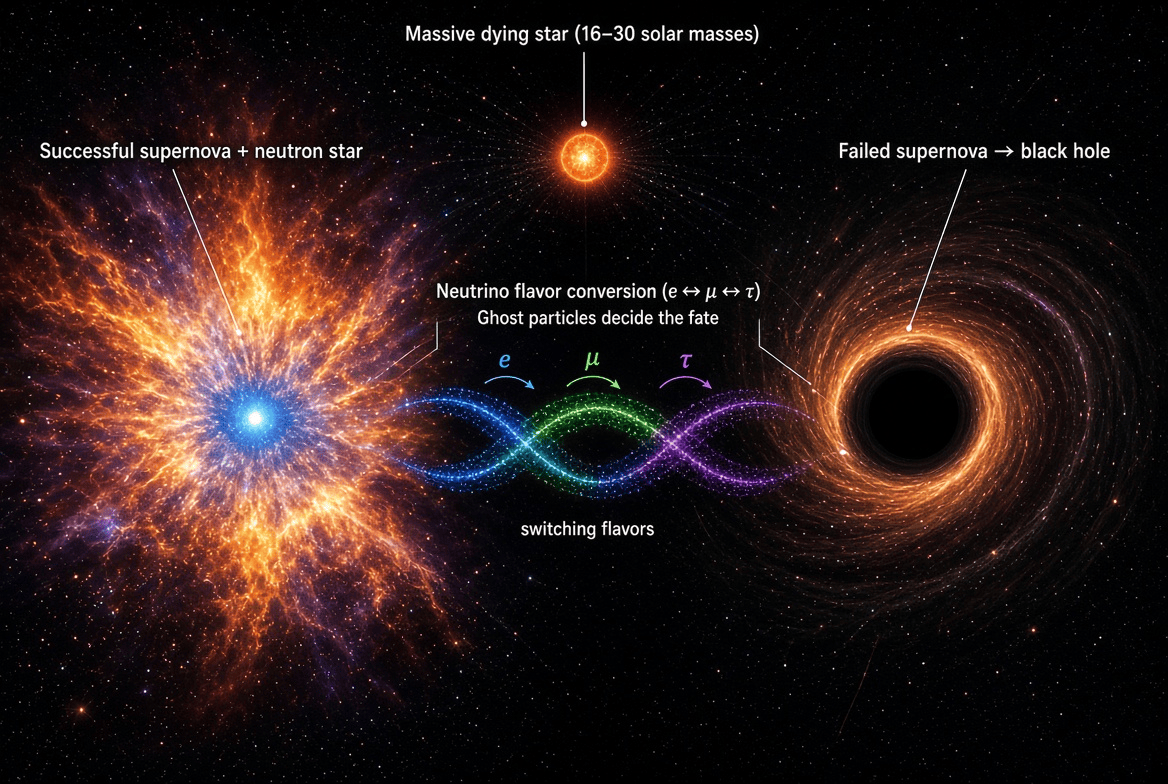
A massive star on its deathbed has two possible endings: a spectacular supernova that leaves behind a neutron star, or a silent collapse into a black hole. For decades that choice has been one of astrophysics’ great unsolved mysteries. New work from the University of Copenhagen suggests the answer may hide in the most elusive particles in the universe: neutrinos.
Neutrinos are nicknamed “ghost particles” because they barely interact with anything. They come in three flavors—electron, muon, and tau—and they can switch between them. Until now most researchers assumed those flavor changes were a curiosity that didn’t actually decide whether a star exploded or vanished.
Mariam Gogilashvili and Irene Tamborra decided to test that assumption. Simulating a dying star is already at the edge of what supercomputers can handle. Adding neutrino flavor conversion made it even harder, so the team built a simplified model and ran 195 collapse simulations of stars ranging from 9 to 120 solar masses. They compared runs with flavor conversion switched on and off, and they triggered the conversion at different densities inside the star.
The results were striking. For stars between about 16 and 30 solar masses, the neutrinos’ flavor-switching behavior flipped the outcome. Stars that exploded in one set of simulations collapsed into black holes in the other. When the researchers lined up all 195 cases, a clear pattern emerged: neutrino flavor conversion is not a side note. It can decide the star’s fate.
That finding may also solve a long-standing observational puzzle known as the supernova rate problem. Theory predicts more supernovae than telescopes actually see. If flavor conversion makes “failed supernovae”—stars that collapse straight into black holes without a bright explosion—more common, then many dying stars would simply disappear from our counts, hidden by dust or never lighting up in the first place.
The story is bigger than explosions and black holes. Massive stars forge the heavy elements that later become planets and people. When they explode, they scatter those ingredients across the galaxy. Understanding whether a star detonates or implodes is therefore also a question about where the atoms in our bodies came from.
Ghost particles, it turns out, may be the quiet referees of stellar death—and of our own cosmic origins.
A magnetic storm on the Sun, frozen in a single dark eye.
This sunspot looks black only by comparison. Its umbra is still thousands of degrees hot — just cooler than the boiling photosphere around it, because intense magnetic fields stand almost straight out of the surface and choke the rising columns of superheated plasma. Those same convective cells, blocked inside the spot, keep bubbling freely outside it, stitching the restless, rice-grain pattern of granulation you see at the edges.
The image was taken in near-ultraviolet light at 396.8 nm — close to the calcium H line — on 2 July 2010 with the Swedish 1-metre Solar Telescope at Roque de los Muchachos on La Palma.
Credit: Swedish 1-m Solar Telescope / Luc Rouppe van der Voort
How Long Does the Moon Take to Orbit Earth? 🌕🌍
The Moon takes about 27.3 days to complete one orbit around Earth relative to the distant stars. This is called the sidereal month.
But there’s another important number: it takes about 29.5 days for the Moon to return to the same phase, such as from one Full Moon to the next. This difference happens because Earth is also moving around the Sun.
And because the Moon rotates once on its axis in about the same time it takes to orbit Earth, we always see nearly the same side of the Moon. 🌙
#Moon #Astronomy #Space #Science #Earth #Universe
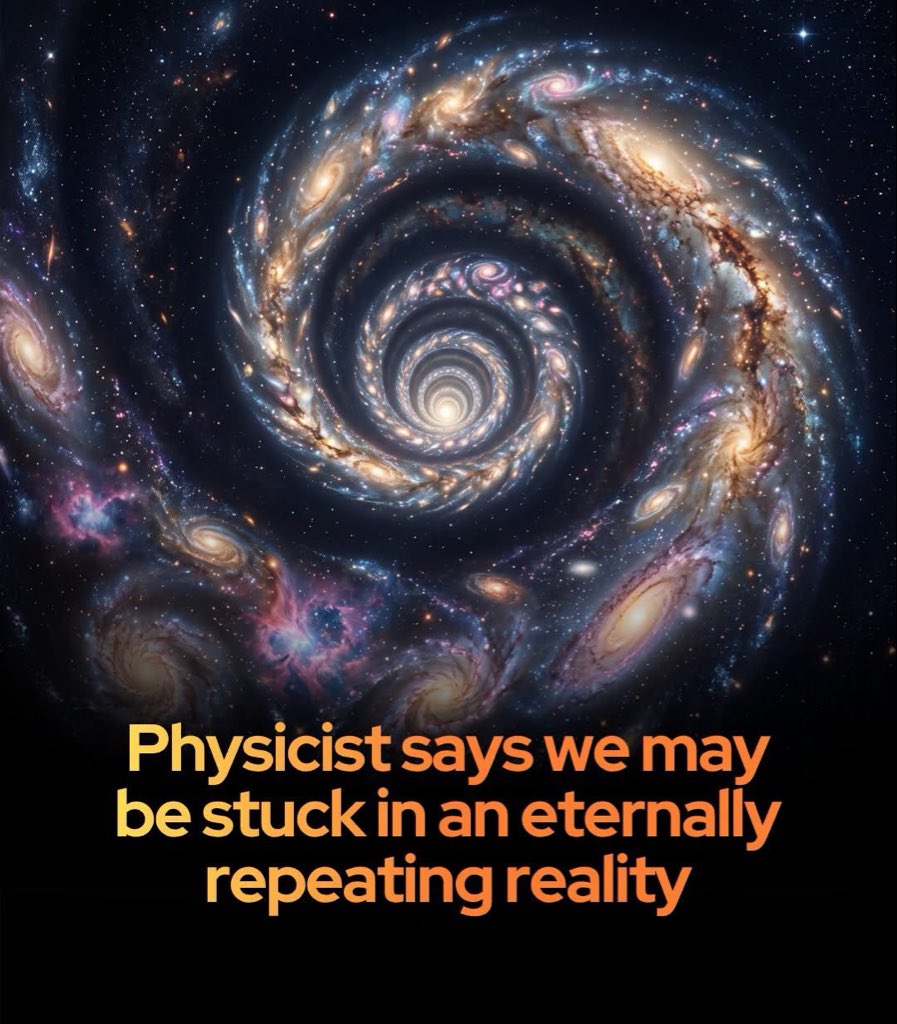
🚨 WHAT IF THE UNIVERSE HAS ALREADY HAPPENED… AN INFINITE NUMBER OF TIMES?
For years, physicists have wrestled with a strange problem known as the Boltzmann Brain paradox. In an unimaginably old and nearly empty universe, random quantum fluctuations could, in principle, produce something far stranger than stars and galaxies: a single conscious observer, complete with artificial memories of a life that never actually happened.
A new paper by physicists Sean Carroll, Nadiia Diachenko and Saakshi Dulani explores a very different possibility. Their model describes a universe that is exactly periodic rather than merely returning close to its previous state after an enormous amount of time.
The key lies in the quantum energy spectrum. Under a special condition where the differences between energy levels are commensurable, the quantum state can repeat exactly. The researchers show that such a system could contain a pronounced low-entropy event resembling a Big Bang, followed by expansion, a long high-entropy phase, and eventually a return toward a Big Crunch — before the cycle begins again.
If such a universe were physically realized, the same cosmic history could repeat over and over again. The stars, galaxies, planets and even the events experienced by observers could recur as part of the same enormous quantum cycle.
But there is an important catch: this is a theoretical model, not evidence that our universe actually repeats. The paper does not prove that every conversation we have or every decision we make has already happened infinitely many times. It shows that quantum mechanics may allow a type of exactly periodic universe in which the usual Boltzmann Brain problem can be avoided.
If the universe really is a perfect cosmic loop, where would you be in the cycle right now — at the beginning, somewhere in the middle, or at a moment that has already happened countless times before?
Source: Sean M. Carroll, Nadiia Diachenko & Saakshi Dulani, Toward a Phenomenologically Acceptable Quantum Cyclic Universe, arXiv:2605.30405 (2026)
Chinese astronomers logged a “guest star” so bright it burned in daylight for weeks — the death of a star in Taurus, now known as SN 1054. When the light faded, it left behind the Crab Nebula: shredded gas still racing outward nearly a thousand years later.
We tend to treat the night sky as frozen. It isn’t. Over the past two decades, telescopes have mapped the nebula’s filaments sliding across the background stars — debris still expanding at millions of miles per hour, driven by a pulsar spinning at the wreck’s heart. A medieval explosion, still in motion.
🌎 The Pale Blue Dot — Earth from 6 billion kilometers away.
This tiny speck of light is our entire world, captured by as it looked back toward Earth from roughly 6 billion kilometers (3.7 billion miles) away.
From that unimaginable distance, our planet appears almost insignificant. Yet every human being, every civilization, every story, and everything we have ever known exists on that single point of light.
Launched on September 5, 1977, Voyager 1 continues its historic journey through interstellar space.
One tiny dot.
One extraordinary home. 🌌
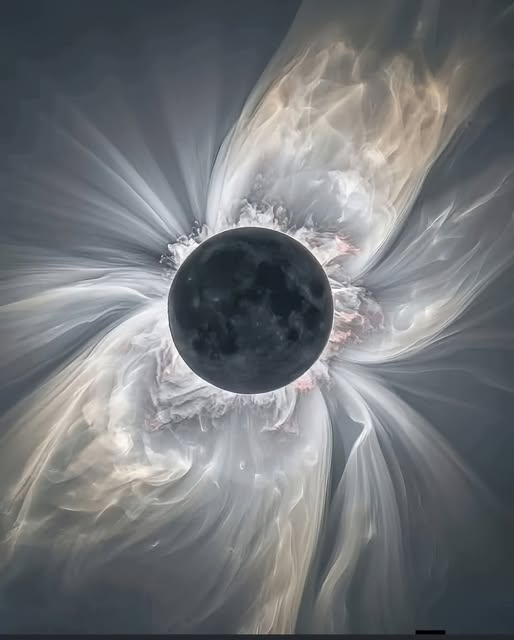
From 50,000 feet above the clouds, the Moon's shadow turned the sky completely dark during a total solar eclipse. 🌑✨
The aircraft flew directly along the path of totality, allowing scientists to capture the Sun's delicate corona from above the clouds and much of Earth's atmosphere.
While the sky overhead was dark, the distant horizon remained brightly illuminated beyond the Moon's shadow.
A view of an eclipse that very few people ever get to see.