Very excited about this awesome paper, on arxiv today! @YaleAstronomy's @konstiplanet investigates energy dissipation in wobbling protoplanetary disks as a potential avenue to produce exoplanet orbits that are well-aligned with their host binary's orbit: https://t.co/fufEXPmMLW
It's Paper Day!
Our new hybrid integrator TRACE is now available in REBOUND, and the paper describing its usage is up on arXiv. It's a strict improvement on MERCURIUS, both in accuracy and speed. Check it out! 🧵
https://t.co/ycuqYiUVZP
Sednoids: Echoes of a Rogue Planet in the Early Solar System?
@astrobites's @konstiplanet reports on the possibility that an ancient rogue planet is responsible for the unusual orbits of a trio of solar system objects called sednoids. https://t.co/OVOsewZJOx
My paper is published!
https://t.co/VdPy4A7URG
Please read if you are interested in dust diffusion in protoplanetary disks, a NEW associated instability and consequences for planetesimal formation.
We envision our model to apply to the quasi steady-state that characterizes the nonlinear saturation of small scale dust-gas drag instabilities, such as the streaming instability. The resulting gas-dust interaction is modeled through diffusion, viscosity and drag terms.
This year I have a birthday paper up on the arxiv — and it's one that I'm super excited about!! 🎈
We examine the joint spin-orbit and orbit-orbit angle distribution for transiting exoplanets in wide (Gaia-resolved) binary systems. Some takeaways..
https://t.co/z5YEfZNMJe
From Konstantin Gerbig: Ancient rogue planet could explain why sednoids in our Solar System follow such unusual, distant orbits.
https://t.co/Sc2Gvs6qz6
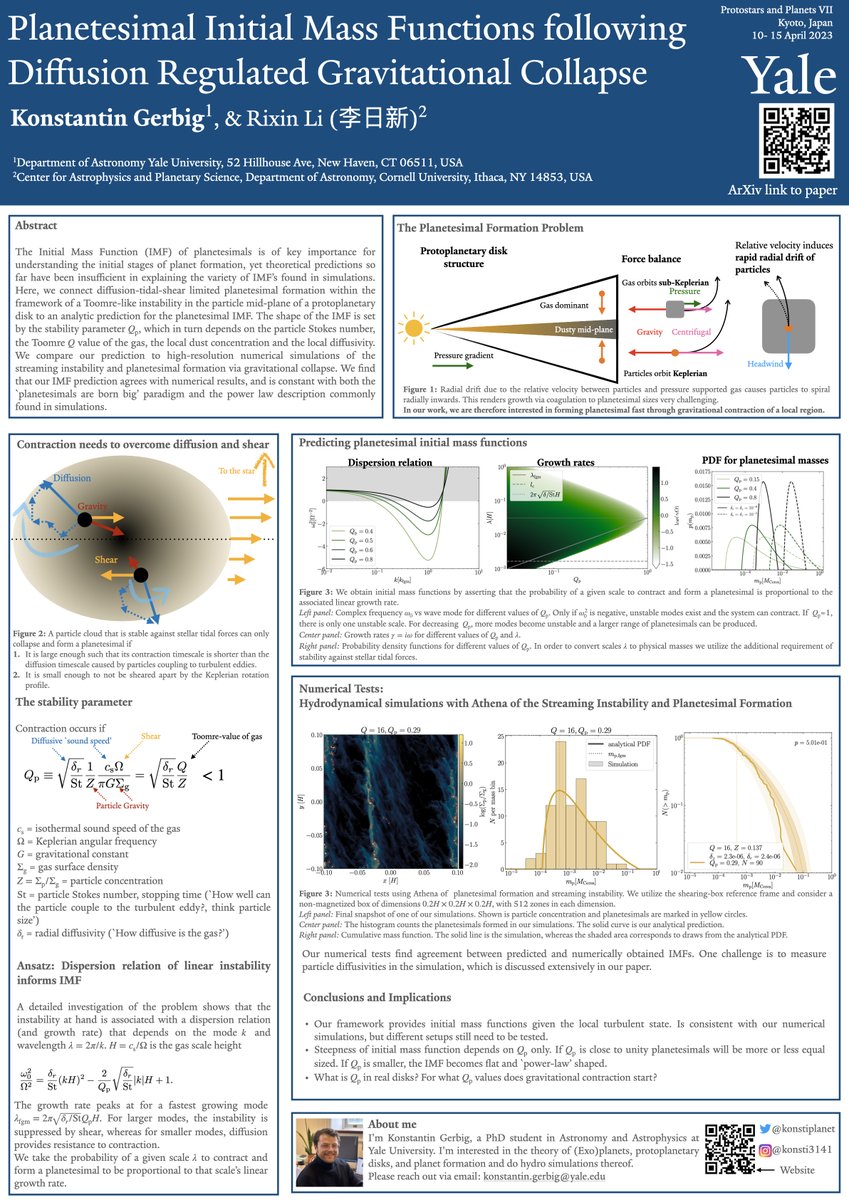
My paper with @rixin_li_astro is published! We provide predictions for the planetesimal initial mass function. Turbulent particle diffusion and Keplerian shear respectively set the smallest and largest possible masses.
https://t.co/zAInUsvzYb
Also, if you're at #ppvii and you're interested in planetesimal formation, check out my somewhat hastily created poster on our work. Poster number PF-06-0013
My paper with @rixin_li_astro got accepted recently. We derive analytical predictions for the planetesimal initial mass function, that match numerical results from hydro sims with active streaming instability. https://t.co/xb7PpTdwIw
From @konstiplanet: Can binary stars have circumbinary disks that orbits them in a perpendicular plane? Today's authors took a closer look at this setup and the complex exchange of material between stars and circumbinary disk. https://t.co/3ReWXe6kGM