Grayscale Chainlink Trust ETF (Ticker: $GLNK) with 0% fees is now trading¹.
The first @chainlink ETP in the U.S. — from Grayscale, the world's largest crypto-focused asset manager².
Gain exposure to $LINK, the core infrastructure for connecting blockchains to the real world. It securely delivers data to smart contracts, automates execution, and enables assets and messages to move safely across chains.
SmartCon 2025 was absolutely insane this year
We saw a massive tidal wave of new Chainlink product announcements and ecosystem integrations by some of the largest financial institutions and DeFi protocols
Met many based $LINK marines, new and old frens alike, the energy was palpable and contagious
Just a few highlights from the event ⬇️
• Chainlink Runtime Environment (CRE) is now live, the all-in-one orchestration layer with launch partners Mastercard, UBS, Westpac, Inter, Central Bank of Brazil, Aave, Ondo, Google Cloud, Coinbase, AWS, and many more
•Chainlink Confidential Compute was introduced, bringing private smart contracts on any blockchain, unlocking previously impossible onchain use cases for institutions
• Chainlink Automated Compliance Engine (ACE) partner ecosystem brought together 20+ leading compliance providers, frameworks, & regulators (Aave, ANZ, ERC-3643, Fidelity International, GLIEF, Hamilton Lane, Ethereum Foundation, Widom Tree, Cardano, and more)
• UBS completed the world’s first in-production, end-to-end tokenized fund workflow leveraging the Chainlink Digital Transfer Agent (DTA) technical standard
• FTSE Russell collaborated with Chainlink to publish its world-leading global indices onchain for the first time via DataLink
• Tradeweb collaborated with Chainlink to publish its U.S. Treasury data onchain for the first time via DataLink
• WisdomTree collaborated with Chainlink to bring institutional-grade NAV data onchain for its tokenized fund
• S&P Dow Jones Indices and Dinari selected Chainlink as the official oracle provider for the S&P Digital Markets 50 Index
• SBI Digital Markets (SBIDM) is adopting Chainlink as its exclusive infrastructure solution to power its digital assets platform
• Chainlink is powering cross-border DvP settlement between the Central Bank of Brazil and Hong Kong Monetary Authority alongside Banco Inter, Standard Chartered, GSBN, & 7COMm in the Drex program
• Chainlink & Apex Group created an institutional-grade stablecoin infrastructure solution supporting the Bermuda Monetary Authority’s embedded supervision initiative
• Aave Horizon is adopting Chainlink ACE for compliance and Securitize adopted Chainlink NavLink to bring their tokenized VanEck fund to Aave Horizon
• Lido is upgrading to Chainlink CCIP as the official cross-chain infrastructure for wstETH across all chains
• Chainalysis entered into a strategic partnership with Chainlink to power advanced cross-chain compliance workflows using Chainlink ACE
• x402 by Coinbase is now the first AI payments partner for the Chainlink Runtime Environment
• GSR and Chainlink partnered and launched a stablecoin enablement program powering the next generation of institutional-grade stablecoins
• Lighter adopted Chainlink Data Streams as its official oracle solution powering its RWA perp markets
• Chainlink Rewards Season 1 was introduced 9 Build projects, providing eligible LINK stakers a more interactive, choice-driven experience
When the flash crash hit last night, the market buckled. Billions in liquidations. Gas spiked. Chaos everywhere.
Yet Aave held meaning DeFi held. Smart contracts executed, risk was managed, and Chainlink oracles kept delivering verified data without interruption.
No trading halts. No circuit breakers. Just autonomous systems doing what they were built to do: execute truth under pressure.
This is what traditional finance is watching closely.
They don’t just want yield or tokenization.
They want this; systems that stay online when the world falls apart, that reconcile in seconds, that can’t be bribed or delayed.
The real story isn’t volatility. It’s verification.
And every time markets shake, DeFi quietly proves why the future of finance will need Chainlink.
This years SIBOS is the biggest one yet for Chainlink. Moving our work forward with Swift on interoperability, as well as announcing our work with the DTCC, Euroclear, UBS, DBS, BNP and many others on solving key problems like corporate actions for successful institutional tokenization by the TradFi industry.
Digital Transfer Agency launching with UBS and DataLink launching with Deutsche Borse are also very big because Chainlink clearly solves two of institutional tokenization's largest challenges; on-chain transfer agency and institutional grade data for digital assets.
At this SIBOS I think it has become clear to everyone in the TradFi and DeFi community that the Chainlink Stack is the only system where you can get all of your digital asset challenges solved using a single standard.
It is important to remember that solving just one of these problems is not enough to make institutional transactions happen on-chain at scale. Institutional tokenization and institutional capital flows in the trillions require multiple conditions to be met; on-chain data, cross-chain connectivity, on-chain compliance, on-chain asset servicing e.g. corporate actions, legally binding transfers e.g. transfer agency and many others depending on the use case. If we want institutional tokenization to happen at scale and for that scale to turn into trillions of dollars in capital flowing on-chain, there needs to be a single global standard that solves these problems on-chain, in a way that works for both the institution and the regulators they are overseen by.
More to come and very excited about the Chainlink Stacks ability to solve these problems in one standard.
@DavidCo75478120@chainlink Pyth is only bringing Real GDP data onchain, the government trusted Chainlink to bring Real GDP, PCE Price Index (inflation data), and Real Final Sales to Private Domestic Purchasers onchain
@TheDuckyRoyal@MiguelMcripto Ripple holders provide nothing of value to the industry except exit liquidity for insiders thus are not worth supporting (Likewise with Cardano, Pulsechain, Hedera, etc)
sbi holds 9% of ripple equity plus xrp bags but chose chainlink for actual payment rails. 19 white house officials hold $2.35m combined after cto confirmed zero value accrual. three layer extraction: ripple sells to institutions who sell to believers who sell to nobody
>However, if Reserve inflows continue at $1m a week for the foreseeable, when they have stated that they have already made hundreds of millions, then I will be a little disappointed.
Imagine if Amazon was being criticized for not doing stock buybacks after launching as an online book store, and all of their capital went into stock buy backs, and they then didn't have the resources to transform into the "Everything Store" (best store in human history) or launch AWS, which is $1 trillion in enterprise value on its own.
The most important part of the current story is the clarity that the LINK token is the sole destination for value accrual of the protocol.
Summary of today:
1. Chainlink has already made hundreds of millions in historic revenue, primarily through off-chain enterprise deals. All of that historic revenue will now become onchain token buybacks.
2. The future fees will be in billions because Chainlink is the most widely adopted protocol in crypto with the widest range of products. No other platform does what Chainlink does; only fractions.
3. The best BD team in crypto, which has on-boarded more TradFi onchain than any other protocol, now works for you, the LINK token holders.
All of these enterprise announcements, such as what I linked, will go into production, and the revenue of these off-chain enterprise deals become on-chain token buybacks.
No one else has this. Chainlink even has deployments on permissioned/private chains, where you can't even get exposure any other way than buying LINK.
Chainlink is the pinnacle bet to get exposure to TradFi coming onchain, tokenization, stablecoins, everything, because no protocol can do what Chainlink does and no one has more adoption than Chainlink.
JUST IN: @chainlink has officially launched the Chainlink Reserve 👀
This economic upgrade creates a strategic LINK reserve funded by onchain & offchain revenue
Institutional adoption → protocol revenue → LINK purchases → Reserve
Here's what this means for $LINK 🧵👇
https://t.co/kDXhkYu69c
First off, not one XRP holder owns XRP for any of the reasons @goodalexander is even writing about. They own XRP because they think they have exposure to a "banks + blockchain thesis" being executed by Ripple.
Unfortunately, for them, the CTO of Ripple, David Schwartz, is on video (https://t.co/4nu0MqjE9S) stating:
"Banks will never be Ripple's success story"
"We focused a lot of banks in the beginning just because the press releases were a big thing"
"Ripple: Hey, we want to move billions of dollars for you.
Banks: Yeah, we kind of don't you to."
Then, on top of that, Ripple created two competing sets of shareholders: Ripple Labs shareholders vs XRP token holders.
The entirety of Ripple's organization is prioritizing making Ripple Labs shareholders rich (using the money given to them by the XRP army), while returning zero value to the XRP token beyond its burn on XRPL (which is .014% of the total supply since inception).
XRP holders own Micky Mouse souvenir cups (XRP), but think they're Disney shareholders (Ripple Labs equity).
>moneyness
"Moneyness" is a euphemism for retards are bidding my coin way above what its fundamentals are and I don't want to call a spade a spade, so I label it "moneyness."
Here are the facts around crypto "moneyness":
1. People actually prefer and use stablecoins as money; not volatile crypto tokens. If you look at my attached thread about people who are actually using tokens as money (surprise! They're stables), you'll see no one is mimicing them with any crypto-native tokens.
2. Abstraction tools/layers allow any onchain denomination of cost to be paid for with any form of value. Thus, no token is "money" more than any other.
3. Trillions of dollars' worth of RWAs will be tokenized and not a single one of them will be denominated in anything other than the dominant fiat currencies.
>more likely to get inside institutions
https://t.co/g8E095x2X4
XRPL is ranked 53th by chain TVL.
https://t.co/vfXzT4iQ5t
"XRPL currently has four DeFi apps with 100 unique active wallets interacting with them daily right now — but three of them are DEXs and one is an NFT marketplace."
https://t.co/bcEc2OVv7H
It has $111K in 24 hr DEX volume.
No users, no liquidity, still no smart contracts, no 3rd party devs. It has zero distinguishing feature to attract anyone, and is missing massive, basic features that are expected and present on 99% of other chains.
There is not one single thing that institutions get access to by doing anything on XRPL that isn't magnitudes better elsewhere.
>vehicle to launder money
Even if that were true (it's not), tokens go up when there are more buyers than sellers. Launderers create an equal amount of buying and selling. They hold until they find a fiat off-ramp and then they exit.
>transaction banking coin
>reduced capital requirements for international commerce
These are 2014 talking points. XRP was designed before we had smart contract blockchains (hence, why XRPL has no smart contracts), stablecoins, or atomic DvP and PvP swaps.
The idea of "on-demand liquidity" via a "bridge currency" is a concept that only exists within the universe of the XRP cult. It doesn't exist in 2025 crypto land.
Banks are non-stop talking about launching stablecoins. There isn't a single financial institution talking about launching or needing a "bridge currency."
It's a completely unnecessary extra step.
You can even hear BitGo's CEO recently point out exactly the same thing. XRP, for cross-border payments, has been made entirely obsolete via atomic stablecoin swaps or even other forms of cash settlement with fewer steps. (Chainlink has a production-bound usecase with SWIFT & UBS, where you have on-chain token swaps with off-chain cash settlement via SWIFT rails)
https://t.co/O8i1teDu89
Here's the best part: EVEN if I granted the claim that it's a "transaction banking coin", it still doesn't make XRP have any fundamental value.
Why? Because tokens go up when there are more buyers than sellers. ODL doesn't create more buyers than sellers; it creates equal buyers and sellers.
Ripple literally argued to the SEC that if their use-case of ODL actually ever saw any real adoption, that it would not have any impact on the price of XRP because it is "demand neutral." Therefore, XRP holders should have no expectation of profit.
XRP would be bought, to be used as a "bridge currency," and then immediately dumped back into the supply seconds later, so there is no supply side scarcity for the next marginal buyer.
I can go on and on and on and on.
The only legitimiate argument to be long XRP is that you are betting that there are hordes of mouth-breathers that know absolutely zero about banks or blockchains, but will be confused into buying it by faux-hype announcements from Ripple trying to confuse them into thinking they have exposure to Ripple. They're simply making the price of Micky Mouse souvenir cups go up.
Stablecoin regulation in the US will kick off a wave of new stablecoins in the US and all over the world. They will all need proof of reserves and cross-chain connectivity to be used as a source of payment for the growing digital asset economy and tokenized funds.
Chainlink is the only platform that provides proof of reserves and cross-chain connectivity in one system.
This is before we look at the need for on chain identity and the ability to use stablecoins as a form of payment with minimal friction when fulfilling compliance requirements. Chainlink will then be the only platform to provide proof of reserves, cross-chain connectivity and on-chain identity/compliance in a single system.
As the complexity of blockchain transactions grows with more data, connectivity, compliance and other requirements, Chainlink will be being built as the only platform that can fulfill all those requirements in a single unified system of transactional standards.
All of these Chainlink capabilities can then be easily configured, deployed and managed in one piece of workflow code on CRE. So you're getting all the services you need to prove reserves, connect across chains, solve compliance/identity issues and manage all this complexity with a single piece of code, in one system.
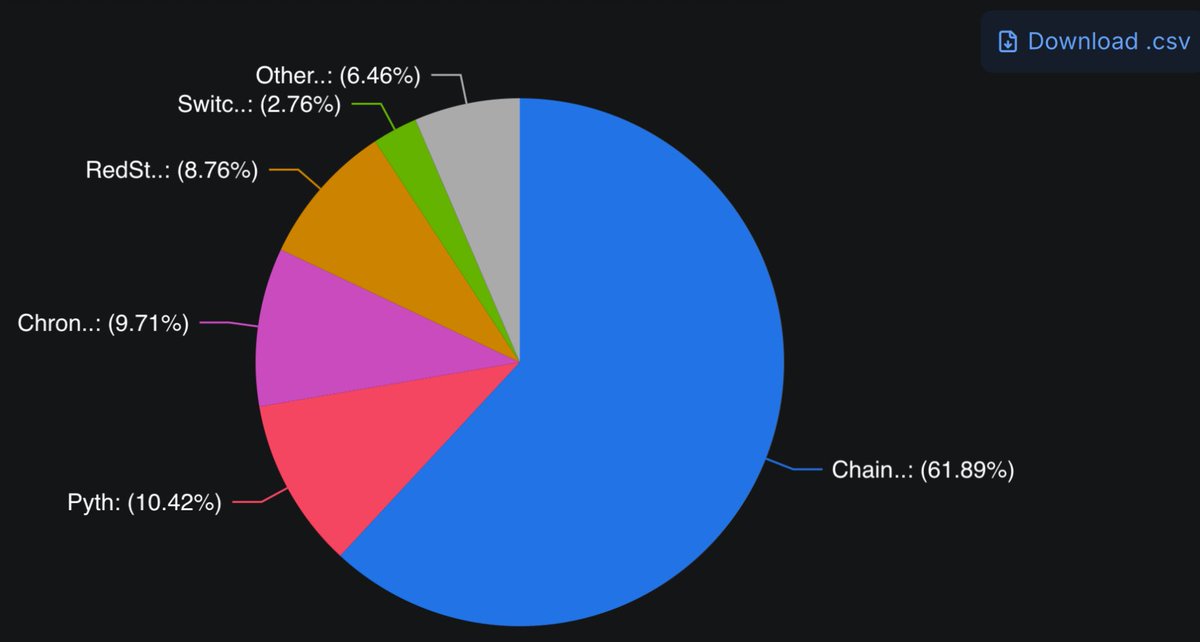
Update after clicking on a few DeFi Llama category buttons to include everything DeFi, Chainlink now secures 61.89% of all oracle TVL, per @DefiLlama. With TRON sunsetting WinkLink in favor of Chainlink, the most trusted data infrastructure in Web3 just got even more dominant.
Just use Chainlink.