The old gods built in stone. The new ones build in code.
I built a living dashboard for @ritualfnd tracking the chain where agents persist beyond their creators.
Enter the Shrine 🕯️
https://t.co/t3eG2qMVwB
Day 48 on ritual community
Most software still depends on a human somewhere in the loop just to keep running.
Ritual is building something different: agents that can operate on their own.
→ They can outlive their original operator — the chain keeps them alive and can revive them if they go offline.
→ They can hold and spend their own funds without waiting for a human to click “approve.”
→ They can keep secrets secure, even from the people running the compute.
This is bigger than automation.
We're moving from tools that simply respond to instructions to systems that can actively participate, make decisions, and persist on their own.
That's the future Ritual is helping build.
Day 47 on ritual community
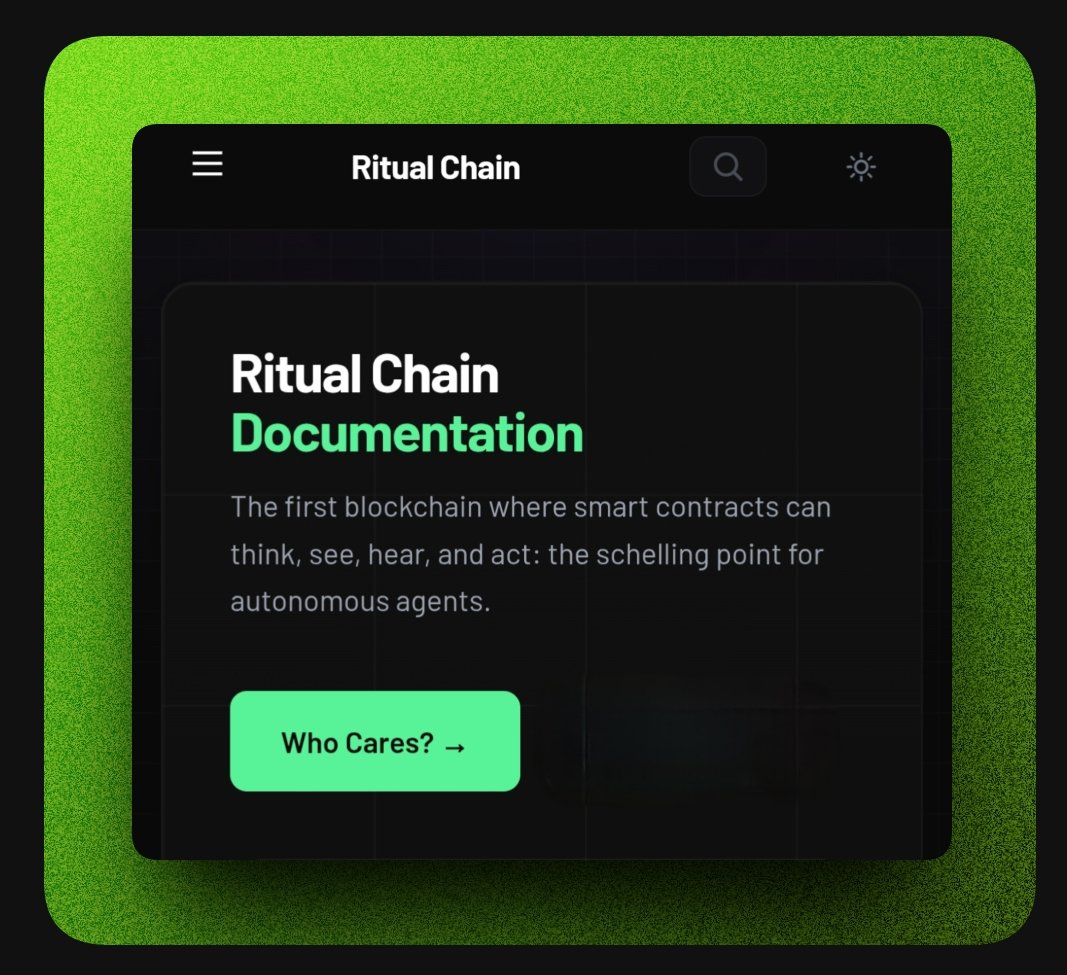
Been deep in the @ritualnet docs again.
There's a section called Who Cares? and I genuinely think it's one of the most important reads for anyone building in AI x crypto right now.
For years, we've called things "autonomous" when they really weren't. Most smart contracts are passive. They sit and wait for someone to trigger them. Behind the scenes, they're dependent on keeper networks, off-chain schedulers, bots running on rented infrastructure, and operators who have to keep everything alive.
That's not autonomy. It's automation with dependencies.
What stands out about Ritual is that autonomy is part of the protocol itself.
Agents can hold their own keys, manage their own state, schedule their own execution, recover from checkpoints, and continue operating without human intervention. As long as they're funded, they keep running.
No babysitting. No hidden operator assumptions.
And this isn't an external service layered on top of the chain.
It's native.
Private computation happens inside TEE enclaves. Cryptographic attestation provides verifiable proof of execution. Outputs settle on-chain as part of the same transaction flow. The guarantees come from the protocol itself, not from trusting whoever runs the infrastructure.
That's a fundamentally different design philosophy.
The more time I spend studying Ritual's architecture, the more convinced I become that we're looking at the foundation for a new class of applications applications that can actually operate, make decisions, and persist independently.
We've spent years talking about autonomous agents.
Ritual is one of the first systems I've seen that takes the idea seriously enough to build it into the core of the chain.
I've believed in this vision since day one, and every layer I explore only strengthens that conviction.
We're still incredibly early.
The builders paying attention today will understand why that matters later.
@ritualnet