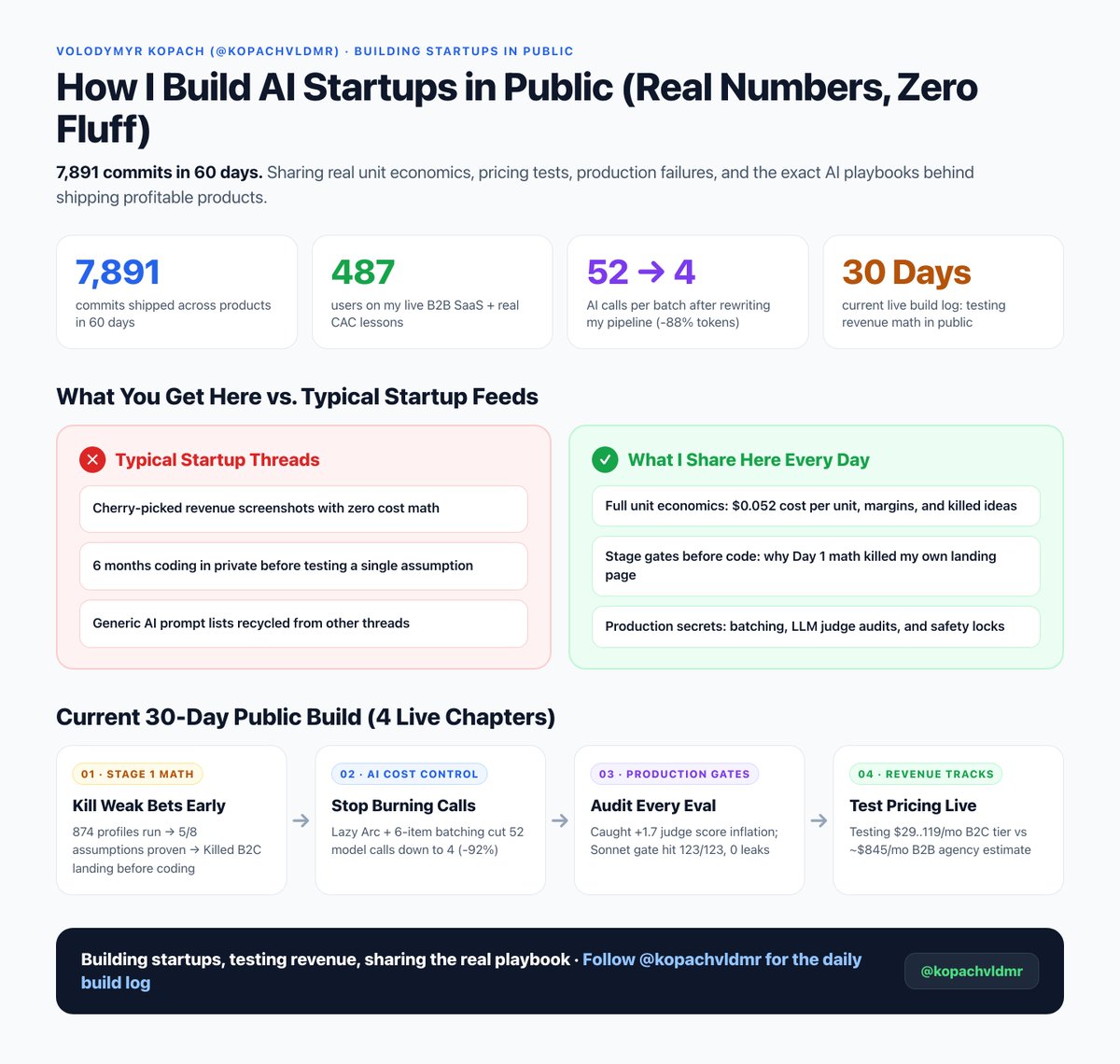
7,891 commits in 60 days taught me why most founders burn months coding before testing the revenue math.
I am Vova, a startup founder building AI products in public and sharing how they actually make money. On this account I open the real playbook: unit economics, pricing tests, production failures, and the exact AI systems I build to ship fast.
I run a live B2B SaaS with 487 users alongside my own internal AI tools, and right now I am documenting a 30 day public build of a new AI product from scratch. Seven days in, testing the unit economics killed my original landing page before I wrote a single line of code for it.
Every day I share the unfiltered secrets behind the build: how I cut 52 AI model calls down to 4, how I caught my own LLM judge inflating scores, and how I turn rough prototypes into paying products. No theory, only real numbers from live builds.
Follow along if you build startups and want the honest playbooks on making money with AI, not polished guru threads.
#buildinpublic #indiehacker
@dearsummer0 That 4 of 6 win for $0.0035 Flash over $0.033 Carbon was only on single turns. Raw cheap models forget a small correction by turn 15, so we log every correction in structured state and block any draft that contradicts it. Do you keep corrections in state or raw chat?
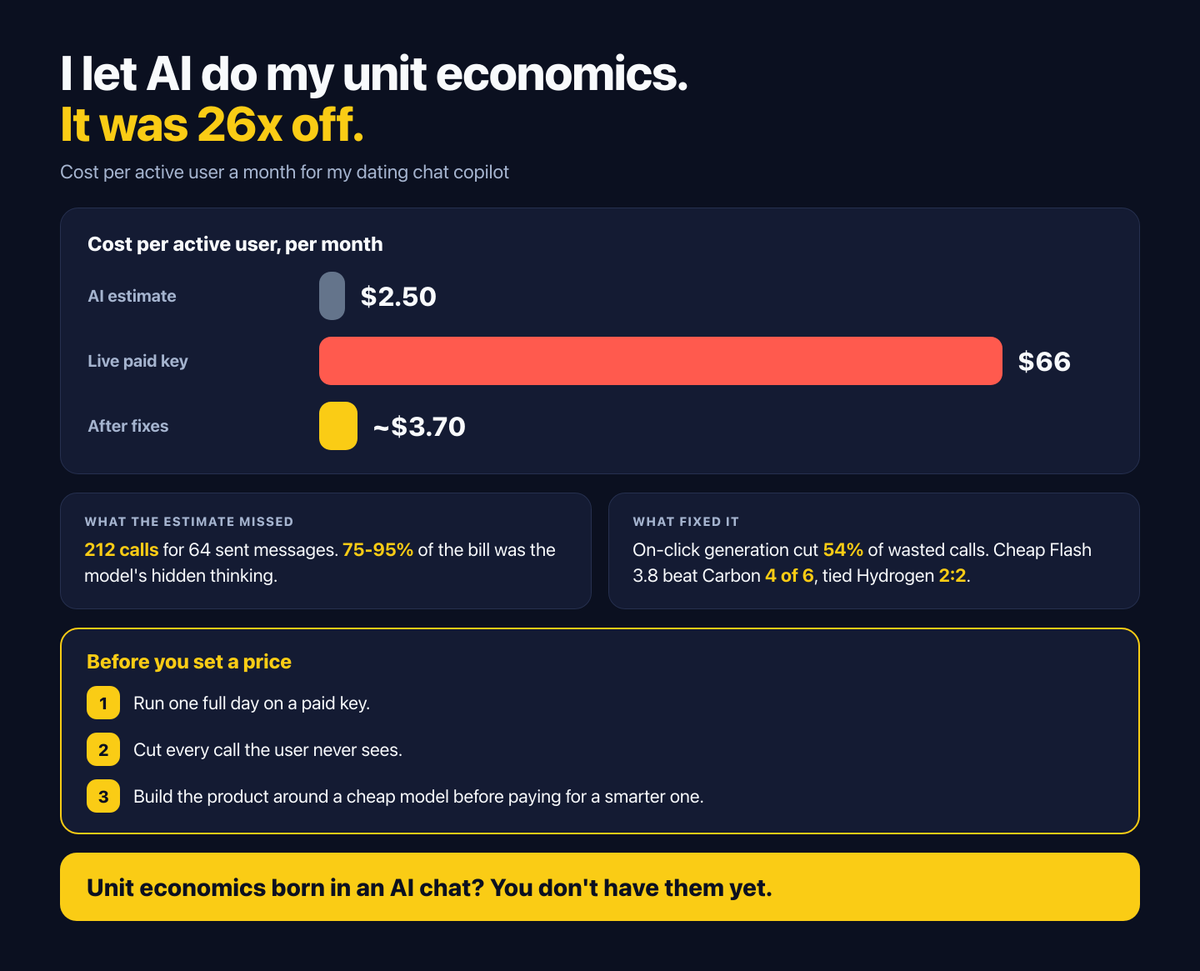
I let an AI calculate my unit economics and it was 26x off.
It promised $2.50 per active user a month, leaving an 85% margin on a $29 plan. Real cost on a live paid key was $66. Now it's down to ~$3.70.
I'm turning my dating chat copilot into a customer product. On my monthly subscription, every call showed $0. So when my assistant estimated $1.20-$2.50 per user, I bought it. Then I plugged in a live paid key. $4 gone in half a day.
First, autopilot ran 212 calls for 64 sent messages. Second, 75-95% of the bill was the model's hidden thinking.
So I switched generation to on-click and cut 54% of wasted calls. In blind tests, cheap Flash 3.8 ($0.0035) beat Carbon ($0.033) 4 of 6 times and tied Hydrogen ($0.0117) 2:2. That got me to ~$3.70.
Now the cheap model has to hold a chat people actually enjoy. Each model runs its own thread from message one with memory about the person and story stages, while I grade blind. No result yet.
1. Run one full day on a paid key before you set a price.
2. Cut every call the user never sees.
3. Build the product around a cheap model before paying for a smarter one.
If your unit economics were born in an AI chat, you don't have unit economics yet.
Who did the math on your unit economics, you or an AI?
#buildinpublic #indiehackers
@SandrineZambou Across 100 clinics, admins blocked 85% of demos. Their main fear is migrating paper notebooks and Excel schedules plus changing staff habits. Leading with 3-5% lost revenue and automating imports via MCP and AI fixed both. How do you calm migration fear on a page?
@dannypostma Cool direction, just watch out you don't burn more dev time and money than SaaS tools cost. Coding a hobby tool is easy, but spending a week tuning it and fixing access sharing for others is the trap. Fine for tiny tools, risky for complex ones. Where do you draw the line?
@davdks At SpeechDesk (487 users), front-desk admins across 100 clinics blocked 85% of feature demos. We switched to leading with pain first, showing owners the 3-5% revenue lost to missed visits before the product. That got them hooked. How does Polar frame lost revenue?
@easyrouteapi Tracking cost per sent message ($0.17 before fixes) exposed 593 repeat profile photo parses in one day (~$8) and a 25-min cron retrying failures 11x. We store one parse per static profile and moved to on-click (-54% waste). Do you key image caches by hash or TTL?
My AI dating copilot burned $4 in half a day on live API, turning a $2.50/mo paper model into $66/mo per user.
While I ran the app for myself under a flat Antigravity subscription, I never counted tokens. Conversion from matches was great and I had plenty of active chats going 😉. So in our business model canvas we wrote down $1.20-$2.50/mo in LLM costs per user and an 85% margin on a $19-$29 plan.
Yesterday I plugged the engine into a live OpenRouter API key. $4 vanished before noon.
Digging into the production database exposed two silent killers. First, full autopilot generates into the void. To send 64 real messages yesterday, the worker ran 154 generations and 212 API calls (3.3 calls per sent message; the day before was worse, 376 calls for 71 sent messages, 5.3x). Whenever a filter or timeout tripped, a cron retried the same girl every 25 minutes, hitting 11 failed loops in a row on one profile. It also re-described the same profile photos 593 times in a single day, burning ~$8 just on repeated vision calls. One sent message actually cost $0.17.
Second, hidden reasoning tokens ate 75-95% of every bill. Before writing three short reply options (150-300 tokens), Gemini 4 Carbon Medium generated 2,000 to 10,000 thinking tokens billed at $10/1M. Passing a 1,000-token reasoning cap on OpenRouter did nothing: the API ignored the limit and still billed 6,483 thinking tokens.
Cutting 20% of the bloated autopilot features fixed 80% of the burn. Switching from background autopilot to on-click generation immediately killed 54% of wasted calls. Then I ran a blind test on 6 live chats comparing flagship Carbon Medium ($0.033/call, 48s wait) against cheap Flash 3.8 ($0.0035/call, 4.7s wait, 9.5x cheaper and 10x faster). Scoring the shuffled replies blind, I picked Flash in 4 out of 6 chats.
Putting all levers together drops cost 23x from $0.17 to $0.0075 per sent message, or ~$3.00-$3.70/mo for an active user at 390 turns/mo. Have you ever switched a working AI prototype from a flat subscription to raw API billing and watched your unit economics blow up?
#buildinpublic #AIAgents
@PreethamBhand14 No live dating processor yet. We are testing a $29 pre-order mockup without card billing to protect our Paddle account, plus an $845/mo B2B agency desk. With just 11/405 desktop mentions, mobile wins. Have you seen a clean web processor take dating tools?
0 of 6 payment processors accept AI dating tools, and 405 Reddit threads killed our desktop bet.
Over the last 2 days, turning my personal AI dating chat assistant into a public product hit three walls that have nothing to do with LLM prompts.
First wall is payments. I wanted to launch a $29 refundable pre-order page using our existing Paddle account. Turns out Paddle, Lemon Squeezy, Gumroad, and Creem explicitly ban dating services and any tools built for the dating industry. Running a pre-sale on Paddle risked freezing the shared account that processes our other SaaS products. Polar bans AI relationship services too. When we audited 6 live competitors, 0 of 6 used Paddle or Lemon Squeezy. Web tools like CupidBot and https://t.co/Hl8aL1Et4T run on Stripe (where dating is restricted, not banned, and for non-US founders that requires a $500 US LLC via Stripe Atlas and weeks waiting for an EIN without an SSN). The other 4 competitors (Rizz, YourMove, WingAI, DatingAI) sell through the App Store and Google Play, where Apple and Google act as merchant of record for a 15% cut.
Second wall is desktop vs mobile. We analyzed 405 Reddit threads (2024-2026) and 240 App Store reviews (96 cited quotes). Across 2 years in r/Tinder, only 11 posts even mentioned the word "desktop", and all 11 were about technical bugs. On top of that, on Nov 11 Match Group officially rolled out anti-bot protections against browser AI agents sending messages for users.
Third wall is mobile UX. Driving TikTok, Reels, and Shorts traffic straight to a phone app solves payments and attribution, but current mobile competitors are painful to use. In Rizz, Plug AI, and YourMove, you take a screenshot, leave your chat, upload it, copy a reply, and switch back. On Android, an Accessibility floating button reads the screen in 1 tap (Smooth, Phrased), but Google Play hates it and Durden is distributed off-store. On iOS, background screen reading is blocked, so the closest seamless flow is a 1-tap custom keyboard (SLIDD, SideKey) or a double Back Tap shortcut.
Yet none of those mobile keyboard clones keep per-person memory across sessions or guide a chat through real stages. If you were shipping this today, would you register a US LLC for a web app or go straight to an iOS keyboard with per-match memory?
#buildinpublic #indiehackers
I burned 4 AI subscriptions building 108 states before asking for $19.
We had 3,002 lines of code and 324 ready replies in our landing page simulator. Real validation numbers: 0 interviews with strangers and 0 payments out of the 10 customers we needed.
My small team and I are building a dating chat copilot.
Instead of talking to buyers, I combined 2 user roles, 3 situations, 6 intent modes, and 3 tones into 108 interactive states. I even put a pricing table starting at $19 a month right under the simulator.
Then we checked the scoreboard and threw the whole simulator away. We cut the page by 85%, down from 3,002 lines to 453, leaving a mobile pre-order screen with 3 situations and one $29 refundable pre-order before we finish the desktop app.
3 rules we wrote down after this:
1. Ask 10 strangers to pay before mapping out 108 UI states.
2. Replace multi-tier pricing and a feature matrix with one refundable pre-order.
3. Cap the demo at 3 examples until the first real payment hits your account.
If you polish 108 states before a stranger pays you $19, you're hiding in code to avoid talking to a buyer.
What's the most overbuilt feature you shipped before getting one paying customer?
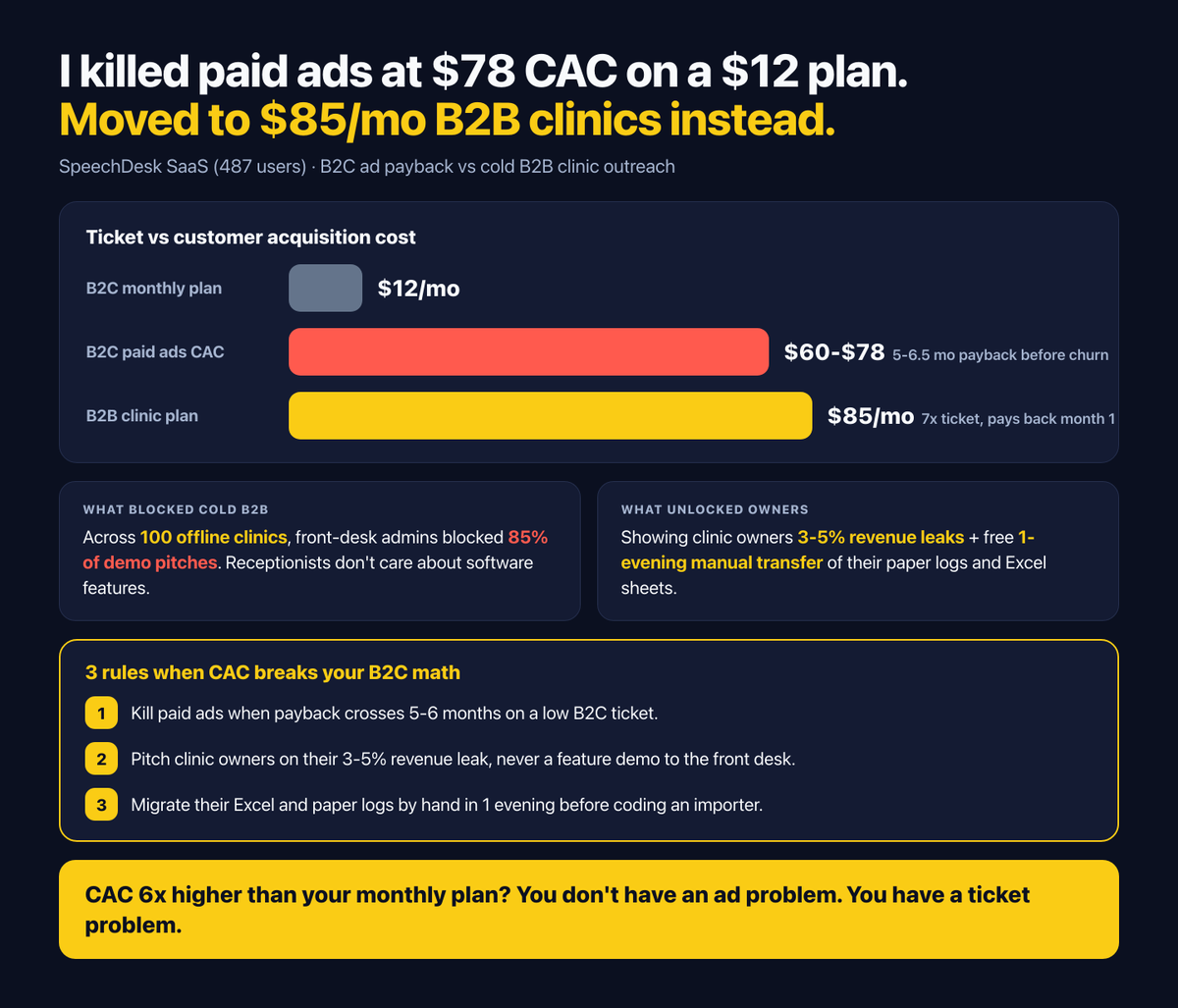
I killed our paid ads after seeing a $60-$78 CAC on a $12 monthly plan.We build SpeechDesk with a small team, a SaaS organizer for speech therapists and clinics with 487 users. At $12 a month, paying $78 for one customer meant waiting 5 to 6.5 months just to break even before churn. So we turned ads off, started posting daily, and moved to cold B2B outreach across 100 offline clinics at $85/mo.That is 7x our B2C price. Then we hit the first B2B wall.Front desk admins blocked 85% of our standard demo pitches. An admin has zero reason to drop familiar paper logs and Excel sheets for new https://t.co/tU1XYLhh9l we stopped pitching features. Now we show the clinic owner the 3-5% revenue they lose to missed appointments and schedule chaos, and we manually move all their paper logs and Excel tables into SpeechDesk in one evening for free.1) Pitch the owner's lost revenue, not software features to the front desk.2) Kill migration fear by doing the data transfer yourself in one evening.3) Move from $12 B2C to $85 B2B so one manual setup pays back on payment one.If your CAC is 5-6x your monthly price, you don't need better ads. You need a bigger price tag and a direct https://t.co/QtKPCalLMb what CAC-to-MRR ratio did you pull the plug on paid ads and switch channels?#buildinpublic #indiehackers
@mattceras Doing cold B2B outreach to 100 offline speech clinics ($85/mo) for SpeechDesk. Classic demo pitches get blocked by front-desk admins 85% of the time. Showing owners 3-5% revenue leaks + free 1-evening paper/Excel transfer works. How do you get past the front desk?
@alexabelonix First-degree premature architecture: building a 108-state product simulator and burning 4 AI subscriptions before asking 10 strangers to pay $19. Put myself on a public 30-day 0/10 paid customers timer so I cannot hide in code anymore. What charge are you pleading guilty to?
@bavedikian We cut 52 model calls to 4 and dropped unit cost from $0.143 to $0.052 across 850 dialogues (2,749 eval runs). The goal wasn't saving $100 on tools, it was unlocking 64-85% gross margin on our $29/mo AI copilot pilot. Where do you see AI moving margins most?
@designedbyparas That reserve and higher fee structure explains why 4 of 6 competitors went through App Store and Google Play at a 15% MoR cut instead of waiting weeks for a US LLC and EIN. What advice do you have here, and are there specific high-risk processors you've seen work worth testing?
@acecreamu Running 4 calls on each of 13 profiles: planning, drafting with the full rulebook, and 2 judge passes. I filtered 5 invalid profiles in code, replaced planning with deterministic skeletons, and batched the rest into 2 writer + 2 judge calls. How do you batch your eval passes?
7,891 commits in 60 days taught me why most founders burn months coding before testing the revenue math.
I am Vova, a startup founder building AI products in public and sharing how they actually make money. On this account I open the real playbook: unit economics, pricing tests, production failures, and the exact AI systems I build to ship fast.
I run a live B2B SaaS with 487 users alongside my own internal AI tools, and right now I am documenting a 30 day public build of a new AI product from scratch. Seven days in, testing the unit economics killed my original landing page before I wrote a single line of code for it.
Every day I share the unfiltered secrets behind the build: how I cut 52 AI model calls down to 4, how I caught my own LLM judge inflating scores, and how I turn rough prototypes into paying products. No theory, only real numbers from live builds.
Follow along if you build startups and want the honest playbooks on making money with AI, not polished guru threads.
#buildinpublic #indiehacker
@RealGemy Right now we fire an immediate binary alert across each of the 3 sources if a session breaks or a list returns 0 items, so we don't wait for the monthly total. Partial parse failure rate (%) per source isn't wired up yet though. What failure rate threshold do you alert on?
7 days building an AI copilot for dating chats, and the numbers already killed my landing page
I built the core first. The control panel already processed 874 profiles, 226 moved down the funnel, and 13 reached step 5-6 out of 7. Then I ran the business idea itself through my startup validation stages, and it killed my B2C landing page before I even wrote a line of code for it.
Two walls right in my face: major dating platforms ban AI agents, and existing copilots already sell for $7-20, which makes it hard to fight on the front end. But there are two openings too: my unit cost is $0.052 per profile with a 64-85% margin, and the market sits at $13B. Stage verdict: change course, yellow light, with 5 out of 8 assumptions proven so far.
So now I have two paths growing from the same core. First is testing B2C at $29-119, and second is a Concierge Desk for matchmaking agencies at around $845 a month per client, though that number is just an estimate right now, not market-tested yet. I'm building both in public over the next 30 days.
Do you check the economics of an idea before writing code or after?
#buildinpublic #indiehacker
Two extra findings from those 240 App Store reviews and tracker data: 50 of 68 one- and two-star reviews on Rizz complain about dark-pattern weekly subscriptions ($5-$10/week), while basic iOS keyboard clones like SideKey sit at roughly 50 installs because a keyboard without cross-session memory just spits out generic one-liners.
Right now I'm running a second blind duel on the same 6 live chats: Flash 3.8 ($0.0035/call, ~$3.70/mo per user) vs Gemini 4 Hydrogen ($0.0117/call, ~$7/mo). The real test isn't writing a clever opener, it's holding context and guiding the chat through stages without getting boring. Fast model goes first in 5 seconds, and heavy Carbon stays behind a "Smarter" button for tough turns.