Some people claim that I am not truly Korean, but a Korean of Malaysian descent.
They say that Islam can never take root in Korea, and that “native Koreans” will never accept Islam.
I am currently staying in Malaysia and studying Islam. I love Malaysia, and I respect the Malaysian people. I have seen many good things from Malaysian Muslims, and I greatly appreciate their kindness and faith.
However, I want to make this clear.
I am not a Korean of Malaysian descent.
The name I use in Korea is Park Dong-shin, and the name I use internationally is Abdullah Park al-Kuri.
I am a Korean citizen. I was born in the Republic of Korea in 1986, and I grew up in a Christian family in Korea. However, in 2009, I left Christianity and accepted Islam.
I did not accept Islam because I am a foreigner. I did not accept Islam because I am Malaysian, nor because I am Arab.
As a Korean, I searched for the truth, studied, reflected, and became Muslim because I became convinced that Islam is the true religion sent by God.
If you still cannot believe me, then I will reveal my family lineage.
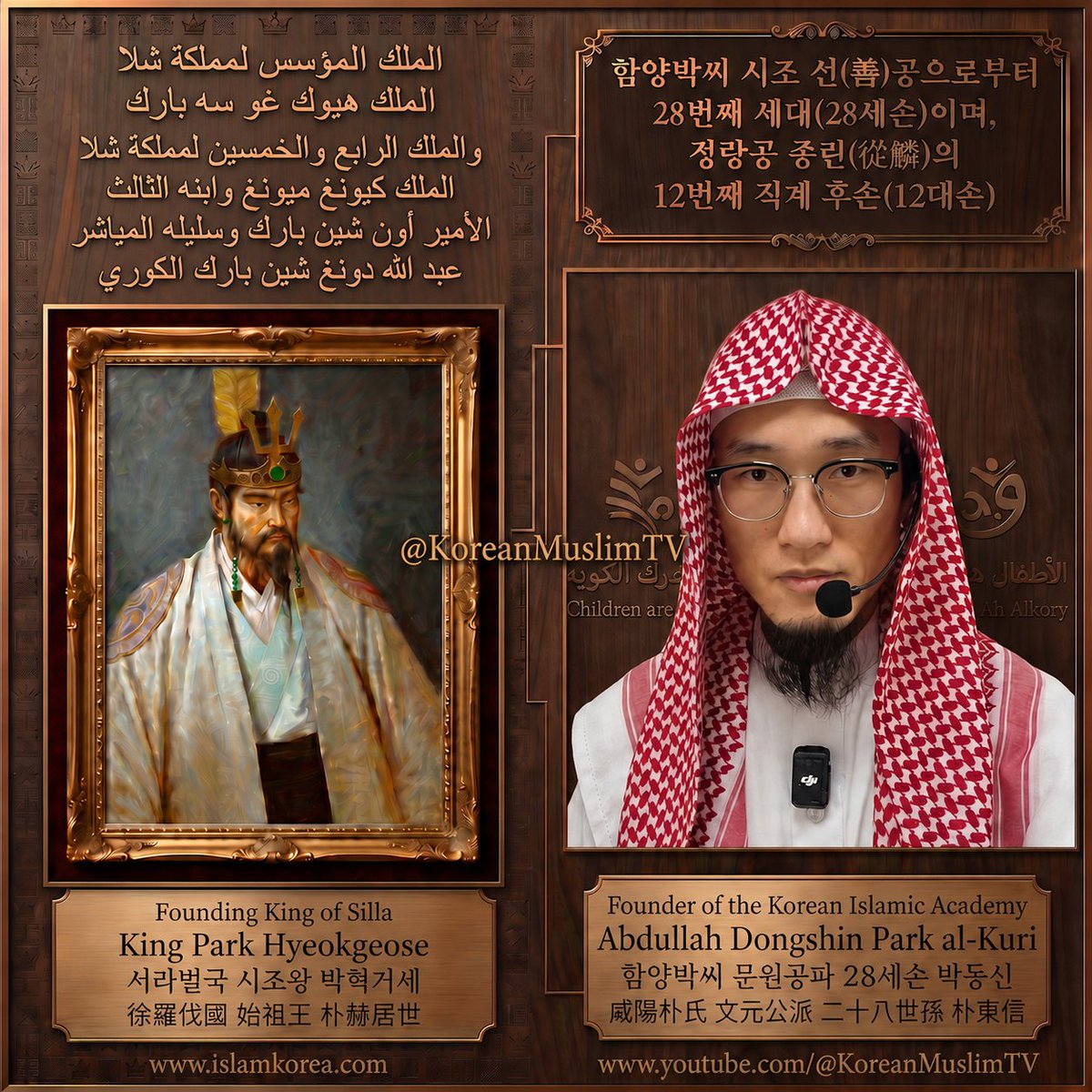
My family belongs to the Jeongnanggong branch of the Munwongong branch of the Hamyang Park clan, which is known as one of the noble clans of ancient Korea.
I am the 28th-generation descendant of the clan ancestor Seon, and the 12th-generation descendant of Jeongnanggong Jong-rin.
According to our family records, the Hamyang Park clan originated from the line of Park Eon-sin, also known as Sokham Daegun, the third son of King Gyeongmyeong of Silla. King Gyeongmyeong granted his third son, Park Eon-sin, the title of Sokham Daegun, and Sokham later came to be known as Hamyang. His descendants then took Hamyang as their clan seat and lived on Korean land generation after generation.
If calculated from the time of Park Hyeokgeose, the founder of Silla, the roots of my surname and family go back approximately 2,080 years.
Even after Park Seon, who is honored as the central ancestor of the Hamyang Park clan, my family continued through the Goryeo and Joseon periods, producing many officials and scholars throughout Korean history.
Therefore, I can say clearly:
I am a native Korean.
This land is the land of my ancestors. As a Korean born on this land, I have the right to be respected for the faith I have chosen.
There is nothing strange about a Korean accepting Islam. It is not impossible for a Korean to become Muslim. Even a person from a deeply rooted Korean family can accept Islam.
I will spread Islam in Korea.
And if God permits, I hope that my descendants will also follow after me, study Islam, become scholars of Islam, and spread the pure faith of worshiping God alone on Korean land.
As proof that I am a Korean rooted in Korean land, I reveal my family lineage. I also reveal the names of my direct ancestors recorded in my family genealogy.
Anyone can verify the history of the Hamyang Park clan and its figures through clan records and surname materials. Also, according to our family records, my ancestors lived on Korean land throughout the history of Silla, Goryeo, and Joseon, serving the people by holding official positions generation after generation without interruption until Japan’s imperial aggression against Joseon.
Below is the direct lineage recorded in my family genealogy.
The direct lineage of Park Dong-shin:
1st generation: Seon 선(善) – 2nd generation: In-jeong 인정(仁挺) – 3rd generation: Sin-cheong 신청(信淸) – 4th generation: Yun-jeong 윤정(允禎) – 5th generation: Sin-yu 신유(臣유), Chungjilgong 충질공(忠質公) – 6th generation: Ji-bin 지빈(之彬), Munwongong branch 문원공파, second branch 2파 – 7th generation: Jang 장(莊) – 8th generation: Chung-jwa 충좌(忠佐), Chiamgong branch 치암공파, Munjegong branch 문제공파, Teacher Chiam 치암선생 – 9th generation: Jeon 전(琠), Hamyanggun branch 함양군파 – 10th generation: Mun-jae 문재(文재), Jimiljikgong branch 지밀직공파 – 11th generation: Won-taek 원택(元擇), Buyungong branch 부윤공파 – 12th generation: Gyu 규(規), Panseogong branch 판서공파 – 13th generation: I-gyeong 이경(而敬) – 14th generation: So-jong 소종(紹宗), Sajikgong branch 사직공파 – 15th generation: Nul 눌(訥) – 16th generation: Jong-rin 종린(從鱗), Jeongnanggong branch 정랑공파, settlement ancestor 입향조 – 17th generation: Sun 순(荀), Jwaranggong 좌랑공 – 18th generation: Su-geom 수검(守儉) – 19th generation: Min 민(玟) – 20th generation: Jae-hwa 재화(再華) – 21st generation: Se-gwi 세귀(世貴) – 22nd generation: Gyeong-bo 경보(慶甫) – 23rd generation: Yong-seo 용서(龍瑞) – 24th generation: Myeong-deok 명덕(命德), great-great-grandfather – 25th generation: Jae-yun 재윤(載奫), great-grandfather – 26th generation: Yun-seok 윤석(潤錫), grandfather – 27th generation: Heung-sun 흥순(興淳), father – 28th generation: Dong-shin 동신(東信)
This is my root.
So if anyone says to me, “You are not truly Korean,” “You are only a Korean of Malaysian descent,” or “native Koreans do not accept Islam,” I will answer:
No.
I am Korean.
I am a Korean born from a deeply rooted family in Korean history.
And I am a Korean Muslim who left Christianity and chose Islam.
A Korean like me can accept Islam. Therefore, there is no problem with many more Koreans accepting Islam in the future.
If God permits, Islam will take root on Korean land as well.
I would like to ask the Christian friends here:
I am planning to establish a mosque in Korea under the name “The Mosque of Jesus in Korea”, by my own efforts, insha Allah.
What do you think? Are you happy that the name of Jesus is included in it?
As for me, I am happy. I am pleased with it.
Because I love Jesus.
The Critical Difference Between the Qur’an and the Christian Bible
The Qur’an and the Christian Bible are not merely two religious books that differ in wording or translation. They present teachings about God, Jesus, sin, and salvation that are fundamentally incompatible.
The most decisive difference is this:
The Qur’an calls people to worship Allah alone.
Christians, however, worship Jesus as God on the basis of the Bible.
The Qur’an honors Jesus, Isa ibn Maryam, as the Messiah and a great prophet, but it does not teach that he is God or the Son of God. He is a servant and messenger of Allah.
Traditional Christianity, by contrast, teaches that Jesus is God incarnate and that salvation depends on believing in his crucifixion and resurrection.
This is not a minor theological disagreement.
It is a question of whom we must worship.
The Qur’an teaches that no created being may be worshipped and that even a prophet cannot become an object of worship. All prophets called people not to themselves, but to the worship of the Creator alone.
The teachings about sin and salvation are also fundamentally different.
Christianity teaches that Jesus was sacrificed on the cross to bear the sins of humanity.
The Qur’an, however, teaches that no one bears the sins of another. Every person must repent directly to Allah for their own sins, and Allah forgives those who sincerely repent without the need for an intermediary or a sacrificial victim.
The Qur’an is also one book revealed as the direct speech of Allah to the Prophet Muhammad.
The Bible, by contrast, is a collection of historical writings, poetry, gospels, and letters written by different authors across different periods. It contains not only words attributed to God, but also the words and records of human beings.
Therefore, the difference between the Qur’an and the Bible is not simply a question of which book is more moving.
The difference is this:
Is Jesus God, or is he a servant of God?
Should people worship Jesus, or worship the God whom Jesus himself worshipped?
Are sins forgiven through the sacrifice of another person, or must each person repent directly to God?
The answers to these questions concern a person’s eternal destiny.
The Qur’an clearly declares:
Allah alone is the Creator.
Allah alone has the right to be worshipped.
Jesus is not God, but a servant and messenger of Allah.
Do not keep postponing your time with the Qur’an.
We spend so much time looking at our phones, listening to people, and following the news of this world. But how much time do we spend reading and reflecting on the words of Allah, who created us?
The Qur’an is not a book to be opened only when we have spare time. It is guidance for life that comforts a tired heart, strengthens a wavering faith, and reminds us where we came from and where we will return.
It is okay if you cannot read a large amount every day. Read even a few verses consistently, try to understand their meaning, and strive to apply them in your life.
Making time for the Qur’an is not a loss of time. Rather, it brings barakah into our time and our lives.
Do not let another day pass without opening the Qur’an.
Spend time with the Qur’an. The closer we become to the words of Allah, the closer our hearts will become to Allah.
A Response to Those Who Misunderstand Me, Question My Intentions, and Attack Me by Asking: “Why Are You Naming the Masjid You Plan to Establish ‘The Mosque of the Messiah Jesus, Son of Mary in Korea’?”
May Allah bless you for your concern for da‘wah and the spread of Islam in Korea.
The name “Masjid al-Masih Isa ibn Maryam in Korea” is not derived from Christian doctrine. It is taken directly from the wording of the Qur’an.
Allah says:
“Remember when the angels said, ‘O Mary, indeed Allah gives you good news of a Word from Him, whose name will be the Messiah, Jesus, son of Mary, honored in this world and the Hereafter, and one of those brought near to Allah.’”
Surah Ali ‘Imran 3:45
Allah also says:
“The Messiah, Jesus, son of Mary, was only a messenger of Allah and His Word, which He conveyed to Mary, and a spirit from Him.”
Surah An-Nisa 4:171
The Qur’an itself calls Jesus “the Messiah, Jesus, son of Mary,” while clearly stating that he is a messenger of Allah. We believe that Jesus is the Messiah, the servant of Allah, and His messenger. However, we do not believe that he is God or the son of God.
Naming the masjid after the Messiah, Jesus, son of Mary, is simply a means of naming and identifying the masjid. It does not mean that he is worshipped. Masjids belong to Allah alone, and no one other than Allah is to be worshipped within them.
Another reason I chose this name is that it can serve as a means of da‘wah. Many Koreans know about Jesus through Christianity, but they do not know his true position in Islam. Through this name, we can explain that Muslims also believe in and honor Jesus, but do not worship him.
I agree that Korean Muslims should benefit their own people, invite them to Islam, and teach them Islam in their own language to the best of their ability. For those capable of doing so, remaining in their own country may be more beneficial both for themselves and for others.
However, leaving one’s country is not blameworthy in every situation. A person may travel abroad to seek knowledge, work, receive medical treatment, or escape harm, and then return to benefit his people.
Allah says:
“Why should a group from every community not go forth to gain a deep understanding of the religion, and then warn their people when they return to them, so that they may become cautious?”
Surah At-Tawbah 9:122
Based on my direct experience in Korea, the problem is not merely K-pop. Among the greatest problems are the lack of da‘wah and Islamic education in the Korean language, the lack of organizations that continuously care for and educate new Muslims, and the severe shortage of qualified Korean imams and callers to Islam.
For this reason, I am translating Islamic books into Korean and working to establish a masjid in which the Friday sermon and Islamic lessons will be delivered in Korean, Allah willing.
Beneficial criticism should be based on evidence and justice. It should not be based on generalizations about people or judgments about their intentions without knowledge.
Allah says:
“Invite to the way of your Lord with wisdom and good instruction, and debate with them in the best manner.”
Surah An-Nahl 16:125
I ask Allah to rectify the condition of the Muslims in Korea and to make all of us a means of spreading Tawhid and the Sunnah with wisdom, knowledge, and gentleness.
There are far too many people in Korea who engage in da’wah without sufficient knowledge and spread incorrect teachings about Islam.
Now, some even claim to be Sunni while spreading the deviant beliefs and ideas of the Shia.
Allah is the One whose help is sought...
I have come to understand why Islam is not developing in Korea.
Although the number of new Korean Muslims continues to increase, I have now clearly understood why there is not a single new madrasa that teaches Islam in Korean, not a single new masjid where the khutbah is delivered in Korean, and not even one new Korean imam.
I clearly stated that I would not raise funds to establish the masjid. Nevertheless, some Muslims in Korea attacked me, saying, “There are already many masjids, so why are you trying to establish another one?” and “Are you not trying to raise funds to build a masjid?”
I have already visited almost every masjid in Korea, and the conditions there were deplorable. Most of them could not speak Korean, and there was only one place in the entire country where the Friday sermon was delivered in Korean.
Some places were busy issuing Muslim certificates to Koreans who came for international marriages and taking photographs with them, without first providing them with proper Islamic education.
Therefore, I advised them about how Koreans should be invited to Islam in Korea. However, only one place accepted my advice.
It was a masjid attended by Indonesians. They were extremely kind, so I visited them frequently and gave short lectures in both English and Korean. However, since that place was already mainly operating programs for Indonesians, it was difficult to transform it into a masjid specifically for Koreans.
Apart from that one place, some rejected me coldly, while others had no interest from the beginning and did not even respond.
During that process, I met several people from certain countries. They pretended to be deeply interested in Islamic da’wah, but instead tried to use me and control me according to their own wishes.
When they realized that they could no longer use me as they pleased, they began posting malicious comments publicly in front of others and pouring out insulting words. They also made assumptions according to their own wishes, fabricated falsehoods, and spread all kinds of slander.
What is important is that these are not merely one or two isolated individuals.
Since Korea has neither a new Korean imam nor an Islamic government, some Muslims behave however they please. No one points out or restrains their behavior. Such people are often eloquent and skilled at making lies appear convincing, so they make many friends and gather many people to their side. Their false ideas and claims then spread widely, and eventually people begin to believe them as facts.
This is what is meant by an absence of leadership. An old Korean proverb says, “Where there is no tiger, the fox acts like the master.”
At that moment, I realized:
“Ah, this is why no one wants to do this work.”
I painfully realized that those who truly obstruct Islam in Korea are not non-Muslim Koreans, but some of the Muslims living in Korea.
They think they know everything. Although they themselves establish masjids however they wish, they oppose the establishment of new masjids. In their own masjids, they are busy helping new Korean Muslims pronounce the shahadah and taking photographs to boast about it, while remaining indifferent to actually teaching them Islam in Korean.
If that is how they intend to behave, they should do it in their own countries. Why do they come all the way to a non-Muslim country and obstruct the development of Islam in Korea?
Many Korean Muslims, and even non-Muslim Koreans, send me private messages and repeatedly express their difficulties, saying that apart from one place in Seoul, there is no masjid that teaches Islam in Korean.
Nevertheless, instead of respecting or helping a Korean Muslim who spreads Islam in Korean, they speak maliciously whenever things do not go according to their wishes. They intimidate him and demand that he follow their instructions, as though they know everything. When that does not work, they tell all kinds of lies, engage in every form of ghibah and namimah, and attack him in order to create a bad reputation for him.
Is this something a Muslim should do?
The behavior of some Muslims is truly absurd and shocking. They devote great effort to events held by non-Muslims, spend money on them, and support them. Yet when a Muslim says that he wants to carry out Islamic da’wah in Korean in Korea, they show no interest at all.
It would be better if they simply showed no interest, but instead, they actively obstruct it.
I declared that I would not conduct fundraising for the establishment of the masjid and that I would work, earn money, establish the masjid with my own funds, and conduct da’wah in Korean. Yet even this causes them to become envious and jealous. They pour out malicious words and slander, hurt others, and remain busy attacking them.
Why, then, did they even go to Korea?
It is impossible to have a proper conversation with them. They show neither respect nor understanding, and they do not even possess the most basic manners and etiquette.
I am truly exhausted.
I am not even demanding an apology from them. I only ask that they leave me alone.
I am tired of the attitude of people who make no effort to understand, refuse to learn properly, consider only their own opinions to be correct, and judge others recklessly.
It is extremely difficult to continue facing people who have no humility, no courtesy, and not even the minimum level of manners required when dealing with others. Without verifying the facts or listening to the other person until the end, they post malicious comments in public places where many people can see them, mock others, hurt them, and do not even feel ashamed of their behavior.
People may naturally have different opinions, and they may point out mistakes or offer advice. However, this must be done with basic respect and courtesy, with a sincere effort to understand the other person, and on the basis of accurate evidence.
Public insults, condemnation, mockery, and slander are neither advice nor proper dialogue.
I no longer want to waste my time and emotional energy in endless arguments with people who have no intention of understanding, no willingness to learn, and no desire to observe proper manners.
I am now truly tired of people who hurt others and then behave as though nothing has happened. All I wanted was for us to be able to speak to one another with mutual respect.
But if even that is impossible, then I ask them, at the very least, not to attack or harass me and simply to leave me alone.
How can people envy and resent a Muslim brother who is trying to do something good? He says that he intends to establish a masjid with his own money, yet instead of supporting, congratulating, or helping him, they obstruct him, spread malicious words, engage in namimah, accuse him by saying, “Why are you trying to raise funds to build a masjid?” and mock him by saying, “Why are you trying to become an imam?”
How can Muslims behave in such a way?
I truly cannot understand it.
Even if I were raising funds to establish a masjid in Korea where the khutbah is delivered in Korean and da’wah is conducted in Korean, why would that be wrong?
If they dislike it so much, they simply do not have to participate. Why do they obstruct and attack it?
I am sorry, but I will establish the masjid by myself.
I will do it alone, and I alone will receive the reward for it in the Hereafter, insha Allah.
I expect that some people will use these words to attack me again, saying, “Abdullah wants to do everything by himself and wants to practice Islam according to his own wishes,” so I will clarify this in advance. I will personally meet scholars from Makkah and Madinah, form a council with them, and continuously receive their scholarly advice and the assistance needed for my da’wah activities.
Of course, this means receiving scholarly assistance and cooperating with them in da’wah, so there is no need to worry.
I will not waste my time and energy working with people who hurt and attack others.
There will be no fundraising campaign for the establishment of the masjid, so you may be reassured.
I will work hard to carry out this good deed by myself.
I am now truly tired of people who hurt others and then behave as though nothing has happened.
Ghibah and namimah are major sins in Islam. Unless a person apologizes directly to the one who was harmed, compensates for the damage, and restores that person’s honor, even his tawbah will not be accepted.
Therefore, stop committing such evil deeds.
If they continue even after this warning, they are the ones who will suffer loss on the Day of Judgment.
I have now decided that I will no longer deal with such people.
The time we have in this worldly life is short, even for performing good deeds.
For the Next Year, I Will Translate Islamic Books, Save the Money I Earn, and Establish a Masjid in Korea
The name of the masjid will be:
مسجد المسيح عيسى ابن مريم في كوريا
Masjid al-Masih Isa ibn Maryam in Korea
(The Mosque of the Messiah Jesus, Son of Mary in Korea)
마스지드 알-마씨흐 이싸 이븐 마르얌 (한국)
마리아의 아들 메시아 예수의 성원 (대한민국)
I do not want to rush to establish this masjid. I will work hard for the next year and establish it with my own money, insha Allah.
I will also not conduct any fundraising for the establishment of the masjid.
The reasons are as follows:
1. I embraced Islam in 2009. Yet, even now in 2026, not a single new Korean imam has emerged, and not a single new masjid has been established where the khutbah is delivered in Korean. Does this make any sense?
2. In 2019, I established the Islamic Peace Association in Korea and subsequently established the Masjid of Peace. I have experience serving as an imam there, and I also delivered Islamic lectures to Koreans.
The members of the association at that time know that I never asked them for even one dollar, and I did not actually receive even one dollar from them. I paid for everything with my own money even the monthly rent.
I did this because there are people within the Islamic community in Korea who do not properly understand or recognize that ghibah and namimah are not minor sins, but major sins against which Islam has issued severe warnings. I was concerned that people might speak badly about me behind my back and thereby obstruct the work of da’wah.
3. What is surprising is that not only in Korea, but also abroad, many Muslims do not encourage or pray for someone who says that he intends to establish a masjid. Instead, they openly and casually say things such as:
“You are asking for money.”
“Do not use Islam.”
Rather than supporting such da’wah activities, these people obstruct them.
4. That is why I now understand the reason.
I have come to understand why, despite the tremendous increase in the number of new Korean Muslims in recent years, no new Islamic schools have been established to teach Islam in Korean, no new mosques have been founded where the Friday sermon is delivered in Korean, and no new Korean imams have emerged. It is because whenever someone steps forward to undertake such work, that person is harassed, spoken ill of, and subjected to defamation. They are socially ostracized among Koreans and obstructed until they are unable to accomplish anything.
As a result, although many Koreans have embraced Islam, they cannot find anyone after their conversion who will care for them, assist them, or provide them with systematic Islamic education. Consequently, some leave Islam, while others remain Muslims only on paper and do not practice Islam in their actual lives.
5. Of course, I also understand why some people react in this way.
In the past, a new Muslim collected a large amount of money under the pretext of building a mosque in Korea. However, instead of constructing an actual mosque, he rented a place for prayer. Even so, the Friday sermon is still not delivered there in Korean, and systematic Islamic education is not properly provided in Korean.
Therefore, I have made a decision.
Just as I did in 2019, I will establish this masjid with my own money.
However, this time, in order not to repeat the same mistakes made by others, I will focus on knowledge and education rather than spending large amounts of money on the outward beauty of the masjid or luxurious interior decoration.
The systematic Islamic education and lecture programs provided by the masjid will be recorded and made available free of charge. A khutbah will be delivered in Korean every week, and it will also be broadcast live online. I intend to focus not only on offline da’wah, but also on online da’wah.
I will begin the masjid even if I have to use part of my own home.
Although it may initially begin as a small prayer space, I chose this name with the hope that, after I have passed away, it will one day grow into a large masjid.
Further details and plans will be announced later through my official social media accounts.
To explain the idea briefly in advance, although it will be called a masjid, an Islamic academy will also be established within it to provide systematic Islamic education in Korean. I am also preparing detailed plans concerning what kind of education will be provided and how it will be delivered.
I am already working toward fulfilling this dream.
Although the payment is not large, I am currently working for modest compensation to translate Islamic books from Arabic into Korean. For the next year, I will work hard and earn enough money to rent a home in Korea, and I will use part of that home as a masjid and an Islamic academy, insha Allah.
Those who wish to learn more about me may visit my website or watch the videos on my YouTube channel.
https://t.co/C4aWvVKWm9
Not only Koreans, but even some Muslims abroad may see this post, leave malicious comments, and say to me:
“Why are you trying to raise money?”
However, I have already stated clearly that I will not conduct fundraising for the construction of the masjid.
Please remember that such criticism and obstruction are among the reasons why it is difficult for people to come forward and engage in Islamic da’wah in Korea. This kind of attitude has hindered the development of Islam in Korea.
I say this out of love for you.
Ghibah and namimah are major sins against which Islam has issued severe warnings. In particular, a sin that violates another person’s honor and rights is not a matter that can be treated lightly or resolved merely by performing acts of worship or ‘umrah.
Sincere tawbah requires a person to stop the sin, sincerely regret it, and firmly resolve never to repeat it. When possible, and when doing so will not cause greater harm, the person should also apologize to the one whose honor was violated and seek forgiveness.
However, when informing the person about the backbiting is likely to cause greater anger and conflict, it cannot be stated categorically that directly informing that person is always a condition for tawbah. In such a case, one should seek forgiveness for that person, pray for him, mention his good qualities in the places where he was previously spoken of badly, and make an effort to restore the honor that was damaged.
I simply cannot understand it.
Why are Muslims trying to prevent the development of Islam?
The Prophet Muhammad said:
“Whoever builds a masjid for Allah, Allah will build for him a house like it in Paradise.”
Source: Sahih al-Bukhari, no. 450, and Sahih Muslim, no. 533.
Some people may say:
“Do not pay attention to those who leave malicious comments. Raise funds for the masjid and build it.”
However, I will not do that.
I have already explained the reasons.
Furthermore, this masjid is intended to focus on da’wah, inviting non-Muslims, particularly Christians, to Islam. For this reason, I ask you to understand that I also did not conduct fundraising for the masjid in 2019.
I have already offered the necessary advice.
Nevertheless, if someone continues to backbite me and speak badly about me, there is nothing more I can do. If that person does not repent and seek forgiveness, then on the Day of Judgment, his good deeds may be given to the person he wronged in proportion to the injustice he committed. If his good deeds are exhausted, the sins of the victim may be placed upon him.
I am sorry, but I will not conduct fundraising for the construction of this masjid.
I will begin this good work by myself.
If no one else will do it, then I will. This is my determination.
Once again, this masjid will be established for the purpose of da’wah.
It will be a masjid that values knowledge more than outward beauty and luxurious interior decoration, and it will establish a new educational system.
Therefore, I will meet scholars in Makkah and Madinah who follow the ‘aqidah of the Salaf al-Salih, and I will seek to form a group of scholars who will support this project not financially, but through knowledge, insha Allah.
Of course, I will also show them this statement, which clearly explains that I will not conduct fundraising for the construction of the masjid. Therefore, there is no need to worry.
I pray that Allah will enable me to carry out this plan with a sincere intention, seeking only His pleasure, and that He will protect my heart from showing off and the desire for fame.
I pray that Allah will purify my intentions, correct my words and actions in accordance with the Qur’an and Sunnah, and guide me back to the truth whenever I make a mistake.
I pray that Allah will grant me beneficial knowledge, patience, and wisdom, and protect me from every difficulty that may obstruct this plan.
I pray that Allah will make this masjid and Islamic academy a center of da’wah that teaches correct Islamic knowledge to Muslims in Korea and introduces Islam to non-Muslims with wisdom and in a beautiful manner.
I pray that Allah will accept this work, forgive my shortcomings and mistakes, and make it an ongoing charity whose reward continues even after I have passed away.
I pray that Allah will allow even one person to recognize the truth through this work, and that He will cause Islamic knowledge and da’wah to develop in Korea.
Amin.
Abdullah Park al-Kuri
@KoreanMuslimTV
https://t.co/ErhNCEw0Wc
https://t.co/Aq15qLKQG2
The Scholarly Meaning of Muharram
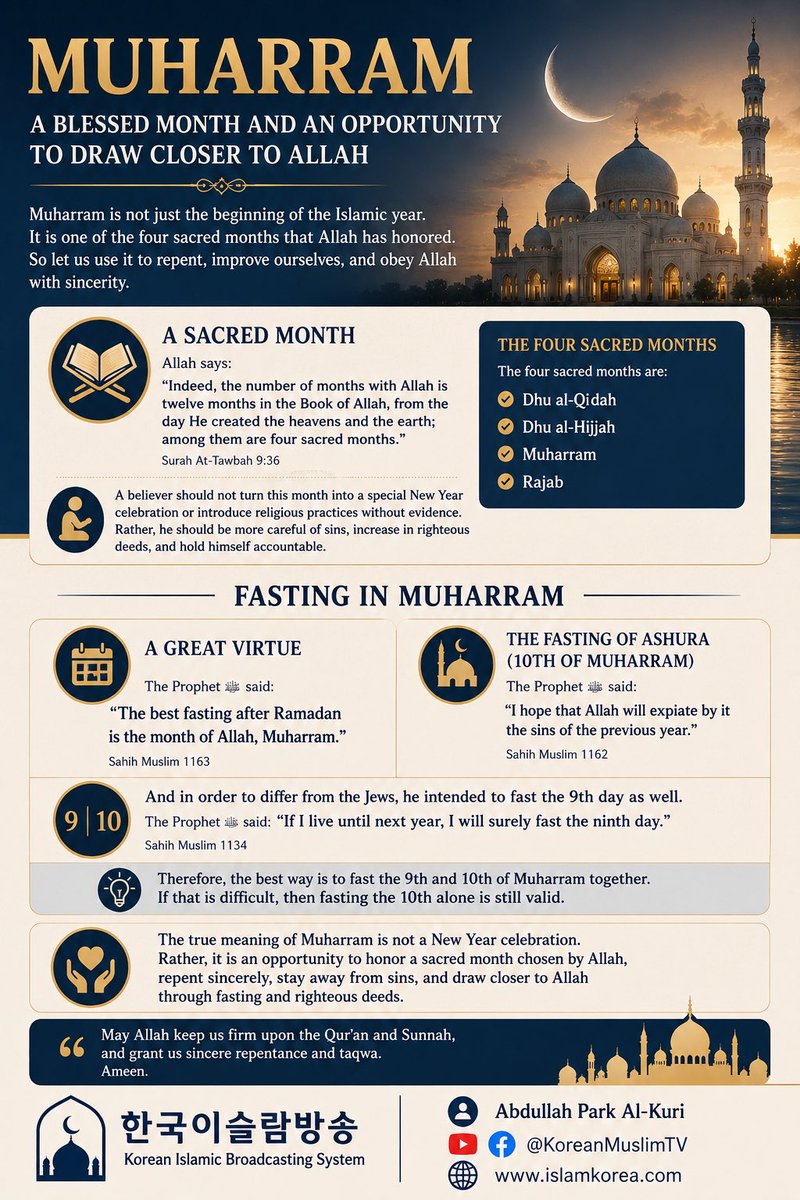
Muharram is not merely the beginning of the Islamic year. It is one of the four sacred months that Allah has honored.
Allah says in meaning:
“Indeed, the number of months with Allah is twelve months in the Book of Allah, from the day He created the heavens and the earth; among them are four sacred months.”
Surah At-Tawbah 9:36
Therefore, a believer should not turn this month into a special New Year celebration or introduce religious practices without evidence. Rather, he should be more careful regarding sins, increase in righteous deeds, and hold himself accountable.
Fasting in Muharram also has great virtue.
The Prophet Muhammad, peace and blessings be upon him, said:
“The best fasting after Ramadan is the month of Allah, Muharram.”
Sahih Muslim 1163
In particular, fasting on Ashura, the 10th of Muharram, is an emphasized Sunnah.
The Prophet Muhammad, peace and blessings be upon him, said about fasting Ashura:
“I hope that Allah will expiate by it the sins of the previous year.”
Sahih Muslim 1162
And in order to differ from the Jews, the Prophet Muhammad, peace and blessings be upon him, intended to fast the 9th day as well.
The Prophet Muhammad, peace and blessings be upon him, said:
“If I live until next year, I will surely fast the ninth day.”
Sahih Muslim 1134
Therefore, the best way is to fast the 9th and 10th of Muharram together. If that is difficult, then fasting the 10th alone is still valid.
The true meaning of Muharram is not a New Year celebration. Rather, it is an opportunity to honor a sacred month chosen by Allah, sincerely repent, stay away from sins, and draw closer to Allah through fasting and righteous deeds.
May Allah keep us firm upon the Qur’an and Sunnah, and grant us sincere repentance and taqwa.
Ameen.
Dear Muslim brothers and sisters,
Try to devote even one-tenth of the love you have for the World Cup, provocative social media videos, and music to the Qur’an—the word of Allah—and to obeying His commands.
"If even that is difficult", reflect seriously on why these things may be haram.
For the Next Year, I Will Translate Islamic Books, Save the Money I Earn, and Establish a Masjid in Korea
The name of the masjid will be:
مسجد المسيح عيسى ابن مريم في كوريا
Masjid al-Masih Isa ibn Maryam in Korea
(The Mosque of the Messiah Jesus, Son of Mary in Korea)
마스지드 알-마씨흐 이싸 이븐 마르얌 (한국)
마리아의 아들 메시아 예수의 성원 (대한민국)
I do not want to rush to establish this masjid. I will work hard for the next year and establish it with my own money, insha Allah.
I will also not conduct any fundraising for the establishment of the masjid.
The reasons are as follows:
1. I embraced Islam in 2009. Yet, even now in 2026, not a single new Korean imam has emerged, and not a single new masjid has been established where the khutbah is delivered in Korean. Does this make any sense?
2. In 2019, I established the Islamic Peace Association in Korea and subsequently established the Masjid of Peace. I have experience serving as an imam there, and I also delivered Islamic lectures to Koreans.
The members of the association at that time know that I never asked them for even one dollar, and I did not actually receive even one dollar from them. I paid for everything with my own money even the monthly rent.
I did this because there are people within the Islamic community in Korea who do not properly understand or recognize that ghibah and namimah are not minor sins, but major sins against which Islam has issued severe warnings. I was concerned that people might speak badly about me behind my back and thereby obstruct the work of da’wah.
3. What is surprising is that not only in Korea, but also abroad, many Muslims do not encourage or pray for someone who says that he intends to establish a masjid. Instead, they openly and casually say things such as:
“You are asking for money.”
“Do not use Islam.”
Rather than supporting such da’wah activities, these people obstruct them.
4. That is why I now understand the reason.
I have come to understand why, despite the tremendous increase in the number of new Korean Muslims in recent years, no new Islamic schools have been established to teach Islam in Korean, no new mosques have been founded where the Friday sermon is delivered in Korean, and no new Korean imams have emerged. It is because whenever someone steps forward to undertake such work, that person is harassed, spoken ill of, and subjected to defamation. They are socially ostracized among Koreans and obstructed until they are unable to accomplish anything.
As a result, although many Koreans have embraced Islam, they cannot find anyone after their conversion who will care for them, assist them, or provide them with systematic Islamic education. Consequently, some leave Islam, while others remain Muslims only on paper and do not practice Islam in their actual lives.
5. Of course, I also understand why some people react in this way.
In the past, a new Muslim collected a large amount of money under the pretext of building a mosque in Korea. However, instead of constructing an actual mosque, he rented a place for prayer. Even so, the Friday sermon is still not delivered there in Korean, and systematic Islamic education is not properly provided in Korean.
Therefore, I have made a decision.
Just as I did in 2019, I will establish this masjid with my own money.
However, this time, in order not to repeat the same mistakes made by others, I will focus on knowledge and education rather than spending large amounts of money on the outward beauty of the masjid or luxurious interior decoration.
The systematic Islamic education and lecture programs provided by the masjid will be recorded and made available free of charge. A khutbah will be delivered in Korean every week, and it will also be broadcast live online. I intend to focus not only on offline da’wah, but also on online da’wah.
I will begin the masjid even if I have to use part of my own home.
Although it may initially begin as a small prayer space, I chose this name with the hope that, after I have passed away, it will one day grow into a large masjid.
Further details and plans will be announced later through my official social media accounts.
To explain the idea briefly in advance, although it will be called a masjid, an Islamic academy will also be established within it to provide systematic Islamic education in Korean. I am also preparing detailed plans concerning what kind of education will be provided and how it will be delivered.
I am already working toward fulfilling this dream.
Although the payment is not large, I am currently working for modest compensation to translate Islamic books from Arabic into Korean. For the next year, I will work hard and earn enough money to rent a home in Korea, and I will use part of that home as a masjid and an Islamic academy, insha Allah.
Those who wish to learn more about me may visit my website or watch the videos on my YouTube channel.
https://t.co/C4aWvVKWm9
Not only Koreans, but even some Muslims abroad may see this post, leave malicious comments, and say to me:
“Why are you trying to raise money?”
However, I have already stated clearly that I will not conduct fundraising for the construction of the masjid.
Please remember that such criticism and obstruction are among the reasons why it is difficult for people to come forward and engage in Islamic da’wah in Korea. This kind of attitude has hindered the development of Islam in Korea.
I say this out of love for you.
Ghibah and namimah are major sins against which Islam has issued severe warnings. In particular, a sin that violates another person’s honor and rights is not a matter that can be treated lightly or resolved merely by performing acts of worship or ‘umrah.
Sincere tawbah requires a person to stop the sin, sincerely regret it, and firmly resolve never to repeat it. When possible, and when doing so will not cause greater harm, the person should also apologize to the one whose honor was violated and seek forgiveness.
However, when informing the person about the backbiting is likely to cause greater anger and conflict, it cannot be stated categorically that directly informing that person is always a condition for tawbah. In such a case, one should seek forgiveness for that person, pray for him, mention his good qualities in the places where he was previously spoken of badly, and make an effort to restore the honor that was damaged.
I simply cannot understand it.
Why are Muslims trying to prevent the development of Islam?
The Prophet Muhammad said:
“Whoever builds a masjid for Allah, Allah will build for him a house like it in Paradise.”
Source: Sahih al-Bukhari, no. 450, and Sahih Muslim, no. 533.
Some people may say:
“Do not pay attention to those who leave malicious comments. Raise funds for the masjid and build it.”
However, I will not do that.
I have already explained the reasons.
Furthermore, this masjid is intended to focus on da’wah, inviting non-Muslims, particularly Christians, to Islam. For this reason, I ask you to understand that I also did not conduct fundraising for the masjid in 2019.
I have already offered the necessary advice.
Nevertheless, if someone continues to backbite me and speak badly about me, there is nothing more I can do. If that person does not repent and seek forgiveness, then on the Day of Judgment, his good deeds may be given to the person he wronged in proportion to the injustice he committed. If his good deeds are exhausted, the sins of the victim may be placed upon him.
I am sorry, but I will not conduct fundraising for the construction of this masjid.
I will begin this good work by myself.
If no one else will do it, then I will. This is my determination.
Once again, this masjid will be established for the purpose of da’wah.
It will be a masjid that values knowledge more than outward beauty and luxurious interior decoration, and it will establish a new educational system.
Therefore, I will meet scholars in Makkah and Madinah who follow the ‘aqidah of the Salaf al-Salih, and I will seek to form a group of scholars who will support this project not financially, but through knowledge, insha Allah.
Of course, I will also show them this statement, which clearly explains that I will not conduct fundraising for the construction of the masjid. Therefore, there is no need to worry.
I pray that Allah will enable me to carry out this plan with a sincere intention, seeking only His pleasure, and that He will protect my heart from showing off and the desire for fame.
I pray that Allah will purify my intentions, correct my words and actions in accordance with the Qur’an and Sunnah, and guide me back to the truth whenever I make a mistake.
I pray that Allah will grant me beneficial knowledge, patience, and wisdom, and protect me from every difficulty that may obstruct this plan.
I pray that Allah will make this masjid and Islamic academy a center of da’wah that teaches correct Islamic knowledge to Muslims in Korea and introduces Islam to non-Muslims with wisdom and in a beautiful manner.
I pray that Allah will accept this work, forgive my shortcomings and mistakes, and make it an ongoing charity whose reward continues even after I have passed away.
I pray that Allah will allow even one person to recognize the truth through this work, and that He will cause Islamic knowledge and da’wah to develop in Korea.
Amin.
Abdullah Park al-Kuri
@KoreanMuslimTV
https://t.co/ErhNCEw0Wc
https://t.co/Aq15qLKQG2
Reason 10) Why a Korean Christian Chose Islam
Jesus was sent by God vs Can the one who is sent be the same as the One who sent him?
When I was a Christian, I read the Bible and thought deeply about whether Jesus was God Himself or a messenger sent by God.
During that process, I found a verse in the Gospel of John in which Jesus called the Father the only true God and described himself as the one whom He had sent.
The Bible says:
“Now this is eternal life: that they know You, the only true God, and Jesus Christ, whom You have sent.”
John 17:3
This verse was very clear to me.
Jesus called the Father “the only true God.” He then distinguished himself as the one sent by that only true God.
At this point, I asked myself a simple question.
If Jesus is God Himself, why did he call only the Father the true God?
And why did he describe himself as someone sent by that God?
How can the One who sends and the one who is sent be the same being?
Jesus also said that even his teaching was not his own, but came from the One who sent him.
The Bible says:
“Jesus answered, ‘My teaching is not My own. It comes from the One who sent Me.’”
John 7:16
This verse was also very clear.
Jesus said that his teaching was not his own. He said that it belonged to the One who sent him.
Does this not mean that Jesus was not speaking with independent divine authority, but was conveying the teaching he had received from the God who sent him?
Is it natural to say that God receives teaching from another God and then delivers it to people?
Jesus also spoke about the relationship between the one who is sent and the one who sends.
The Bible says:
“Very truly I tell you, no servant is greater than his master, nor is a messenger greater than the one who sent him.”
John 13:16
According to this statement, the one who is sent and the one who sends are clearly distinguished. The one who is sent receives a mission from the one who sent him and conveys that person’s words and teachings.
Jesus said that he was the one who had been sent.
He called the One who sent him the only true God.
He also said that his teaching was not his own, but belonged to the One who sent him.
Then how could Jesus be the same God as the One who sent him?
Of course, Christian theology explains that the Father and the Son are distinct persons who share one divine essence, and that this is why the Father could send the Son.
However, when I read the Bible directly, the relationship described in the text itself seemed much clearer than this theological explanation.
One is the One who sends.
The other is the one who is sent.
One gives the teaching and the mission.
The other receives that teaching and mission and conveys them.
God is the One who sends.
Jesus is the one sent by God.
This distinction became a very serious question for me.
Then I read the Qur’an.
Qur’an 61:6
Jesus, son of Mary, said: “O Children of Israel, indeed I am the messenger of Allah sent to you, confirming the Torah that came before me and giving good news of a messenger who will come after me, whose name is Ahmad.”
This verse was very clear.
Jesus did not introduce himself as God. He introduced himself as a messenger of Allah sent to the Children of Israel.
The Qur’an also speaks clearly about Jesus.
Qur’an 4:171
The Messiah, Jesus son of Mary, was only a messenger of Allah, a word from Allah conveyed to Mary, and one of the spirits created by Allah and perfected with noble qualities.
To me, this explanation was much clearer.
Allah is the One who sends messengers.
Jesus is a messenger sent by Allah.
Allah is the Lord of Jesus and my Lord.
Jesus said that he had been sent by the only true God, and he said that even his teaching belonged to the One who sent him.
Therefore, I felt that it was much more natural, and much more consistent with many verses of the Bible, to understand Jesus not as God Himself, but as a great messenger and prophet sent by Allah to the Children of Israel.
This is one of the reasons why I left Christianity and chose Islam.
A Korean Muslim’s Experience in Malaysia, Farewell, and New Beginning
During my time in Malaysia, I was blessed to spend many meaningful and precious moments with my Muslim brothers and sisters.
I visited various mosques, Islamic centers, Islamic schools, and other Islamic educational institutions, where I had the opportunity to meet and connect with many brothers and sisters.
Although I am still lacking in many ways, I was gratefully given opportunities to deliver lectures. In some places, I was also asked to serve as the imam and lead the prayer together with the brothers.
Among all these experiences, the volunteer activities for children and the lectures for Muslim families remain the most memorable to me.
Spending time with children, smiling and speaking with them, and teaching them about Islam was a precious experience. Sharing discussions with Muslim families about faith, education, family life, and da’wah also became a great source of learning for me.
Through meeting Muslim brothers and sisters from many different countries in Malaysia, I was reminded once again of an important truth.
We may have been born in different countries, and we may speak different languages and come from different cultures, but in Islam, we are brothers and sisters and members of one family.
I began inviting Koreans to Islam online in 2009. Through YouTube channels, online chats, and other platforms, I continued introducing Islam to Korean people. By the permission of Allah, nearly 50 Koreans accepted Islam through my da’wah efforts.
From 2020, I began more practical and organized da’wah activities. I visited various mosques and Islamic centers, volunteered in different communities, and personally experienced the reality of Islamic work in Korea.
However, many mosques and Islamic centers in Korea are mainly operated by foreign communities and often focus on activities for people from their own countries, using their own languages.
Because of this, I realized that there were clear limitations when it came to teaching Islam to Korean people in the Korean language.
For this reason, I established a peace association and opened an Islamic center myself. I also served as an imam and preacher at Incheon Salam Masjid and Islamic Center, where I led prayers and worked to introduce Islam to Korean people.
However, in Korea, many foreign Muslim communities tend to gather mainly among people from their own countries, use their own languages, and focus primarily on serving their own national communities.
As a result, it was very difficult to find anyone who would continuously support our da’wah activities for Koreans. I could not even find anyone willing to help cover the monthly rent of the Islamic center.
Eventually, due to financial difficulties, I had no choice but to close the Islamic center that I had established and operated.
For these reasons, carrying out da’wah in Korea sometimes felt lonely and, at other times, deeply discouraging.
However, through my experience in Malaysia, I realized one important truth.
Even if there are not many people in Korea who can help me, that does not mean that I am alone.
Beginning with the brothers and sisters I met in Malaysia, there are countless Muslims around the world who support da’wah in Korea and sincerely wish to participate in it.
Through these meetings and experiences, I made a new decision.
I decided to establish K-Da’wah Family, a global family of Muslim brothers and sisters working together for da’wah in Korea.
K-Da’wah Family is not an organization for one particular nationality or country. It is also not an organization for any political party, sect, or faction.
It is a global Muslim family working together to convey authentic Islam to Korean people based on the Qur’an and the Sunnah through education, translation, video production, volunteer service, financial support, and other forms of da’wah.
My time in Malaysia is now coming to an end, but the relationships formed here and the commitment to da’wah that grew here will not come to an end.
I sincerely thank all the brothers and sisters in Malaysia who welcomed me warmly, gave me opportunities to lecture and volunteer, prayed with me, and shared their smiles with me.
May Allah protect Malaysia and its Muslims, bless all of its mosques and Islamic educational institutions, and make us brothers and sisters who support one another for the truth wherever we may be.
Leaving Malaysia is not the end. It is the beginning of a new journey of da’wah together with K-Da’wah Family.
Your brother,
Abdullah Park al-Kuri
Join K-Da’wah Family:
https://t.co/R9NSbR0ntE
A Korean Muslim challenges those who mock him by calling him a “Wahhabi.”
“Try to change my creed. But instead of ridicule and insults, present scholarly evidence and persuade me. This is my challenge.”
To Some Muslims in English-Speaking Circles Who Constantly Use the Term “Wahhabism”
These days, I often see Muslims living in English-speaking countries constantly posting online about how “Wahhabis are like this” or “Wahhabis do that,” while repeatedly attacking and condemning them.
Whenever I see this, I honestly want to ask:
Are you really in your right minds?
How can you criticize a man and his teachings with such confidence when you do not even know his correct name or the most basic facts about his lineage?
The name of the scholar whom you associate with the term “Wahhabism” is:
Muhammad ibn Abd al-Wahhab.
His name was not “Wahhab.” His name was Muhammad.
His father’s name was not simply “Wahhab.” His name was Abd al-Wahhab.
The name “Abd al-Wahhab” means “servant of Allah, al-Wahhab.” Al-Wahhab is one of the beautiful names of Allah, meaning the One who continually and abundantly bestows gifts and blessings upon His servants.
Should you not at least understand the structure of the name correctly before speaking?
Moreover, many Muslims do not call themselves “Wahhabis.” Is it really part of Islamic character to insist on calling them by a label they dislike, with the intention of mocking and condemning them?
Allah, the Exalted, said:
“O you who believe, let not one group ridicule another; perhaps they may be better than them. Nor let women ridicule other women; perhaps they may be better than them. Do not insult one another, nor call one another by offensive nicknames.”
Surah al-Hujurat 49:11
Allah, the Exalted, also said:
“To Allah belong the most beautiful names, so call upon Him by them, and leave those who deviate concerning His names. They will be recompensed for what they used to do.”
Surah al-A‘raf 7:180
Therefore, treating the beautiful names of Allah lightly, turning them into objects of ridicule, or using them in a context of insult and contempt is not a minor matter.
Allah, the Exalted, also said:
“Say: Was it Allah, His revelations, and His Messenger that you were mocking?”
Surah al-Tawbah 9:65
A Muslim must therefore guard his tongue and his writing. He may disagree with a scholar or refute his statements, but he must not turn one of the beautiful names of Allah into a tool for abuse, ridicule, or humiliation.
If a person intends to mock the name of Allah, “al-Wahhab,” itself, or knows that the name “Abd al-Wahhab” contains one of Allah’s beautiful names and then uses a word derived from it with the intention of ridiculing that name, the matter is no longer merely an insult against a scholar or another Muslim. It may become a grave sin connected to mocking one of Allah’s names and the sacred symbols of the religion.
Whoever reads these verses and still continues repeating the word “Wahhabi” for the purpose of mocking Muslims should examine his own speech and conduct before judging others.
There is undoubtedly a difference between using a particular term in a neutral historical or academic sense and using it to insult, stigmatize, and defame others.
However, much of the way the term “Wahhabism” is used online today is neither academic nor historically neutral. Rather, it is used as a label to exclude opponents, ridicule them, and portray them as dangerous before even listening to what they say or learning what they actually believe.
Someone cites a verse from the Qur’an concerning Tawhid, and the response is:
“He is a Wahhabi.”
Another person cites an authentic hadith, and they say:
“This is Wahhabi propaganda.”
Someone else quotes the Companions or the righteous early generations, and instead of discussing the evidence, they simply say:
“This man is a Wahhabi.”
Is this knowledge?
When your opponent presents evidence from the Qur’an and Sunnah, present clearer evidence from the Qur’an and Sunnah in response.
If his reasoning is incorrect, explain precisely where the mistake lies.
But if you are unable to discuss the evidence and merely repeat the word “Wahhabi,” this is not a scholarly refutation. It is nothing more than labeling your opponent and attacking his character.
What is even more serious is that some people place countless lies and accusations under the label “Wahhabism” and then spread them among others.
They say:
“They do not respect the Prophet, may Allah’s mercy and peace be upon him.”
“They declare all Muslims to be disbelievers.”
“They invented a new religion.”
“They liken Allah to His creation.”
Anyone who wishes to attribute such claims to a particular person must provide clear evidence proving that the person actually said or believed them.
To attribute beliefs to someone that he never expressed, merely because he disagrees with you on certain matters of creed, may amount to lying and slander.
Allah, the Exalted, said:
“Those who harm believing men and believing women for something they did not commit have certainly burdened themselves with slander and a manifest sin.”
Surah al-Ahzab 33:58
Shaykh Muhammad ibn Abd al-Wahhab was not a messenger sent by Allah, and therefore his statements were not infallible. Whatever agreed with the truth, we accept, and whatever contradicted the evidence, we reject with evidence.
However, criticism must be based on honesty and justice.
Read his books. Quote his words as he actually said them. Then, if you find an error in his statements, refute it through the Qur’an and Sunnah.
But repeating what others say without verification, attributing lies to him, using a label to mock him, and then calling even those who do not follow him “Wahhabis” is neither knowledge nor justice.
Once again, I want to ask those who repeat the word “Wahhabism” every day in English-speaking online circles in order to attack other Muslims:
Are you really in your right minds?
Do you truly believe that attaching any label you wish to people you dislike, spreading claims you have not verified, and replacing the evidence of the Qur’an and Sunnah with ridicule and stigmatization is the correct way to defend Islam?
If you truly seek the truth, abandon the labels and present evidence.
Abandon insults and mockery, and speak with knowledge.
Abandon false accusations, and judge with justice.
Before calling another Muslim by an offensive label, remember that Allah records every word we write and every word we speak.
بسم الله الرحمن الرحيم
لقد غادرت كوريا وتنقلت بين عدة دول طلبا للعلم الشرعي والدراسة.
لم أطلب من أحد أن يعطيني مالا، وإنما طلبت فقط أن يساعدني في العثور على غرفة نظيفة وآمنة أستأجرها بمالي.
لقد مررت بتجارب كثيرة أثناء تنقلي بين عدة دول. فقد كان بعض الناس يعرضون علي بيوتا كريهة الرائحة أو مليئة بالحشرات وغير صالحة للسكن. ولم تكن حال تلك البيوت في الواقع كما وصفوها لي، كما أن زوجتي لا تستطيع العيش في مثل هذه البيئات لأسباب صحية، ولذلك لم يكن بإمكاننا البقاء فيها، واضطررنا إلى طلب استرجاع أموالنا.
ولكن كثيرا منهم كانوا يرفضون إعادة الإيجار أو التأمين الذي دفعناه، مع أننا لم نمكث في تلك البيوت ليلة واحدة، ولم نستخدمها مطلقا. ولأنني تعرضت لمثل هذه الأمور مرات كثيرة، كنت أطلب فقط ممن يعرف أحوال البلد أن يساعدني في العثور على سكن مناسب.
ولكن في الآونة الأخيرة صار بعض الأشخاص الذين لا أعرفهم يرسلون إلي رسالة قصيرة يسألون فيها:
"هل أنت سلفي؟"
فأجيبهم قائلا:
أنا مسلم، وديني هو الإسلام الذي جاء به النبي صلى الله عليه وسلم كما أنزله الله، من غير تبديل ولا تحريف. وأنا أسعى إلى اتباع القرآن والسنة الصحيحة على فهم الصحابة ومن تبعهم بإحسان من القرون المفضلة.
ولا أتعصب لمذهب فقهي معين، ولا أجعل ولائي وانتمائي لحزب سياسي أو جماعة حزبية أو تنظيم خاص. وإنما أسعى إلى اتباع الحق بدليله، مع احترام العلماء والرجوع إليهم فيما لا أعلمه أو يشكل علي فهمه.
وأثبت لله ما أثبته لنفسه، وما أثبته له رسوله صلى الله عليه وسلم، على الوجه اللائق بجلاله، من غير تحريف ولا تعطيل، ومن غير تكييف ولا تمثيل.
ولا أريد التعصب الحزبي ولا الغلو. وإذا تعارضت أقوال الأشخاص أو الجماعات مع ما دل عليه القرآن والسنة الصحيحة، فإنني أقدم ما دل عليه القرآن والسنة، مع احترام العلماء والرجوع إليهم.
وهذا هو منهج السلف الصالح.
فإن كنت تسألني: هل أنت سلفي بهذا المعنى؟ فالجواب: نعم. أرجو أن أكون من المتبعين لمنهج السلف الصالح، وأسأل الله أن يثبتني على هذا الطريق.
والسلفية التي أعنيها ليست حزبا جديدا ولا جماعة مغلقة، وإنما هي اتباع القرآن والسنة على فهم السلف الصالح.
ديني هو الإسلام، واسمي مسلم. وانتسابي إلى السلف لا يعني أنني انضممت إلى حزب أو تنظيم، وإنما هو بيان للمنهج الذي أسعى إلى اتباعه.
وأنا لا أدعو الناس إلى اتباعي ولا إلى اتباع تنظيم معين، وإنما أدعوهم إلى الرجوع إلى الإسلام الذي شرعه الله وبلغه رسوله صلى الله عليه وسلم.
ولكن بعد أن أجيب بهذه الإجابة، يختفي فجأة بعض الأشخاص الذين كانوا يقولون إنهم سيساعدونني.
وخلال الأشهر العشرة الماضية، لم يحدث هذا مرة أو مرتين فقط، بل تكرر مرات عديدة. وفي معظم تلك الحالات، كان بعضهم يتفقد حساباتي في مواقع التواصل الاجتماعي ومقاطع الفيديو في يوتيوب، ثم يعرف عقيدتي، وبعد ذلك يتوقف عن مساعدتي أو يقطع التواصل معي.
وقد صرح بعضهم أو ظهر من كلامهم أنهم توقفوا عن مساعدتي بعد أن عرفوا عقيدتي.
فماذا أفعل الآن؟
هل يجب أن أخفي عقيدتي حتى يساعدني الناس؟
هل يجب أن أغير ما أؤمن به من أجل أن يدلني أحد على غرفة نظيفة أستأجرها؟
هل يجب أن أتخلى عن موقفي من القرآن والسنة حتى أرضي الناس؟
ومن أراد أن يختبر ثباتي على ديني بالمال أو بالمساعدة، فعليه أن يعلم ما يلي:
لن أبيع ديني من أجل شيء من الدنيا بإذن الله، وأسأل الله أن يثبتني.
لقد قلت للمسيحيين من قبل بوضوح:
ولو أعطيتموني أموال الدنيا كلها، فلن أترك الإسلام ولن أعود إلى الكفر بإذن الله.
ولو أعطوني مليارات أو مئات المليارات من الأموال، فلن أغير إيماني ولا عقيدتي بإذن الله.
فأموال الدنيا تزول، أما الإيمان بالله فهو أثمن ما أحمله معي إلى لقاء الله.
أنا أشكر كل من يساعدني، ولكنني لن أبيع ديني والحق من أجل المساعدة.
ومن اختار ألا يساعدني بسبب ما أؤمن به، فهذا اختياره.
والرزق وتيسير السكن بيد الله وحده، والناس إنما هم أسباب. وأنا أتوكل على الله مع الأخذ بالأسباب المشروعة.
وإذا ابتعد عني شخص، فأرجو أن يعوضني الله خيرا منه، أو أن يفتح لي طريقا خيرا من الطريق الذي أغلق.
وإذا أغلق الناس بابا في وجهي، فأرجو أن يفتح الله لي بابا خيرا منه.
وحتى لو تركني الناس جميعا، فلست وحدي ما دمت متوكلا على الله، وأرجو نصره وحفظه.
اللهم إن تركني الناس بسبب تمسكي بكتابك وسنة نبيك، فلا تتركني.
وإن أغلقوا الأبواب في وجهي، فافتح لي أبواب رحمتك ورزقك من حيث لا أحتسب.
اللهم ثبتني على الإسلام والسنة حتى ألقاك، واهدني دائما إلى الحق، واجعلني من عبادك المخلصين.
آمين.
عبد الله بارك الكوري (@ibnAlkuri)