We see similar results looking at a historical episode of inflation. The first run-up in the 1970s peaked at 6.5% (02/1970), then declined to 2.95% (08/1972), then starting its 2nd run-up. We see that attention was ~2 times as high for “normal” levels of inflation post peak.
This raises interesting questions as to why attention remains elevated. One interpretation is a Rational Inattention framework. In these settings, above a threshold, attention is a (+) function of inflation persistence and volatility, and a (-) function of the cost of info.
Elevated inflation attention is one possible interpretation of the slower-than-expected disinflation experienced in late 2023-early 2024. Understanding how the dynamics of inflation are impacted by attention is an important question. See some interesting papers by @PfaeutiEcon
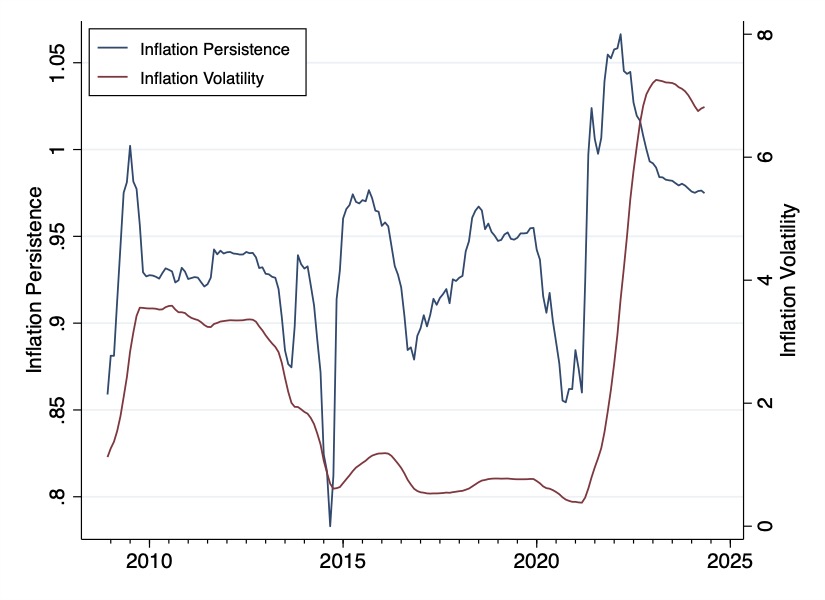
Consistent with this RI interpretation, we see that both inflation persistence and volatility spiked post-2020, and remain elevated (esp. for volatility) (constructed with 5-year rolling windows) (U.S. example again):
Excited to share a new working paper (w/ @KorenokOleg ) "The Rockets and Feathers of Inflation Attention" It's a short follow-up from our earlier paper looking at attention towards inflation, but now thinking about disinflations. 🧵https://t.co/q2CjeJzYq4
The Richmond Fed has teamed up with @URichmond Robins School of Business and @VCUBusiness to host the #DivEc23 Conference in October. This annual event supports students pursuing an econ degree or interested in an economics career. Learn more & register: https://t.co/11iO4DwjYO.
The best response to the proposal to negotiate with #Russia’s Putin was given by #Ukraine’s Foreign Minister Kuleba:
“[Prigozhin] had a conflict with Putin, he had successful negotiations: ended the conflict, agreed to security guarantees. And then Putin killed him.”
THREAD Russia's dictator Vladimir Putin threatens sovereignty of Poland, questioning Poland's borders and calling the current shape of Poland "a Stalin's gift to (ungrateful) Poles". Why it is extremely important, how it repeats Putin's Ukraine politics, and what does it mean /1
Richmond is the place to be for great macro research over the next year! Join us for I-85 Macro on Oct. 27, and pencil in May 17-19, 2024, on your calendars when we'll be co-hosting Midwest Macro with the Fed.
Western countries should prepare to use frozen #Russian assets to help fund #Ukraine’s reconstruction.
Read our @ForeignAffairs piece with Robert Zoellick and Philip Zelikow:
The Other Counteroffensive to Save Ukraine https://t.co/TL4CkQQaaL via @ForeignAffairs
New essay on future of AI
"For 20 generations we have been living in an information revolution"
"We fear the artist & writer will starve, but artist & writer are already starving b/c our copyright system serves mainly monopolies... Policy is everything"
https://t.co/UX89fAUEdP
Friends and #EconTwitter: I have started a petition to request the AEA to help pursue libel and threats on the EJMR. Please spread the word and sign if you are able. https://t.co/3jl6UjSrYS
“...class attendance [is] a better predictor of college grades than any other known predictor of academic performance, including scores on standardized admissions tests such as the SAT, high school GPA, study habits & study skills"
Details in this paper: https://t.co/fqIyDOqDYK
"Russia issues an unending stream of nuclear threats. In the West today... these are discussed in psychological rather than strategic terms... When Russians talk about nuclear war, the safest response is to ensure their very conventional defeat."
https://t.co/cdrPyPmtvg