In this piece, I argue that we should create a Social Capital Hub that acts as a semi-structural approach to supporting low-income households and vulnerable groups during both shocks and normal times.
To protect its vulnerable citizens, Cambodia should develop an informal social capital hub as the first step to creating a formal safety net, writes Kosal Nith.
https://t.co/Td7WDB5lGA
Anwar Shaikh has left this world.
He was so clear in his thinking that he left a deep imprint on the thinking of generations of New School students and readers behind.
He would always insist that we had to get the first principles right. If you start from an absurd model and then argue the world is imperfect measured against that standard from cloud cuckoo land, you have gone astray with no way to return but to start anew.
He wanted to rebuild economics from scratch going back to the classics and in this process became a classic himself.
It’s hard to picture economics without Anwar. As we are challenged to rebuild the basics, we need his thinking more than ever. Thank you for leaving your writing for us. May you rest in peace.
We are calling for abstracts for the Workshop on Island Economies and Ecological Planning in the Philippines, taking place on 9–10 De 2026.
⏰Deadline: 30 October 2026
🖇️Apply now: https://t.co/bEXm2Wb8iA
With Edgar, Jr. Reyes, @sattwickdb@ysi_commons , UP Los Baños
In the first blog in this series, we noted that Cambodia has successfully mobilised resources for development. This strategy, which helped drive Cambodia from low- to middle-income status, is running out of steam https://t.co/nFHQ197RdC
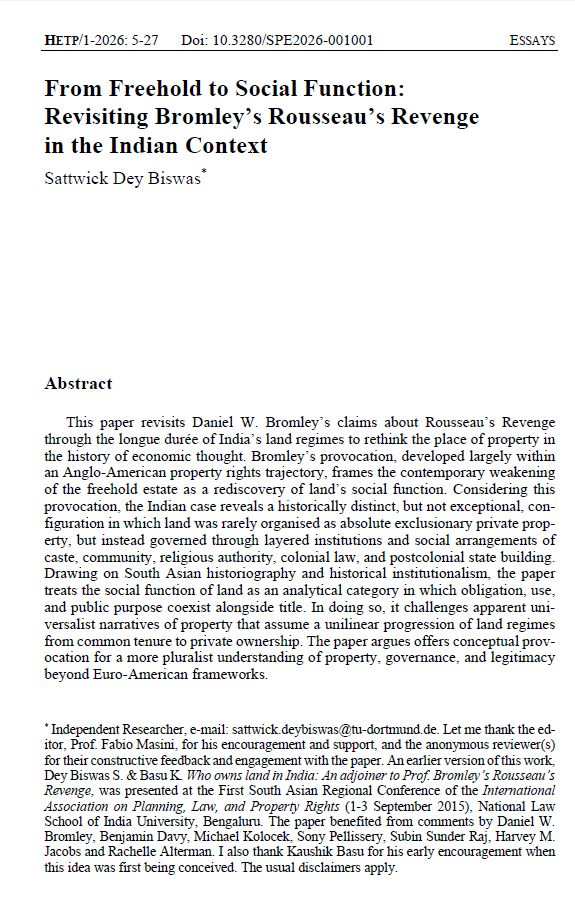
New paper alert! From Freehold to Social Function: Revisiting Bromley’s Rousseau’s Revenge in the Indian Context | History of Economic Thought and Policy | FrancoAngeli Edizioni | https://t.co/NBhzkhrn2f | @het_ysi
It is a choice for every society that faces scarcity. It is a policy question, and a commitment and action to make change happen will depend on political processes. https://t.co/gvlLxkOspd
@LowrieJohn While private MFIs are seeking to generate more revenue, this needs other approaches for financing rural households with a low interest rate.
1/8 🧵
New study: “Determinants of Informal Borrowing: Evidence from Households in 11 Rural Villages in Cambodia” by Prof. Samreth and myself.
Informal credit remains an important financing source for rural Cambodian households, exposing them to exploitative interest rates.
8/8
The findings suggest that combining financial literacy enhancement, income improvement, and finance-related community networks can promote safer and more sustainable financial inclusion in Cambodia.
#Cambodia#FinancialInclusion#DevelopmentEconomics
7/8
Higher household income and residential land ownership reduce reliance on informal credit.
The household head’s age also has nonlinear effects: reliance on informal borrowing initially declines with age but increases again at older ages.
🚨Super excited to announce 4th Southeast Asia Economic Research and Development Conference
📆 Date: December 3–4, 2026
🖇️ https://t.co/xVDSB3foqs
With @sattwickdb, @ysi_commons, @CDRI_Official, @heterodoxnews
On 12 May, Prof. Fabio will discuss the global economic order and the making of a new #Europe in the context of challenges posed by the #Trump administration.
Register here if you’re interested: https://t.co/PINBppITbC
@sattwickdb@ysi_commons
[Call for Papers]
Climate Change and Its Impact on the Economy, Business, and Society: A Global Perspective
📅 Conference Dates: 15–17 July 2026
📍 Venue: Pondicherry University, India
- Deadline for Abstract Submission: 10 May 2026
Web: https://t.co/Z4e0irBtsc
The capital gains tax system should be carefully considered and implemented, with many exemptions and varying tax rates for specific groups, to uphold a high standard of equity and successfully finance public goods. https://t.co/IgoWOC7I3n
Public service delivery in #Cambodia remains slow and unequal. For those unwilling or unable to pay informal fees, the administrative system becomes a bottleneck.
https://t.co/nEjdZmOqZD