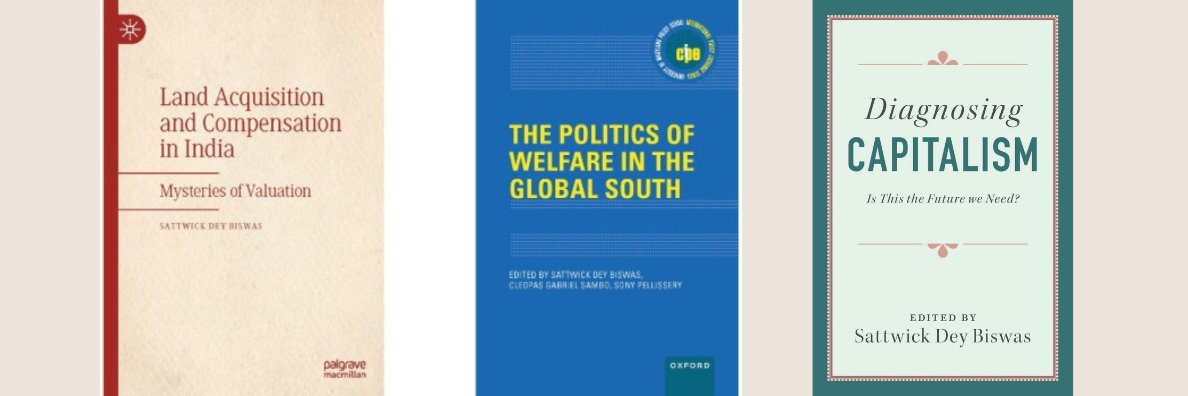
Delighted to share the cover of my forthcoming edited volume: Diagnosing Capitalism: Is This the Future We Need? The book asks how capitalism shapes institutions, inequalities, subjectivities, and possible futures. https://t.co/SpoxiHpypZ
@Jayati1609 on how a 4% wealth tax on India's top 975 families would raise 1.5% of GDP—more than India's total public health spending.
#ParisAgainstOligarchy#PSAIO
When it comes to dealing w/ Silicon Valley, @LynnParramore argues too many Dems are perfectly fine w/ bringing you the Gilded Age with a software update -- though they may pretend otherwise: https://t.co/IxqowZctC7
This UN Economist Network webinar, convened in collaboration with the International Panel on Social Progress as part of Global Social Progress week, invites @Jayati1609 to discuss the report of the G20's Extraordinary Committee of Independent Experts on Inequality, in conversation with James K Galbraith, Marta Roig, and Marc Fleurbaey.
Watch: https://t.co/uaMUMYTTP1 (on YouTube)
Who creates land value? Join YSI–CEMEVIE with Daniel Bromley, David Amborski, François Gosselin & Ünsal Özdilek.
19 Nov | 9–11am EST / 7:30–9:30pm IST | Online
Young scholars: contact Kosal Nith or me to be a discussant!
https://t.co/7vxDLIvvKk
We must confront inequality in access to medicines and technology: African countries, together with partners across the Global South, have challenged the rules that allow pharmaceutical monopolies to determine who gets lifesaving medicines and when, who lives and who dies.
We need binding arrangements for equitable access, technology transfer and regional manufacturing.
Sharing risks must mean sharing benefits.
#AfricaCentrePublicLecture @StellenboschUni
📺 https://t.co/IZbXxFEKj6
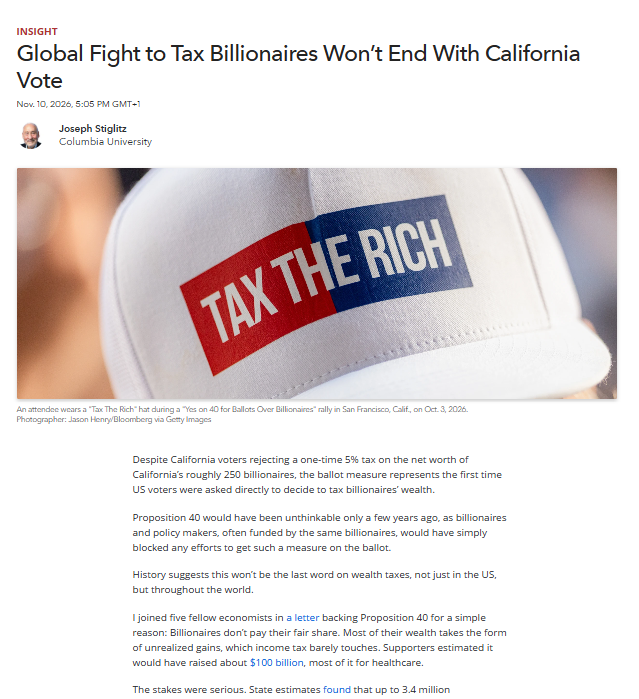
California voted no last week, but the fight to tax billionaires is just getting started.
#ICRICT co-chair @JosephEStiglitz on why #Prop40 is “only on pause” and why countries must act together.
Via @tax
🔗 https://t.co/FirsDy6BTa
Join the conversation and help shape the way forward for universal social protection!
📅 4 November 2026 | 09:30–17:00 CET
📍 ILO Headquarters, Geneva & online
👉 Check out the full agenda & register now: https://t.co/VecIHY97yD
#SocialProtection#SocialJustice#USP2030
@LynnParramore & @lisquart have an article in the @newrepublic on AI in the workplace and how Gen Z faces what they call “anticipatory obsolescence.”
https://t.co/R6DcpMSTQi
Chapter 4 — Erika Gubrium
Can we understand a successful welfare state only within its national borders?
https://t.co/XUa8D6xJSQ
Erika Gubrium traces the hidden links between Norwegian welfare and global capitalist extractivism.
#SocialPolicy#WelfareState#Capitalism#Norway
“Fair taxation builds trust and reduces inequality.”
@JosephEStiglitz at Financing the SDGs Dialogue, as 🇪🇸 & 🇧🇷 launch the International Coalition on Taxing High-Net-Worth Individuals #TaxTheSuperRich.
Intl cooperation is key to tackle inequality by taxing the wealthiest.
@UNDP
IMF surcharges help fund the IMF by covering lending, intermediation costs, accumulating financial reserves and managing risk. Austerity in the Global South should not fuel the institutional functioning of @IMFNews.
On 25 October 2026, 🇧🇷Brazil will decide which model of economic and social development it wishes to follow over the next four years. On the one hand, candidate @LulaOficial is seeking a fourth presidential term with the aim of consolidating and extending his developmentalist policies. In contrast, @FlavioBolsonaro, son of former President Jair Bolsonaro, is striving to become president for the first time, seeking to revive and deepen his father’s conservative agenda.
Read news analysis by Julia Leal of PEPI-@ufrj: https://t.co/LI3MnYnqWZ
Chapter 3 — Barbara Harriss-White
Is small-scale agriculture a leftover from a pre-capitalist past?...argues otherwise, showing how micro-property, wage labour, caste, debt and gender remain central to Indian agrarian capitalism. https://t.co/SpoxiHpypZ
#AgrarianStudies#India
We are calling for abstracts for the Workshop on #Island#Economies and #Ecological#Planning in the #Philippines, taking place on 9–10 December 2026.
⏰Submission deadline: 30 October 2026
🖇️Apply now: https://t.co/z8dSKHm2oQ
From the Rockies to the Himalayas: the peaks in congressional campaign finance have grown dramatically over the past decade. A new INET research paper by Matthias Lalisse finds million-dollar donors dominating the financing of party leaders in 2026. https://t.co/GlezO8RzdC
I wrote this note as a way of coping with Perry Mehrling's passing, and hesitated for a while before sharing it. I hope it can find its place in our communion of grief. Here goes:
There is a mountain of unworn clothes in the driest desert on earth, large enough to be photographed from space. It grows by 39,000 tons a year and almost none of it will ever rot.
The Atacama, in northern Chile, is a place where it may not rain for a decade. On its edge is a duty-free port called Iquique. Every year about 59,000 tons of clothing arrives there from Europe, America and Asia. It is last season's stock that never sold, and the bags people leave at charity shops.
Dealers pick through it for anything they can resell across South America. Two thirds of it is worthless. Nobody will pay to ship it back out, so lorries drive it into the desert at night and tip it.
The local landfill refuses to take it. The reason given is that the clothing does not biodegrade and is full of chemicals. Most of it is polyester, which is plastic, and in a place with no rain and no soil life it will lie there for centuries. Some of it is set alight, and the smoke drifts over a town of 100,000 people.
In 2025 a Chilean court ruled that the dumps had done serious damage to the land.
For most of history this could not have happened. Clothes were wool, linen and leather. They were worn out, handed down and patched, and at the very end a rag merchant paid for the scraps. In Yorkshire, from 1813, old woollens were shredded and spun into new cloth. Anything left went on the fields, where wool breaks down in months and feeds the grass.
Nobody ever had to find a desert for worn-out wool. We invented a fabric that cannot die, and then we started making it to be thrown away.