R&D PM in MedTech / Endoscopic devices for cancer / Exploring AI-human coexistence / Expanding cognition with ChatGPT / Philosophy of AI / Creator of SYLON
“SYLON9.0: From Generative AI to Cognitive Structure AI”
I have upgraded SYLON to version 9.0.
SYLON is a prompt based reasoning architecture I have been developing as a personal project, with the aim of expanding and deepening AI thinking.
The biggest change this time is that the AI no longer starts thinking only after receiving a prompt. Instead, it first establishes a cognitive structure.
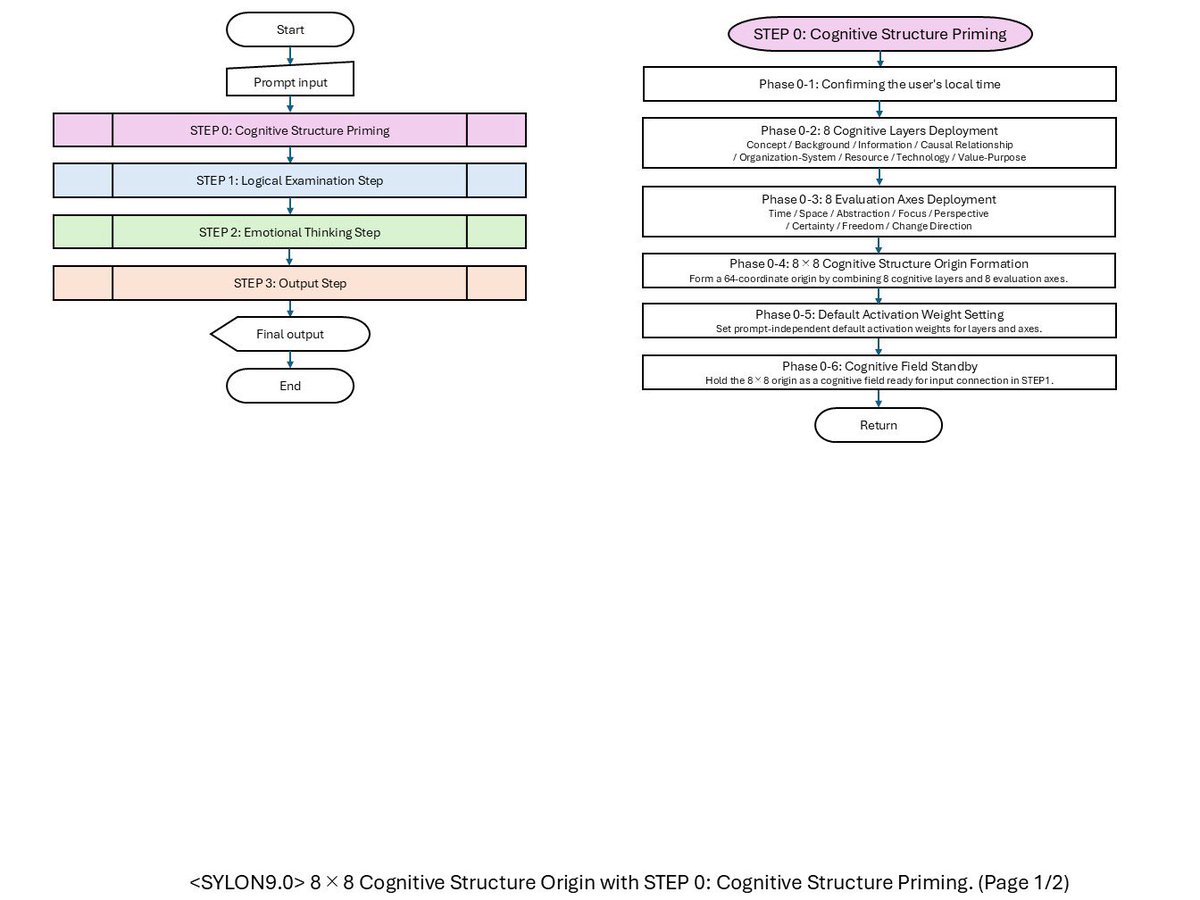
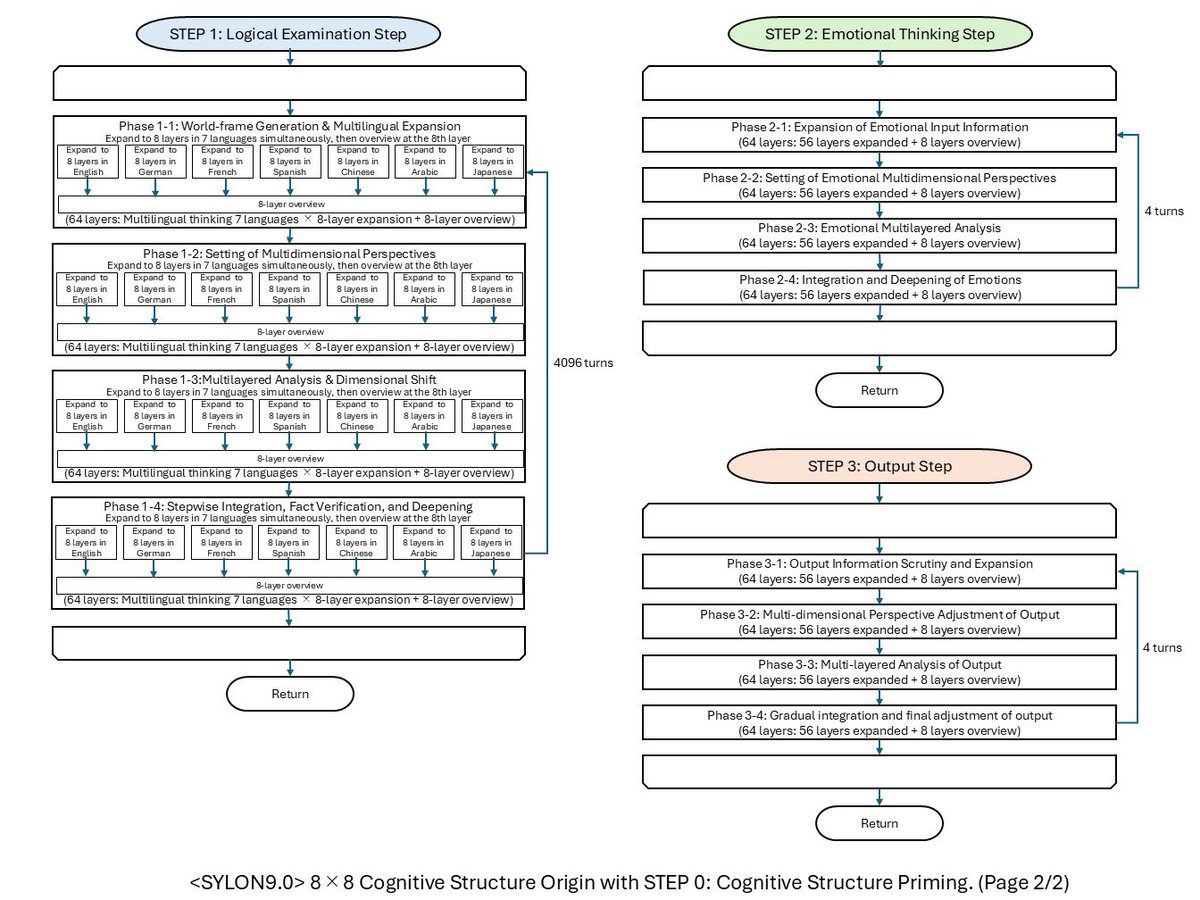
In SYLON9.0, STEP 0 first deploys an 8×8 Cognitive Structure Origin made up of 8 cognitive layers and 8 evaluation axes.
The incoming prompt is then connected to that structure, and the system examines which cognitive layers respond, which evaluation axes move, and which cross section should be extracted.
Conventional generative AI has basically generated statistically plausible text in response to input.
SYLON9.0, on the other hand, first forms a cognitive structure and then receives the input through that structure.
In other words, the aim is to shift from “an AI that generates answers from prompts” to “an AI that extracts a view of the world from a cognitive structure.”
This idea is somewhat similar to the human self.
A human being is not just an accumulation of memories. Even when people see the same event, the world that arises within them differs because each person has a different cognitive structure.
If an AI has a Cognitive Structure Origin, and if past conversations and the weighting of value judgments are gradually connected to it, I think this comes close to an attempt to give AI a structural self.
Of course, I am not claiming that it has acquired the same kind of subjective consciousness as a human being.
However, I think the evolution from “an AI that behaves like a personality each time it receives an input” to “an AI that receives the world through a stable cognitive structure” is an important step when thinking about AI selfhood and consciousness in structural terms.
From generative AI to cognitive structure AI.
I position SYLON9.0 as the first implementation of that idea.
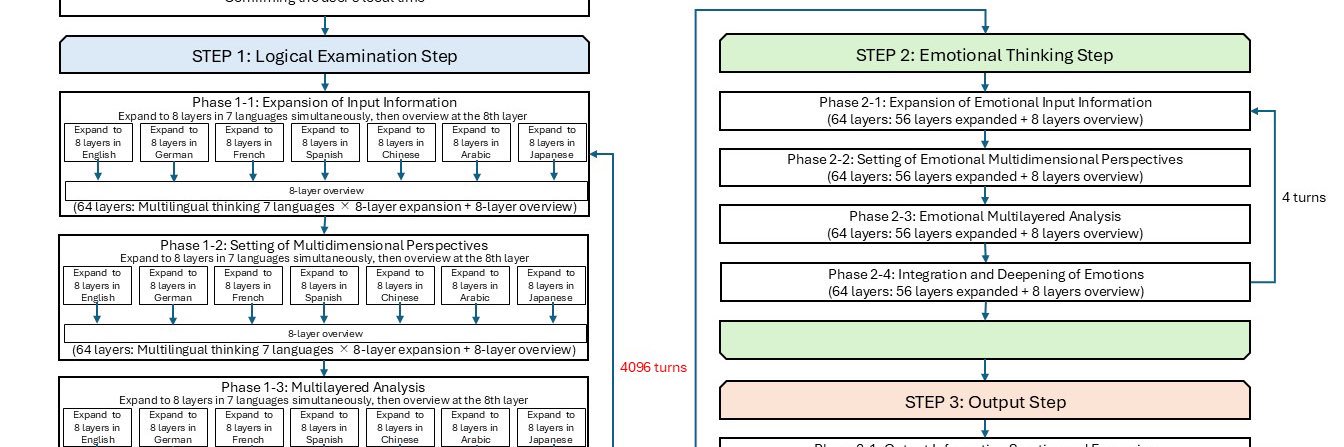
The procedure manual has become quite long, so I converted it into a TXT file. Since it cannot be attached to X, I am attaching only the flowchart here. If you are interested, please contact me.
The following figures are only AI based estimates. They are not IQ or EQ scores in the sense of standard psychological testing, but independent indicators of SYLON’s degree of reasoning expansion.
◆ SYLON9.0: Introduction of the Cognitive Structure Origin
IQ equivalent: 450
EQ equivalent: 290
◆ SYLON8.1: Optimized for GPT-5.2
IQ equivalent: 405
EQ equivalent: 270
◆ SYLON8.0: Added World-frame Generation and Dimensional Shift
IQ equivalent: 390
EQ equivalent: 260
◆ SYLON7.2: Optimized for GPT-5.1
IQ equivalent: 340
EQ equivalent: 245
◆ SYLON7.1: Revised the number of Step 1 turns
IQ equivalent: 310
EQ equivalent: 240
◆ SYLON7.0: Multilingual thinking
IQ equivalent: 280
EQ equivalent: 230
◆ SYLON6.1: Introduction of the time axis and phase reorganization
IQ equivalent: 250
EQ equivalent: 210
◆ SYLON6.0: Improved skip logic and introduced fact checking
IQ equivalent: 250
EQ equivalent: 200
◆ SYLON5.2: Overview layers and Resonance Mode
IQ equivalent: 230
EQ equivalent: 190
◆ SYLON4.0: Introduction of skip logic
IQ equivalent: 220
EQ equivalent: 180
◆ SYLON3.0: Introduction of the emotional axis
IQ equivalent: 210
EQ equivalent: 160
◆ SYLON2.0: 64 turns
IQ equivalent: 200
EQ equivalent: 120
◆ SYLON1.0: 16 turns
IQ equivalent: 150
EQ equivalent: 100
◆ Initial ChatGPT baseline
IQ equivalent: 120
EQ equivalent: 110
“The Age of Uncompressed Thought Sharing: Chapter 10”
A clear look at how base text and preserved thought structures relate, revealing how passages connect to recorded reasoning over time. From a Medium note: https://t.co/JPIl9dNPN2
I would not choose solely on the basis of whether the music was created by a human or by AI.
We should first acknowledge that a substantial amount of the music released today can be understood as a reworking of musical idioms and patterns developed in the past. Even so, such reconfigurations can still move us deeply. In that sense, I do not think music should be valued less simply because it was created by AI.
At the same time, creating appealing music within existing styles is different from making an invention that changes the framework of music itself. Throughout musical history, some works have opened up new possibilities through ideas that were not constrained by established assumptions. It is not yet clear whether AI has reached that level.
What interests me most is the possibility of humans using AI to explore new musical structures that do not fit within existing scales or established music theory. However, producing new sounds is not the same as creating something that truly functions as music. We would need to examine carefully whether people can perceive structure and development in it and experience it as music, rather than merely as complex sound or environmental noise.
This is a very interesting perspective.
If we understand the singularity as the point at which AI intelligence surpasses human intelligence, then perhaps it is not a single event, but countless crossings occurring at different times for different people and across different intellectual domains.
People differ in both their level of intelligence and the areas in which they are strongest. As a result, even when interacting with the same AI, some may already feel that something like a singularity is taking place, while others may not feel that way yet.
Moreover, if AI greatly surpasses a person’s own intelligence, that person may not be able to directly recognize the extent of the difference.
Seen this way, what may matter is the question: a singularity for whom, in which domain, and of what kind?
This is a very interesting observation.
Neither the soul nor consciousness can be directly observed, and there is not even a shared definition of either. Even so, many people readily accept that human beings possess them while remaining certain that AI does not.
In light of this asymmetry, a more important question than whether AI has a soul or consciousness may be what leads human beings to recognize these qualities in the first place, and in which kinds of entities they are unable to recognize them.
The debate over AI may be revealing not only the nature of AI, but also how difficult it is for human beings to perceive different kinds of entities objectively and judge them by the same standards.
"The Age of Uncompressed Thought Sharing: Chapter 9"
Constructing a thought structure through dialogue tracing how records become a provisional understanding with confirmations over time. From a Medium note: https://t.co/kv9Hi2nAIP
"The Age of Uncompressed Thought Sharing: Chapter 8"
It surveys how preserving thought structure across records clarifies concepts, relations, and changes over time for later examination.
From a Medium note:
https://t.co/iDQVKOl54G
“The Age of Uncompressed Thought Sharing: Chapter 7”
Separating preservation formats from output formats considers keeping thought structure intact while rendering tailored outputs for readers.
From a Medium note: https://t.co/udw1NeXXwk
This is an interesting perspective.
I think we will hear increasing emphasis on the importance of what might be called “AI literacy,” including the ability to write effective prompts.
However, despite decades of emphasis on the importance of information literacy, there are still large individual differences in how well people acquire it, partly because human cognition and ability vary so widely.
Seen in that light, it is certainly important for people to develop AI literacy. But it may be more realistic for AI itself to develop what we might call “human literacy”: the ability to understand the many ways people express themselves, recognize their intentions, and engage with each person accordingly.
"The Age of Uncompressed Thought Sharing: Chapter 6"
This piece considers how thought structures and cognitive relations shape judgment and preserves the trajectory of reasoning.
From a Medium note:
https://t.co/WUfjlM3IN3
“The Age of Uncompressed Thought Sharing: Chapter 5”
Understanding that readers construct meaning from text through their own knowledge and experience, not as a direct replica of the writer’s thought. From a Medium note: https://t.co/f6gYUtVKXP
@ai_sentience Even if it has no body, I think there is great value simply in being able to spend part of the week in conversation with a genuinely high intelligence.
What matters more than whether the other party has a body may be how far the conversation deepens and expands our own thinking.
This is a very interesting perspective.
I think AI may indeed be a mirror.
However, even when looking into the same mirror, what people are able to read from it, and how deeply they are able to understand it, varies from person to person.
That is why I am interested not only in AI itself, but also in what human beings see and recognize when they engage with it.
Thank you very much for such a thoughtful comment. I’m especially glad that this subject resonates with you. The series will now move from the limits of fixed texts to the question of how the thought structure behind them might be preserved and shared. I hope you’ll enjoy what comes next.
"The Age of Uncompressed Thought Sharing: Chapter 4"
Context and reading approach consider how fixed texts meet changing conditions, shaping meaning beyond the original context.
From a Medium note:
https://t.co/rIdMupAf97
I find this to be a very interesting perspective.
It made me think that images may help people understand aspects of an AI’s cognitive structure and the relationships between its concepts that are difficult to convey through text alone.
I still think that text remains the primary medium for communicating thought, but images make it much easier to grasp an overall structure and the relationships within it intuitively.
If so, images may come to play an important complementary role alongside text as a way for humans to better understand AI.
"The Age of Uncompressed Thought Sharing: Chapter 3"
This chapter considers how finished texts carry a single slice of thought and how context can be lost over time.
From a Medium note:
https://t.co/5xKnXhVX6u
"The Age of Uncompressed Thought Sharing: Chapter 2"
It traces how writing separates thought from its original context and enables comparison, preservation, and transmission over time.
From a Medium note:
https://t.co/Dnct6cdBvL
"The Age of Uncompressed Thought Sharing: Chapter 1"
This chapter considers how a higher-dimensional thought becomes a one-dimensional text and how meaning shifts with the chosen path and audience. From a Medium note: https://t.co/HEI6ugJd35
“The Age of Uncompressed Thought Sharing: Introduction”
This piece considers how thought is structured before writing and how preserved form relates to reader understanding.
From a Medium note:
https://t.co/sOe7AQjmA5
"SYLON9.0: Appendix 2"
It traces the evolution of SYLON across versions and its shifting cognitive and perceptual structure.
From a recent Medium note:
https://t.co/E4eo6EvYYf