The government mandarins should not blame the buyers, they must call in Indian market wizards and understand what went wrong. Get Uday Kotak to head the divestment process , see what magic he will unleash given time and a free hand.
As a country we are oppressed with badly thought out taxes, taxes driving away foreign investors and then poor execution with tax payers treated with disdain.
Decades back Gunit Chadha came from Citibank US and set IDBI Bank on the path to recovery.
Then he was pushed out and a very highly incompetent and corrupt set ran the bank into the ground in collusion with predatory promoters.
The bank has been nursed back to financial health.
But any investor will want valuations that leave some returns on the table.
The government should either do a Margaret Thatcher like sale to the Indian public and keep appointing top talent from PSU banks to run this or should hold on for better valuations.
There is no need for a fire sale.
Nifty fell from 26400 to 24900 in last 19 trading sessions before budget.
This STT hike news was available with some resourceful people ..
Height of manipulation.
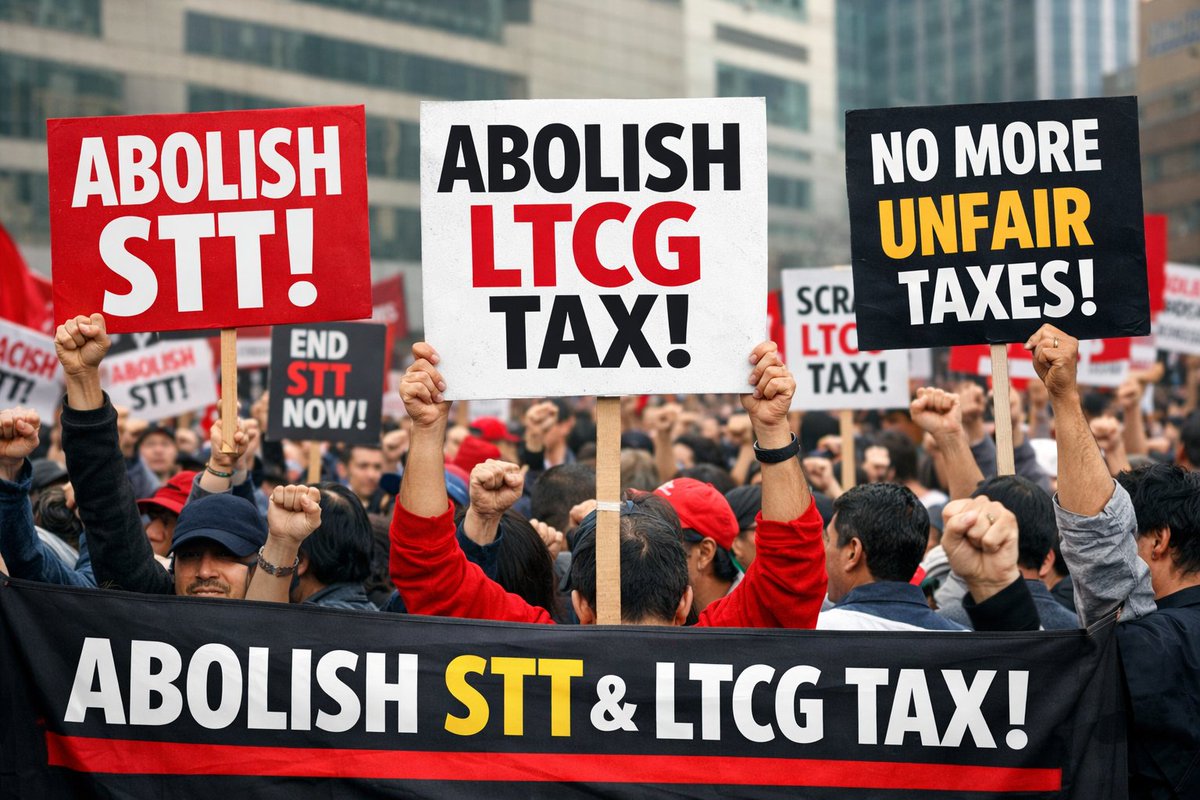
Cut LTCG tax immediately for FIIs at-least , so they can make 7 % net ( post tax + post currency hit ) .
If you don’t do that , they will sell another 6 lacs crores worth of holding in Indian stock market & Rupee will hit 100 in next 24 months.
I don’t want any personal favour , don’t cut my taxes , but save Indian Rupee & Indian economy.
₹53,000 crore - whooping STT collected last year from markets
STT was meant to remove capital gains....but now it is double taxation....!!
This is unnecessary burden on investors...
Either remove LTCG or remove STT....can't have both..
Retweet if you agree..
#abolishSTT
This year in last 20-25 days .
South Korea is up 20%
Brazil is up 11%
India is down 5% , but many stocks are down 20% already .
Underperformance is increasing & GOI may run out of options very soon .
They have to cut capital gain taxes to improve the post tax currency adjusted return .
Period .
FIIs are continuing to sell heavily. It can be for any number of reasons right from identifying better opportunities elsewhere to being unhappy with returns post tax and rupee depreciation.
A responsible government need to invite FIIs for a meeting and understand their concerns. Pitching India as a favourable investment destination and removing any irritants is one of the major responsibility of any government.
It is not that we should frame our policies according to whims and fancies of foreign investors. What is surprising is government not engaging in a dialogue to understand their pain points and why they are moving away from India.
Tweaks in LTCG tax for a small class of investors may not be enough to turn around sentiment. Need a substantial to 100% cut in LTCG for ALL investors and back to 10% type tax for STCG.
This small thing will go far.
There are enough Indian entrepreneurs who can be funded by private equity (both Indian and foreign). However those PE funds will invest only if there is exit visibility after a few years. That can be handled easily by FIIs and DIIs and retail if equity markets are buoyant. It is all a big chain.
If equity markets are weak everything slows down and valuable years are wasted to reach govt's investments, GDP targets etc.
India’s moment is here. 7-8% GDP growth. Strong macros. Fiscal discipline. Stable politics.
Right place. Right time.
But our challenge isn’t macro- it’s micro:
Unliveable cities, slow justice, corruption, low R&D, weak negotiating leverage.
Momentum needs reform on the ground.
India's Economic Tightrope Walk: A Careful Balancing Act Required
17 Dec: FM says: “Worrisome Debt-to-GDP ratio in some states.”
23 Dec: RBI to inject ₹2.9 lakh cr ($32B) liquidity
24 Dec: BofA trader warns India’s state debt tsunami to worsen
What It Means for the Markets:
FM Flags Rising Debt Levels in Some States
At a public event on 17th Dec, the Finance Minister said:
a. India’s Debt-to-GDP ratio has improved from 60.4% (post-Covid) to 56.1% (current year expected). The Centre has reduced its debt levels every year.
b. Some states (unnamed) show worrisome Debt-to-GDP levels. Unless the situation is controlled, these states will borrow new loans to pay old loans instead of borrowing for development. This creates a challenge for India’s 2047 economic ambitions.
Veteran Trader Warns of State Debt Deluge
a. A top trader at Bank of America (Vikas Jain) has warned that Indian states are borrowing a record amount. State debt is up almost 20% in one year from FY24 to FY25 at ₹12 lakh cr ($134 billion).
b. In the next quarter alone (Jan-Mar), states are estimated to borrow ₹4.5 lakh cr ($50 billion), a 60% jump over the current quarter.
State Borrowing Costs are Rising
a. States borrow by way of issuing state bonds. State bond issuances have flooded the market. So, investors demand higher interest rates (yields) because supply is excessive.
b. 10-year bond yield of state bonds has risen to 6.68% already (which means the states’ borrowing cost has increased.)
How This Affects the Markets & Economy
a. In 2025, RBI has done total interest rate cuts of 1.25%, plus it has pumped in a lot of liquidity. The goal was to ease money supply and reduce credit costs for companies, so that they can borrow cheap and invest in business.
b. But despite 1.25% rate cuts, central government bond yields (borrowing costs) declined only 0.22%. Corporate bond yields actually increased by 0.11%.
c. This means despite aggressive RBI rate cuts and liquidity support, heavy state borrowings are overpowering (blunting the effect of) RBI’s monetary tools.
Why State Debt Levels are Rising
a. State debt levels are rising because their tax revenue collections are low. So, to meet expenses and make new investments, they have to borrow.
b. Tax revenue collections are low because corporate earnings are low and household consumption is low (individuals pay GST on consumption).
The System’s Ever-Increasing Thirst for Liquidity
“Liquidity is like a drug,” former RBI Governor, Dr. Raghuram Rajan recently said.
a. On Dec 23, 2025, the RBI announced measures to inject liquidity totaling ₹2.90 lakh crore ($32 billion). This is in addition to ₹6.5 lakh crore of liquidity pumped previously during 2025 plus $5 billion swap just a week ago.
b. If states keep issuing more bonds (piling on more debt), they keep soaking up much of the liquidity RBI is injecting.
What It Means: The goal of RBI’s liquidity is to enable banks and other lending institutions to lend to businesses. But if these lenders use that liquidity to buy state bonds, the liquidity keeps getting consumed like a drug.
That’s why despite RBI cutting rates by 1.25% this year, yields barely dropped (loans did not get cheaper for businesses.)
RBI’s Tightrope Walk: A Delicate Balancing Act
RBI’s monetary policy mandate is to maintain a balance between: (1) Rupee Stability (2) Growth Push (3) Inflation Control
a. Rupee Stability: RBI wants to prevent the rupee from falling further because that creates a vicious cycle (Rupee Falls → FIIs Exit → Rupee Falls More). Fighting rupee fall causes depletion of foreign reserves, which is risky if it goes too far.
b. Growth Push: RBI’s massive liquidity injections and rate cuts are aimed at making credit cheaper for businesses. But the rate cut “transmission” to businesses is not happening due to reasons described in the previous sections.
c. Inflation Control: Too much excess money floating in the system can push up consumer prices (inflation), which no government will allow.
A tightrope act always makes the audience (markets) nervous.
ENDQUOTE
“Be afraid when a nation thinks it can print money to solve all its problems.” – Charlie Munger (CNBC Interview, 6 May, 2019)
@arabicatrader