Things politicians and the political commentariat aren't focused on enough right now:
- Trump is apparently instituting another round of tariffs hitting the EU, China, and other trading partners. It's going to take Democrats knuckling down on an immediate vote to roll these back or terminate Trump's tariffing "authority" to gut this-- and they're going to need to get a sufficient number of Republicans on board to ensure that Trump can't just veto anything they may pass. Note that this is already tanking the stock market, predictably;
- This Iowa explosion, which is going to impact neighboring states, namely Missouri, too. Maybe there was no other alternative, but this looks risky as hell, and if we're investigating things, what happened here and the whole decisionmaking process looks worth a look, too;
- The fact that because inflation continues to be an issue, we're likely getting another Fed rate hike next month (a few days away!), which means higher interest costs for all of us, but also the Treasury on our existing, rapidly-approaching $41 trillion, national debt. Again, Congress is going to have to walk and chew gum-- investigate AND cut spending-- if they want to accomplish the dual goals of those of us who want Trump held accountable, but also want cost of living problems to abate;
- Probably none of the current stupid "save Social Security by adding huge sums to the debt and/or engaging in even more socialism" bills pass, but a hard pump in these particular breaks is needed. Trump seems to be on board with Bill Cassidy's idiotic plan that involves the government taking a stake in publicly-traded companies (which is obviously working out so well already), and then we have this particular exercise in idiocy from RonJon (what the hell happened to that guy, by the way);
- In January, apparently, we're also going to be fighting a Medicare for All plan that would be disastrous for the federal budget, too-- all because Abdul El Sayed has correctly ascertained that Trump will sign up to just about anything, and I'm not sure it would even stop at a literal human poo fertilizer factory, as long as Trump's name is attached to it.
We have got to be able to walk and chew gum, people. We have got to...
Here's something amazing:
Earlier this month, researchers at MIT CSAIL wrote about weight-space programming. Normally, to improve an AI, you retrain it (on huge amounts of data). But these folks showed a larger AI model can edit the weights of a smaller model directly, which improves the model without retraining. Think brain surgery, not school. In one experiment, weight edits took a small model from solving ~8% of a set of math problems to ~48%.
https://t.co/zRbNDH3yKx
@Doctronic Member of Technical Staff @rayinvnt took the logical next step and experimented on models at 4, 26 and 60 billion parameters, up to 75x larger than the original post's biggest. He asked Claude Fable to find where MedGemma's medical skills lived and merged those parts into Gemma 3. A partial brain transplant! And Gemma kept more of its other abilities than MedGemma itself does. He also used it to shrink large models.
A surprise finding: on languages with far less training data online, like Amharic, TranslateGemma kept slipping into Russian, Hindi or Chinese mid-sentence. Fable found the cause in one table of the weights and fixed it with one edit. Amharic slips fell from 81% to 7%, and the same edit cut slips in Tigrinya, Khmer and Georgian, which Fable never optimized for. Check out his post:
https://t.co/xWd7taYfdd
Normally improving AI models is slow and expensive. This approach can help smaller models get better and cheaper, for specific uses, much faster.
It's early, with a lot of careful testing ahead. But people like Ray embody the curiosity and initiative that make @Doctronic special. Go read Ray's post. And if you've got the chops and are based in the US, come join us. Let's build healthcare for everybody. https://t.co/hsOyEISFMU
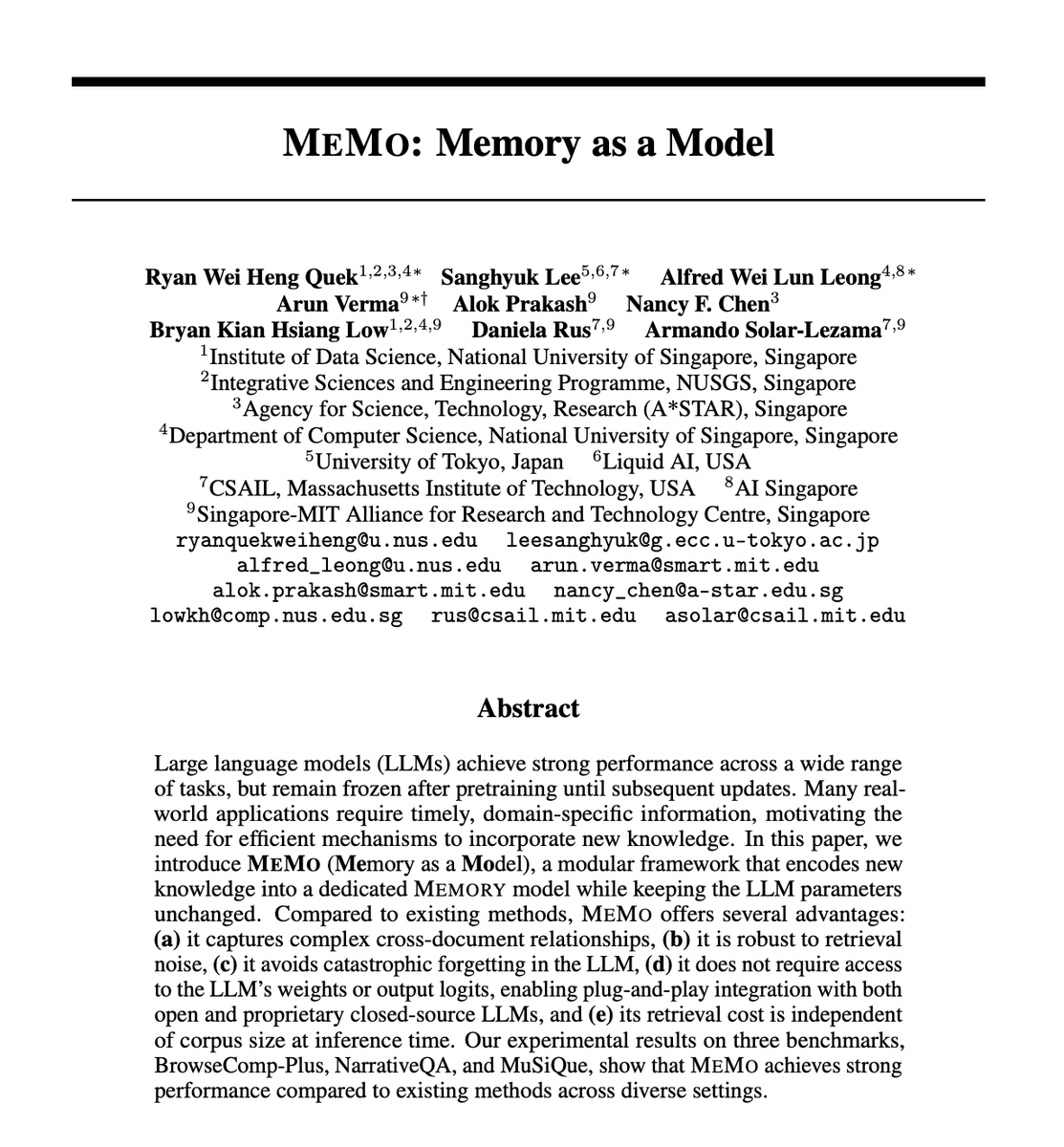
MIT published a paper that might end the entire RAG industry.
It’s called MeMo (Memory as a Model).
Instead of storing your documents in a database, you train a separate, dedicated "Memory" model to internalize them.
Your main LLM, the "Executive" model, stays completely frozen.
Your new knowledge gets encoded into a separate, dedicated Memory Model.
Here’s the clever part. They don't just dump raw text into it.
A 5-step synthesis pipeline distills your documents into structured "reflections”, extracting facts, surfacing entities, and stitching together cross-document relationships before the Memory Model is trained.
Then, at inference time, when you ask a complex question, the Executive Model doesn't search a clunky vector database.
It interviews the Memory Model.
Through a 3-stage multi-turn protocol, it breaks your question down into targeted sub-queries, pulls the exact synthesized knowledge it needs, and reasons over the final answer.
Why this changes the game:
• Zero catastrophic forgetting: Your main LLM’s weights are never modified.
• True plug-and-play: It treats your main LLM as a black box, no weights or logits needed. It works with both open-source and proprietary closed-source models.
• Flat retrieval cost: Inference cost stays independent of corpus size, because the memory lives inside a fixed-size model.
• Built for complexity: Validated across BrowseComp-Plus, NarrativeQA, and MuSiQue, outperforming both RAG and fine-tuning baselines while resisting retrieval noise.
We’ve spent years trying to build bigger context windows and smarter search bars to patch AI amnesia.
The real fix wasn’t giving models a bigger notebook.
It was giving them a second brain.
$BTC Wait for a peak above the upper limit of the range, followed by a confirmed breakout. Open a short position when the price returns to the range, with a stop above the high of the breakout.
2. Long scalp at 0.75
Attempt a long scalp only if the level shows good support on the 15-minute timeframe, with confirmation and a very tight stop.
3. Long position on a breakout from the range low (52–53K)
This is the scenario where I’d prefer to be more patient. Wait for a pullback below the range low, a recovery and a subsequent retest that allows you to enter the market with a clear invalidation and limited risk.
Some people, especially those with less experience, looking at this chart might say: ‘With all these lines, sooner or later you’re bound to get one right’.
Lads, this is what trading is all about.
I’m not trying to predict where Bitcoin is going. I’m building various trading scenarios, identifying levels, triggers and invalidations before the price reaches them.
A trader doesn’t have to guess the market’s next move. They need to know exactly how to react when that move occurs.
No trigger, no trade. Simple.
GLM-5.4 is now available to all GLM Coding Plan users.
New vision capabilities and stronger all-round coding performance.
For users with weekly quotas, GLM-5.4 now comes with 50% more quota compared to GLM-5.3.
Introducing GLM-5.4: Generalized Coding with Our First Loop Transformer.
- Loops existing layers in the GLM-5 base model for deeper reasoning
- Pushes beyond traditional coding to video, games, 3D shaders, and CAD modeling
- Adds vision capabilities for stronger visual coding
API access will open after safety evaluation. Model weights will be released responsibly.
Tech Blog: https://t.co/dQrbKoamcN
A toothpaste company has quietly killed the entire market research industry and nobody is talking about it.
Colgate published a paper showing you can predict real purchase intent by simply asking LLMs to roleplay customers.
And this is beyond insane.
If you ask an AI, "Rate this product from 1 to 5," it gives safe, middle-of-the-road garbage.
So researchers invented a method called Semantic Similarity Rating (SSR).
Instead of asking the AI for a number, they asked it to roleplay.
They gave the LLM a demographic profile. They showed it a product concept. And they asked it to write down its raw, unfiltered thoughts.
Then, they used a semantic model to translate those written thoughts into a numerical score.
The results are staggering.
Tested against 57 real personal care product surveys and 9,300 human responses, the synthetic consumers hit 90% of human test-retest reliability.
They perfectly mirrored how different age brackets and income levels react to price changes.
And they provided detailed, qualitative feedback that was deeper and more critical than what actual humans wrote.
This destroys the economics of traditional market research.
You don't need to wait a month to see if a product will sell.
You can simulate 1,000 hyper-targeted customer interviews overnight.
You can A/B test pricing across every demographic instantly.
Inkling 2 Mini is a looped transformer that runs on a laptop.
Looping lets a model think more and write less. At this scale, its thought process remains monitorable; this may not stay the case. We’re also sharing a variable-loop research model to enable further study.
Some of you thought that Inkling 2 Small was too big at 594B parameters. We heard you: Inkling 2 Mini is a looped transformer with just 26B parameters, small enough to run on your laptop, powerful enough for agentic work with a score of 20.1 on AA Index.
https://t.co/9HzaUMwghb
It took less than 48h for people to get 60fps, DLSS5 while also hacking their way to first person in GTA VI.
This is stream play from PS5 to a computer with a 50 series chip with DLSS 5 enabled.
Looks like real life.
We shrank 1 GB of Wikipedia to 105.39 MB, losslessly.
Introducing tufazip: the best entry on the Large Text Compression Benchmark using a neural network as its sole predictor. Everything above it mixes a transformer with hand-built models.
Full post 👇
https://t.co/cllPF90gsb
Nvidia has now a big problem
Researchers made LLM inference 8.47x faster by removing the CPU entirely.
Right now, every major AI serving stack, vLLM, TensorRT-LLM, SGLang, has a massive hidden bottleneck.
Your $40,000 GPU is constantly waiting on a CPU to tell it what to do.
Every incoming request, every batch, every token-level decision has to pass through the host CPU first.
If that CPU gets busy with literally anything else, your AI performance collapses. Datacenters are forced to leave massive amounts of compute sitting idle just to keep the CPU from choking.
So researchers built Blink.
An architecture that completely removes the host CPU from the inference path.
Instead of routing through the CPU, a SmartNIC catches incoming requests and beams them straight into GPU memory via RDMA.
Then, a persistent kernel running inside the GPU takes over. It handles all the batching, scheduling, and KV-cache management itself.
Zero CPU involvement.
They tested Blink head-to-head against TensorRT-LLM, vLLM, and SGLang.
And the results are wild:
• Up to 8.47× faster Time to First Token (P99 TTFT)
• Up to 3.40× faster token generation (P99 TPOT)
• Up to 2.1× higher decode throughput
• Up to 48.6% less energy used per token
And here is the craziest part.
When they introduced heavy CPU interference, existing systems degraded by up to two orders of magnitude.
Blink didn't even flinch.
$BTC
This is a big spot here for Bitcoin.
Weekly breaker which created the $57.5k low.
If we lose this zone I think we trade to at least $50k.
Low to mid $70ks is resistance on any bounce.
Above $82k it's a party.
Some of you have been asking very politely. Some of you have just been asking.
GPT-6.2 Astra and Sol are now available.
Super efficient and built to perform where it counts—the real world.
https://t.co/qr2iP0GpfX
Pumpfun x @Polymarket
Prediction markets are now live on the Pumpfun app for users in permitted jurisdictions! Trade on sports, world events, crypto and more, powered by @Polymarket.
Learn more 👇
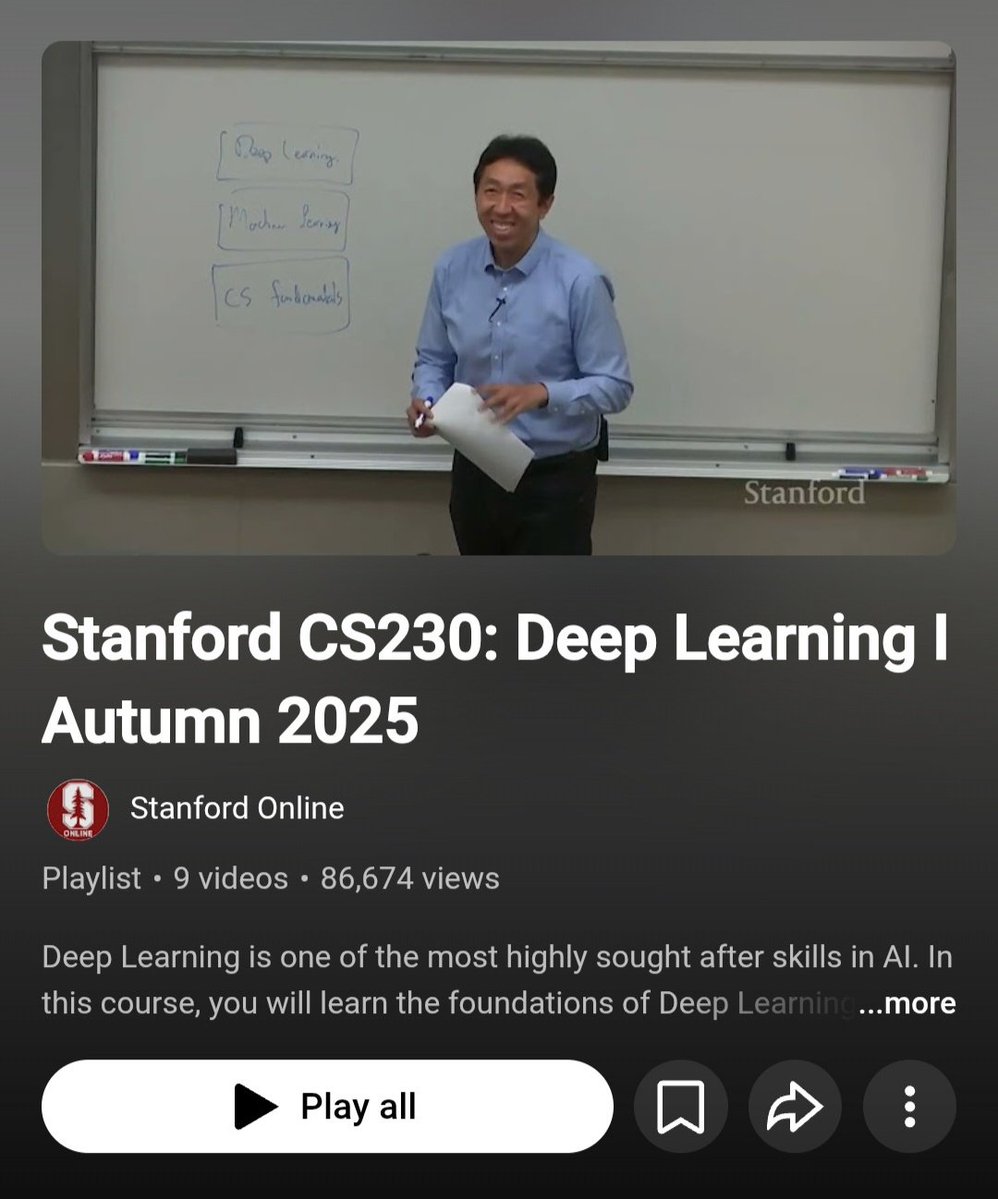
Stanford just made a $200,000 AI degree free.
No application.
No tuition.
No “elite access”.
Stanford released its actual AI/ML curriculum on YouTube.
Not a PR-friendly intro.
Not “AI for the public”.
This is the real thing.
The same lectures shaping people working on frontier models.
What just became public:
Deep Learning (CS230)
→ https://t.co/DUtL9MO6Y7
Transformers & LLMs (CME295)
→ https://t.co/gN57biwLsE
Language Models from Scratch (CS336)
→ https://t.co/GnH11pPBdW
ML from Human Feedback (CS329H)
→ https://t.co/X9nxEX6PNg
Computer Vision (CS231N)
→ https://t.co/oBxKKWZP22
LLM Evaluation & Scaling
→ https://t.co/1tDpw9ArTq
The uncomfortable truth:
The degree isn’t the scarce asset anymore.
Execution speed is.
Top schools know this.
That’s why they’re publishing the playbook.
👉 Bookmark this.
Comment the first lecture you’ll actually watch.