Long time no post. Been rebuilding chunks of the OopsBackup agent after finding a couple of subtle issues in production.
Biggest update: automated backup verification. I’ve been using it on all my personal projects for months now and it's rock solid.
Point-in-Time Recovery (PITR) ensures no more lost transactions. Even if a crash occurs at 11 PM, you can roll back to the precise moment before failure. Continuous stream tracking is crucial. #backup#database
Automating cron backups takes minutes, but relying on manual weekend dumps risks permanent user churn from data loss during bad deploys. Don't gamble on manual processes. #backup#devops
Kept Oops Backup client binary simple with a flat module structure. No premature optimizations. This boosts execution speed and builds trust with devs. #buildinpublic#saas
Just deployed a backup verification feature! Two modes: Integrity Test to simulate restore and Full Restore for a complete check. Runs directly on the user's server. No data leaves the premises. #backup#devops
Infinite log retention is a compliance horror. A 32-day sliding retention policy balances recovery needs and keeps storage costs in check. Linear growth is key for bootstrappers.
#database#backup
Running pg_dump on production spikes I/O and locks tables. Avoid this by using read-replicas or streaming transaction logs asynchronously. Prevents performance hits and downtime.
#backup#database
Most backup tools manage encryption keys on their infrastructure, risking data leaks. Oops Backup employs zero-knowledge AES-256 encryption, ensuring our servers only see unreadable data chunks. Security matters. #backup#saas
Backup without verification is worthless. Many teams confirm dumps but skip restore testing. Regular recovery drills are crucial to catch indexing errors or data corruption.
#backup#database
Cloud-managed DBs like Mongo Atlas or RDS aren't foolproof. Bad migrations or account breaches can replicate errors instantly. Always maintain isolated, external backups.
#backup#database
A backup isn't just a safety net, it's a lifeline. Data loss can stem from hardware failures, human errors, or cyberattacks. Without verified backups, recovery is uncertain. Prioritize robust backup strategies for peace of mind.
#backup#database
Something big is brewing for 𝗢𝗼𝗽𝘀 𝗕𝗮𝗰𝗸𝘂𝗽.
We’re reimagining how zero-knowledge encryption works for your databases. No middleman, no shared keys, just pure security.
The 𝗢𝗼𝗽𝘀 𝗔𝗴𝗲𝗻𝘁 is going to change the game for self-hosted data.
#SaaS#BuildInPublic#backup
Roadmap Update!
Prototyping an Agent for true E2EE:
Local Encryption: Encrypted on your server first.
Zero-Knowledge: We never see your keys/data.
Simplicity: 1-line install.
Managed for speed, Agents for security. Best of both worlds.
#buildinpublic#indiehackers#selfhosted
Building in public lesson: Pēteris from @healthchecks (HN) caught my "E2EE" misnomer. He’s right. My setup is Encrypted at Rest, not true E2EE.
Fixed the site copy and now prototyping an Agent for a true Zero-Trust option.
Thanks for keeping the bar high.
#buildinpublic#SaaS
Snapshots are great for config errors. 𝗢𝗼𝗽𝘀 𝗕𝗮𝗰𝗸𝘂𝗽 is there for disasters.
If your server dies or a snapshot fails, what’s left?
You can replace hardware in minutes. You can't replace lost data. Ever.
#database#backup#buildinginpublic#mongodb#postgresql#mysql
You want to see what Oops Backup looks like before subscribing?
Here it is.
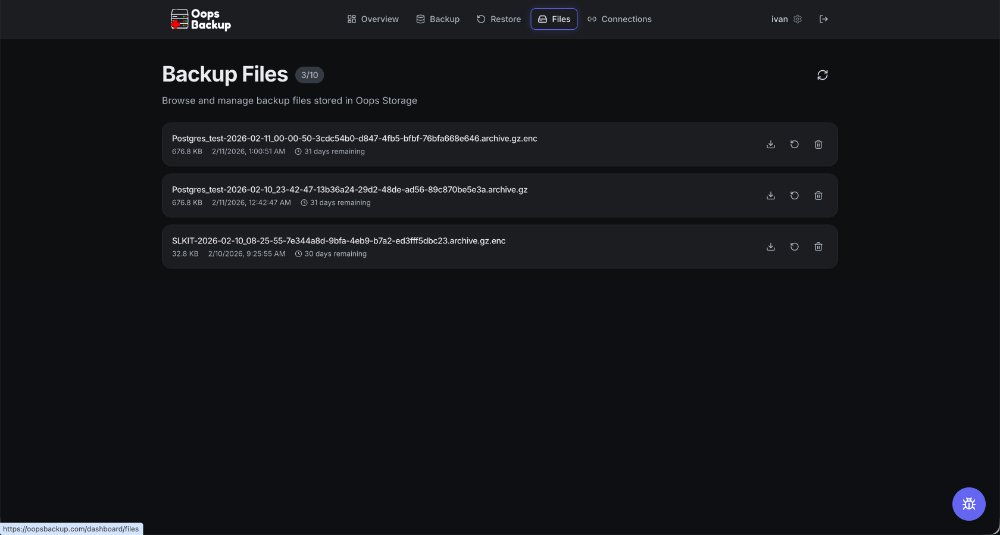
You can schedule backups, encrypt them, get notifications, download backup files or upload to your S3 or transfer using SFTP, restore,...
#buildinginpublic#backup#database#mongodb#postgresql#mysql
The hardest part of building 𝗢𝗼𝗽𝘀 𝗕𝗮𝗰𝗸𝘂𝗽 isn't the code, it's the discipline.
My brain is screaming: "Build the iOS and Android app! Add Redis support!"
But I'm forcing myself to stop. I need to listen to my current users first.
#buildinpublic#SaaS#DevOps