Kovrr launches the AI Risk Governance Suite, empowering enterprises to unlock GenAI value by managing risk across the full lifecycle.
A connected platform for discovery, compliance, quantification & oversight.
🔗 https://t.co/fJIY3N8T6e
#AI#GenAI#RiskManagement#Governance
Two more capabilities added to Kovrr's CRQ platform! 🚀🚀🚀
Scenario Intelligence is a new dedicated section of the platform that surfaces the latest cyber incidents and lets you filter for what's hitting organizations like yours — then add them directly to your risk register.
Scenario templates in the cyber risk register let teams build new scenarios faster, starting from real-world events like SolarWinds or MOVEit, or from common pre-defined scenario types.
Both capabilities deepen the connection between Kovrr's real-world incident intelligence and the day-to-day work of managing cyber risk.
The threat landscape is always moving, and now your risk register can keep up.
Read the blog and dive into the details >> https://t.co/2Pm5AYVdRp
📣 We’re introducing a new way for organizations to approach 🇪🇺 EU AI Act compliance. Start automating the process today!
https://t.co/cIoefjWzQc
As the regulation moves toward full enforcement, teams are under increasing pressure to demonstrate that AI systems are governed in a structured and traceable way.
The problem is that documentation is fragmented, and evidence, if it exists at all, is spread far and wide across enterprise systems.
Consolidating all of that information is going to take a lot of work, and approaching it manually is not a viable option to maintain a consistent and reliable view of compliance.
Kovrr’s updated AI Compliance Readiness module now includes automated EU AI Act compliance capabilities designed to bring that process together
The platform automatically collects documentation from enterprise applications, maps evidence to #EU AI Act Articles, and provides visibility into which requirements are already supported and where gaps remain.
As documentation is reviewed, everything is organized into a structured EU AI Act Auditor Pack, including mapped evidence, requirement alignment, and a full audit trail.
From there, organizations can work with Kovrr’s audit partners to complete certification and obtain an official EU AI Act compliance certificate.
Explore how the 🆕 AI Compliance Assurance module supports EU AI Act readiness: https://t.co/cIoefjWzQc
#EUAIAct #AICompliance #AIGovernance #AIRegulation #Compliance #RiskManagement #GRC #AIRisk
How can cyber risk management support broader business resilience?
By being integrated into the enterprise risk strategy, quantified in business terms, and aligned with evolving regulatory expectations.
Organizations that treat cyber as a high-level enterprise exposure and prioritize it like any other are better equipped to make informed investment decisions and ensure operational continuity.
From using frameworks like NIST CSF to embedding CRQ into board-level reporting, strategic teams are turning cyber risk into a source of strength.
Resilience starts with communication clarity. And communication clarity starts by aligning cyber and ERM metrics.
Read more: https://t.co/Sv8lE0mcBy
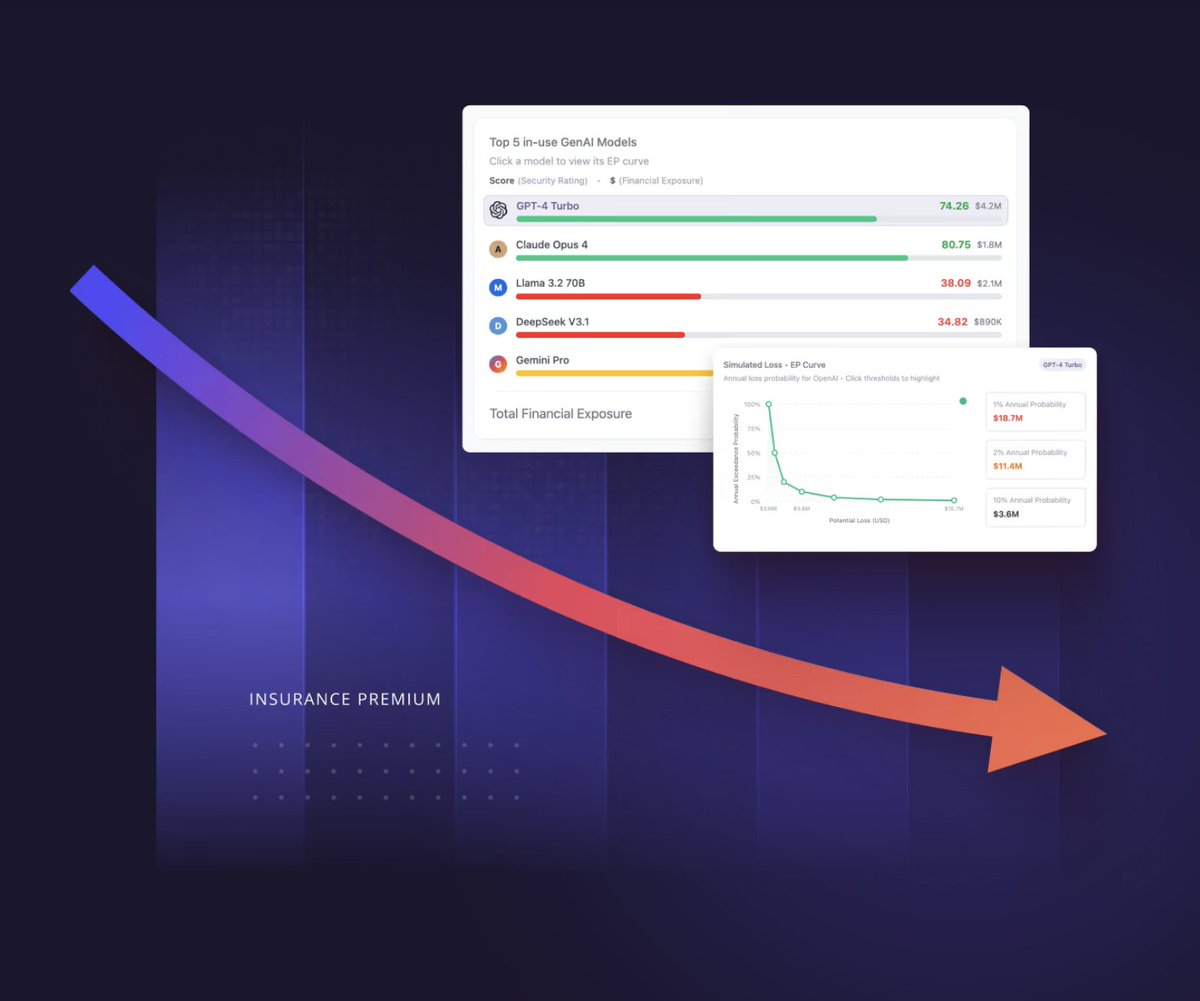
The biggest hurdle to scaling GenAI isn't the technology, but it’s the inability to prove your risk posture. Without a clear way to quantify exposure, organizations are essentially paying for their insurer's guesswork, leading to unnecessarily high costs.
The best way to lower your costs? Prove you have a handle on the risk.
We’re excited to announce that by quantifying your enterprise’s GenAI financial exposure with Kovrr’s AI Risk Governance suite, you can now receive up to a 20% 𝑫𝑰𝑺𝑪𝑶𝑼𝑵𝑻 on your AI insurance premiums.*
How? We provide the high fidelity, insurer relevant data that carriers need to see to reward your governance efforts.
Kovrr's suite empowers your security teams to:
✅ Expose Shadow AI: Automate discovery of sanctioned and unsanctioned tools.
✅ Simplify Compliance: Auto-link data to regulations like the EU AI Act and NIST.
✅ Quantify Impact: Translate technical risks into clear financial terms (ALE).
✅ Be Audit Ready: Generate the evidence backed reports insurers demand.
Ready to see how your posture translates to direct savings? Check out the details here: https://t.co/f9OLIovxxM
*𝘐𝘯 𝘱𝘢𝘳𝘵𝘯𝘦𝘳𝘴𝘩𝘪𝘱 𝘸𝘪𝘵𝘩 𝘒𝘰𝘷𝘳𝘳'𝘴 𝘪𝘯𝘴𝘶𝘳𝘢𝘯𝘤𝘦 𝘯𝘦𝘵𝘸𝘰𝘳𝘬.
hashtag#AIGovernance hashtag#RiskManagement hashtag#AIInsurance hashtag#GenAI hashtag#CyberRisk hashtag#InsurTech hashtag#GRC
AI adoption is accelerating, but so is AI risk.
As insurers begin to evaluate GenAI exposure, organizations that can measure and prove their AI risk posture will have a clear advantage.
With Kovrr's 𝗔𝗜 𝗥𝗶𝘀𝗸 𝗚𝗼𝘃𝗲𝗿𝗻𝗮𝗻𝗰𝗲 𝗦𝘂𝗶𝘁𝗲, enterprises can assess and quantify their GenAI financial risk exposure, providing insurers with a comprehensive, data-driven view of AI risk in a market still adapting to AI.
Continuous monitoring of shadow AI, third-party dependencies, compliance posture, and modeled financial impact helps demonstrate stronger governance and risk control.
Receive up to a 𝟐𝟎% discount on your AI insurance premium by showing insurers a clearer picture of your AI risk.
Unlock your exclusive AI insurance discount today 👉 https://t.co/f9OLIovxxM
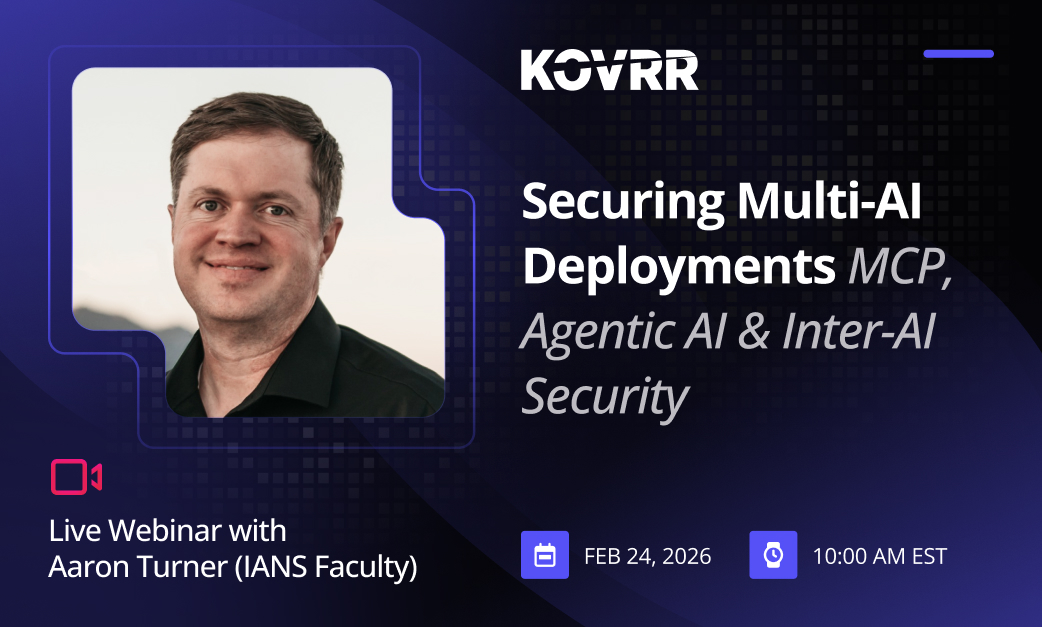
Agentic AI is transforming tech, but are security teams being asked to keep up without mature standards? 🤔
In our recent live session with Aaron Turner (IANS Faculty), we explored why inter-AI communication and Model Context Protocol (MCP) are creating new security blind spots and what you can do about it today.
If you missed the live discussion, the resources are now available on-demand:
▶️ Watch the webinar: https://t.co/dEikB3w5eP
📥 Download the research (7 Steps to Securing Multi-AI Deployments): https://t.co/h1yztvGHHR
As Aaron noted, securing your environment starts with visibility. If you don't have a clear view of the AI systems operating across your business, governance becomes reactive.
To help, we’re offering free access to Kovrr’s 𝗔𝗜 𝗩𝗲𝗻𝗱𝗼𝗿 𝗥𝗶𝘀𝗸 𝗖𝗮𝘁𝗮𝗹𝗼𝗴. Search any GenAI vendor by name or domain and get an instant risk breakdown (scores, governance signals, and exposure indicators) to strengthen your third-party oversight.
Search the catalog here: https://t.co/tWIXJsGTVH
The Monetary Authority of Singapore (MAS) Consultation Paper on Guidelines on Artificial Intelligence Risk Management places AI firmly within formal financial supervision.
The framework cements board accountability, structured materiality assessments, lifecycle controls, and enterprise-wide visibility into how AI is deployed across institutions.
What it does not explicitly integrate, however, is the translation of AI exposure into capital sensitivity, financial aggregation, or stress-testing regimes.
As AI becomes embedded in revenue-generating and risk-sensitive workflows, that financial dimension becomes increasingly relevant.
Institutional resilience will depend not only on proportional governance but on whether materiality is grounded in economic consequence.
We unpack this in our latest analysis >> https://t.co/FUOGoZu1MH
Why did we create the AI Vendor Risk Catalog? Because AI tool approvals are happening faster than vendor visibility can keep up.
Access it today for FREE >> https://t.co/tWIXJsGTVH
Across enterprises, new GenAI tools are introduced into workflows every week. Requests move quickly, and teams want to experiment. But security and risk leaders are expected to evaluate these vendors in real time.
The problem is that approval decisions are often made based on what a vendor's risk looked like during onboarding.
Meanwhile, models evolve, features expand, and internal reliance deepens. Over time, the approved version and the operational version quietly diverge.
The AI Vendor Risk Catalog was built to close that assumption gap, giving teams continuously updated intelligence across vendors, applications, and underlying models so approval decisions reflect current exposure.
Explore the AI Vendor Risk Catalog for FREE >>
https://t.co/tWIXJsGTVH
Got risk? Kovrr just launched the 𝙁𝙍𝙀𝙀 𝙏𝙝𝙞𝙧𝙙-𝙋𝙖𝙧𝙩𝙮 𝘼𝙄 𝙍𝙞𝙨𝙠 𝘼𝙨𝙨𝙚𝙨𝙨𝙢𝙚𝙣𝙩.
As AI agents and GenAI systems are embedded deeper and deeper into enterprise workflows, third-party AI vendors are gaining broader access to, and even control over, data and decision-making processes.
Even if you performed an initial evaluation, model updates happen quickly, shifting behavior. Integrations expand and exposure, slowly but surely, accumulates.
Traditional third-party questionnaires were simply not designed to account for this level of autonomy.
Which is why we're bringing the assessment to you for free!
𝙏𝙝𝙚 𝙏𝙝𝙞𝙧𝙙-𝙋𝙖𝙧𝙩𝙮 𝘼𝙄 𝙍𝙞𝙨𝙠 𝘼𝙨𝙨𝙚𝙨𝙨𝙢𝙚𝙣𝙩 provides instant visibility into the risk profile of a specific vendor, application, or system, with results grounded in continuously updated intelligence.
In seconds, teams can better understand how third-party AI exposure may be affecting their organization, ensuring they can take action before the risk materializes.
Try It Out Here: https://t.co/KQqsbaLTDn
Most teams already know hashtag#AI introduces new exposures.
The harder problem is deciding what actually deserves attention first.
The organizations that are making progress in this area are changing how they prioritize. They evaluate AI risk through business context and apply AI risk quantification to understand consequences.
That shift turns AI security from a reactive exercise into a structured decision-making process that leadership can stand behind.
We explored what effective AI security prioritization looks like in practice, why traditional approaches fall short, and how AI risk quantification enables disciplined action.
Read the full article here >> https://t.co/gIC1Su6lSN
#AI systems and hashtag#GenAI tools are embedded across hiring processes, internal workflows, and third-party services.
In response, regulators are raising the bar.
Frameworks like the EU AI Act and Canada’s proposed AIDA make it clear that accountability and oversight are now expected, not optional.
Yet in many organizations, AI compliance is still fragmented across teams. Everyone owns a piece, but no one owns the whole. That lack of structure makes consistency difficult and defensibility harder when scrutiny increases.
Forward-looking organizations are addressing this issue by formalizing AI compliance ownership. The AI Compliance Officer is emerging as a practical response to growing regulatory pressure and operational complexity.
Read our latest blog >>
https://t.co/UvublpS4nh
Kovrr's CEO Yakir Golan recently joined the Compliance Podcast Network's Compliance and AI, hosted by Thomas Fox , the award winning Voice of Compliance to discuss the intersection of AI, cyber risk, and compliance.
In the episode, Yakir shares insights from his journey into cybersecurity and explains why managing AI driven cyber risk requires stronger governance, visibility, and a risk based approach.
He also touches on emerging “insider AI” risks and the growing need to quantify cyber risk for executive decision making.
🎧 Listen here: https://t.co/Pikrq7Si16
As organizations embed more GenAI into their operations, one challenge keeps surfacing again and again: AI risk. It’s nearly impossible to manage effectively when management processes aren’t structured.
Too often, AI risk lives in conversations, slide decks, or scattered documents. The result? Unclear priorities, fragile accountability, and governance that becomes reactive instead of intentional.
We’ve seen this exact pattern before in early cyber risk programs, and AI governance is on track to repeat it.
That’s why we built Kovrr’s AI Risk Register. It gives teams a practical way to document AI risk as structured scenarios, assign ownership, track mitigation efforts, and maintain a clear, evolving view of what matters most as AI usage scales.
It also connects AI assets, detected control gaps, and real-world threat intelligence to model realistic risk scenarios and quantify their potential business impact.
Curious how structured AI risk management looks in practice?
👉 Take a quick interactive tour and add your first five AI risk scenarios for free!
https://t.co/Jb3NarSITT
Cyber risk quantification (CRQ) has already become central to how organizations manage cyber exposure.
In 2026, it will become foundational to how the ERM strategy is developed.
This year will see CRQ shape (among other things) how risk registers are built, how to plan investments, and how the wider risk management teams prioritize actions.
Everyone, not just CISOs and cybersecurity leaders, is going to be well versed in cyber risk quantification, recognizing that these insights influence board decisions, insurance negotiations, and resilience posture.
We outlined 6 trends that show how hashtag#CRQ will grow this year, both in the cyber landscape and the market as a whole.
Don't get left behind. Read the full piece >> https://t.co/6FycuuYfhi
🎙️ Episode 5 of Taming the Chaos is live!
Generative AI is moving fast—and for many organizations, governance is struggling to keep up. In this episode, we explore the real financial, operational, and regulatory risks behind GenAI adoption and how enterprises can move from chaos to control using a structured, data-driven approach.
Listen to learn how a quantified, end-to-end governance approach can help organizations manage AI risk with confidence.
https://t.co/1KAKGVPdZ1
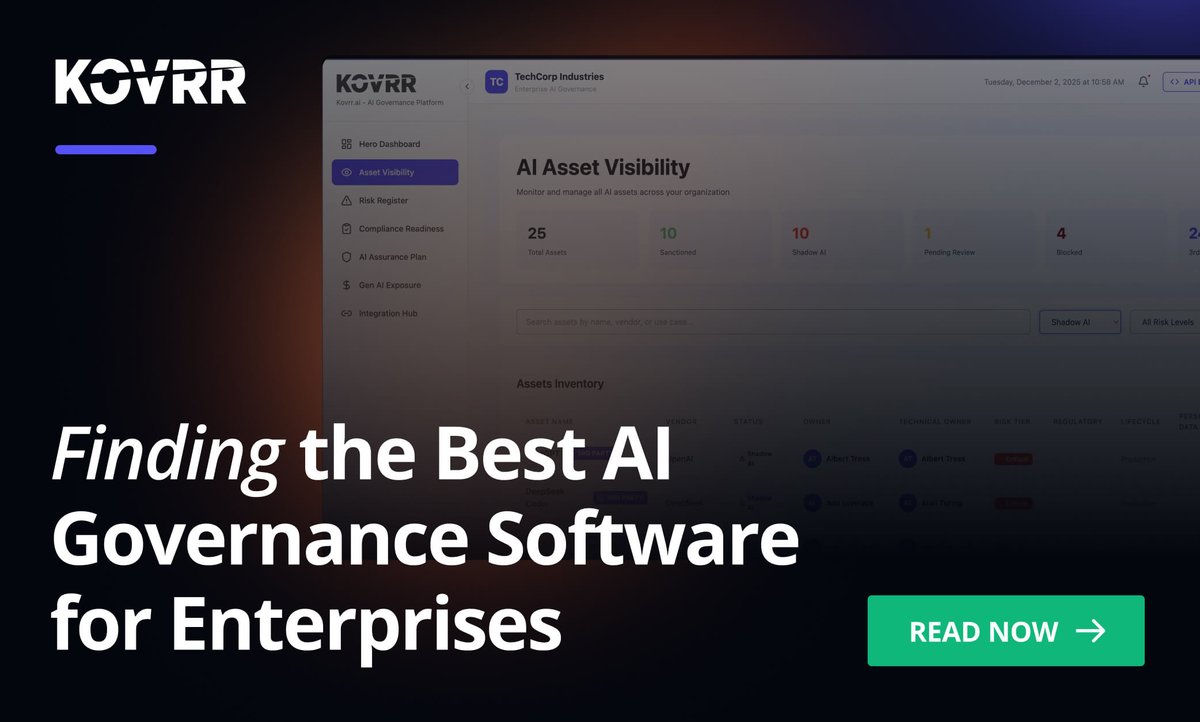
Enterprises are adopting hashtag#GenAI tools faster than their oversight practices can evolve, and leadership teams are feeling the strain.
AI governance software has emerged as a practical way to understand:
* Where systems are embedded
* How safeguards perform
* If programs comply with regulations
* Which risks deserve immediate attention
And more.
This blog examines the capabilities that give stakeholders the structure required to manage AI responsibly.
Elements like asset visibility detection and AI risk quantification help leaders align decisions with operational goals and maintain accountability as adoption scales.
Read the full piece to see how governance software supports enterprise resilience >> https://t.co/e1G5qag9DJ
In 2023, only 12% of S&P 500 companies mentioned AI in their SEC 10-K risk disclosures.
Two years later, that number has surged to 72%. Next year, no doubt, it will be in the 90s.
It’s official: AI has entered the boardroom.
Nevertheless, most of what’s being reported remains descriptive, not demonstrable, making the challenge less about recognizing AI risk and more about proving that it’s being governed with rigor.
Our latest blog explores why AI governance must evolve from narrative to measurable oversight, how frameworks like the NIST AI RMF and ISO 42001 provide structure, and why quantification will soon define regulatory readiness.
Boards that can demonstrate proactive management, not just claim it, will set the standard for responsible, resilient AI.
Read the full piece here: https://t.co/pShNL5GD4G
As 2025 comes to a close, we’re reflecting on a year of meaningful progress in cyber risk, AI governance, and enterprise resilience.
Kovrr 2025 Highlights
Launched the Kovrr AI Risk Governance Suite, enabling enterprises to gain AI visibility, assess risk and maturity, quantify exposure in business terms, and align governance with emerging global regulations.
https://t.co/Tx7rtHOH5E
Introduced Kovrr AI Advisory Services, a new offering designed to help organizations define AI governance strategies, operationalize controls, and prepare for regulatory and risk challenges.
https://t.co/CzHyB6mL7L
Earlier this year, we released the industry’s first CRQ-powered Cyber Risk Register, bringing financial quantification into cyber GRC to help organizations prioritize risk based on real business impact.
https://t.co/jhKmNgX3Ks
Published The Enterprise Guide to AI Governance and Risk Resilience, helping organizations navigate AI and cyber risk with practical, enterprise-ready guidance.
https://t.co/iGCiW4bwPy
Thank you to our customers, partners, and community for being part of the journey.
Onward to 2026 🚀
AI is reshaping how decisions are made.
Yet many boardrooms still struggle to interpret the risks that come with rapid adoption.
The issue is the language being used to explain what exposure actually means for performance and long-term strategy.
However, when AI risk is framed through business impact rather than technical metrics, directors can finally engage with clarity and confidence.
That shift changes everything about how organizations govern AI.
Read the full blog for the complete breakdown: https://t.co/gqfPVKCsJ5
𝙌𝙪𝙖𝙣𝙩𝙞𝙛𝙮 𝙂𝙚𝙣𝘼𝙄 𝙍𝙞𝙨𝙠: 𝙏𝙧𝙖𝙣𝙨𝙡𝙖𝙩𝙚 𝙀𝙭𝙥𝙤𝙨𝙪𝙧𝙚 𝙞𝙣𝙩𝙤 𝙁𝙞𝙣𝙖𝙣𝙘𝙞𝙖𝙡 𝙖𝙣𝙙 𝙊𝙥𝙚𝙧𝙖𝙩𝙞𝙤𝙣𝙖𝙡 𝙏𝙚𝙧𝙢𝙨.
Frameworks define responsible practices, but they often do not quantify how often AI-related incidents might occur or what their real impact could be.
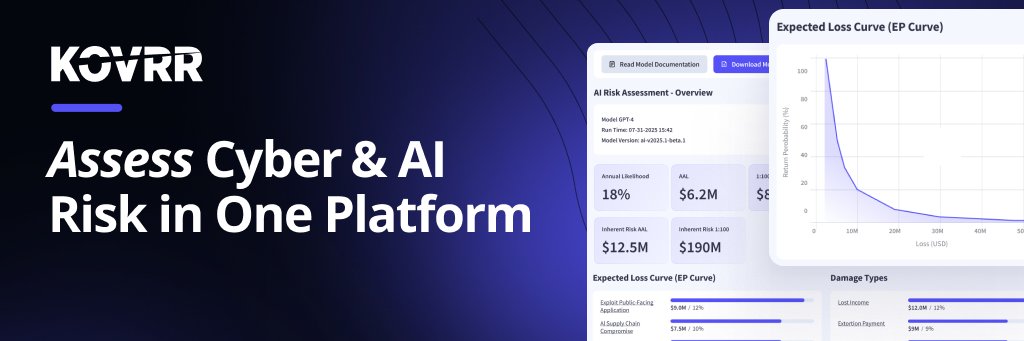
Kovrr’s 𝐀𝐈 𝐑𝐢𝐬𝐤 𝐐𝐮𝐚𝐧𝐭𝐢𝐟𝐢𝐜𝐚𝐭𝐢𝐨𝐧 𝐦𝐨𝐝𝐮𝐥𝐞 measures and manages GenAI risk with precision and scale.
This module uses a simulation-based modeling engine to calculate the likelihood and potential losses of GenAI-related incidents. It translates complex exposure into clear financial and operational terms, such as Annualized Loss Expectancy (ALE) and loss exceedance curves.
The quantified results give leaders a defensible foundation for prioritizing safeguards and investments, allowing them to communicate AI risk to leadership and prove the ROI of high-impact safeguards.
Move from assumptions to evidence-based AI risk management:
👉 Schedule your AI Risk Quantification demo: https://t.co/xv2snYXbx8