Seems obvious to me that what we TSLA diehards are waiting for is being intentionally slowed down, IMO to provide a smooth path to the SpaceX IPO. Elon is quieter in posting. I’m predicting no v3 rocket launches until after the IPO, no Robotaxi or cybercab rollout until after the IPO. No Optimus V3 demo until after the IPO. A combination of not steeling the thunder via good news and also trying to avoid any negative news like a rocket RUD, even though we know it’s expected and normal.
🚨 TESLA'S 48V BACKBONE: THE END OF THE SPAGHETTI HARNESS ⚡️
🪦 RIP wiring harnesses (1954–2024) 👋
For 70 years, automotive wiring has been a chaotic mess of low-voltage "spaghetti."
Traditionally, distinct wiring harnesses have connected every single electrical component back to a central power source. This results in miles of flexible cables snaking through the car body. Because these bundles consist of multiple round conductors that lack rigidity, they are floppy and unpredictable.
This makes them impossible for robotic arms to manipulate. Consequently, installation has remained a slow, expensive manual task where human hands must painstakingly thread wires through tight spaces.
It creates a major bottleneck in general assembly—one that has plagued the industry for decades.
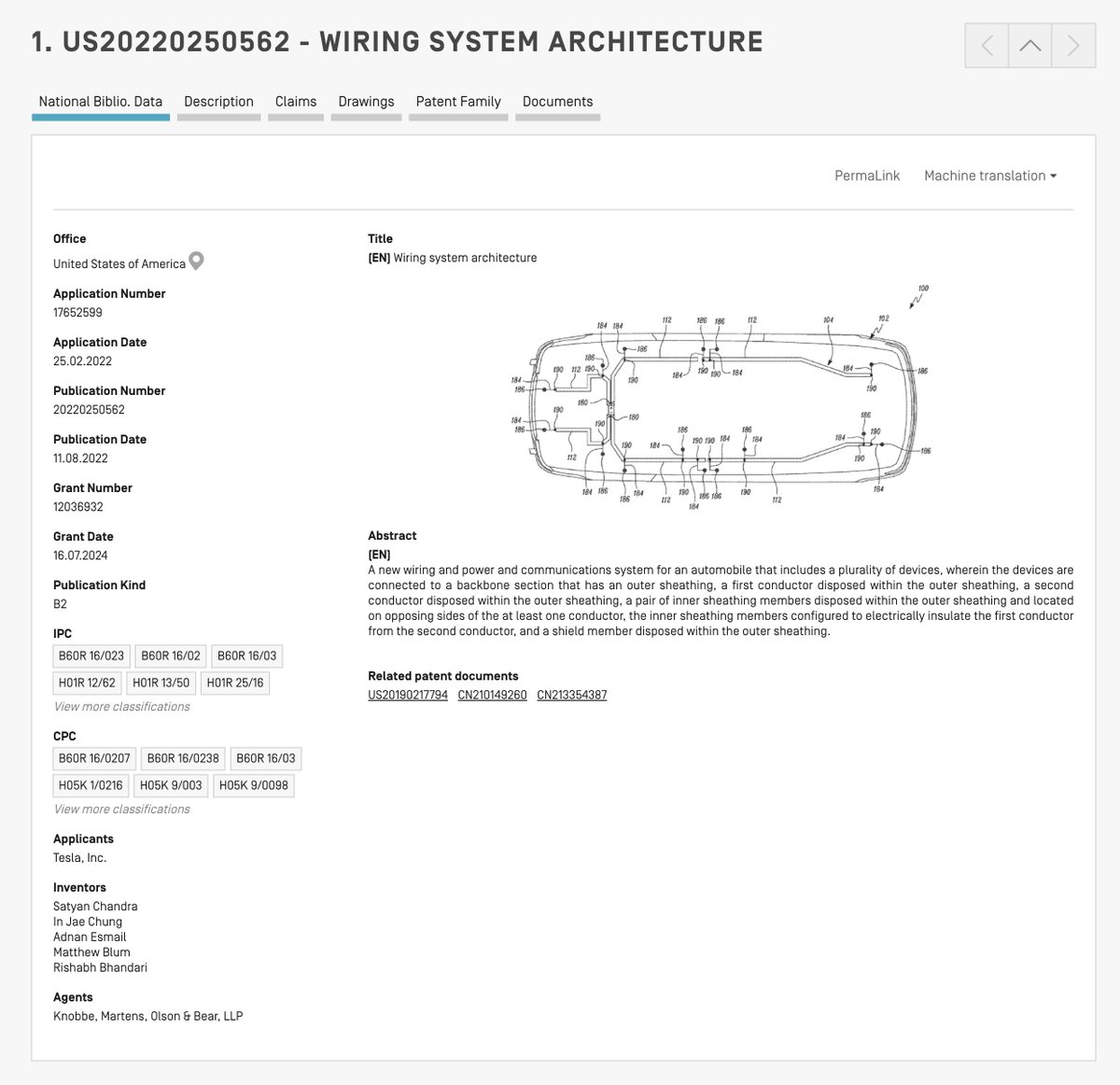
🚪 The exit strategy: Patent 12,036,932 📜
On July 16, 2024, Tesla finally showed us the solution.
Patent US 12,036,932 is not just a document; it is the blueprint for a rigid, structural backbone that fuses high-power 48V distribution with sensitive data streams.
This is the breakthrough that lets robots take the wheel in assembly, slashing copper weight and forcing the entire industry to abandon the legacy 12V standard for good.
Tesla’s solution proposes replacing that traditional flexible harness with a rigid "backbone" system. This isn't just a bundle of wires, but a structured component carrying both power and data signals.
Instead of running individual wires from every light, sensor, and motor back to a central computer, this architecture utilizes a primary backbone running through the car that connects to localized subassemblies.
For instance, a door assembly would contain a single local controller managing all devices in that door—locks, mirrors, speakers. This door then connects to the main backbone via a single connection point, drastically simplifying the complexity of the vehicle's nervous system.
🦴 Anatomy of the backbone 📐
The physical structure of this innovation marks a radical departure from the norm.
The patent details a shift from round wire bundles to a specific flat, stacked geometry where a central bus bar for power and parallel conductors for data are all encased within an outer sheath.
Crucially, the patent describes adhesive layers on the exterior. This allows the rigid backbone to be stuck directly onto vehicle body panels. It transforms the wiring from a loose assembly requiring thousands of clips and zip-ties into a structural element that is robotically applied to the frame, much like applying a sound-dampening patch.
But running high-power transmission lines next to sensitive data communication lines presents a major technical challenge: electromagnetic interference (EMI).
To solve this, Tesla introduces a sophisticated shielding architecture where conductive members made of copper or aluminum wrap around communication lines. These block electromagnetic fields emitted by the power bus bar.
Beyond shielding, the patent outlines a redundant loop architecture for safety-critical systems. Specific conductor lanes are dedicated to bidirectional feedback—one lane transmits a control signal (e.g., "deploy airbag"), while a parallel, isolated lane returns a status signal. This ensures that even within a simplified backbone, safety systems maintain the high reliability of traditional discrete wiring.
🪟 Intelligent "Windows" and modular assembly 🧩
To connect to this continuous backbone, Tesla invented a novel method called "windowing."
The manufacturing process involves stripping away specific insulation layers to expose the conductor underneath, creating a "window" for connection. However, the connection mechanism is more than a simple plug.
The patent details a backbone connector housing an internal PCBA (Printed Circuit Board Assembly) equipped with spring fingers or pogo pins to contact the exposed traces.
This allows the connector itself to host active electronics—such as microcontrollers or MOSFETs—meaning intelligence is distributed not just to the sub-assemblies, but potentially to the connection nodes themselves.
This design enables a truly modular assembly process using specialized interconnect systems. Rigid pins and receptacles—which can be cylindrical or polygonal—create secure physical and electrical bonds between segments.
This means parts like the front and rear Gigacastings can be pre-wired with their own backbone sections. When the chassis is finally joined, these sections plug into one another, instantly unifying the vehicle's network.
To handle the harsh environment of an automotive chassis, the architecture uses specific insulating materials like polyethylene (PE) and polypropylene (PP) to withstand the heat generated by the bus bars. Furthermore, connectors are sealed with ingress protectors and gaskets to meet IP67 standards, preventing dust and moisture entry for the vehicle's lifespan.
👾 Unlocking the "Alien Dreadnought" 🤖
This patent serves as the technological foundation for Tesla’s "Alien Dreadnought" manufacturing vision and its transition to a 48V architecture.
Currently deployed in the Cybertruck as a proof-of-concept, the system has demonstrated that a vehicle can shed up to 75% of its copper weight. However, the upcoming Cybercab is where this innovation becomes truly revolutionary.
This rigid backbone is the physical key that unlocks Tesla's "Unboxed" manufacturing process, allowing sub-assemblies to be built and tested independently before simply snapping together.
By eliminating the need for human workers to snake flexible wires through a finished chassis, the technology drives the extreme automation necessary to make the Cybercab viable at a sub-$30k price point.
⚡ The 48V revolution 🌍
Despite these gains, adoption across the wider industry remains a long-term battle.
The automotive world has run on 12V for over 70 years, creating a supply chain vacuum where off-the-shelf 48V components simply do not exist at scale. Tesla had to design and build many parts in-house for the Cybertruck, a costly process difficult to scale to high-volume models like the Model Y.
To break this deadlock, Tesla famously sent a "How to Build a 48V Car" manual to executives at Ford, Toyota, and GM. While Ford CEO Jim Farley publicly acknowledged the move, confirming their next-generation platform is on a similar path, widespread adoption has not yet materialized.
Tesla's strategy is to force a market shift by openly sharing the blueprint. They hope to encourage competitors to start buying 48V parts, eventually creating a global supply chain robust enough to lower costs for everyone.
@elonmusk After listening to everything you’ve said this past week, I think I can piece together the ultimate picture of information flow anywhere on the planet with high speed and low latency and with Tesla providing all of the hardware and software needed:
Grok AI will be ubiquitous and cheap because it will run on Tesla data centers in space — delivered near-term by SpaceX and Starship, and later built and deployed from the Moon.
Mobile phones will be a thing of the past. They’ll be replaced by a Tesla-built device whose hardware simply provides high-resolution video and audio. No apps — just ask Grok, and the device delivers the result.
The next step after this is getting rid of the bulky hand held device and instead having an implant that interfaces directly to the brain, eyes, and ears.
Here’s why this feels like the endgame:
•Starlink already enables mobile phone service anywhere on Earth via direct-to-cell. Comments have suggested that Tesla should buy Apple or strike a deal to integrate iPhones with direct-to-cell.
•You mentioned the AI phone-like device on Joe Rogan podcast as I recall. You also mentioned Neuralink uploading consiousness to embodied AI which made me think of an implant interfacing space AI to brain, eyes, and ears.
•A SpaceX Falcon 9 recently launched an Nvidia H100 AI chip into orbit as part of an orbital data center demo — likely the spark behind all the public talk about space-based compute. More power generation, cheap cooling.
•At the shareholder meeting, you mentioned that Samsung and TSMC can’t supply enough AI5/6/7 chips for your plans. That means Tesla will likely build its own tera-fab. And if you can build a fab, it’s likely that you would then build devices — which is how we get the AI-native phone replacement.