I recorded a 20-min video on how to set up footprint charts, including settings and use cases
0:14 - market orders
0:52 - passive/aggressive flow
1:48 - cluster vs profile
2:38 - dual cluster mode
3:51 - tick sizes
6:08 - other render & text types
7:33 - delta shading
8:20 - big player absorption
9:33 - colour settings
9:48 - point of control
10:32 - imbalances
13:40 - aggregating footprint
15:08 - open interest
17:15 - bar stats
17:57 - use case
So many Traders get this wrong about Volume.
When the volume bar on TradingView is red, it does not mean that "only market sells came through".
Volume is just counting the total # of coins that were transacted over that time period.
The only reason why the volume bar is red is because the price candle just so happens to be red. It is only colored differently for aesthetics purposes.
This is the reason why I have all volume bars on my charts as the same color (black), because it literally does not make a difference.
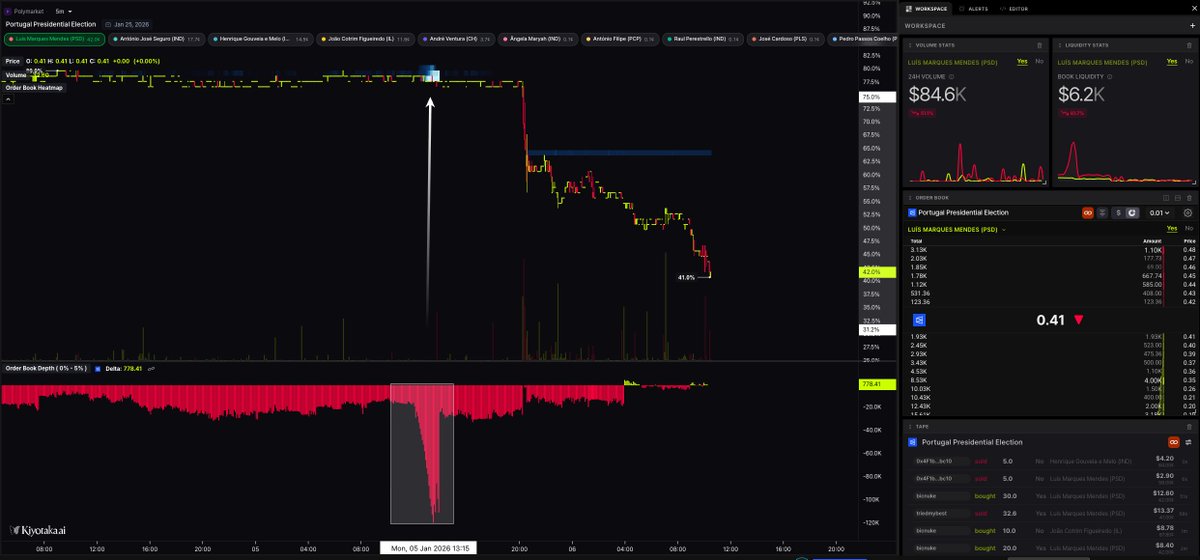
We’re excited to launch a completely new way to see prediction markets.
Today we’re rolling out a complete trading stack for prediction markets, from visualization to execution. This unlocks a fundamentally different way to see how money positions before odds move.
Here’s what that looks like in real time: a large sell wall appears in the Portugal Presidential Election market hours before the odds moved down sharply.
speaking of vibe coding, which is quite a topic right now.
Over the last couple of months, I've been able to consolidate all my trading strategies and the things I care about into one place that spits out the trades I should take each day.
I tried to do this for years and got quoted quite a lot of money for something like this. Now I've done everything myself without any help, which is insane to me.
There is definitely going to be some top with thousands of productivity apps, and YouTube videos on how to make passive 10k a month with one single prompt, but honestly, this very very cool tech and the first thing in very long time which I find to be generally extremely useful rather than just a trend which will fade away.
If you're a Trader who's feeling a bit lost without a Strategy
Below are my unfiltered ramblings on how to get over this hurdle ↓
-----------------------
There are only 4 components to a Strategy
1. The style (momentum or mean reversion)
2. Entry trigger (if X happens, enter the trade)
3. Stoploss (if Y happens, exit the trade for a loss)
4. Target (if Z happens, exit the trade for a win)
The immediate goal isn't to build something that prints money or is even profitable, it's just to build "something" rather than "nothing".
Once you have "something", then the next step is proving consistency.
• consistency
• this is referring to how well can you actually adhere to the rules of the strategy.
• the reason why this needs to get proven ASAP is because if you have a perfectly winning strategy but are unable to follow the rules, then you're still going to lose money.
• so consistency comes FIRST, before anything else. This is literally the most important thing because it's the foundation of everything.
• before you have are "consistently trading a profitable strategy", you need to be "consistently trading a strategy... it doesn't necessarily even have to be profitable."
Even if the strategy is NOT a winning strategy, it doesn't matter. Again, huge huge emphasis on nailing the consistency. (Yes I might sound like a broken record here, but repeating something over and over stresses how important something is)
"But if I'm consistent with a losing strategy then I'll lose money!" - relax lol, you don't actually have risk money on trades to prove consistency.
• You can trade with pretend money (on demo) or just take paper trades (live or on replay mode).
• The goal at this step is getting confirmation that you can actually follow the rules of your strategy. That's it... literally nothing else matters apart from this.
If you are struggling to adhere to the rules of your strategy:
• make the rules easier to follow
• make the rules harder to break
• repeat over and over again until you're able to make every single trade look pretty much the same and you're not deviating from the trading rules.
------------
QUESTION:
→ "Okay I've confirmed that I can perfectly adhere to my Strategy Rules... Now what?..."
ANSWER:
→"Now it's time to make the strategy suck less."
After you confirmed that you have perfect consistency, flawlessly following the rules of your trades, the next step is optimizing your strategy.
If you're perfectly following the rules of a strategy that sucks, you're still going to lose money.
Strategy optimization only can properly begin after achieving perfect consistency.
• Here you will need to journal/track every single trade that's taken and regularly review the trades.
• Compare winning trades with losing trades and play the game of "spot the difference".
• Do more of what's working in the winners, do less of what's showing up in the losers.
• Repeat over and over and over again until the strategy and execution is really polished and refined.
------------
TL;DR:
Step 1. Just build something. Something is better than nothing. It doesn't even have to make money.
Step 2. Prove that you can actually stick to the rules of the strategy. If you can't, make the strategy easier. If you can follow the rules, move onto step 3.
Step 3. Optimize the Strategy by making it suck less. Do less of what's common in your losers. Do more of what's common in your winners. Journalling/Tracking everything and regular reviewing is crucial at this stage.
Good luck.
🌶️
1/ funding rates
funding rates are probably the one thing everyone on the list which everyone knows about at this point; therefore, the edge in it is not that high/rare to happen.
very tldr for those of you that never heard about funding rates:
If funding is positive, it means that the perpetual swap is trading above the index price, and if funding is negative, it means that the perpetual swap is trading below the index price.
If funding is positive, longs pay a fee to shorts.
If funding is negative, shorts pay a fee to longs.
you will find more details here: https://t.co/jlkb4KOufK
One of the most commonly used tools in trading, and also one of the easiest tools to misread.
Today I'll cover some useful methods of analysis that I've learned to use over the years.
Let's get started...
VWAP 🧵 (1/8)
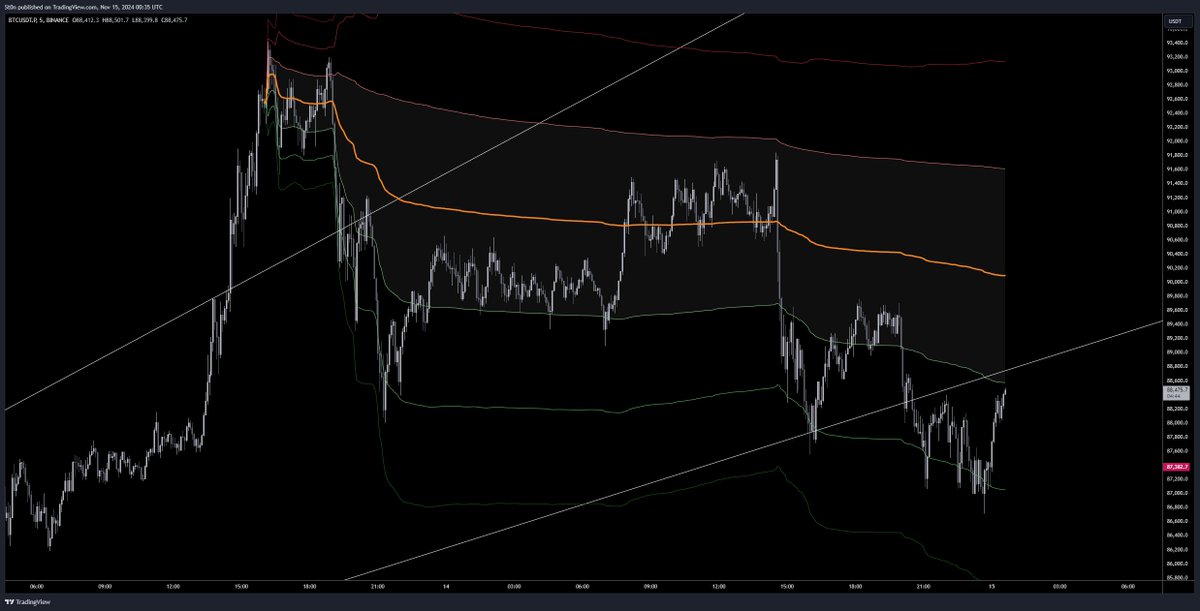
Anchored VWAPs with Std Devns might be something to explore if you're into scalping this sorta rotational PA intraday and also getting directional bias
15:50
Trading is not about figuring about the best line or the most reliable indicator or the most reliable SR level.
It’s all about managing your risk around sound silly goofy lines.
Last some month’s performance
Got some gucci bottom and top shorts
While scalping with members live on telegram
Enjoy your weekend outside will be bacc on Monday 🧍