🚨 $RFD alert: ~$25K buy just hit the chain.
Blurr.eth’s 2023 token +8% 24h, volume ~$40K.
Same guy co-founding @papertrade_xyz.
Official: no link. Speculators: timing is interesting.
Who’s accumulating? 👀
0x955d5c14c8d4944da1ea7836bd44d54a8ec35ba1
NFA
$RFD: Quietly Gaining Momentum Alongside Ethereum
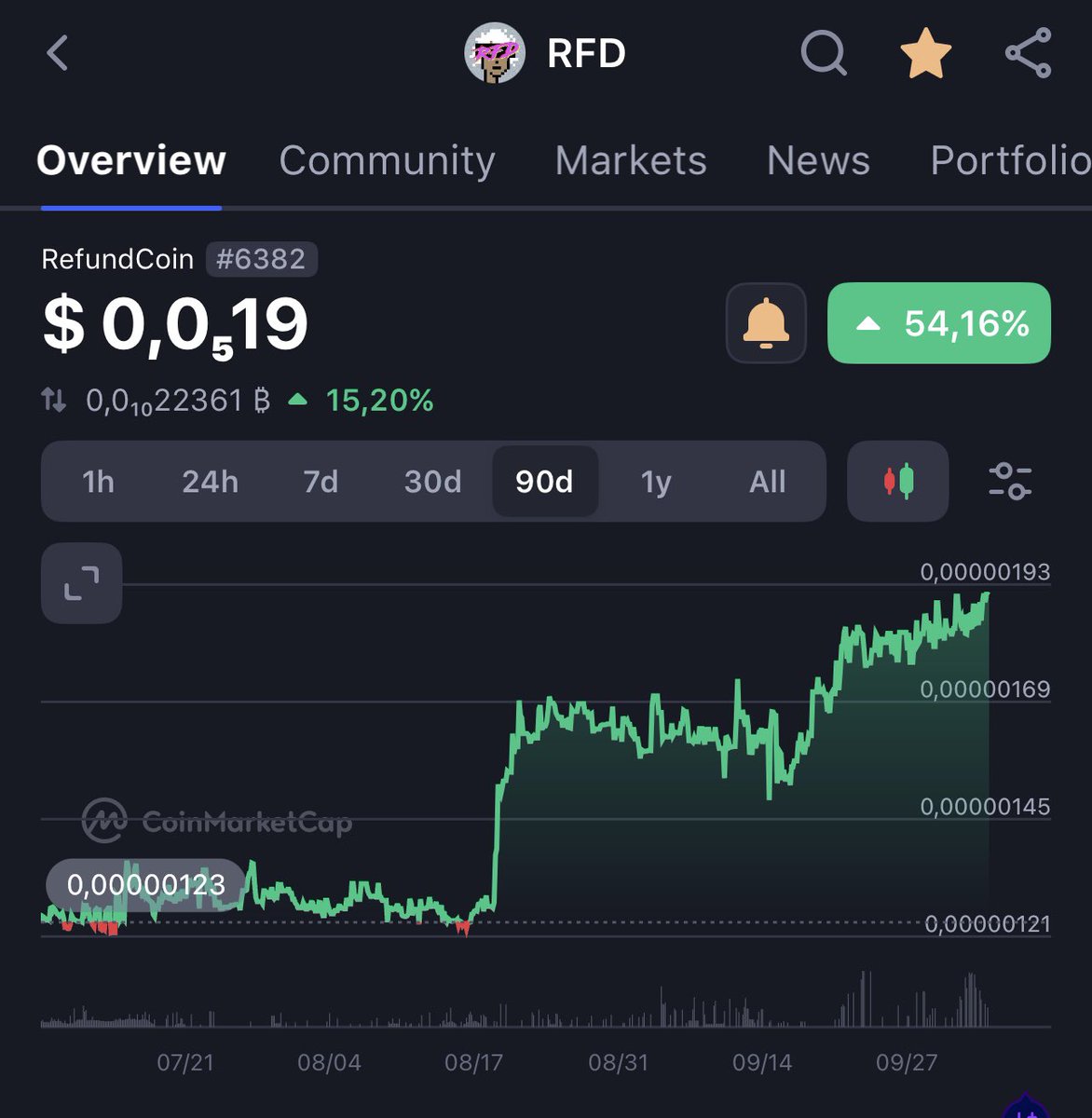
Over the past 90 days, $RFD has moved remarkably in step with ETH, while slightly outperforming it: roughly +54% vs. +50%.
Even more encouraging, the past 30 days have shown a slow but steady increase in new wallets buying RFD, suggesting gradually expanding participation.
If this momentum continues, the coming days could paint an even more interesting picture for $RFD. 📈
Slow growth. Stronger base. Brighter days ahead.
0x955d5c14C8D4944dA1Ea7836bd44D54a8eC35Ba1
Why Could $RFD + https://t.co/3a2SkB6lBX Create a Self-Sustaining On-Chain Economy?
Are Blurr and Jez trying to turn some of crypto’s most persistent human behaviors into a self-sustaining on-chain economy?
$RFD, created and launched by Blurr.eth on May 20, 2023 (0x955d5c14C8D4944dA1Ea7836bd44D54a8eC35Ba1), together with its 13 cryptic messages, taps into the social dynamics that make memecoins so powerful: community, identity, attention, and, of course, the asymmetric dream of turning relatively small amounts of capital into extraordinary returns.
@papertrade_xyz taps into another powerful human behavior: the appetite for speculation, competition, and extreme leverage, where a relatively small number of traders can potentially win enormously while many others lose their positions.
#DeFi provides the infrastructure capable of transforming all of this activity into liquidity, fees, treasury flows, and programmable economic value.
It is also worth considering that while the Papertrade ecosystem itself could provide a foundation for developing many attractive economic utilities, not every utility necessarily needs, or should, to be embedded directly into the core protocol. In a broader decentralized ecosystem, maintaining some separation between economic interests and incentive mechanisms can be valuable, particularly where integrating a protocol’s own direct economic interests into every mechanism could create conflicts of incentives or reduce neutrality.
From that perspective, an independent project with complementary characteristics could potentially expand the economic design space around Papertrade without requiring every function to be internalized by Papertrade itself. If RFD were ultimately intended to play such a complementary role, its independence would not necessarily imply separation from the broader ecosystem; paradoxically, that independence could be precisely what allows the ecosystem to expand while preserving distinct incentives, communities, liquidity structures, and economic functions.
The interesting part is what happens to the losses.
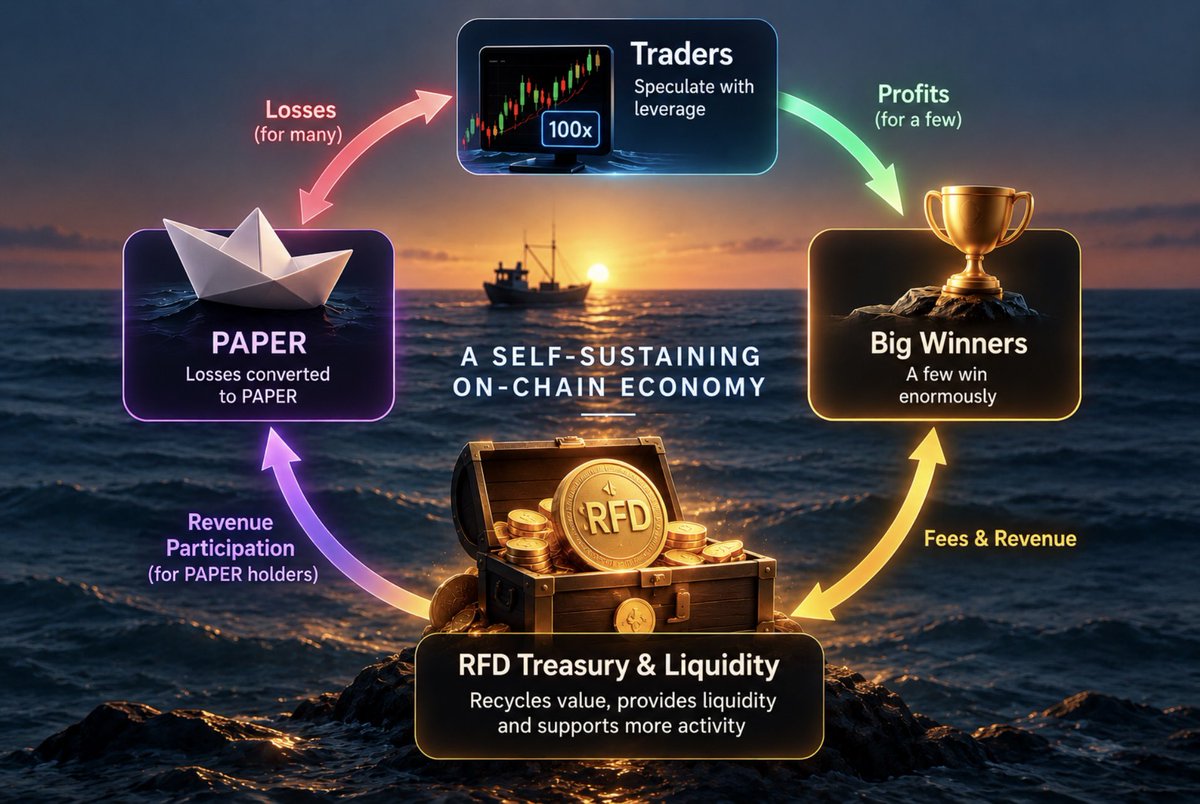
In conventional leveraged trading, a trader loses $1,000 and, economically, that is largely the end of the story for that trader. But if Papertrade converts trading losses into PAPER, and staked PAPER represents participation in future platform revenue, part of the economic value associated with that loss may effectively be recycled into a new claim on future cash flows.
If, as I anticipate, $RFD eventually becomes another predetermined layer in that loop through a Builder channel, treasury, liquidity, conversion mechanism, or some other utility, the architecture becomes even more interesting:
Speculation → trading profits/losses → PAPER → revenue participation → RFD / treasury / liquidity → recycling losses by acquiring future claims or expected PAPER value at a discount → more economic activity.
In such a model, the treasury could potentially act as an economic intermediary: providing immediate liquidity by acquiring claims on future value at a discount, while recycling capital back into the ecosystem.
That would not mean a system with “no losers.”, but it could mean something more unusual: an on-chain economy where losses do not necessarily become economically dead capital, but can instead be transformed into new assets, claims on future revenue, liquidity, and continued participation in the ecosystem.
Perhaps the bigger idea isn’t to eliminate crypto’s endless appetite for speculation, but to build an economic machine around it, and continuously recycle the value generated by that speculation.
Whether RFD is actually part of that machine remains entirely speculative. But if it is, the name “Refund” suddenly becomes much more interesting.
In my view, @blurr may have envisioned “Refund” , from the beginning, as more than returning money: a reward-mechanism for turning risk, losses, and future claims into continued economic participation.
A Thought Experiment:
Could an Auction Marketplace Become RFD’s Most Interesting Papertrade Utility?
We’ve already explored one possible role for the $RFD treasury within the Papertrade ecosystem: providing liquidity to $PAPER holders who prefer immediate liquidity rather than holding or staking PAPER for future platform revenue.
But there may be another, and potentially much more interesting, opportunity on the other side of the trade: the winners.
What happens when Papertrade’s LP cannot immediately settle all profitable positions?
Some winners may have to wait in a creditor queue until sufficient liquidity becomes available. This creates an interesting possibility: what if those pending claims were made transferable?
Imagine you have a $10,000 claim, but nobody can tell you exactly when it will be fully settled.
Would you wait?
Or would you take $7,000 today? $5,000? Maybe even $3,000?
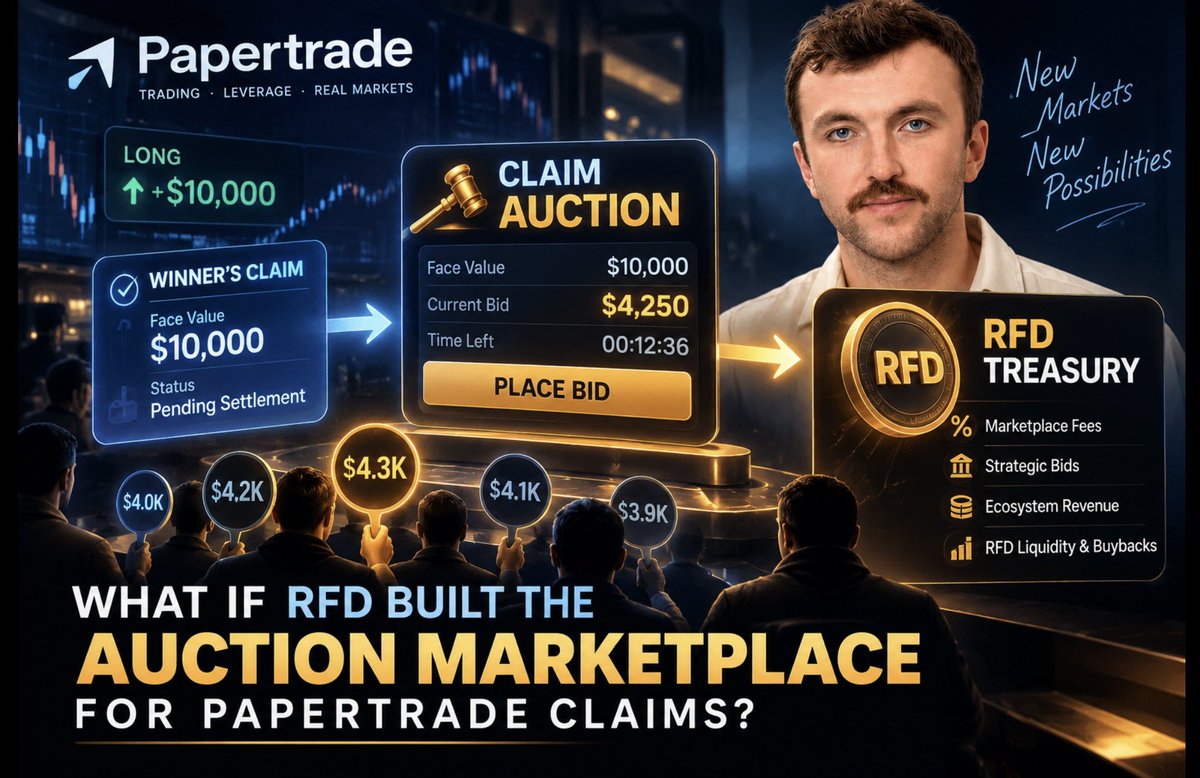
Now imagine putting that claim into an auction marketplace, where buyers compete for the right to its eventual $10,000 settlement.
https://t.co/3a2SkB6lBX would effectively create another market:
a market for discounted future claims.
This is where #RFD could potentially become particularly interesting.
The RFD treasury could participate as a bidder when discounts become attractive, potentially providing liquidity to winners who prefer immediate cash over waiting for settlement.
But RFD wouldn’t necessarily need to take the balance-sheet risk itself.
If RFD provided the marketplace infrastructure, it could potentially collect a fee on every claim traded between third parties. In other words, rather than simply deploying treasury capital, RFD could monetize the flow of capital through the marketplace.
Combined with the earlier PAPER-liquidity thesis and potential Builder fees, an interesting structure begins to emerge:
Papertrade trading
→ PAPER liquidity
→ pending claims
→ claim auctions
→ Builder + marketplace fees
→ RFD Treasury
→ RFD buybacks / protocol-owned liquidity / other value-accrual mechanisms
At that point, the RFD treasury would no longer look like capital sitting around waiting for a purpose.
It could potentially become a liquidity and capital-allocation layer around the Papertrade ecosystem.
There is also something particularly interesting about a claim auction: the discount itself becomes a market price for liquidity, time and settlement risk.
A $10,000 claim trading for $8,000 tells one story.
The same claim trading for $3,000 tells a very different one.
That could make the secondary claim market almost as fascinating to watch, and potentially trade, as Papertrade itself.
Importantly, transferable claims do not necessarily need to exist in Papertrade’s initial architecture for this idea to be technically possible. Making creditor claims transferable would itself be a design choice or additional utility that could be introduced if the developers (@blurr@izebel_eth ) wanted to enable such a secondary market. Claims could potentially be represented as transferable on-chain rights, allowing ownership of the future settlement to change hands before the underlying payout occurs.
And since Blurr seems determined not to spoil whatever plans he may have for Refund, we might as well enjoy the sport of theorizing and trying to predict them ourselves. 😄
Maybe RFD’s biggest advantage isn’t simply that it has a treasury.
Maybe it’s that a treasury gives its deployer, Blurr, the capital, and flexibility, to invent utilities that otherwise wouldn’t be possible.
But for now, let’s put the theories aside and focus on Oct. 10, Papertrade launch day, with pre-deposits opening on 8th. Wishing Blurr and Jez a successful launch. Whatever our RFD theories may turn out to be, building something genuinely new, taking the risk of bringing an unconventional idea to life, and putting it out there for the market to judge deserves respect. Innovation doesn’t happen without people willing to take those risks. Good luck!
He showed up on @notthreadguy as co-founder of @papertrade_xyz.
Same wallet. Same name. The one that deployed $RFD and then went quiet.
No press release. No “we are back.” Just him, on camera, building something else.
If you bought $RFD in 2023 and still feel like you got used as exit liquidity for someone else’s story, read this.
Blurr.eth just walked back into the light.
A Speculative Theory
Could $RFD Be the Missing Economic Layer Around Papertrade?
https://t.co/3a2SkB6lBX is expected to launch soon. Based on the information available so far, @izebel_eth appears to be the principal architect behind Papertrade, with @blurr participating in its design and development.
One detail in the early Papertrade “whitepaper” is particularly interesting for the Refund community. Blurr was not introduced simply as a developer or collaborator, but specifically as:
“Blurr — Refund Contract Deployer”
This does not prove any connection between #RFD and Papertrade. However, Blurr is well known independently of Refund, so explicitly identifying him through Refund was not strictly necessary. It is therefore reasonable to ask whether Refund could eventually play a role in the broader economic architecture surrounding Papertrade.
$PAPER Appears to Control Papertrade’s Internal Economy
The current Papertrade model does not appear to require a large amount of initial liquidity. Instead, liquidity can grow progressively from traders’ losses. Losing traders receive PAPER, which can be staked to participate in the protocol’s future economics and revenue.
This makes PAPER the central economic asset inside https://t.co/3a2SkB6lBX
Based on everything publicly disclosed so far, there is no demonstrated role for RFD within the core Papertrade protocol.
That, however, does not necessarily mean there is no role for Refund outside the core protocol.
The Builder Layer Creates Another Economic Opportunity
Papertrade’s Builder architecture allows third parties to build their own frontend or integrate Papertrade contracts into their existing distribution.
In simple terms, https://t.co/3a2SkB6lBX can be viewed as the trading engine, while Builders can create alternative gateways to that engine.
A successful Builder therefore needs to offer users something valuable enough to justify choosing it over the native Papertrade frontend.
This could include better tools, fee rebates, rewards, automation, special access, or benefits connected to holding another asset.
This is one possible place where $RFD could theoretically acquire utility.
For example:
Hold RFD → Trade through a Refund Builder → Receive better fees, rebates or additional benefits
$USDC could still remain the trading collateral. $RFD would not need to become the currency used for trading; instead, it could function as a utility or access asset within the Refund layer.
Could Refund Treasury Become a Liquidity Backstop for PAPER?
There is another potentially more significant possibility.
If $PAPER is transferable under its final token rules, a separate smart contract could theoretically allow $PAPER holders to transfer or sell their PAPER to the Refund Treasury in exchange for $USDC or $ETH.
Importantly, this would not require a $PAPER/$RFD liquidity pool.
A hypothetical mechanism could work like this:
Trader loses on Papertrade
→ Receives PAPER
→ Trader chooses between:
A. Stake PAPER and retain the right to future Papertrade revenue
or
B. Transfer/sell PAPER to the Refund Treasury and receive immediate $USDC or $ETH liquidity
The Refund Treasury could determine the purchase price according to a transparent formula or at a discount to some reference valuation.
For example, a trader may prefer immediate liquidity rather than waiting for future staking income. Refund Treasury could purchase that PAPER, provide USDC or ETH to the trader, and then stake the acquired PAPER itself.
The economic relationship would therefore be straightforward:
Trader gives up future PAPER income in exchange for liquidity today.
Refund Treasury provides liquidity today in exchange for acquiring the future economic rights associated with PAPER.
If PAPER staking generates meaningful revenue, accumulating PAPER at an appropriate valuation could potentially become a productive use of Refund’s treasury rather than simply holding ETH or other assets passively.
🧵1/3
$BTC Halving: Bitcoin pays you less every 4 years.
$N Doubling: $N makes you wait twice as long every 10519200 eth block!
Same destination: ~21M coins, ever.
Where we stand: ~6.5M $N emitted (~31%). Still epoch one. First doubling hits ~Jan 2028 at actual chain pace.
The contract notes wrote a 92-year story, assuming 12s blocks. But Ethereum is planning to progressively cut slot times toward 2s. The supply curve is immutable; the calendar isn’t. Every slot cut is a fast-forward button: same movie, played faster. We’re not waiting 92 years. We’re time-traveling through them.
BTC’s clock is welded shut, 95% mined.
$N rides a chain that keeps accelerating.
One burns out. One freezes forever.
Ice may come sooner than the poem promised.
You can’t print patience.
A Theory on How $RFD Could Benefit From Papertrade
After months of silence, the news that @Blurr is certainly involved in the creation of https://t.co/3a2SkB6lBX alongside @izebel_eth has once again opened the door to speculation within the $RFD community. The question naturally arises: could there eventually be a connection between this new project and Refund, or even $N?
Based on the currently available documentation describing https://t.co/3a2SkB6lBX, there appears to be no explicit role for Refund within the protocol. However, one possibility has captured my attention: the potential use of assets held in the Refund treasury to help bootstrap and strengthen this new ecosystem.
In my opinion, one of Blurr’s well-known investment principles is that when a high-risk opportunity presents itself, the greatest rewards often belong to those willing to participate earliest. Just as importantly, he has repeatedly demonstrated the patience required to wait for those rewards to materialize.
Imagine the following scenario. Once https://t.co/3a2SkB6lBX completes its audit process and officially launches in summer, Blurr allocates a portion of the Refund treasury to trade on the platform.
There are only two possible outcomes.
If the trade is profitable, the treasury could benefit from significant gains, potentially increasing Refund’s assets substantially.
If the trade is unprofitable, the outcome may be even more interesting. The loss would contribute directly to the growth of Papertrade’s LP, helping strengthen the protocol during its earliest and most vulnerable stage. At the same time, the treasury would receive $PAPER tokens in return. Those tokens can be staked and are entitled to a share of the platform’s economic output, effectively making #Refund an economic stakeholder in the Papertrade ecosystem.
Under such a scenario, Refund would not require any predefined role or formal integration within https://t.co/3a2SkB6lBX. Instead, it could gain meaningful exposure to the protocol in a way that is entirely transparent, organic, and consistent with the fair-launch philosophy that both projects appear to embrace.
Of course, it remains possible that Refund may eventually receive a more explicit role as Papertrade evolves. However, for now, I find myself focused on a scenario that could realistically unfold within the coming months.
My personal expectation is that Blurr may choose to deploy a portion of the Refund treasury on https://t.co/3a2SkB6lBX. In that case, both outcomes could potentially benefit Refund. A winning trade would grow the treasury directly, while a losing trade could result in the accumulation of $PAPER and a long-term stake in the platform’s future success.
If given the choice, I would personally prefer the latter outcome.
Either way, the weeks ahead are shaping up to be very interesting.
Have a great weekend, everyone.
The West has created an utterly evil state religion where an accusation of “racism�� is the gravest offense that can be committed, even worse than rape or murder!
So if police show up at a crime scene and a British boy is bleeding out and an immigrant says the British boy is racist the cops will cuff the dying British boy.
$N Blurr ambassadors, let us rise and wish a happy 3-year anniversary to our kindred token $RFD.
Through fire and ice, we were forged to last and to shine.
Congrats to all who are still part of this mysterious journey, the ones who know and do not speak. Silence is not stillness. Be ready to see them surface and act ...
Worth revisiting the essence of the RFD community contribution over the past years:
https://t.co/PsOHtnXxUB & https://t.co/UE9SMvA6QW
@RefundSociety@HauskenHelge@suremohsen@Yourpop8@stekisteks@henokcrypto@TaikiMaeda2
On August 18, 2024 at 4:16 PM, at block #20556650, the RFD/N pair went live on the blockchain, marking the beginning of a unique experiment that has since attracted traders, minters, and liquidity providers alike.
Why is this pair interesting?
RFD 🔥 Deployed by the legendary Blurr.eth
Deep, native liquidity on the RFD/WETH pair makes it a stable and easily tradeable asset on Uniswap.
N 🧊 Also deployed by Blurr.eth via contract 0xE73d53e3a982ab2750A0b76F9012e18B256Cc243
More volatile by nature, N can be acquired by trading on the RFD/N pair or by directly calling the mint() function. Liquidity is organically added by participants and traders.
Why This Pair is Special?
In Uniswap V3, liquidity providers concentrate their capital within a specific price range, earning fees whenever the price trades within that range.
The RFD/N dynamic creates a natural balance.
When N pumps, the LP position automatically rebalances — selling N and accumulating RFD, which tends to hold its value steadily meanwhile when N corrects, the position reaccumulates N at lower prices while RFD acts as an anchor.
This means LPs are constantly buying the dip on N and locking in gains into RFD — all passively, through the mechanics of the pool itself.
N mints cool 🧊RFD burns 🔥 — a perfect alchemy
Alea iacta est
Bitcoin had Satoshi.
$N has Blurr.eth
The parallels are undeniable...
0xE73d53e3a982ab2750A0b76F9012e18B256Cc243
⛏️ Mined block by block...1 token per block
📉 Supply tightens every 4 years, just like BTC halving
🔢 Hard cap ~21,000,000 $N
♾️ 92 years to reach full supply
👻 Anonymous founder.
No pre-mine. No VC bags.
Fully on-chain. No admin keys. No upgradeable proxy. The contract is the rules — immutable, permissionless, unstoppable.
Alea iacta est. The die is cast. 🔥🧊
@BlurrNCoin
Love this framework. The “prediction market → mission-aligned oracle” pattern is powerful.
Funny you mention “$N per month”, there’s an actual $N token (Blurr.eth) that accidentally embodies this ethos:
• No team allocation, no VC, no admin keys
• 92yr emission = slow value accrual over hype (21M theorical max supply)
• Community self-selects through conviction
Not a creator coin, but same energy: let scarcity + time filter for alignment over attention games.
Just turned 2 years in Jan 2026 🫡
Congrats to those who participated and qualified for a BlurrPunks airdrop from the 2-year Blurr.eth $N anniversary event!
Airdrop = Done!
Enjoy Fire & Ice, dear familia!
Winners:
0xb8e42073e4B352ba53cCc2b1df77833012aC43B0
0x3CB407ff161D3Bcf1249425162d28fd281d0a0b7
0xD82A5C5Ac5129E812D05c815a5C73f20d5913654
0xA22F1AC02b5Fc04f2E355c30AEBFd82a7465b250
Here is #799 BlurrPunks now in our top #1 holder wallet – get a piece of $N.FT history collection! Enjoy chad ! https://t.co/qFo6VJOdVf
- 0.05 ETH each until 300/1000 minted, then price goes up to 0.1
- All funds go to community building
@Blurr #BlurrAmbassadors #FireNice
🔥❄️ Blurr.eth $N Token Turns 2 Years Old: CELEBRATION/GIVEAWAY 🔥❄️
2 years of building. 2 years of scarcity ticking.
Celebrate with us and enter for a chance to win a share of 20 $N community BlurrPunks — a piece of $N NFT history (1 ETH total value).
To enter:
✅ Buy & hold $50+ of Blurr.eth $N by VC time
✅ Purchase between Jan 27 12:00 UTC → 17:30 UTC
✅ Join tomorrow on TG: https://t.co/m0brLyZzyy
How to buy $N:
DEX (Uniswap, MetaMask, CowSwap,... ERC-20)
0xe73d53e3a982ab2750a0b76f9012e18b256cc243
Want a BlurrPunks now? 👉
https://t.co/qFo6VJOLKN
(0.05 ETH/NFT → All funds to $N community building)
Event details:
📅 Jan 28 | 16:30-17:30 UTC on TG VC: https://t.co/m0brLyZzyy
90 years of emissions left. The clock's ticking.
Some say fire. Some say ice. We say... 90 years of emissions remain. The clock doesn't stop.
See you tomorrow, believers. 🫡
In whispers we trust. In mystery we hold.
Blurr.eth ambassadors, let's unite!
January 28, 2026 marks 2 years of $N.
**No launch hype. No shortcuts.**
Just fire, ice, and time doing the sorting.
Some burned early. Some froze and stayed.
The chain remembers both.
A quiet wink to those who’ve been here since day one. You know who you are.
$N didn’t need noise to exist.
Only time and scarcity. Those two alone have already defeated the weak to favor the great…
Respect to @blurr
Respect to all of us ❄️🔥
Two years of total faith in total mystery certainly deserve celebrating the real investors who are part of this journey and the familia born from it. A VC is about to be announced in TG !