Vehicles stuck at the port for years. Owners suffering. Treasury collecting zero revenue.
At last week's #COPF session, I heard the case of a retired Govt servant who used his pension to import a vehicle, still stuck at the port, deteriorating.
We have written to the Secretary to the Treasury: resolve this within three weeks. A fair penalty or demurrage settlement. Let people take their vehicles home.
Nobody benefits from this except the lawyers.
We can confirm that we don't wish to add Gautam Gambhir to our coaching staff. He clearly has talent, though. To take those Indian players and deliver those results in Ireland takes truly remarkable gifts.
We are not a political organisation, but naturally we have a manifesto, and we think global not local:
1. All 12 Test teams must play each other in 3 match series in the World Test Championship over a 4 year period, home and away.
2. Minimum boundary lengths of 70 metres should be enforced in all international cricket.
3. Women's Test cricket should be significantly expanded and played over 5 days.
4. Coalitions of nations should be owed to play together e.g. the Nordics, as the WI already do.
5. The ICC should provide funding to those nations seeking associate membership.
6. Profits from T20 cricket need to be better redistributed to enable players to play Test correct with high wages.
7. Bowlers should be allowed one leg-side delivery an over in short form cricket.
8. The number of teams in the T20/ODI World Cups should be further expanded.
9. 'Bad light stopped play' should be abolished unless the ball literally cannot be seen.
10. The 'spirit of cricket' should be regarded as a drink, not a moral mantra.
Sri Lanka is exploring the establishment of artificial intelligence (AI) data centres aimed at meeting both domestic and regional demand, while also creating a new source of foreign exchange earnings, Deputy Minister of Digital Economy Eranga Weeraratne said recently.
Speaking on the country’s digital economy ambitions, Weeraratne said procurement processes are currently underway to facilitate the development of AI data centre infrastructure in Sri Lanka.
“We are currently carrying out procurement processes to establish AI data centres in Sri Lanka. The objective is not only to meet local requirements but also to build a community that can provide AI data centre services to the wider region,” he said.
According to the deputy minister, the growing global demand for AI infrastructure presents an opportunity for Sri Lanka to position itself as a regional hub for AI-related services.
“Through this, we will be able to create another avenue for bringing foreign exchange into Sri Lanka because global demand for AI data centres is expected to increase significantly in the future,” he said.
Weeraratne noted that Sri Lanka’s favourable climate and renewable energy potential could help attract investment in sustainable AI infrastructure.
“We know that Sri Lanka is a country with strong potential for renewable energy. This gives us the opportunity to develop AI data centres powered by renewable energy, reducing carbon emissions and setting an example for other countries,” he said.
The deputy minister also stressed the importance of developing a skilled workforce capable of creating AI technologies, rather than solely using them.
“It is not enough for Sri Lanka to simply use AI technology. We need to build the workforce required to develop these technologies,” he said.
He further emphasized the need for Sri Lanka to develop its own large language model (LLM) tailored to the country’s cultural, linguistic and social context.
“If a country like Sri Lanka is to preserve its sovereignty, we need AI technologies and a large language model that reflect our culture, civilisation and language,” Weeraratne added. (Newswire)
The crackdown on scam compounds in Cambodia is leading some gangs to relocate to beach resorts and office buildings in Sri Lanka, in what may be the next phase of one of the world’s fastest-growing criminal industries. Read more: https://t.co/adcz5wVlvN
📷️: Ishara S. Kodikara/AFP/Getty Images
“Vehicles are not an essential matter for this country. Compared to the people’s needs for rice, dhal, sprats and canned fish, energy requirements, healthcare equipment and medicines, vehicles are not an essential priority. A person only needs a vehicle for personal matters. Public transport should be developed for commuting to work.”
— Deputy Minister Chathuranga Abeysinghe
Screenshots of alleged WhatsApp messages from the SIS Director to the Defence Ministry Secretary warn of a possible Easter Sunday attack ahead of April 21, 2019.
Sri Lanka intelligence had reportedly received information as early as April 4, 2019 about a potential attack.
📸 @OshalaHerath
How can a government ask people to comply with taxes when it mishandles public money?
Debt payment & coal fiascos alone have costed ~LKR 5 billion which the people have to bear.
Public money is a two way street.
#NPP@anuradisanayake@Dr_HariniA
https://t.co/2YxvghhHcD
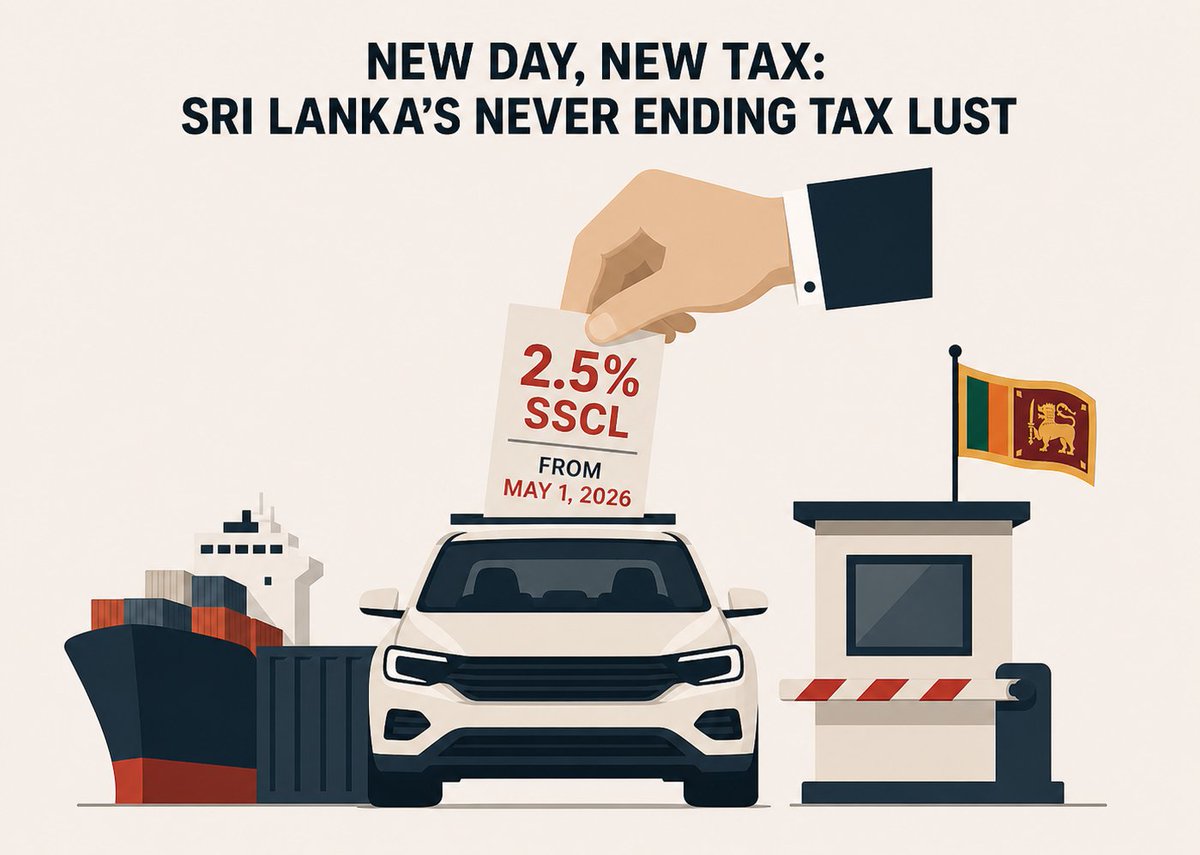
New Day, New Tax: Sri Lanka’s 🇱🇰 Never Ending Tax Lust
⭕️ From May 1, 2026, the Government has decided that vehicle imports will be subject to a 2.5% Social Security Contribution Levy (SSCL) at the point of importation.
⭕️ “At the point of importation” means that anyone importing a vehicle, including personal importers, will now be subject to this tax.
⭕️ Previously, SSCL was mainly paid by vehicle importers after the sale. Personal importers were not directly subject to this tax at the point of importation.
⭕️ Even vehicle importers may not have properly paid SSCL under the previous turnover-based system, as it left room for anything from creative accounting practices to outright tax fraud.
⭕️ Effectively, this change means that if you buy a vehicle, your cost will increase by around Rs. 2%-3% or more, depending on the CIF value and the relevant taxes for that vehicle.
⭕️ Rs. 7 million -> ~ Rs. 150,000 🔺
⭕️ Rs. 10 million -> ~ Rs. 200,000 🔺
⭕️ Rs. 15 million -> ~ Rs. 300, 000🔺
⭕️ SSCL works like VAT, it is charged on the basis of CIF value and other applicable taxes.
2.5% SSCL = (CIF value + CIF x 10% + CID + Excise Duty + any other taxes) x 2.5%
CID = CIF x 30%
Excise Duty = Changes based on the vehicle type
Other taxes = such as surcharge, PAL, etc. Currently 0 for vehicles
⭕️ SSCL was introduced in 2022 as a temporary tax to support Sri Lanka’s economic recovery by charging 2.5% on turnover.
⭕️ The Government has no real justification to keep increasing taxes on people, especially when revenue generating agencies have exceeded their targets during the last two to three years, and any expected revenue increase from this measure could have already been achieved through improved collection.
⭕️ The only other group that benefits from this change is large scale vehicle importers, as it removes one of the key cost advantages of personally importing a vehicle over buying from an established importer.
⭕️ Adding more taxes on already heavily taxed vehicles does not create any meaningful value for the country in the long run, especially when it locks away capital in depreciating assets like vehicles.
⭕️ Higher taxes do not help grow the economy. They discourage economic activity and reduce people’s ability to spend, invest, and build businesses. In simple terms, it is another case of handing more money to the Government, often the worst manager of money in any country.
⭕️ If Sri Lanka 🇱🇰truly wants a fair and low tax system, the focus should be on widening the tax base, improving the collection system, reducing leakages, and ensuring that everyone contributes fairly.
#SriLanka #VehicleTaxes