Worked on a project analyzing state-wise elementary education in India (2015–16)
Explored:
1. Enrollment trends
2. Dropout patterns
3. Infrastructure gaps
Found clear regional differences and some strong outliers.
Data really shows what numbers alone don’t.
GitHub: https://t.co/wjfvA5kSK5
#DataAnalytics #Python #DataScience
We’re building more schools.
But are we distributing them properly?
I analyzed Indian school education data.
Instead of totals, I looked at infrastructure per 1000 people.
Here’s what shows up:
• Bigger states ≠ better access
• Teacher distribution is uneven
• Urban areas ≠ better infrastructure
The problem isn’t just building more.
It’s how resources are allocated.
If money wasn’t a constraint, I’d build a real time system to track how policies actually perform, not just how they’re announced.
This is my Round 2 submission.
@emergentlabs
Most beginners run correlation and move on.
That’s a mistake.
Correlation is not a conclusion - it’s a clue.
While exploring data:
• Higher total bill - higher tips
• Group size impacts spending
• But correlation ≠ causation
Real insight starts after ".corr()", not before.
#DataScience #Analytics #Python
@Python_Dv This looks clean on paper, but overkill for most beginners, you don’t need docker + tests + configs to build your first 3–4 projects, people should earn this complexity, not start with it
@freeCodeCamp pricing isn’t confidence, it’s positioning
early stage → you trade price for trust
later stage → you trade reputation for price
most people mix this up and stay stuck
@fchollet this whole debate is flawed tbh, people compare AI to an idealized version of humans that doesn’t exist
humans make dumb mistakes, hallucinate, and fail basic reasoning all the time, AI is just exposing that gap more clearly
@TDataScience@Nikhil_on_ds Most people learn linear regression as a formula, understanding it as a projection problem changes how you think about it entirely.
Math intuition > memorizing equations.
@lqiao@FireworksAI_HQ@cursor_ai Interesting but tbh but curious how much of this translates to real-world workflows vs just benchmarks, eating models on a terminal bench is one thing, reliability in messy production environments is another.
That’s fair, but that’s more about pricing & policy than the tech itself, data centers will always go where power is cheapest, same thing happened with factories and cloud infra, if costs are being shifted to locals, that’s a regulation/design problem, not just “AI is bad”, real fix = better energy policy + efficiency, not just blaming usage
@RoundtableSpace Free courses are everywhere now.
The real question is: how much of this actually improves your thinking vs just speeding things up?
Tools evolve fast, fundamentals don’t.
@github@_Evan_Boyle Multiple models can catch more bugs but they can also amplify confusion.
Without strong fundamentals, more AI ≠ better results.
Tooling is evolving fast, but thinking still matters more.
@pvergadia AI isn’t the problem, over reliance is. If someone can’t read or debug their own code, the issue existed before AI. Tools amplify skill, they don’t replace it.
Most people jump straight into ML models.
I started with a simpler question:
What actually drives customer satisfaction?
Correlation showed:
• Service quality > delays
• Experience > operations
• Age & gender ≈ irrelevant
You can be on time and still lose the customer.
Insights > models.
#DataAnalytics #EDA #Machinelearning
@SashaxChipz@dilfyuan not fully agree tbh
it’s not just water vs power, both are part of same system
yeah data centers use a lot of energy, but that’s true for anything at scale… internet, cloud, streaming
real issue is efficiency, not just blaming AI
After hours of learning, sometimes the smartest move is to stop.
Most people think consistency = working non-stop.
Wrong.
Consistency = managing energy so you can show up again tomorrow.
Still learning. Still building.
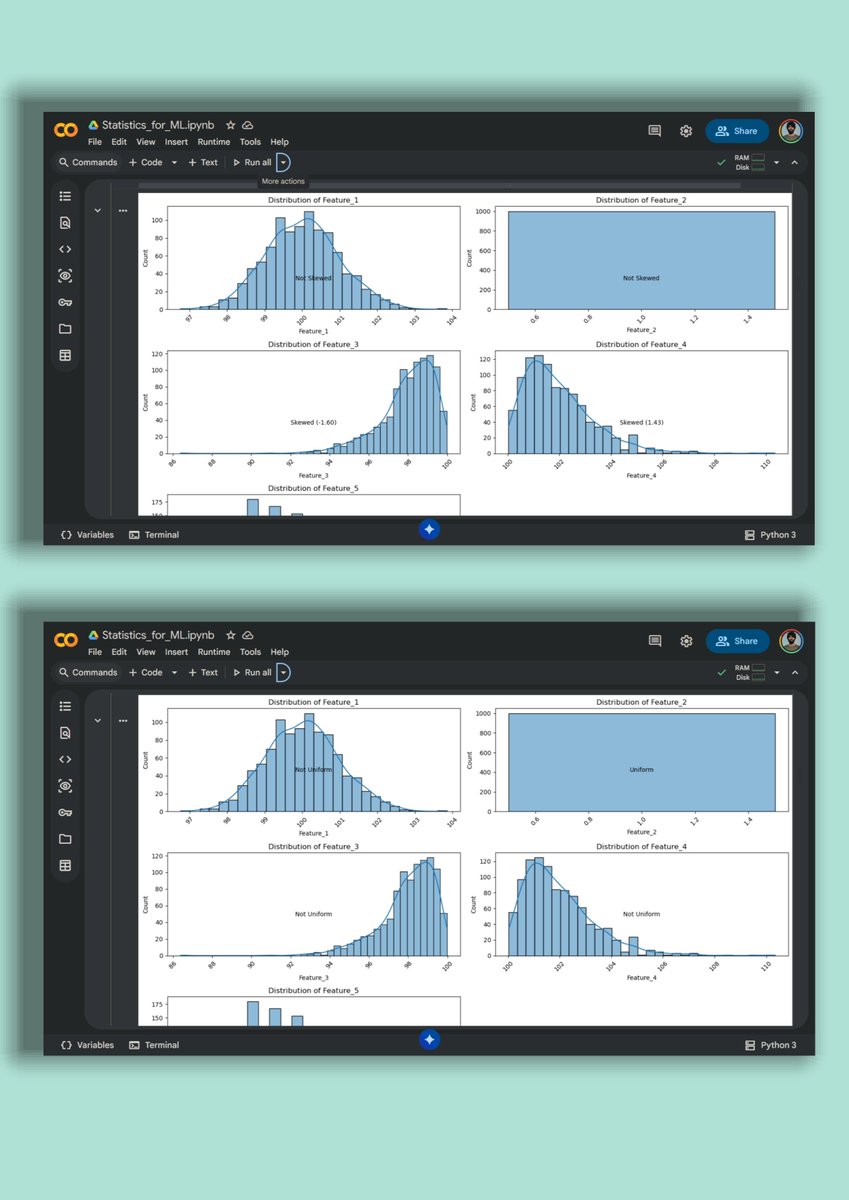
Most beginners think histogram = understanding data.
Wrong.
A few plots I ran today:
• Normal → clean, predictable
• Skewed → hidden bias
• Uniform → no clear pattern
The real lesson:
Distribution tells you how your data behaves before modeling.
Ignore this → your model lies.
@MicrosoftLearn This looks simple, but I feel the hard part is not learning patterns, it’s choosing the right data to learn from.
Still trying to understand that part.