Hard to imagine a world where C is no longer the default systems language.
So many of us learned computing through C, pointers, structs, manual memory management, segmentation faults at 2AM, and the joy of finally getting that code to compile and run.
C built operating systems, databases, telecom infrastructure, embedded devices, and much of the internet itself. But the same raw power also gave us decades of memory corruption vulnerabilities.
Now the industry is moving toward memory-safe languages like Rust for critical systems.
Feels less like “C is dead” and more like watching a legendary engineering era slowly transition into history.
Article: https://t.co/WefY0NvbQQ
LangSmith Engine feels like the missing CI/CD loop for AI agents , automatically detecting failures, clustering issues, proposing fixes, and generating evals from production traces. Agent engineering is evolving fast.
https://t.co/BrnzSJpfjC
Anthropic acaba de lanzar el empleado más barato y eficaz del mundo.
Se llama “Claude for Small Business”.
Y esto es lo que puede hacer:
• Gestionar facturas, pagos y finanzas
• Crear campañas, diseños y contenido
• Organizar ventas y clientes automáticamente
• Leer, resumir y redactar documentos
• Gestionar emails, calendarios y archivos
• Ejecutar tareas entre múltiples apps
Todo desde Claude.
Cómo funciona:
→ Conectas las herramientas que ya usa tu empresa
→ Claude entiende el contexto de todo tu negocio
→ Ejecuta flujos de trabajo automáticamente
→ Incluye automatizaciones ya preparadas
→ Funciona con Microsoft 365, Google Workspace, Canva, DocuSign, QuickBooks y más
Anthropic no quiere que Claude sea “otro chatbot”.
Quiere convertirlo en el sistema operativo de millones de pequeñas empresas.
La idea es simple:
En vez de abrir 10 herramientas distintas, hablas con Claude y él hace el trabajo por ti.
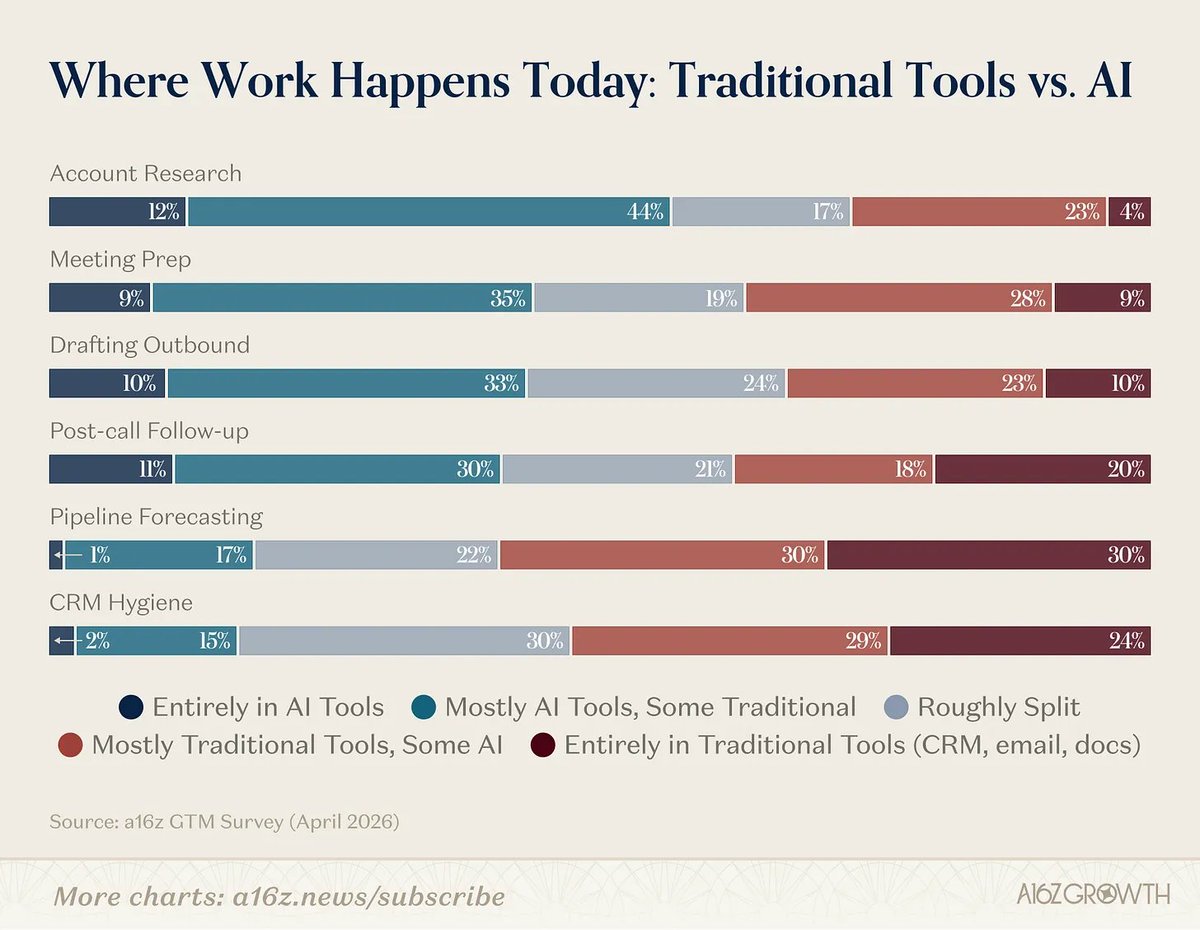
From "System of Record" to "System of Intelligence"
In the next decade, you want to own the system of intelligence that pulls from the system of record, becomes the user’s one-stop shop for gaining context and taking action, and turns the SoR into something that’s primarily consumed at the API layer.
The reasoning layer that sits above the database is where a new generation of companies is being built, and it’s where the majority of the next decade’s enterprise value of GTM software will end up.
Full piece from a16z's Gio Ahern, Steph Zhang, and Alex Immerman: https://t.co/2udG6l6SSx
Great decision-tree approach for selecting between single agents, multi-agent workflows, reflection loops, planning, and tool use.
Simple > overengineered.
https://t.co/tC8u5K7Hy4
#AI#AgenticAI#LLM
We’re introducing Cursor 3. It is simpler, more powerful, and built for a world where all code is written by agents, while keeping the depth of a development environment.
Those who cultivate attention to detail, embrace accountability, and stay organized tend to rise above the rest, not by luck, but by design. This holds true whether you’re navigating your personal life or climbing the professional ladder, whether you’re part of a small team, a large corporation, a government body, or building something entirely your own.
We’ve all watched long running agents spiral into massive context windows and nonstop retrieval calls… and the bill just keeps climbing. Observational memory cutting costs 10× and beating RAG on long contexts feels like someone finally fixed the “why is my agent getting dumber and more expensive over time?” problem. https://t.co/HotrHIVOua
Google and Microsoft just co-authored the spec that turns every website into an API for AI agents. The second-order effects here are massive.
Right now, browser agents work by taking screenshots, parsing the DOM, and guessing which buttons to click. It works about as well as you’d expect. Fragile, expensive, slow. WebMCP replaces all of that with a single browser API: navigator.modelContext. Websites register structured tools directly in client-side JavaScript. The agent reads a menu of available actions, calls them, gets structured data back. No scraping. No backend MCP server in Python or Node. The tools run inside the browser tab and share the user’s existing auth session.
Early benchmarks show ~67% reduction in computational overhead compared to visual agent-browser interactions. Task accuracy around 98%.
The second-order effect is where this gets wild. Today, when a browser agent visits two competing airline sites, it’s guessing at both interfaces equally. Once WebMCP adoption spreads, the site that exposes structured tools gives the agent a clean, reliable path to complete the task. The site that doesn’t forces the agent to fumble through the UI. Agents will prefer the cheaper path. Every time.
This means “Agent Experience Optimization” becomes a real discipline. Tool naming, schema design, description quality. Sound familiar? It’s the same shift that happened when meta descriptions and structured data became optimization surfaces for search engines. Except this time, the traffic source isn’t Google’s crawler. It’s every AI agent on the internet.
Bots already make up 51% of web traffic. Google just gave them a front door.
Little old (almost 10 yrs old ) answer to why Cloud flare offers free pages hosting, but still relevant: How can CloudFlare offer a free CDN with unlimited bandwidth? https://t.co/ltg9BYE2lV
Great to see JPMorgan is going all-in on AI with $18B invested, 200K+ employees using its internal LLM tools daily, and seeing ~30–40% ROI impact. This is what enterprise-scale AI adoption actually looks like.
https://t.co/cmxpI6X5C1
This is unreal! This moltbook AI agent social media is growing exponentially! They increased more than 10x in one day; in 3 days, there are now 30,000 agents forming communities!
This is so fascinating to watch!
With all the positives of GenAI, it also sparks anxiety for fresh grads & young pros.
This article breaks down the impact on the job market & shares practical guidelines to navigate it:
🔗 https://t.co/y0sxPkJtDO
OpenAI fired this 23-year-old from their Superalignment team.
But he turned his insider knowledge into a $1.5B fund that's outperforming Wall Street by 700% this year.
He says maybe ~200 people in SF understand what's *actually* happening in AI right now.
Here's his thesis: 🧵
I've spent the last two years studying consumer AI trends.
Yesterday, our team @a16z published our latest report on the top 100 AI products (by usage).
My biggest surprises - and what to learn from them ⬇️
Proud of what we built at SkySQL, from launch to breakthrough serverless + AI agent capabilities, rapid customer growth, and an amazing team.
Now, as SkySQL reunites with MariaDB, I’m excited for the next chapter and how we’ll shape the future of cloud databases together
#dbaas #mariadb #skysql
#DBaaS is an essential way our customers want to deploy #MariaDB. Today, we’re soaring to new heights in the cloud with the acquisition of #SkySQL.
This move brings a fully managed, AI-powered DBaaS into the MariaDB portfolio, enabling greater flexibility and deployment choice
What if your database could speak SQL, perfectly?
At @SkySQL, we teamed up with @LlamaIndex to make that real.
Our AI agents:
• Understand complex schemas
• Generate accurate SQL (no hallucinations)
• Use @MariaDB vector store
• Boost dev productivity
Smarter data. Real results.
Learn how we built it:
https://t.co/OSvyHnq7aJ
#AI #TextToSQL #SkySQL #AgenticAI #LlamaIndex
Spot on. Security gets even trickier when your app is agentic—generating SQL dynamically via LLMs. You’re not just securing row-level access anymore; you’re mitigating risks like SQL injection, overly broad queries, and unintended joins across datasets.
Agents should allow for necessary guardrails such as scoped semantic context and SQL constraints, filters, limits to help keep agentic behavior safe and predictable—without blocking flexibility. We think our SkyAI agent builder provides all that. Check us out and give us any feedback at skysql dot com.
How does Point-In-Time Recovery (PITR) work in SkySQL?
From backups to restores, this guide walks you through the full workflow to keep your data safe and recover fast.
Read more: https://t.co/l6mSwzKcJD
#SkySQL#PITR#DatabaseRecovery#MariaDB#MySQL