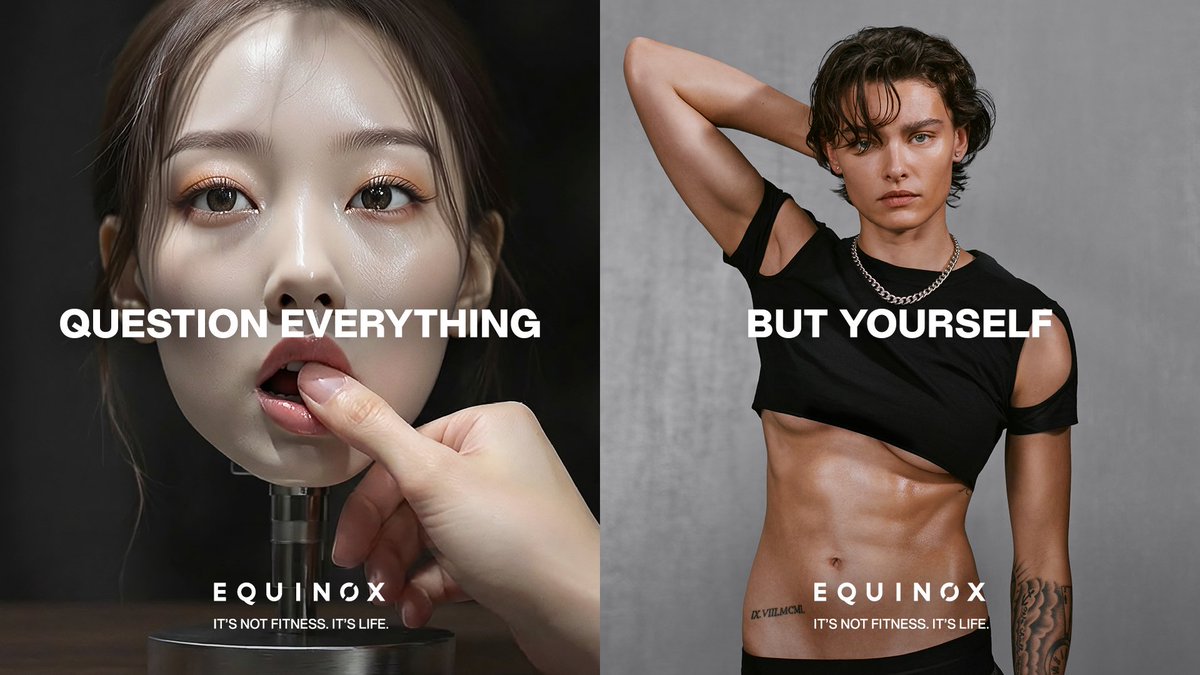
Last week, we officially launched new work with @Equinox.
I want to share a bit of the thinking behind it -- because this campaign didn’t start with a line, a film, or even AI. It started with a cultural observation that felt increasingly impossible to ignore.
We are entering a moment where “fakeness” is no longer an exception -- it’s infrastructure.
AI, yes. But also filters, catfishing, performance wellness, curated identity, algorithmic selfhood. Entire systems now exist to help people look healthier, happier, more successful, more confident than they actually are.
Fakeness has become extensible.
You can apply it to your face, your body, your voice, your relationships, your beliefs. You can manufacture proximity, belonging, even conviction.
So the real strategic question wasn’t “how do we comment on AI?”
It was this:
In a world where almost everything can be optimized, edited, simulated, or faked -- what is still unquestionably real?
The answer we kept coming back to was the body.
The body does not care what you claim.
It reflects what you do.
It records effort, stress, discipline, avoidance, resilience.
It is the last remaining ledger that cannot be photoshopped at scale.
That insight became the foundation of this campaign.
“Question Everything” isn’t an anti-technology message.
It’s not nostalgia.
And it’s not provocation for provocation’s sake.
It’s a positioning move.
A deliberate contrast between a synthetic culture and a physical truth.
Between appearance and earned reality.
Between the stories we tell and the work we do.
The launch film is intentionally confrontational because the idea itself is confrontational. It asks people to sit with an uncomfortable possibility: that in a world of infinite signals, your body may be the only source that doesn’t lie to you.
What made this work possible is the bravery of the client.
It takes real conviction for a brand -- especially one with the scale and visibility of Equinox -- to resist the urge to soften the edges, over-explain the message, or turn a cultural insight into a slogan.
Instead, they chose to treat this as a long-term platform, not a one-off moment.
This launch is a stake in the ground. What follows is a year of pulses -- across culture, identity, dating, fashion, belief -- continuing to test this idea in different arenas where fakeness shows up wearing new costumes.
That’s the work we love doing at Angry Gods®.
Not chasing relevance.
Not decorating trends.
But helping brands take a clear, opinionated position in moments where culture feels unstable -- and trusting the audience to meet them there.
12/ Final thought:
Most people reduce it to “brand = trust, marketing = sales.”
But the truth is sharper:
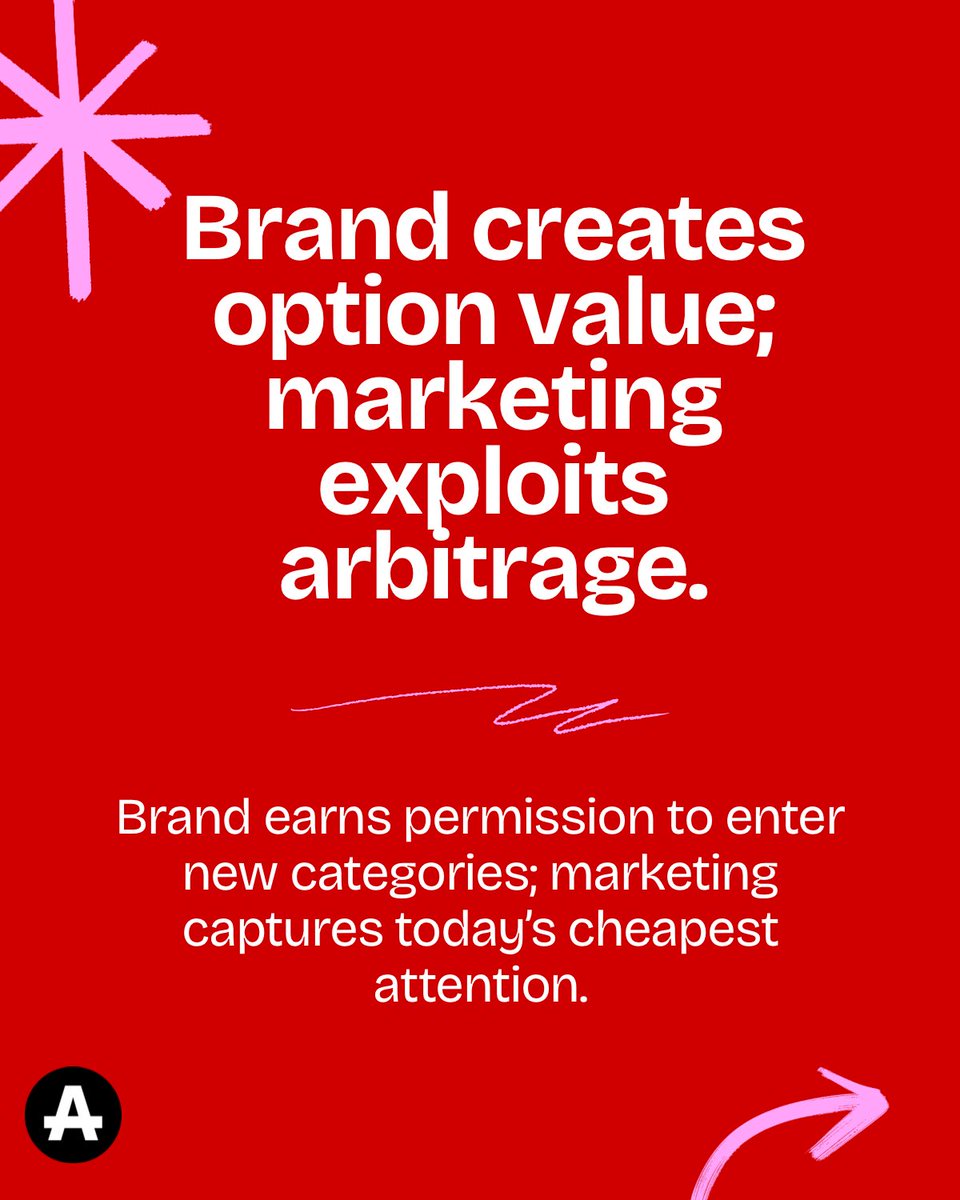
- Brand is the system.
- Marketing is the spend.
Mix them up and you’ll either burn money, or starve the brand.
1/ Everyone’s debating “Brand vs Marketing.”
Most posts are shallow: brand = long-term, marketing = short-term.
True, but not useful.
Here’s the deeper cut—10 brutal distinctions every leader should know 🧵
12/ Final thought:
Most people reduce it to “brand = trust, marketing = sales.”
But the truth is sharper:
- Brand is the system.
- Marketing is the spend.
Mix them up and you’ll either burn money, or starve the brand.
The startup world has lived and died by the MVP — Minimum Viable Product.
Strip it down. Ship it fast. See if it survives.
But Erie Kim at Forerunner has been pushing something else: the Minimum Lovable Product.
Not the bare minimum to exist, but the bare minimum to inspire affection.
I love this because it mirrors a truth brand strategists have known forever:
People don’t fall in love with “viable.”
They fall in love with what feels considered, intentional, and human — even if it’s version 0.1.
The MLP forces a different question:
What’s the smallest thing we can make that earns genuine passion?
That’s a much higher bar than “works as intended.”
For centuries, great brands have launched imperfect products that were nonetheless irresistible — because they made you feel something.
That could be beauty in design, a story you wanted to tell, or an experience that made you feel seen.
The danger with MVP thinking is that you might prove your product “works” while failing to prove it’s worth loving.
And without love, you have no loyalty.
And without loyalty, you have no brand.
Maybe the lesson is this:
If you’re going to test, test for love as early as you test for function.
The graveyard is full of products that worked just fine.
Everything I know about good design (from almost two decades running a design firm.)
I don’t romanticize design. My job has been to hire the right people, protect the brief, remove noise, and hold a brutal standard. After shipping work across banks, bands, biotech, and everything in between, a few things have proven consistently true.
1. Good design starts before any sketch. If I can’t circle the problem in one sentence, we’re not ready to draw. “Who is this for?” and “What job must this do under pressure?” are the only doors worth opening. Purpose first, taste later.
2. Every element is a decision with a cost. Fonts, spacing, motion, words—each either pays rent or gets evicted. A beautiful thing that doesn’t change behavior is furniture.
3. Constraints are the strategy. Time, budget, regulation, legacy systems—don’t fight them, shape them into form. Great work isn’t despite constraints; it’s because of them.
4. Choose who loses. If everyone gets a little of what they want, the user gets a lot of what they don’t need. Sharp design is the courage to say no publicly.
5. Design the default, not the path. Most people will never change a setting, read a tooltip, or watch a tutorial. If the default is right, everything feels “obvious.” Obvious is expensive to build and priceless to experience.
6. Coherence beats consistency. Consistency is matching socks; coherence is a point of view. Everything doesn’t need to match—everything needs to agree.
7. Reduce to signal, not to minimalism. Subtraction is not an aesthetic; it’s the removal of doubt. Clarity is the luxury good.
8. Write like you design. Microcopy is interface. Labels, error states, empty states, receipts, notifications—this is where trust happens or dies.
9. Accessibility is the brief. If someone can’t use it, it isn’t good. We don’t get credit for intention; we get judged by who we included.
10. Systems outlast artifacts. Logos, screens, decks—these are instances. The win is a decision system anyone on the team can use to get to the same answer.
11. Measure consequences, not clicks. Good design reduces support tickets, returns, time to task, and the need for explanation. When it’s right, ops gets quieter.
12. Launch is halftime. The real work is in the papercuts: the 404, the opening door, the first-run, the cancel flow. Users remember the seams more than the hero shot.
13. Craft scales. Grids, rhythm, typographic discipline, motion grammar—these are not snobbery. They are how teams ship fast without getting sloppy. Craft is speed.
14. Trend is a tax. Borrow techniques, not identities. The goal is for your choices to feel inevitable 5 years from now, not impressive for 5 minutes today.
15. And culture is the product. If leadership treats design like a coat of paint, the organization will too.
After almost twenty years, that’s my summary. Good design is a chain of hard choices made in service of one clear promise.
Most design to be noticed. The great design to be inevitable.
Most design to be noticed. The great design to be inevitable.
Sydney Sweeney’s latest campaign for American Eagle is headline‑grabbing—because it needed to be. A pretty face, a pun (“great genes”/”jeans”), and a blonde, blue‑eyed A‑list star? That’s advertising 101. It’s bold, borderline cringey, and clearly designed to spark conversation.
The real story isn’t eugenics or white supremacy—it’s attention engineering. American Eagle knew exactly what it was doing. And it worked: viral backlash, trending news, rising stock, and a sold‑out denim drop tied to charity.
Yet the backlash reveals how modern criticism often masquerades as moral clarity—when really it’s just virtue‑signaling outrage. Labeling this “tone‑deaf racism” only amplifies the ad—it doesn’t undermine it.
Don’t mistake being upset for having been harmed. Sydney Sweeney sells jeans. That’s it.
Bottom Line
•Advertising uses attention—there’s nothing new there.
•The campaign may have been provocative, but it was clearly intentional.
•Overplaying moral outrage often becomes part of the playbook. Criticism can fuel virality as effectively as campaigns.
In short: this is just advertising theater, and “wokeness” too often cements the show rather than stopping it.
I spent 15 yrs on a menswear forum. The longest argument I had was over a tiny detail that can be seen in this photo. For 6 months, I argued with the same five guys non-stop every day. The argument got so heated the forum owner banned one guy for life.
Here is the detail. 🧵
A name is like tofu.
It tastes like whatever you cook it in.
This is why naming is harder than people think.
A name isn’t just a label — it’s a sponge.
You could never launch a lifestyle brand called Virgin today. The culture wouldn’t let it. It would get dragged before it had a chance to explain itself. But in the late 70s, that name soaked up rebellion, danger, and sex appeal — and became iconic.
Same with Yahoo. Once thrilling, but if launched now… cartoonish.
Or Overstock. Once clever, but if launched now… a liability.
Even Slack — once a genius signal of frictionless work — if launched now, just sounds like an HR problem.
Names don’t stand alone. They steep in the world around them.
In trends. In tone. In timing.
Which means that even a brilliant name can go bad if left in the wrong sauce for too long.
But good names — the ones that last — do two things at once:
1.They hold meaning on their own.
Nike evokes victory.
Patagonia whispers wilderness.
Apple suggests simplicity and rebirth.
2.They leave space for meaning to grow.
Google meant nothing… until it meant everything.
Meta was ridiculed… until AI gave it a second act.
So when people ask what the “perfect” name is, I tell them this:
There’s no perfect name.
There’s only the name you’re willing to pour meaning into.
The one you’re ready to fight for, live up to, and evolve with.
Because in the end, your name doesn’t define your brand.
Your brand defines your name.