Indian listed companies love to acquire loss making companies in Europe
and struggle for years to turn them around
Some realize their mistake early on and course correct
others just keep at it in hopes of profitability some day
So many examples
सोनम वांगचुक यांच्या उपोषणाचा हा आजचा १९ वा दिवस. त्यांच्या तब्येतीच्या ज्या बातम्या ऐकू येत आहेत किंवा जी दृश्य खासकरून सोशल मीडियावर दिसत आहेत ती निश्चितच काळजीत टाकणारी आहेत. हे म्हणायला प्रचंड वाईट वाटतंय की सरकारने सोनम वांगचुक यांचा आणि पर्यायाने या देशातील आंदोलनाची म्हणून एक जागा आहे तिचा बळीच घ्यायचा ठरवला आहे. हे सरकार जिथे श्रीरामाच्या तिजोरीला लुटलं जात असताना शांतपणे बघू शकते तिथे त्यांना नागरिकांच्या आंदोलनांने काय फरक पडणार ?
ज्या संस्थांनी निष्पक्ष वागायला हवं त्यांनाच स्वतःच्या ताब्यात घेतलं आहे. निवडणुका हव्या तशा मॅनेज करून घेतल्या जात आहेत. त्यासाठी अतिप्रचंड पैसा खर्च केला जात आहे. तो कुठून आला असा प्रश्न बहुसंख्य माध्यमं विचारत नाहीयेत. उलट हीच बहुसंख्य माध्यमं त्यांच्या अदृश्य बॉसच्या सांगण्यावरून सत्ताधाऱ्यांच्या पक्षातील स्वकीयांची आणि विरोधकांना कसं बदनाम करता येईल यांत व्यस्त आहेत. आणि जी माध्यमं बोलत आहेत त्यांना आणि त्यांच्या मालकांच्या डोक्यावर एक टांगती तलवार फिरत आहे. त्यामुळे एका चांगल्या मुद्द्यासाठी उभ्या केलेल्या आंदोलनाला चिरडणं, आंदोलनकर्त्याच्या शरीराचे हाल करणं हे सरकारला सहज सोपं आहे.
सोनम वांगचुक यांच्याबद्दल एकेकाळी भारतीय जनता पक्षाला आस्था होती. अर्थात भारतीय जनता पक्षाचं एक बरं असतं की त्यांच्या सोयीचा असेपर्यंत त्यांना तो माणूस प्रिय असतो. सोनम वांगचुक यांना २०१८ साली री-इन्व्हेस्ट कॉन्फरन्सला बोलावून त्यांच्याकडून अपारंपरिक ऊर्जा इत्यादींबद्दल ऐकून घेऊन त्यांचं कौतुक पण केलं होतं. अर्थात तेंव्हा आम्ही किती अपारंपरिक उर्जेला महत्व देतो हे दाखवायचं होतं म्हणून सोनम वांगचुक चालले. पुढे लडाख हा स्वतंत्र प्रदेश घोषित झाल्यावर वांगचुक यांना पण भाजपचं कौतुक वाटलं. पण पुढे वांगचुक यांच्या लक्षात आलं की यांचे हेतू अजिबात स्वच्छ नाहीत. लडाखला स्वतंत्र राज्याचा दर्जा मिळायला हवा, लडाखमध्ये दोन लोकसभा मतदारसंघ हवेत, तिथल्या लोकांच्या जमिनीवरचा हक्क राखला गेला पाहिजे या मागण्या वांगचुक यांनी केल्या, त्यासाठी उपोषण, आंदोलनं केली पण सरकारने काहीही केलं नाही. त्यांना आश्वस्त केलं आणि पुढे कृती काहीच नाही. कारण हेतू जे दाखवले जातात तसे कधीच नसतात.
आज वांगचुक यांची मागणी नीट परीक्षेचा झालेला गोंधळ आणि तो ज्या व्यक्तीमुळे झाला त्या मंत्र्याची हकालपट्टी करा आणि या परीक्षांमध्ये पारदर्शकता आणा हीच आहे. यात काहीच वावगं नाही. भाजपच्या सत्तेच्या काळात सर्वत्र परीक्षांमध्ये घोळ होत आलेत. मध्यप्रदेशातील व्यापम घोटाळ्यापासून ते नीटच्या परीक्षांचे पेपर्स फुटणे ते अगदी आत्ता शिक्षकांच्या परीक्षांचे पेपर्स फुटण्यापर्यंत. हे सगळं यांच्या काळात का होतं आणि ते झाल्यावर हे इतके निर्ढावल्यासारखे का वागतात याचं उत्तर सोपं आहे. ते म्हणजे हाताशी सगळ्या यंत्रणांना धरून आलेली अमर्याद सत्ता.
निवडणुकांत अनेक उद्योग करून ओढून आणलेलं यश हे लोकांच्या मूकसंमतीचं द्योतक म्हणून दाखवायचं आणि आम्हाला कोणी प्रश्न विचारायचे नाहीत हा एक वेगळाच माज सध्या भाजपला आला आहे. आणि मी भाजप अशा अर्थाने म्हणतोय की त्यांच्या घटक पक्षांना स्वतंत्र अस्तित्वच नाहीये, त्यांना दिल्लीतूनच चालवलं जात आहे.
माझी पंतप्रधान श्री. नरेंद्र मोदी यांना विनंती आहे की जरा या प्रश्नात लक्ष घाला. NEET परीक्षांचा विषय आणि त्यातला गोंधळ हा काही सोपा विषय नाही. या परीक्षेतील घोळाने लाखो विद्यार्थ्यांच्या आयुष्याची वाट लागली आहे. आणि हे आत्ताच घडलं आहे असं नाही याच्या आधी पण असे प्रकार घडले आहेत. *आणि हा विषय राजकीय नाहीये. हा विषय सामाजिक आहे. NEET परीक्षा देणारे लाखो विद्यार्थी, त्यांचे पालक हे ज्या त्रासातून गेले, जो मनस्ताप झाला त्याच्याशी संबंधित हा विषय आहे. आणि यात भारतीय जनता पक्षाचे समर्थक, त्यांचे पदाधिकारी, त्यांचे कार्यकर्ते या सगळ्यांनाच त्रास झालेला असणार. त्यामुळे आंदोलनाकडे राजकीय नजरेतून केंद्रातील सत्ताधारी पाहत आहेत, तेच मुळात त्यांच्या लघुदृष्टीचं लक्षण आहे*.
#WATCH | Bengaluru, Karnataka: Dr Devi Shetty, Founder and Chairman, Naryana Health says, "The biggest problem in our country is that people don't know that how fit they feel has nothing to do with how fit they are. You can have very serious heart problem, yet you may not be aware of it. People are refusing to go for a health checkup. You have seen so many people just dropping down dead on a treadmill or running marathon or a day to day activity. If they went for a basic check like a blood test, an ECG, and a cardiac CT scan, that's all, none of those people would have had a heart attack, none of them. Because the blockage would have been diagnosed and they would have been under treatment. So the problem of healthy people the suddenly dropping down dead could have been eliminated completely if only people went for a health checkup. Our biggest problem is people refuse to see the doctors unless they have pain..."
As bull cycle starts & market participation increases, know that you will never be able to catch everything
Try to aim for the PF level goals & then select the companies that will help you achieve that goal
Rather than trying to capture everything
Happy Bull Market to all
#AzadEngineering#AZAD
Azad Engineering makes parts that spin inside jet engines and power turbines at temperatures where most metals would simply give up and melt.
The company, apparently, does not believe in giving up.
It crossed ₹600 Crore in revenue, built a ₹6,500 Crore order book, maintained 33%+ EBITDA margins, and somehow convinced the market to pay 63× FY28 forward earnings for a machine shop in Hyderabad.
That last part requires some explanation.
Business story
In 2008, from a small workshop in Hyderabad, Rakesh Chopdar set out to break a structural global monopoly.
For decades, the market for hyper-critical rotating components — the blades and airfoils that spin inside jet engines and power turbines — was owned by legacy foundries in Europe and America. GE and Mitsubishi rarely trusted new suppliers. A single blade fracture at 10,000 RPM means a catastrophic engine failure.
Azad's answer was obsession. Not bidding on standard job contracts — mastering how to shape Inconel, Titanium, and Nimonic to micron-level accuracy. Then enduring the 3-5 year qualification chasm where global OEMs audit, test, and vet every tolerance before awarding a single commercial order.
The pivot that changed the scale: aerospace. Energy and oil & gas (81.5% of FY26 revenue) built the cash flows, the certifications, and the trust. Now Azad is systematically deploying that same qualification credibility into aerospace — the highest-margin vertical. Aerospace crossed ₹100 Crore revenue milestone for the first time in FY26 (17.2% of revenue).
The growth triggers are layered:
→ Baker Hughes dedicated facility launched April 2026 — oil & gas vertical from sub-₹10Cr to ₹60Cr by FY28
→ Boeing 737, Airbus A320/A350 component supply agreements already live
→ DRDO/GTRE Advanced Turbo Gas Generator (ATGG) — domestic defence propulsion partner
Management's explicit target: reduce energy from 81.5% to 55-60% over 4-5 years. Aerospace takes the gap.
Wide Moat:
Imagine you're a well-funded Indian engineering firm that wants to compete with Azad.
Year 1-2: You spend ₹1.5 Crore getting AS9100D certified. Congratulations. You now have a certificate that says you're allowed to try.
Year 2-7: You spend 3-5 years getting a single component qualified by Boeing. Boeing sends auditors. You improve your toolpaths. Boeing sends more auditors. You improve them again.
Year 7: You invest ₹150-200 Crore in 5-axis CNC machines. You are now ready to bid.
Year 7.5: You discover Azad already has the contract, signed it 5 years ago, and it runs until 2035.
This is why Azad's order book is ₹6,500 Crore. Not because nobody wants the business. Because the door to enter it takes a decade to open.
① Entry barriers: Strong
② Switching costs: Strong — 18-36 months of regulatory re-certification to change suppliers mid-programme
③ Process IP: Moderate — excellent toolpath know-how, but no patents; replicable in 5-7 years by someone with patience and money
④ Strategic position: Strong — ROIC 15.29% above WACC; actually creating value
⑤ Durability: Strong — 190,000 sq. mt footprint; dedicated facilities for Mitsubishi, Siemens, Baker Hughes
Valuation & the mix-shift math
FY26 → FY28E: Revenue ₹603cr → ₹942cr (capped at 25% CAGR by design). EBITDA margin 37.3% → 39%. EBITDA ₹225cr → ₹367cr — +63%, outrunning the 25% revenue cap. EPS ₹20.59 → ₹34.22.
That gap between EBITDA growth and revenue growth is real operating leverage — fixed capacity is already built, and utilisation climbing from ~40% toward 85% as the Mitsubishi/Siemens/Baker Hughes lines ramp is what does the work, not fresh capex.
At ₹2,149, that operating leverage story is already the base case, not the upside case — the stock is pricing ~63x FY28E earnings today, versus an ~45x multiple the underlying model implied if priced fairly against its own FY28E EPS. The gap between those two numbers (₹2,149 actual vs ~₹1,540 "model-implied") is roughly the premium the market is paying purely for confidence in execution.
Growth triggers: Aerospace mix moving 17.2% → 23% (FY27E) → 28% (FY28E); Baker Hughes facility scaling past its current sub-₹10cr run-rate; utilisation actually reaching 85%.
Red flags: heavy customer concentration in a handful of Tier-1 accounts; historical negative free cash flow and high pre-IPO finance costs; related-party exposure given the centralised Hyderabad ecosystem.
Management & governance
Founder-MD Rakesh Chopdar personally holds two decades of GE/Boeing/Mitsubishi qualification relationships — a real asset, and a key-man risk in the same breath (thin visible second-line leadership).
Promoter holding: 60.33% — strong skin in the game, plus early institutional trust from names like Sachin Tendulkar's investment vehicle.
Track record on guidance: management said 33–35% EBITDA margin, delivered 36.9% in FY26 — beat their own number. Used IPO proceeds to deleverage; finance costs trending down. Clean audit history, no material qualifications flagged.
Closing
So, back to the hook: Azad isn't a "hope and a prayer" aerospace stock. It's a real Tier-1 supplier that GE and Mitsubishi actually trust with parts spinning at 10,000 RPM — which is more than I trust myself with a Swiss Army knife. Wide moat, promoters with real skin in the game, margins that beat their own guidance. Genuinely good company.
But at ₹2,149 — ~63x FY28E earnings, two years into the future — the market isn't just pricing in good execution. It's pricing in good execution, a tailwind, a following wind, and the airfoil gods smiling down personally on every single delivery milestone.
This is a stock where "in-line quarter" is basically a sell signal and "beat guidance" barely moves the needle, because beating guidance is already the entry ticket, not the upside.
So here's what actually decides this, not vibes:
① Does the ₹6,500cr order book convert on schedule, or quietly slip a few quarters (as order books mysteriously tend to)?
② Does Baker Hughes turn from a rounding error into real revenue?
③ Does Aerospace mix hit 23% in FY27 on the way to 28% in FY28, or does Energy stubbornly refuse to let go of the steering wheel?
④ Does utilisation actually climb toward 85%?
Nail all four and ~63x might age fine. Miss one, and the multiple has a lot further to fall than the fundamentals do — because right now, the fundamentals are merely excellent, and the price is already behaving like they're flawless.
[Not investment advice, DYOR]
These are the GMs of the Telangana Water Board
₹80,000 salary
When he spent ₹35 crore on his daughter’s wedding, the department and ACB raised their eyebrows
Then when his assets were investigated, from his house
» ₹100 crore in bank accounts
» Papers of 18 acres of land
» Registrations of several plots and flats
» Large amounts of gold and diamond jewellery
Just imagine, this is one person who got caught. How many more could there be in our system?
When millions of people work hard and pay taxes, it is with that same tax money that corrupt people sitting in the system become millionaires
How do these government officials gather such huge wealth❓
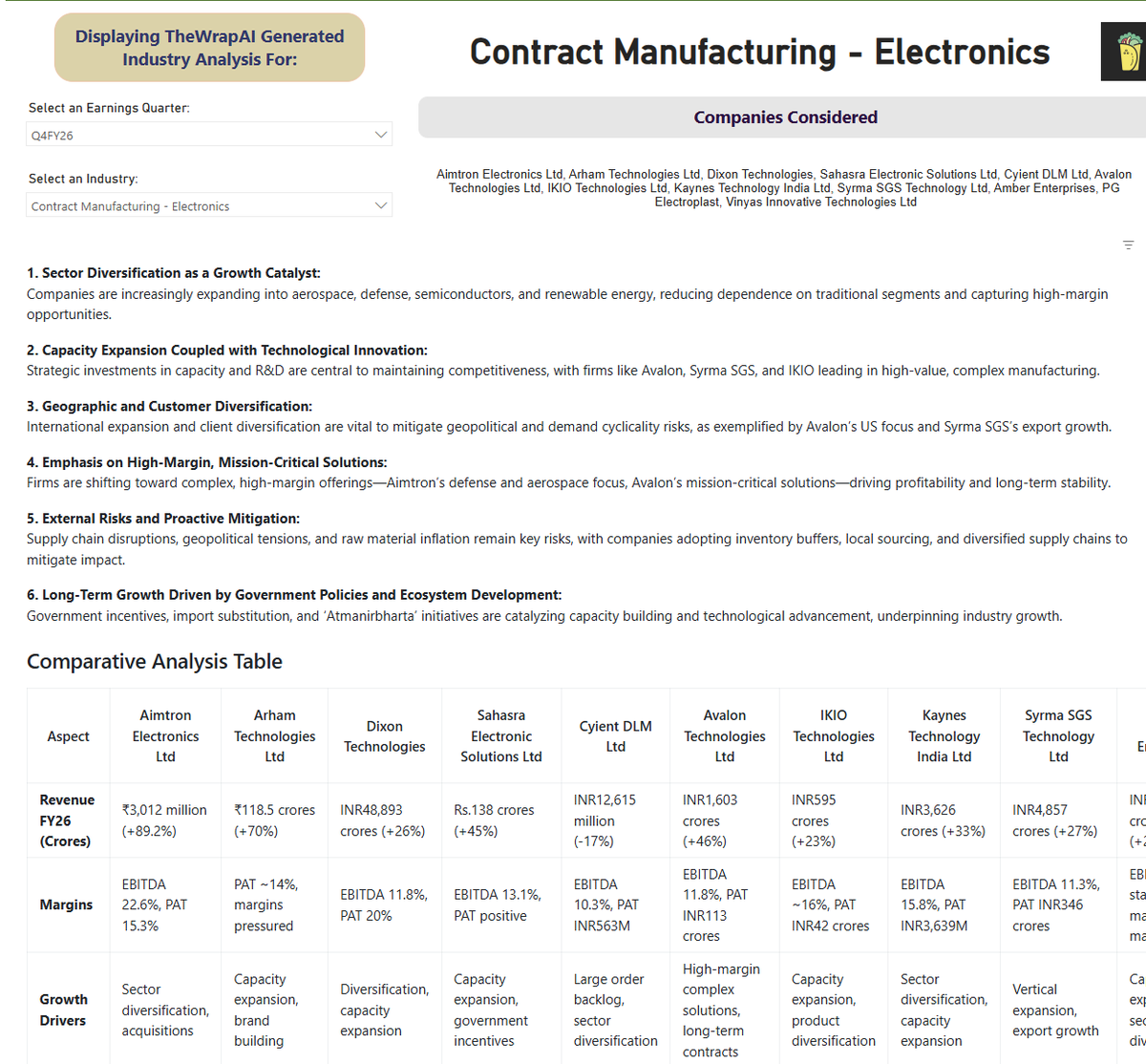
Consistently for last four Qtrs
Have been able to read aggregate insights from all 1300+ earnings calls by aggregating them at industry level
This is the only way someone can get insights across every listed sector
We track 150+ sectors @ #TheWrap🌯
https://t.co/ZyomxE9B7p
India is betting big on coal.
The Centre has approved a ₹37,000 crore coal gasification scheme to turn coal into gas that can be used to make fertilisers, power and chemicals.
The bigger goal? Reduce dependence on imports and make better use of India’s vast coal reserves.
Read the thread to understand how coal gasification works and why this move could play a key role in India’s energy security.





![ramesh_vd's tweet photo. #AzadEngineering #AZAD
Azad Engineering makes parts that spin inside jet engines and power turbines at temperatures where most metals would simply give up and melt.
The company, apparently, does not believe in giving up.
It crossed ₹600 Crore in revenue, built a ₹6,500 Crore order book, maintained 33%+ EBITDA margins, and somehow convinced the market to pay 63× FY28 forward earnings for a machine shop in Hyderabad.
That last part requires some explanation.
Business story
In 2008, from a small workshop in Hyderabad, Rakesh Chopdar set out to break a structural global monopoly.
For decades, the market for hyper-critical rotating components — the blades and airfoils that spin inside jet engines and power turbines — was owned by legacy foundries in Europe and America. GE and Mitsubishi rarely trusted new suppliers. A single blade fracture at 10,000 RPM means a catastrophic engine failure.
Azad's answer was obsession. Not bidding on standard job contracts — mastering how to shape Inconel, Titanium, and Nimonic to micron-level accuracy. Then enduring the 3-5 year qualification chasm where global OEMs audit, test, and vet every tolerance before awarding a single commercial order.
The pivot that changed the scale: aerospace. Energy and oil & gas (81.5% of FY26 revenue) built the cash flows, the certifications, and the trust. Now Azad is systematically deploying that same qualification credibility into aerospace — the highest-margin vertical. Aerospace crossed ₹100 Crore revenue milestone for the first time in FY26 (17.2% of revenue).
The growth triggers are layered:
→ Baker Hughes dedicated facility launched April 2026 — oil & gas vertical from sub-₹10Cr to ₹60Cr by FY28
→ Boeing 737, Airbus A320/A350 component supply agreements already live
→ DRDO/GTRE Advanced Turbo Gas Generator (ATGG) — domestic defence propulsion partner
Management's explicit target: reduce energy from 81.5% to 55-60% over 4-5 years. Aerospace takes the gap.
Wide Moat:
Imagine you're a well-funded Indian engineering firm that wants to compete with Azad.
Year 1-2: You spend ₹1.5 Crore getting AS9100D certified. Congratulations. You now have a certificate that says you're allowed to try.
Year 2-7: You spend 3-5 years getting a single component qualified by Boeing. Boeing sends auditors. You improve your toolpaths. Boeing sends more auditors. You improve them again.
Year 7: You invest ₹150-200 Crore in 5-axis CNC machines. You are now ready to bid.
Year 7.5: You discover Azad already has the contract, signed it 5 years ago, and it runs until 2035.
This is why Azad's order book is ₹6,500 Crore. Not because nobody wants the business. Because the door to enter it takes a decade to open.
① Entry barriers: Strong
② Switching costs: Strong — 18-36 months of regulatory re-certification to change suppliers mid-programme
③ Process IP: Moderate — excellent toolpath know-how, but no patents; replicable in 5-7 years by someone with patience and money
④ Strategic position: Strong — ROIC 15.29% above WACC; actually creating value
⑤ Durability: Strong — 190,000 sq. mt footprint; dedicated facilities for Mitsubishi, Siemens, Baker Hughes
Valuation & the mix-shift math
FY26 → FY28E: Revenue ₹603cr → ₹942cr (capped at 25% CAGR by design). EBITDA margin 37.3% → 39%. EBITDA ₹225cr → ₹367cr — +63%, outrunning the 25% revenue cap. EPS ₹20.59 → ₹34.22.
That gap between EBITDA growth and revenue growth is real operating leverage — fixed capacity is already built, and utilisation climbing from ~40% toward 85% as the Mitsubishi/Siemens/Baker Hughes lines ramp is what does the work, not fresh capex.
At ₹2,149, that operating leverage story is already the base case, not the upside case — the stock is pricing ~63x FY28E earnings today, versus an ~45x multiple the underlying model implied if priced fairly against its own FY28E EPS. The gap between those two numbers (₹2,149 actual vs ~₹1,540 "model-implied") is roughly the premium the market is paying purely for confidence in execution.
Growth triggers: Aerospace mix moving 17.2% → 23% (FY27E) → 28% (FY28E); Baker Hughes facility scaling past its current sub-₹10cr run-rate; utilisation actually reaching 85%.
Red flags: heavy customer concentration in a handful of Tier-1 accounts; historical negative free cash flow and high pre-IPO finance costs; related-party exposure given the centralised Hyderabad ecosystem.
Management & governance
Founder-MD Rakesh Chopdar personally holds two decades of GE/Boeing/Mitsubishi qualification relationships — a real asset, and a key-man risk in the same breath (thin visible second-line leadership).
Promoter holding: 60.33% — strong skin in the game, plus early institutional trust from names like Sachin Tendulkar's investment vehicle.
Track record on guidance: management said 33–35% EBITDA margin, delivered 36.9% in FY26 — beat their own number. Used IPO proceeds to deleverage; finance costs trending down. Clean audit history, no material qualifications flagged.
Closing
So, back to the hook: Azad isn't a "hope and a prayer" aerospace stock. It's a real Tier-1 supplier that GE and Mitsubishi actually trust with parts spinning at 10,000 RPM — which is more than I trust myself with a Swiss Army knife. Wide moat, promoters with real skin in the game, margins that beat their own guidance. Genuinely good company.
But at ₹2,149 — ~63x FY28E earnings, two years into the future — the market isn't just pricing in good execution. It's pricing in good execution, a tailwind, a following wind, and the airfoil gods smiling down personally on every single delivery milestone.
This is a stock where "in-line quarter" is basically a sell signal and "beat guidance" barely moves the needle, because beating guidance is already the entry ticket, not the upside.
So here's what actually decides this, not vibes:
① Does the ₹6,500cr order book convert on schedule, or quietly slip a few quarters (as order books mysteriously tend to)?
② Does Baker Hughes turn from a rounding error into real revenue?
③ Does Aerospace mix hit 23% in FY27 on the way to 28% in FY28, or does Energy stubbornly refuse to let go of the steering wheel?
④ Does utilisation actually climb toward 85%?
Nail all four and ~63x might age fine. Miss one, and the multiple has a lot further to fall than the fundamentals do — because right now, the fundamentals are merely excellent, and the price is already behaving like they're flawless.
[Not investment advice, DYOR]](https://pbs.twimg.com/media/HMUOs8tbAAEQCqT.png)