Agents need stateful little computers where they can install packages, edit files, follow long-running threads of work, and come back to where they left off.
They need to run code that is untrusted by default.
We built LangSmith Sandboxes specifically for this execution model.
https://t.co/r9KVnvtOQN
@Wipro@tcs it's known to happen in Wipro not surprised.. but tcs came as a shock because again this organisation is headed by a minority group that came from outside.. so it needs to be vigilant as this could happen anywhere..
The PyTorch Foundation Ambassador Program is open for 2026 nominations. The program supports community leaders who organize events, create technical content, mentor contributors, and support regional PyTorch communities worldwide.
We especially encourage applications from contributors across Africa, Latin America, the Middle East, Oceania, Southeast Asia, and Eastern Europe as we continue expanding representation across local PyTorch communities.
Ambassadors receive recognition through PyTorch Foundation channels, access to collaboration and training opportunities, support for approved community activities, and complimentary admission to PyTorch Conference.
Nominations are open through June 18, 2026. Individuals may nominate themselves or someone else.
🔗 Learn more and apply: https://t.co/G8tYgOpjb1
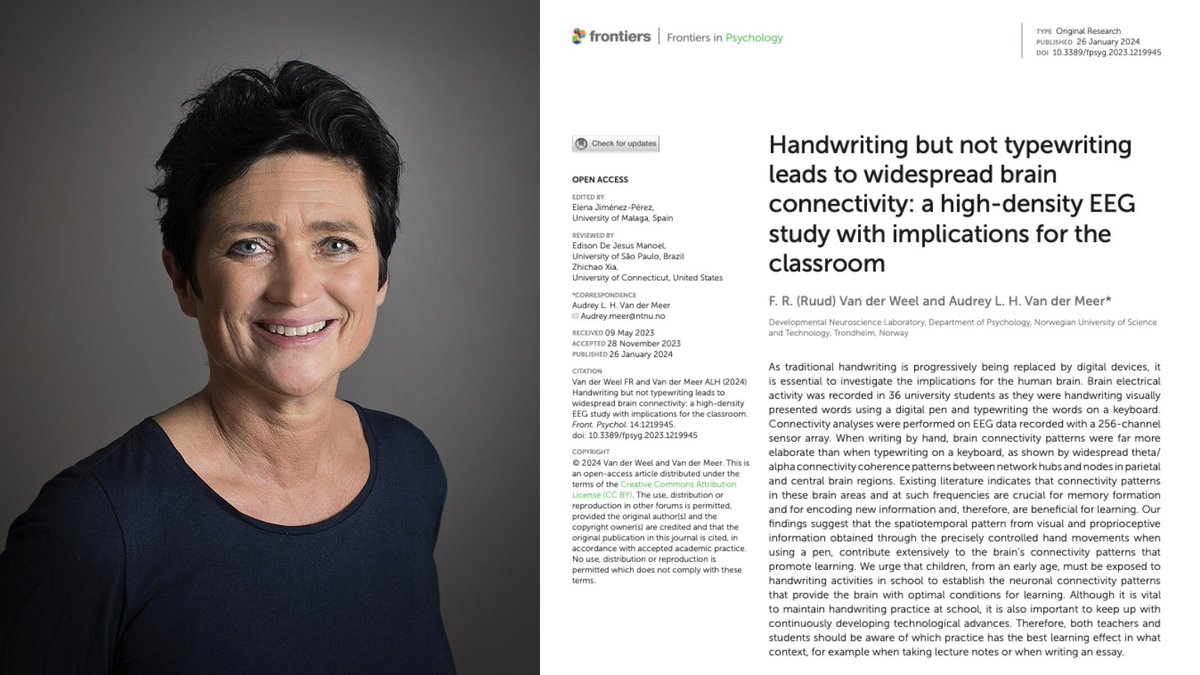
A Norwegian neuroscientist spent 20 years proving that the act of writing by hand changes the human brain in ways typing physically cannot, and almost nobody outside her field has read the paper.
Her name is Audrey van der Meer.
She runs a brain research lab in Trondheim, and the paper that closed the argument was published in 2024 in a journal called Frontiers in Psychology. The finding is brutal enough that it should have changed every classroom on Earth.
The experiment was simple. She recruited 36 university students and put each one in a cap with 256 sensors pressed against their scalp to record brain activity. Words flashed on a screen one at a time.
Sometimes the students wrote the word by hand on a touchscreen using a digital pen, and sometimes they typed the same word on a keyboard. Every neural response was recorded for the full five seconds the word stayed on screen.
Then her team looked at the part of the data most researchers had ignored for years, which is how different parts of the brain were communicating with each other during the task.
When the students wrote by hand, the brain lit up everywhere at once.
The regions responsible for memory, sensory integration, and the encoding of new information were all firing together in a coordinated pattern that spread across the entire cortex. The whole network was awake and connected.
When the same students typed the same word, that pattern collapsed almost completely.
Most of the brain went quiet, and the connections between regions that had been alive seconds earlier were nowhere to be found on the EEG.
Same word, same brain, same person, and two completely different neurological events.
The reason turned out to be something nobody had really paid attention to before her work. Writing by hand is not one motion but a sequence of thousands of tiny micro-movements coordinated with your eyes in real time, where each letter is a different shape that requires the brain to solve a slightly different spatial problem.
Your fingers, wrist, vision, and the parts of your brain that track position in space are all working together to produce one letter, then the next, then the next.
Typing throws all of that away. Every key on a keyboard requires the exact same finger motion regardless of which letter you are pressing, which means the brain has almost nothing to integrate and almost no problem to solve.
Van der Meer said it plainly in her interviews.
Pressing the same key with the same finger over and over does not stimulate the brain in any meaningful way, and she pointed out something that should scare every parent who handed their kid an iPad.
Children who learn to read and write on tablets often cannot tell letters like b and d apart, because they have never physically felt with their bodies what it takes to actually produce those letters on a page.
A decade before her, two researchers at Princeton ran the same fight using a completely different method and ended up at the same answer. Pam Mueller and Daniel Oppenheimer tested 327 students across three experiments, where half took notes on laptops with the internet disabled and half took notes by hand, before testing everyone on what they actually understood from the lectures they had watched.
The handwriting group won by a wide margin on every question that required real understanding rather than surface recall.
The reason was hiding in the transcripts of what the two groups had actually written down.
The laptop students typed almost word for word, capturing more total content but processing almost none of it as they went, while the handwriting students physically could not write fast enough to transcribe a lecture in real time, which forced them to listen carefully, decide what actually mattered, and put it in their own words on the page.
That single act of choosing what to keep was the learning itself, and the keyboard had quietly skipped the choosing and skipped the learning along with it.
Two studies. Two countries. Same answer.
Handwriting makes the brain work. Typing lets it coast.
Every note you have ever typed instead of written went into your brain through a thinner pipe. Every meeting, every book highlight, every idea you captured on your phone instead of on paper was processed at half depth.
You did not forget those things because your memory is bad. You forgot them because typing never woke the part of the brain that would have made them stick.
The fix is the thing your grandmother already knew.
Pick up a pen. Write the thing down. The slower road is the faster one.
Instead of watching an hour of Netflix, watch this 2 hour hour Stanford lecture will teach you more about how LLMs like ChatGPT and Claude are built than most people working at top AI companies learn in their entire careers.
@rajkumarbhatisp Bahan ke laud... So did they write about halala.. triple Talak.. maulana raping girls.. human bomb in islam.. and if not then why didn't u ask this from them before.. now u r fucking giving your side of story.. u r a pig shit
.@Clay uses LangSmith to manage 300M agent runs a month, with an average 10-30 steps each.
@hwchase17’s conversation with Clay’s Head of AI @jeffbarg on how they run this at scale → https://t.co/eE2j07OBkI
Most AI agents still respond in plain text. In our latest course, Build Interactive Agents with Generative UI, you’ll create agents that generate UIs like charts, forms, and interactive components on demand.
Work across the Generative UI spectrum and connect a LangChain agent to a React frontend using CopilotKit and the AG-UI protocol.
Made in collaboration with @CopilotKit, and taught by its CEO, @ataiiam.
Enroll for free! ➡️ https://t.co/KW2pzTZwH3
New course: Spec-Driven Development with Coding Agents, built in partnership with @jetbrains, and taught by @paulweveritt.
Vibe coding is fast, but often produces code that doesn't match what you asked for. This short course teaches you spec-driven development: write a detailed spec defining what to build, and work with your coding agent to implement it. Many of the best developers already build this way.
A spec lets you control large code changes with a few words, preserve context across agent sessions, and stay in control as your project grows in complexity.
Skills you'll gain:
- Write a detailed specification to define your mission, tech stack, and roadmap, giving your agent the context it needs from the start
- Plan, implement, and validate features in iterative loops using a spec as your agent's guide
- Apply the same repeatable workflow to both new and legacy codebases
- Package your workflow into a portable agent skill that works across agents and IDEs
Join and write specs that keep your coding agent on track!
https://t.co/hI4GwuvhtN
In honor of World Quantum Day, we’re heading onto our campus to answer the top trending questions people are searching for. Join Jenna and Andrew from our team as they break down the basics of quantum and what these systems could actually be used for → https://t.co/cSlLGN6o1I
@IRCTCofficial@RailwaySeva@RailMinIndia this is regarding 6601909852.. if u r charging 235 for dinner then u must provide a food worth 235... Food quality was pathetic..
Google Quantum AI is now accepting proposals for the Willow Early Access Program.
We are seeking proposals for experiments that can be run on our Willow processor that have the potential to produce foundational, high-quality results. Learn more → https://t.co/48NExeWFqA
10 BEST YouTube Channels to Learn AI in 2026:
1. DeepLearningAI / https://t.co/mkHuKT0Y6J
High-quality AI courses, interviews, and practical breakdowns from industry leaders.
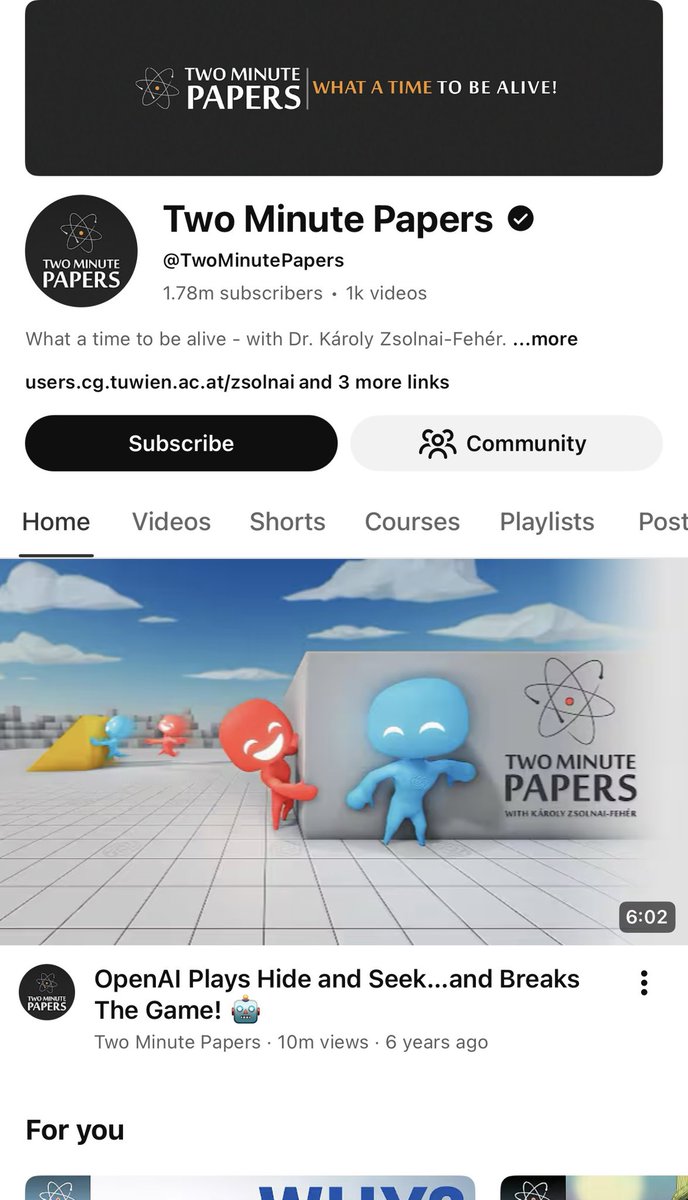
2. Two Minute Papers / https://t.co/elAIJfumbf
Explains cutting-edge AI research in a way that actually makes sense.
3. Yannic Kilcher / https://t.co/fAeHOInqWx
Deep dives into AI papers, architectures, and research trends.
4. StatQuest / https://t.co/PyForGz8i4
Clear explanations of ML fundamentals, math, and statistics.
5. AssemblyAI / https://t.co/PLShxIJZoW
Practical AI engineering tutorials and real-world demos.
6. Fireship / https://t.co/UDmQDokp0t
Fast, sharp overviews of AI tools, frameworks, and dev trends.
7. Sentdex / https://t.co/sOO36VREeV
Hands-on Python and machine learning builds.
8. Krish Naik / https://t.co/psKmGZuFWM
Practical ML, LLM projects, and deployment tutorials.
9. freeCodeCamp / https://t.co/h6mVgajoTo
Full-length AI and ML courses, completely free.
10. Arxiv Insights / https://t.co/unh5C1kl6K
Research-focused AI paper explanations and trend analysis.
Learn the fundamentals.
Follow the research.
Build real projects.
That’s how you move from “AI enthusiast” to AI builder.
Ready for the next one?
So simple question.. is today's @RSSorg is the same as i knew 20 years back.. Today's RSS is guided by a person who takes pride in standing behind thug @narendramodi